The direct answer
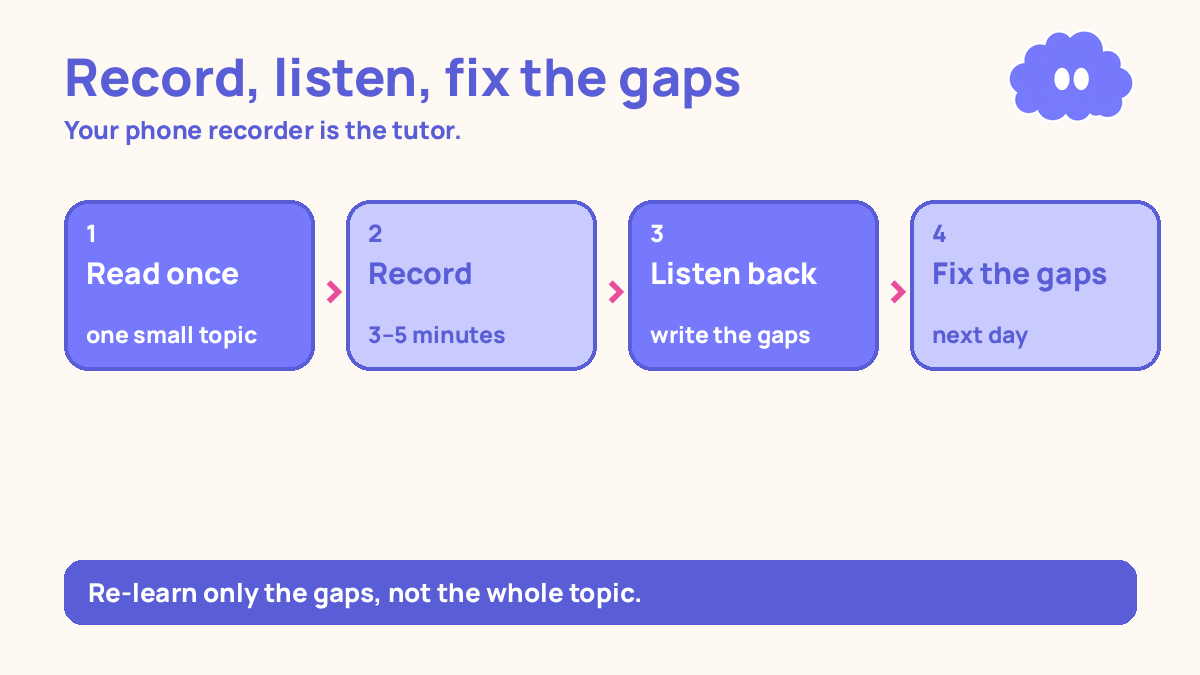
Record yourself explaining one topic out loud for three to five minutes, as if teaching a friend, with your notes closed. Then listen back, write down every place you hesitated, mumbled or skipped, and re-learn only those gaps. Record the same topic again the next day and compare the two recordings. The gaps you hear are your study list, and the second recording is the proof they are closing.
You are studying alone. There is no tutor to ask, and no study group to test you. You read a topic, it feels familiar, and then the exam asks you to explain it — and nothing comes out. That gap between reading and explaining is the whole problem. Reading feels like knowing. Explaining shows whether you know.
This system closes that gap with the one tool you already have: the voice recorder on your phone. No tutor, no group, no app to buy. You become your own examiner, and the recording is the exam paper.
It is a close cousin of the feynman-technique-for-students — explain it simply, find the gaps, fix them — but this version adds the recorder, which changes two things. First, you cannot skip past the gaps the way you can in your head; the recording keeps them. Second, you can compare today with yesterday, and hear the improvement instead of guessing at it. It also sits next to how-to-check-your-own-understanding-when-studying-alone: that system gives you several ways to test yourself alone, and this is the one that uses your own voice.
The system in short
- Pick one small topic you can explain in three to five minutes, and read it once.
- Close your notes, press record, and explain it out loud as if teaching a friend.
- Listen back once, and write down every hesitation, mumble and skip — that list is your gaps.
- Re-learn only the gaps, from your notes, in short bursts.
- Record the same topic again the next day, listen back, and compare. Repeat at three days and seven days if the gaps are still there.
Step 1: Pick one small topic and read it once
Pick a topic small enough to explain in three to five minutes. “How photosynthesis works” is a topic. “All of biology” is not. “Why the French Revolution started” is a topic. “The whole history course” is not. If you are not sure whether a topic is small enough, try saying its name and one sentence about it. If that one sentence already has three ideas in it, split it.
Read the topic once, properly. Not a skim, not a highlight pass — one read, with attention, so you know what is in it. Then put the notes down. The read is preparation, not the study itself. You will learn the topic by explaining it, not by reading it again.
Choose the topic the night before, if you can. A topic chosen in the morning, five minutes before you record, is usually the topic you already feel good about — the easy one. The topic you need is the one you have been avoiding. Write it on a scrap of paper the night before: tomorrow, photosynthesis. Then you start with the hard one, not the comfortable one.
One topic per recording. That rule matters more than it sounds. A recording that covers three topics gives you a gap list with three topics mixed together, and you will fix none of them properly. One topic, one recording, one gap list. If you have three topics to cover, make three recordings, on three days if you have to. Slow is fine. Mixed is not.
Step 2: Close the notes and explain it out loud
Press record and explain the topic as if you are teaching a friend who knows nothing about it. Not a teacher, not an examiner — a friend. A friend makes you use plain words. An examiner makes you recite. Plain words are the test: if you can only say it in the textbook’s words, you have memorised the textbook, not understood the topic.
Talk for three to five minutes. Do not stop the recording when you get stuck. That is the most important rule in this whole system. When you hesitate, stay on the recording and say what you can: “I know this part is about… I think it starts with…” The hesitation is the finding. If you stop and start again, you hide the finding from yourself, and the gap list comes out empty when it should not be.
Say it in your own words, even if the words are clumsy. “The thing that makes the plant take in the air” is a better start than silence, because it shows you where the real word should go. You can fix a clumsy sentence. You cannot fix a blank.
Do not read from your notes while you record. The notes are closed. If you catch yourself opening them, stop, close them again, and start the recording over. An explanation read aloud is a reading test, not an understanding test. The whole point is to find out what is in your head when the notes are gone — because that is exactly what the exam will ask.
If you cannot start at all, use the one exception. Read the first sentence of the topic from your notes, say it out loud, then close the notes and keep going. One sentence, not a paragraph, not the whole page. The first sentence is a push, not a script. Most freezes end after the first sentence, because starting was the hard part, not the topic. If you still cannot say anything after that first sentence, stop the recording. The topic needs one more read before you try again — that is not failure, it is information. Read it once more, slowly, and record again tomorrow.
Record somewhere you can talk out loud without feeling watched. A bedroom with the door closed, a walk outside with earphones in, an empty room. If you whisper because someone might hear, the recording will be full of whispers, and you will not hear the gaps clearly. Find the place first, then press record.
Step 3: Listen back and write the gap list
Listen to the recording once, all the way through, with a pen in your hand. Do not listen while doing something else. The listen-back is the study, and half-listening gives you half a list.
Write down every place you hesitated, mumbled, skipped something, or said something you are not sure is right. Be specific. Not “the middle part was bad”. Write: “Paused for ten seconds before the second step.” “Said ‘and then the thing happens’ instead of naming the process.” “Skipped the formula completely.” “Said the date was 1789, not sure if that is right.” Each line on the list is one gap, and each gap is one thing to fix.
Count the gaps. A normal first recording has five to ten. Fewer than three usually means the topic was too easy, or you stopped the recording when you got stuck. More than twelve usually means the topic was too big — split it in half and record one half tomorrow.
This is where the research earns its place. In a small 1989 study, Chi and colleagues watched 8 physics students study worked examples while thinking aloud. The 4 who later solved problems best — 82% correct — generated 15.3 explanations per example. The 4 who did worst — 46% correct — generated 2.8. That is a small observational study, a pattern, not proof that prompting anyone to explain causes the same result. But the pattern points the same way as the bigger evidence: explaining, out loud, in your own words, is where the learning happens — and the places where the explanation breaks down are exactly where the learning is missing.
A larger review backs that up. Bisra and colleagues (2018) looked across 64 reports — 69 effect sizes, about 5,917 learners — and found that prompting self-explanation produced a moderate average benefit (g = 0.55), and the benefit held when time on task was controlled. It worked best for principle-based material: physics, maths, medicine. If your subject is built on principles and steps, explaining it out loud is one of the strongest tools you have. Dunlosky and colleagues (2013) rated self-explanation as moderate utility in their review of ten techniques — below practice testing and distributed practice, which were the only two rated high, and above rereading, which was rated low.
So the gap list is not a list of failures. It is the most useful page in your notes. Every other study method gives you a list someone else wrote. This one gives you a list your own voice wrote, in your own words, about your own gaps.
Do not fix the gaps yet. Just write the list, and put it with the recording. Fixing comes next, and fixing from a written list is faster than fixing from a vague feeling.
Step 4: Re-learn only the gaps
Now open your notes — and read only the gaps. Not the whole topic. The whole topic is what you already read in step 1, and reading it again is the low-utility work. Open the notes at the first gap on your list, read that one point, close the notes, and say it out loud once, without recording. Then move to the next gap.
One gap at a time, in short bursts. Ten minutes on a gap is enough for most of them. A gap is usually one fact, one step, or one connection — not a whole chapter. If a gap takes more than twenty minutes to fix, it is probably two gaps hiding as one. Split it: what is the first half, and what is the second half?
Say each fixed gap out loud before you move on. Reading the missing fact is not the same as being able to say it. Close the notes, say the sentence, check it. If you can say it cleanly once, move on. If you cannot, read it once more and say it again. That is the whole fix.
Do not re-record today. The re-recording comes tomorrow, after a night’s sleep, because tomorrow’s recording is a real test and today’s would only be a repeat of what you just read. The gap between the two recordings is what makes the second one honest. This is the same reason re-testing beats re-reading: in one study, students who recalled a passage remembered more a week later than students who restudied it, even though the restudiers felt more confident immediately after studying (Roediger & Karpicke, 2006). Feeling fluent right after reading is not the same as remembering later. Your second recording, tomorrow, is the check that tells you which one you have.
Step 5: Record again tomorrow and compare
The next day, record the same topic again, notes closed, three to five minutes, same rules. Then listen back and compare it with yesterday’s recording. Not by feeling — by counting. How many gaps were on yesterday’s list? How many are gone today? How many are still there? How many new ones appeared?
Write the comparison down in three lines. “Yesterday: 8 gaps. Today: 3 gaps left, 1 new. Fixed: the second step, the formula, the date.” That is your evidence. It is small, it is yours, and it is honest in a way that “I feel better about it now” is not. Students are systematically wrong about which strategy is helping them — in one study, the retrieval group predicted worst and did best, and feeling fluent is not knowing (Karpicke & Blunt, 2011). The comparison of two recordings does not ask you how you feel. It asks you what you can say.
If the gaps are mostly gone, the topic is done for now. Record it once more in three days, and once more in seven days, to check it holds. That 1-3-7 pattern — review next day, in 3 days, in 7 days — is a practical starting schedule, not a research rule. The research says spacing beats cramming; the exact days are a starting point you can adjust. If the gaps are still there after the second recording, do step 4 again — re-learn only the gaps that remain — and record again the day after that. A topic that needs three recordings is not a failed topic. It is a topic you actually learned, instead of one you only read.
Keep the latest recording of each topic until you can explain it cleanly, then delete the older ones. If a topic is done and you can explain it without hesitating, you do not need the recording any more. The next re-test, a few days later, is the check that matters — not a folder full of old audio. Delete ruthlessly. A phone full of recordings you will never listen to again is clutter, not revision. Keep one recording per topic, the latest, and only while the topic is still being fixed.
A worked example: cell respiration, three recordings, one week
This is a worked example, with the article’s own numbers — not a real student, and not a promise of a grade.
You have a biology test in two weeks. One topic on the list is cell respiration, and you have been avoiding it because every time you read it, the steps blur together. Monday evening, you pick it as tomorrow’s topic and write it on a scrap of paper.
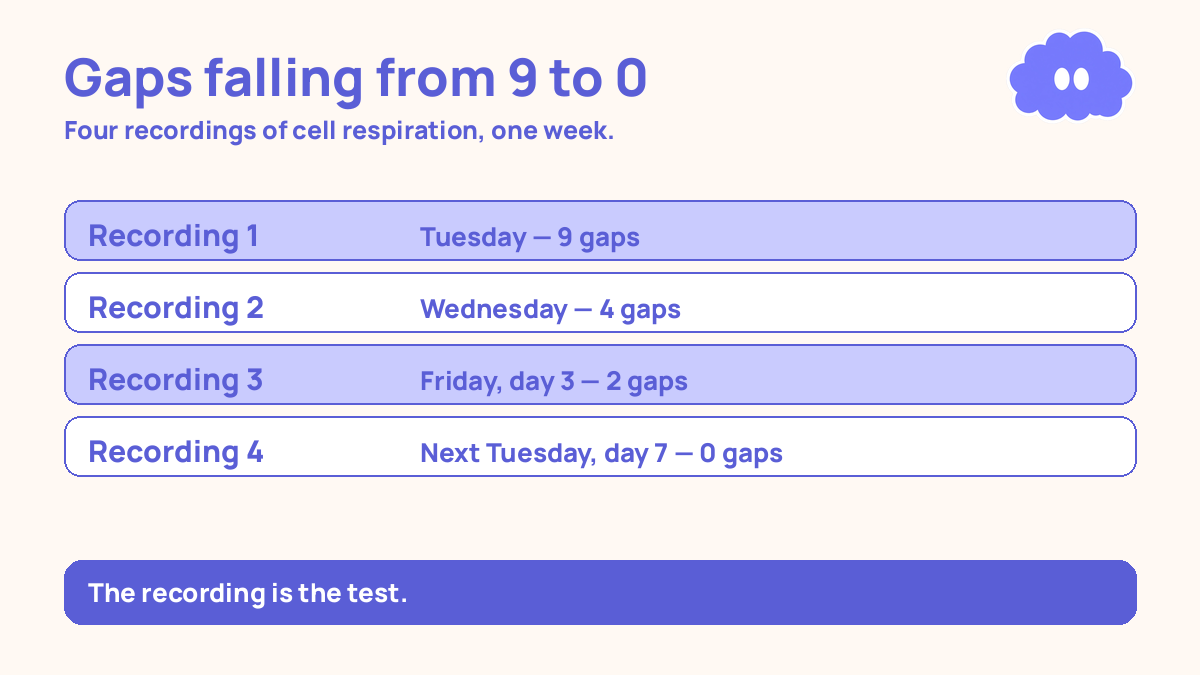
Tuesday, recording 1: You read the topic once, 15 minutes, then close the notes and record. You talk for 4 minutes. Listening back, you count 9 gaps: you pause for a long time before the second step, you say “and then the energy thing happens” instead of naming ATP, you skip the difference between aerobic and anaerobic completely, you get two numbers mixed up, and you mumble through the last minute. The gap list has 9 lines.
Tuesday evening, fixing: You open the notes and work through the 9 gaps only, one at a time, about 10 minutes each for the big ones and 2 minutes for the small ones — 45 minutes in total. You say each fixed gap out loud once, notes closed, before moving on. You do not re-read the whole topic. You do not re-record.
Wednesday, recording 2: You record the same topic again, notes closed, 4 minutes. Listening back, 6 of the 9 gaps are gone. Three remain: the second step still hesitates, one number is still wrong, and the anaerobic part is still skipped. One new gap appears: you now say a step in the wrong order. The comparison is three lines: yesterday 9 gaps, today 4 gaps, fixed 6. You fix the 4 remaining gaps that evening, 25 minutes.
Friday, recording 3 (day 3): You record again. Two gaps left: the second step is clean now, but the number is still shaky and the anaerobic part is thin. You fix those two, 15 minutes.
Next Tuesday, recording 4 (day 7): You record once more. Zero gaps. Four minutes, clean, in your own words, in the right order. You delete recordings 1 to 3 and keep recording 4 until the test, then delete that too.
| Recording | Day | Length | Gaps heard | Gaps fixed since last time |
|---|---|---|---|---|
| Recording 1 | Tuesday | 4 minutes | 9 gaps | — |
| Recording 2 | Wednesday | 4 minutes | 4 gaps (3 old, 1 new) | 6 of 9 |
| Recording 3 | Friday (day 3) | 4 minutes | 2 gaps | 2 of 4 |
| Recording 4 | Next Tuesday (day 7) | 4 minutes | 0 gaps | 2 of 2 |
Total time for the topic: about 2 hours spread over a week, including the recordings and the listen-backs — and most of that time went on the gaps, not on re-reading the parts you already knew. Compare that with reading the topic four times, which would have taken similar time and left you with no evidence at all about what you could actually say.
When it goes wrong
You cannot start, and the recording is thirty seconds of silence. Use the first-sentence rule: read the first sentence from your notes, say it out loud, close the notes, and keep going. If you still cannot say anything, the topic needs one more read before you try again. Do not record a blank and call it a gap list. A blank means the preparation was missing, not that the method failed.
The recording is all hesitation, from start to finish. The topic is too big. Split it in half and record one half tomorrow. A recording that is all gaps gives you a list too long to fix, and a list too long to fix gets ignored. Half a topic, explained cleanly, beats a whole topic mumbled through.
You keep stopping and restarting the recording. You are hiding the gaps from yourself. Leave the recorder running, hesitations and all. The ugly recording is the useful one. A clean recording made by restarting five times tells you nothing — it is a performance, not a test.
You listen back and fix nothing, because the gaps feel embarrassing. The embarrassment is the point. Every gap you hear is a mark you would have lost, found early, while there is still time to fix it. The exam will find the same gaps, without the chance to fix them. Hearing them now, alone, in your room, is the cheapest place to find them.
You re-record the same day and call it progress. Same-day re-recording is just repeating what you just read. Wait until tomorrow. The gap is what makes the second recording a test instead of an echo. If you cannot wait, use the time to fix the gaps instead, and record tomorrow.
You record everything and never listen back. A recording you never listen to is not a test, it is a diary. The listen-back is the study. If you are short on time, record fewer topics and listen to all of them, rather than recording many and listening to none.
You read from your notes while recording. Stop. Close the notes and start over. An explanation read aloud proves you can read, not that you can explain. The exam will not let you bring the notes. Neither should the recording.
Weekly review checklist
Copy this list and use it each week:
- How many topics did I record this week, and how many reached zero gaps?
- Which gap came back on the second recording, and what did I change to fix it?
- Did I split any topic that was too big, and was the half-topic recording cleaner?
- Did I delete old recordings once a topic was clean, or is my phone filling up with audio I will never listen to again?
- What one change will I make next week: smaller topics, a better recording spot, or fixing gaps the same evening instead of leaving them?
Downloadable infographic spec: one vertical image, title “Record yourself explaining a topic”, with the five steps — pick one small topic, close the notes and explain it, listen back and write the gap list, re-learn only the gaps, record again tomorrow and compare — and the rule “the gaps you hear are your study list” in Thynq cream, Cloud Purple, Dark Purple and pink, with the cloud mascot. Text taken word-for-word from this article.
What this system is not
It is not a promise of a better grade, and it is not a claim that recording yourself guarantees understanding. A clean recording means you can explain one topic, on one day, in your own words — which is a real and useful thing, but it is not the whole exam. It is not a replacement for past papers, for testing yourself with questions, or for asking a teacher when a gap will not close. It is one tool for one job: finding, by ear, the places where your understanding stops, when you are studying alone and nobody else can test you.
It is also not a performance. Nobody needs to hear these recordings. They are rough, they are full of pauses, and that is exactly what makes them work. If you start re-recording until it sounds good, you have turned a test into a show, and the show tells you nothing. Keep the ugly recordings. They are the honest ones.
Sources
- Chi, M. T. H., et al. (1989). Self-explanations: How students study and use examples in learning to solve problems. Cognitive Science, 13(2), 145-182. In a small observational study, 8 physics students studied worked examples while thinking aloud; the 4 who later solved problems best (82% correct) generated 15.3 explanations per example, while the 4 who did worst (46%) generated 2.8.
- Bisra, K., et al. (2018). Review of Educational Research, 88(6), 845-884. Across 64 reports (69 effect sizes, about 5,917 learners), prompting self-explanation produced a moderate average benefit (g = 0.55), and the benefit held when time on task was controlled; it worked best for principle-based material such as physics, maths and medicine.
- Dunlosky, J., et al. (2013). Psychological Science in the Public Interest, 14(1), 4-58. Self-explanation rated moderate utility; only practice testing and distributed practice rated high; rereading rated low.
- Roediger, H. L., & Karpicke, J. D. (2006). Psychological Science, 17(3), 249-255. Students who recalled a passage remembered more a week later than students who restudied it, even though restudiers felt more confident immediately after studying.
- Karpicke, J. D. & Blunt, J. R. (2011). Science, 331(6018), 772-775. Students are systematically wrong about which strategy is helping them — the retrieval group predicted worst and did best; feeling fluent is not knowing.
The 1-3-7 review pattern used in this article — review next day, in 3 days, in 7 days — is a practical starting schedule, not a research rule.
For the wider technique this builds on, read the feynman-technique-for-students, and for other ways to test yourself alone, read how-to-check-your-own-understanding-when-studying-alone.
Questions
How long should the recording be?
Three to five minutes for one small topic. If you cannot finish in five minutes, the topic is too big — split it in half and record one half. A short recording is easy to listen back to, and a short gap list is easy to fix.
What if I just freeze and cannot say anything?
Say the first sentence from your notes, then close them and keep going in your own words. A rough start is fine — the recording is not a performance, it is a test. If you still cannot say anything after that, the topic needs one more read before you record again.
Do I need an AI app for this to work?
No. Your phone’s voice recorder is the whole tool. The recording catches the gaps, the listen-back makes the study list, and re-recording the next day checks whether the gaps are closed. AI can help you draft questions to test yourself with, but it must not write your explanation for you.
When should I delete old recordings?
Keep the latest recording of each topic until you can explain it cleanly, then delete the older ones. If a topic is done and you can explain it without hesitating, you do not need the recording any more — the next re-test, a few days later, is the check that matters.