The direct answer
Two exams on the same day need both subjects ready before the day starts, because there is no gap to learn in. Split the night before between the two subjects by the hour, with the morning paper getting the last session. That is how to revise with two exams on the same day.
The clash is not about total study time. It is about freshness. Both subjects must be at their best at the same time, and the one you sit second has to survive a morning of exam stress. That means the work happens before the day, not during it.
This system covers the three days before the clash, the night before, the morning, and the gap between the papers.
The system in short
- Pre-load both subjects: get each one exam-ready three days before, with no new learning left.
- Split the night before by the hour: the afternoon subject gets the longer session, the morning subject gets the last session.
- Run the morning paper routine: same wake time, same breakfast, warm-up, then stop.
- Run the between-exams window: food, rest, a short warm-up for the second subject, and no post-mortem on the first paper.
- Reset for the afternoon paper, sit it, then stop for the day.
Step 1: Pre-load both subjects before the clash
The rule is simple: both subjects must be exam-ready three days before the clash. Exam-ready means you can answer practice questions from memory, under timed conditions, and your error log is short. If a subject is not ready three days before, you have a problem to fix now, not on the day.
Start with the weaker subject. Give it the bigger share: two sessions a day on the weaker subject, one on the stronger. The exam week plan for students shows how to build a week like this.
Stop learning new material three days before. After that point, you are testing, fixing small gaps, and re-testing. If you find a big gap two days before, do not try to learn a whole topic. Learn the one point the exam is most likely to ask, write it on your summary, and move on.
Make the two one-page summaries now, one per subject. Each page holds the facts you keep forgetting, the formulas or dates you need cold, and the three topics most likely to appear. Write them by hand, in your own words, one side of paper each. These pages are the only revision material you will use on the day itself.
Step 2: Split the night before by the hour
You have two subjects to keep fresh, and only one evening. Split it by the hour, and write the split down before you start, so you do not drift.
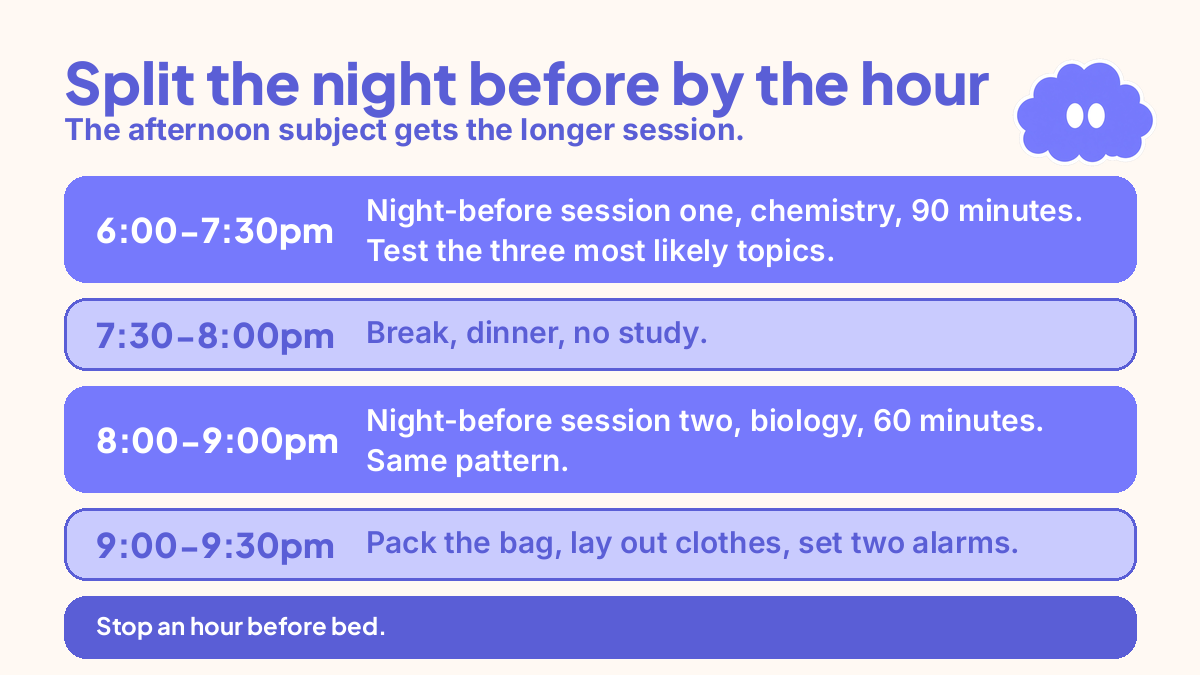
Give the afternoon subject the longer session, and the morning subject the last session. A workable split for a 6:00pm start is: 6:00 to 7:30pm on the afternoon subject, a 30-minute break, then 8:00 to 9:00pm on the morning subject. The subject you test first must be the freshest, so it gets the last hour.
Use each session the same way. Test yourself from memory on the three topics most likely to appear, using your own questions or the revision system for exams without cramming. Check the misses, fix the small ones, and write the rest on the summary page. Do not open new topics. The night before is for warming up what you already know.
Stop an hour before bed. Pack your bag for both papers: pens, calculator, water, your exam slip, and both summary pages. Lay out your clothes. Set two alarms. Then run the evening wind-down for better sleep before exams, and sleep at your normal time. A late night before a clash costs you twice: it dulls the morning paper and leaves nothing for the afternoon one.
Step 3: Run the morning paper routine
Wake at your normal time. Do not set the alarm earlier to squeeze in extra revision. An early start steals sleep and buys nothing.
Eat the same breakfast you always eat. Do not try a new breakfast on exam day. Drink water. Dress in the clothes you laid out. Leave at the time you wrote down last night, with 15 minutes to spare.
Warm up the morning subject for 20 to 30 minutes, no more. Read your one-page summary once, test yourself on the three topics most likely to appear, and check the misses once. Then close the notes. The warm-up is a reminder, not a study session. If you find a gap, write it on a small card, read it once, and put the card away. The morning-of-an-exam system covers this routine in full.
Arrive, sit down, read the whole paper before writing anything, and start with the question you are surest about. Do not think about the afternoon paper while you sit the morning one. Thinking about it now costs marks on the paper in front of you.
Step 4: Run the between-exams window
The gap between the papers is the part of the day most students waste. It is usually 60 to 90 minutes, and it has four jobs: food, rest, a warm-up for the second subject, and no post-mortem on the first paper. Do them in that order.
Leave the exam room and do not discuss the paper. Do not ask friends what they wrote. Do not check answers on your phone. The paper is finished. Nothing you learn in the gap can change your mark on it. If friends start talking about it, walk away.
Eat something real. A sandwich, fruit, and water, not a chocolate bar and an energy drink. Sit down to eat it. Give yourself 20 minutes for lunch, away from your notes. Your brain has just done 90 minutes of hard work, and it needs fuel and a break.
Rest for 20 minutes. Sit somewhere quiet, close your eyes, or take a short walk outside. Do not study during this rest. A tired brain does not learn well, and 20 minutes of rest buys more than 20 minutes of cramming.
Then warm up the second subject for 20 to 30 minutes. Read your one-page summary once. Test yourself on the three topics most likely to appear. Check the misses once, then close the notes. Do not learn new material. The interleaving system for mixed subjects explains why switching subjects is hard, and the warm-up is how you switch cleanly: one summary, one test, then stop.
Step 5: Reset for the afternoon paper, sit it, then stop
Five minutes before the afternoon paper, stop everything. Put the summary page away. Drink some water. Take three slow breaths. Walk into the room as if it were the first exam of the day.
Read the whole paper before writing anything, and start with the question you are surest about. Do not rush the first question to make up time. A calm first 10 minutes sets the pace for the whole paper.
Take a proper break inside the paper if you need one. Put your pen down for 60 seconds, look away from the paper, breathe, and then carry on. One minute of rest inside a 90-minute paper is not lost time. The breaks that actually help study make the same point for revision sessions, and it holds inside an exam too.
When the paper ends, stop for the day. Do not go home and study for tomorrow’s exam the same evening. Eat a proper dinner, do something ordinary, and sleep at your normal time. Two exams in one day is a full day’s work, and your brain needs the evening to recover.
A worked example: biology at 9:00am, chemistry at 1:30pm
Your situation: A-level student, biology paper 9:00 to 10:30am, chemistry paper 1:30 to 3:00pm, same day, same exam hall. Biology is stronger, chemistry weaker. Both summaries written, both subjects exam-ready three days before.
- Wednesday, the day before, 10:00-10:45am: timed biology set, morning slot, as a rehearsal. 2:00-2:45pm: timed chemistry set, afternoon slot, as a rehearsal. Mark both. Fix only the small gaps. 6:00-7:30pm: night-before session one, chemistry, 90 minutes. Test the three most likely topics, check the misses, update the summary. 7:30-8:00pm: break, dinner, no study. 8:00-9:00pm: night-before session two, biology, 60 minutes. Same pattern. 9:00-9:30pm: pack the bag, lay out clothes, set two alarms. 9:30-10:00pm: wind-down, no screens, bed at 10:00pm.
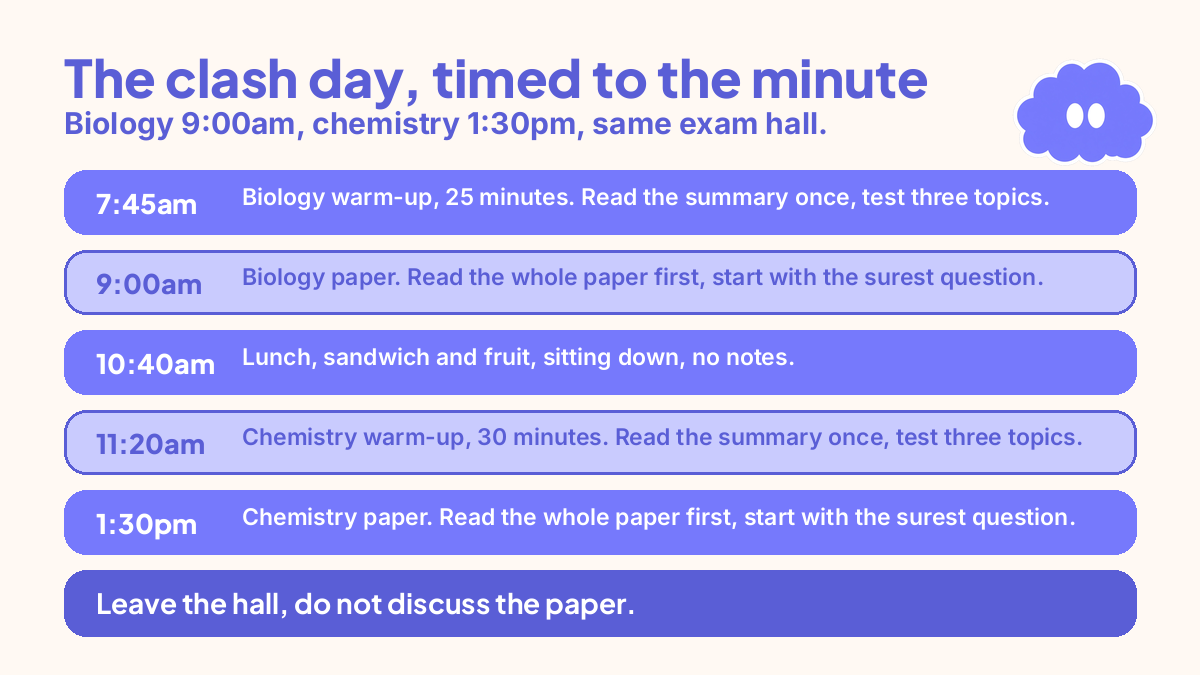
- Thursday, exam day, 7:00am: wake, same breakfast, water, dressed by 7:45am. 7:45-8:10am: biology warm-up, 25 minutes. Read the summary once, test the three most likely topics, check the misses once, close the notes. 8:10-8:30am: walk to the hall. 9:00-10:30am: biology paper. Read the whole paper first, start with the surest question.
- 10:30-10:40am: leave the hall, do not discuss the paper. 10:40-11:00am: lunch, sandwich and fruit, sitting down, no notes. 11:00-11:20am: rest, 20 minutes, quiet corner, eyes closed. 11:20-11:50am: chemistry warm-up, 30 minutes. Read the summary once, test the three most likely topics, close the notes. 11:50am-12:00pm: second rest, 10 minutes, walk outside. 12:00-1:00pm: free hour, water, no study. 1:00-1:25pm: walk to the hall, arrive early. 1:25-1:30pm: three slow breaths, summary page away, water. 1:30-3:00pm: chemistry paper. Read the whole paper first, start with the surest question.
- 3:00pm: both papers done. Go home, eat a proper dinner, no study, bed at the normal time.
When it goes wrong
One subject is not ready three days before. Give it the bigger share of the remaining days, and cut the stronger subject to one short session a day. If a whole topic is unlearned, learn the one point most likely to be asked, put it on the summary page, and accept the rest. Do not sacrifice the ready subject to rescue the unready one.
The night-before split slips, and one subject gets no session. Do the morning subject, even if it is only 30 minutes. The morning paper comes first, and it needs to be fresh. Give the afternoon subject its warm-up in the gap tomorrow. Do not stay up late to make up the lost hour. A late night costs both papers.
The first paper goes badly. Treat it as finished the moment you leave the room. Do not replay it, do not check answers, and do not change your plan for the second paper. Eat, rest for 20 minutes, and run your warm-up. One bad paper is one paper. The second one still counts the same. If the day leaves you shaken, use the back-on-track system for a bad study day tonight: note what happened, decide one change, and leave it there.
The gap between the papers is only 30 minutes. Skip the rest and cut the warm-up to 15 minutes, but keep the food. Eat a sandwich while you walk, read the summary page once, test the three most likely topics, and go in. A short gap is a reason to be stricter about the routine, not to abandon it.
You start discussing the first paper with friends. Walk away, even mid-sentence, and say you need to eat. It feels rude for ten seconds, and it saves your afternoon. If you already heard an answer you got wrong, note it on a scrap of paper and do not look at it again until the day is over.
Weekly review checklist
Use this checklist in the week before the clash, in writing, in 15 minutes.
- Is each subject exam-ready, and which one is weaker?
- Are both one-page summaries written, and do they fit on one side each?
- Is the night-before split written down, with exact times?
- Do you know both paper times, the hall, and the travel time between them?
- Is the between-exams window planned: food, rest, warm-up, and no post-mortem?
- What will you do if the first paper goes badly, and have you agreed it with yourself in advance?
Downloadable infographic spec: one vertical image, title “Two exams, one day”, with the five steps from “The system in short” and the six review questions above, in Thynq cream, Cloud Purple, Dark Purple and pink, with the Cloud mascot. Text taken word-for-word from this article.
What this system is not
This system does not make two exams on one day easy. It makes them manageable. It does not add study hours, and it does not promise grades. It moves the work to before the day, so the day itself is a routine you follow rather than a problem you solve while tired.
It is not a revision plan for exam week. The week plan comes first, and this system is the plan for one day inside it. It is not a substitute for knowing the material.
Sources
- Roediger, H. L., & Karpicke, J. D. (2006). Test-enhanced learning. Psychological Science, 17(3), 249-255. Students who recalled a passage remembered more a week later than students who restudied it.
- Dunlosky, J., et al. (2013). Improving students’ learning with effective learning techniques. Psychological Science in the Public Interest, 14(1), 4-58. Only practice testing and distributed practice rated high utility; rereading and highlighting rated low.
- Cepeda, N. J., et al. (2006). Distributed practice in verbal recall tasks: a review and quantitative synthesis. Psychological Bulletin, 132(3), 354-380. Spaced practice beat massed practice; the optimal gap grows with the retention interval.
For the full system behind this plan, start with the exam week plan, which this system sits inside.
Questions
How do I revise for two exams on the same day?
Get both subjects exam-ready before the day, because there is no gap to learn in. Split the night before between the two subjects by the hour, with the morning paper getting the last session. Between the papers, rest, eat, and warm up the second subject from a one-page summary. Do not go over the first paper.
Should I study between two exams on the same day?
Study a little, and only the second subject. Use the gap for food, rest, and a short warm-up from your one-page summary: 20 to 30 minutes of recall, then stop. Do not learn new material, do not re-read whole chapters, and do not discuss the first paper with anyone.
How do I split the night before two exams?
Give the afternoon paper the longer session and the morning paper the last session. A workable split is 90 minutes on the afternoon subject, a 30-minute break, then 60 minutes on the morning subject, and stop an hour before bed. The subject you test first in the morning must be the freshest in your mind.
What if the first exam goes badly?
Treat it as finished the moment you leave the room. Do not replay questions, do not check answers with friends, and do not change your plan for the second paper. Eat, rest for 20 minutes, and run your warm-up for the second subject. One bad paper is one paper, and the second one still counts the same.