The direct answer
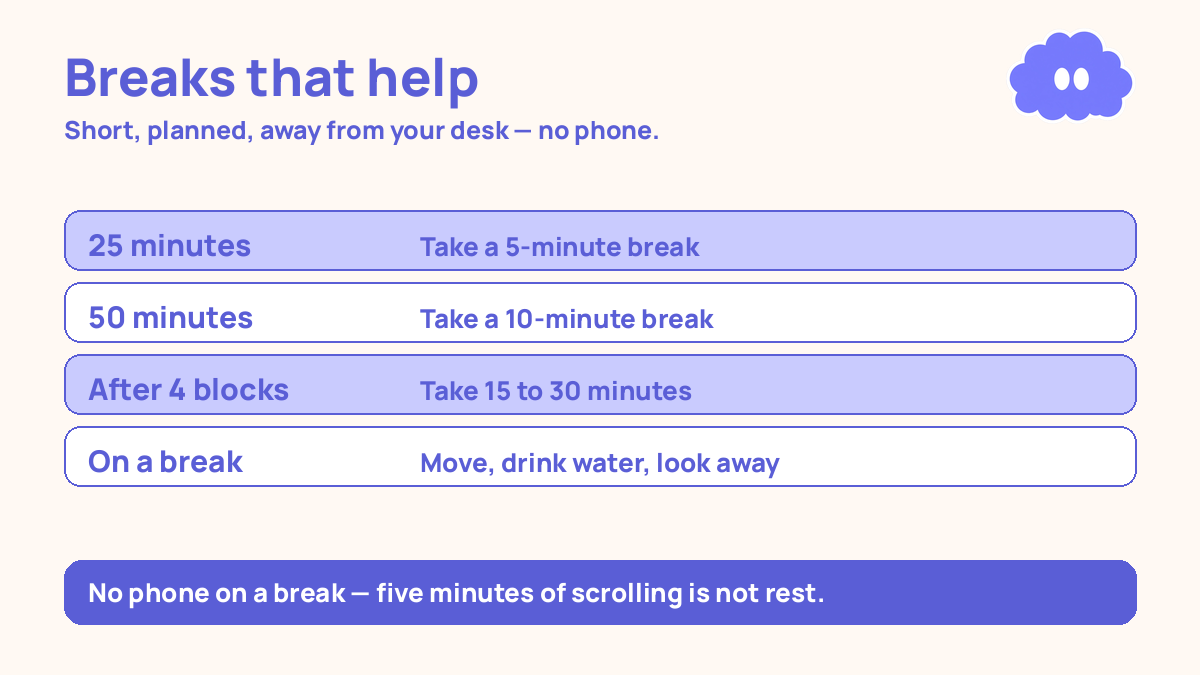
A break that helps is short, planned, and away from your work: 5 minutes after a 25-minute block, 10 minutes after a 50-minute block, and 15 to 30 minutes after four blocks. During the break you stand up, move, drink water, and look away from your desk. You do not check your phone. That is the whole system.
It works because focus is a limited resource. You cannot use it for hours without a pause, and you cannot refill it by switching to a different kind of screen. A real break gives your brain a rest. A fake break gives it a new job.
Why breaks fail
Most breaks fail in the same way. You finish a block, you feel tired, and you reach for your phone. Five minutes of scrolling becomes twenty. You come back to your desk feeling worse than when you left it, and the next block never starts properly.
The other failure is the opposite: you skip the break. You feel fine, so you push on. An hour later you are staring at the same page, reading the same line, and nothing is going in. You blame yourself, but the problem is the missing break.
A break works when it is planned before the block starts. You know when it comes, how long it lasts, and what you will do in it. That removes the decision. The plan has already chosen rest.
Breaks are part of every timer system. The Pomodoro technique for students is 25 minutes of work and a 5-minute break, with a longer break after four rounds. 50-minute blocks work the same way, with a 10-minute break.
The system in short
- Plan your breaks before you start: 5 minutes after 25, 10 minutes after 50, 15 to 30 minutes after four blocks.
- When the timer rings, stop. Do not finish one more thing.
- Stand up and move away from your desk.
- Drink water, eat if you need to, and look out of a window.
- Do not open your phone, and do not start a new task.
- When the break timer ends, sit down and start the next block.
- Once a week, check which breaks helped and which ones broke your day.
Step 1: Plan the break before the block
Before you start a block, know when the break comes. Write it down if it helps: “25 work, 5 break, repeat four times, then 30 minutes.” You do not decide in the moment, because in the moment you will decide to keep going, or to scroll, or to do one more thing.
The break is not a reward. It is part of the work. A block without a break borrows focus from the next one. You will pay it back later, in a wasted afternoon.
If you use 50-minute blocks, the break is 10 minutes. If you use 25-minute blocks, the break is 5 minutes. After four blocks, take a longer break of 15 to 30 minutes, when you eat, walk, or rest properly. Do not skip it. The fifth block after a skipped long break is usually the one where your focus falls apart.
Step 2: Stop when the timer rings
When the timer rings, stop. If the task is nearly done, finish the sentence or the step, then break. Do not finish the whole task. That is how breaks disappear.
Stopping is hard, especially when the work is going well. But a break you take on time is a break you can trust. If you know the break will come, and the work will still be there after it, starting the next block is easier.
Put your pen down. Close the book, or close the laptop lid. Stand up. A break taken at your desk, staring at the same page, is not a break.
Step 3: Move, drink water, and look away
A good break has three parts: move, drink, and look away. Stand up and walk around. Stretch. Get a glass of water. Look out of a window, or step outside if you can.
Movement matters. Sitting still for hours makes you stiff and sleepy. A short walk, even around the room, wakes you up. Water matters too. Most students do not drink enough while they study. Keep a glass on your desk, and refill it on the break.
Looking away matters because your eyes are tired. Hours of reading strain them. Look at something far away for a minute. Look out of a window. Your eyes need distance, the same way your brain needs a pause.
Step 4: Do not open your phone
This is the hardest rule, and the most important one. Do not open your phone on a break. Five minutes of scrolling is not rest. It is new information and new messages. It pulls your attention away and makes the next block harder to start.
If your phone is in another room, this rule is easy. If it is on your desk, it is hard. That is why the phone focus system for distracted students starts with the phone in another room. The phone stays where it is.
The same goes for videos, games, and social media on your laptop. A break is not a different kind of screen time. It is time away from screens. If you need something to do, do nothing. Sit by the window. Walk. Eat an apple. Boredom for five minutes is fine.
Step 5: Eat and rest properly on the long break
After four blocks, take a longer break of 15 to 30 minutes. This is the break where you eat, walk, or rest properly. Eat something simple: a meal, or a snack with protein, not just sugar. Sugar gives you a quick lift and then a crash.
Use the long break to move properly. Go for a walk. Go outside. Stretch. If you are tired, lie down for 10 minutes with your eyes closed — but set an alarm. A short rest with an alarm is a break. A nap without one is the end of the day.
Do not use the long break to start a new subject, or to catch up on messages. It is a break, not a gap to fill. The next set of blocks will be better if you actually rested.
A worked example: a morning of study with real breaks
Maya studies from 9am to 12pm. She uses 50-minute blocks. Her plan is simple: 50 work, 10 break, repeat, then a longer break.
9:00–9:50 — Block 1: She tests herself on cell division from memory, then checks her answers. 9:50–10:00 — Break: She stands up, walks to the kitchen, drinks a glass of water, and looks out of the window. No phone. 10:00–10:50 — Block 2: She works through five maths problems. 10:50–11:00 — Break: She stretches, refills her water, and steps outside for two minutes. 11:00–11:50 — Block 3: She writes one essay paragraph. 11:50–12:00 — Break: She stops, eats lunch, and takes a 30-minute break before the afternoon.
Three blocks, three real breaks, and she finishes the morning knowing what she did. Compare that with a morning of three hours at a desk, with the phone in hand, where the breaks were scrolling and the work was half-done. The time is the same. The result is not.
When it goes wrong
The 5-minute break becomes 20 minutes. This is the most common failure, and it almost always starts with the phone. Leave the phone in another room. Set a timer for the break, the same way you set one for the block. When the break timer rings, sit down and start. If breaks keep running long, make them shorter: 3 minutes instead of 5.
You skip the break because you feel fine. Take it anyway. Breaks are part of the system, not a reward for feeling tired. Skipping breaks is how a good morning turns into a wasted afternoon. If you feel fine, the break will be short and easy, and the next block will be better for it.
You take the break, but you come back more tired. You probably did not rest. You checked your phone, or you started a new task, or you sat at your desk thinking about the work. A break should be away from the desk, away from screens, and away from decisions. Move, drink water, look out of a window.
You feel guilty for taking a break. That guilt is the system working backwards. A break is not laziness. It is how focus is refilled. A student who never takes a break does not study more. They study worse, for longer, and remember less. In a 2013 review, Dunlosky and colleagues rated ten common study techniques, and only two received a high utility rating: practice testing and distributed practice. Spacing your work out, with breaks between blocks, is part of what makes distributed practice work.
Weekly review checklist
Copy this list and use it each week:
- How many breaks did I actually take this week, and how many did I skip?
- Which breaks ran long, and what made them run long — phone, messages, or starting a new task?
- Which break activity left me feeling fresh, and which left me feeling tired?
- Did I take the long break after four blocks, or did I skip it?
- What is the one change I will make next week — and only one?
The one-change rule matters. If you try to fix five things at once, you will fix none of them. Pick the single change that would help most: phone in another room, a break timer, a walk instead of scrolling, or a proper lunch. One change, tried for a full week, then judged honestly.
Downloadable infographic spec: one vertical image, title “Breaks that actually help”, with the break rules — 5 minutes after 25, 10 minutes after 50, 15 to 30 minutes after four blocks — and the three break actions, move, drink water, look away, and the rule “no phone on a break” in Cloud Purple #7679FC, Dark Purple #5A5ED6, Cream Paper #FFF9F3 and Pink #E94E9A, with the Cloud mascot. Text taken word-for-word from this article.
What this system is not
It is not a promise of a grade, and it is not a claim that a 5-minute break is the scientifically correct length for every brain. It is a practical system: short, planned breaks, away from your desk, without your phone, and a longer break after four blocks.
It is also not a system for avoiding work. A break is 5 minutes, not an hour. It is a pause, not an exit. If your breaks keep turning into the rest of the day, the problem is not the break. It is the phone, or the task, or the plan. Fix the setup, keep the breaks short, and trust the timer.
Sources
- Dunlosky, J., et al. (2013). Improving students’ learning with effective learning techniques. Psychological Science in the Public Interest, 14(1), 4-58. Only practice testing and distributed practice received a high utility rating; rereading was rated low.
- Cirillo, F. — Pomodoro Technique, late 1980s. Classic cycle: 25 minutes work, 5 minutes break, longer break after four. The 25-minute length was Cirillo’s practical choice, not a number derived from cognitive science.
For the timer that sets the breaks, use the Pomodoro technique for students, and for the longer blocks, use how to study in 50-minute blocks.
Questions
How long should a study break be?
Five minutes after a 25-minute block, or 10 minutes after a 50-minute block. Take a longer break of 15 to 30 minutes after four blocks. Short, regular breaks beat one long break after hours of tired work.
Is checking my phone a good break?
No. Five minutes of scrolling is not a break, it is a new distraction. It pulls your attention away and makes the next block harder to start. Leave the phone in another room during breaks too.
What should I do on a break?
Stand up, move, get water, look out of a window, or eat something simple. A break should rest your eyes and your brain, not feed them more information. Do nothing that needs a decision.
What if I feel fine and want to skip the break?
Take it anyway. Breaks are part of the system, not a reward for feeling tired. Skipping breaks is how a good morning turns into a wasted afternoon. The next block will be better for it.