The direct answer
When there are no past papers, you make your own. Turn the learning outcomes and lecture headings into practice questions at three difficulty levels, answer them from memory under timed conditions, and mark them against a rubric you wrote in advance. That is how to revise when there are no past papers.
A new course, a changed syllabus, or a university module with no published papers leaves you without the usual revision tool. That does not leave you without a test. The paper was never the point.
It takes about 90 minutes to set up for one subject. You need the syllabus, the lecture slides, and your notes.
The system in short
- Find the real test targets: collect the learning outcomes and lecture headings, and turn them into a topic list.
- Write 8 to 12 practice questions per topic, at three levels: recall, explain, and apply.
- Answer the questions from memory, under timed conditions, with the notes closed.
- Mark your answers without a mark scheme, using a rubric, a source check, and a teacher check.
- Log every error in an error log, fix the gaps, and re-test them after two days.
Step 1: Find the real test targets
A past paper tells you what the exam asks. Without one, the learning outcomes do the same job. Find them in the syllabus, the module handbook, or the first lecture slides: the sentences that start with “describe”, “explain”, “evaluate”, or “apply”. Copy them out, one per line, on a single page: your exam map.
Add the lecture headings underneath. Every lecture title and chapter heading is a topic the examiner can ask about. If a heading appears in three lectures, it is a core topic. Mark the core topics with a star. You will write more questions for those.
Now check what is missing. If an outcome has no notes behind it, that is a gap to learn first, not a topic to test. If a topic in your notes has no outcome behind it, it is probably background.
This step takes 30 minutes for one subject. Do it before you write a single question. If your course has no published outcomes, use the assessment description and any sample question the lecturer gave in class.
Step 2: Write your own practice questions at three levels
Write questions from the outcomes, not from your notes. Open your notes to write the answer key, but write the question from the outcome. That keeps the question honest: it asks what the exam will ask.
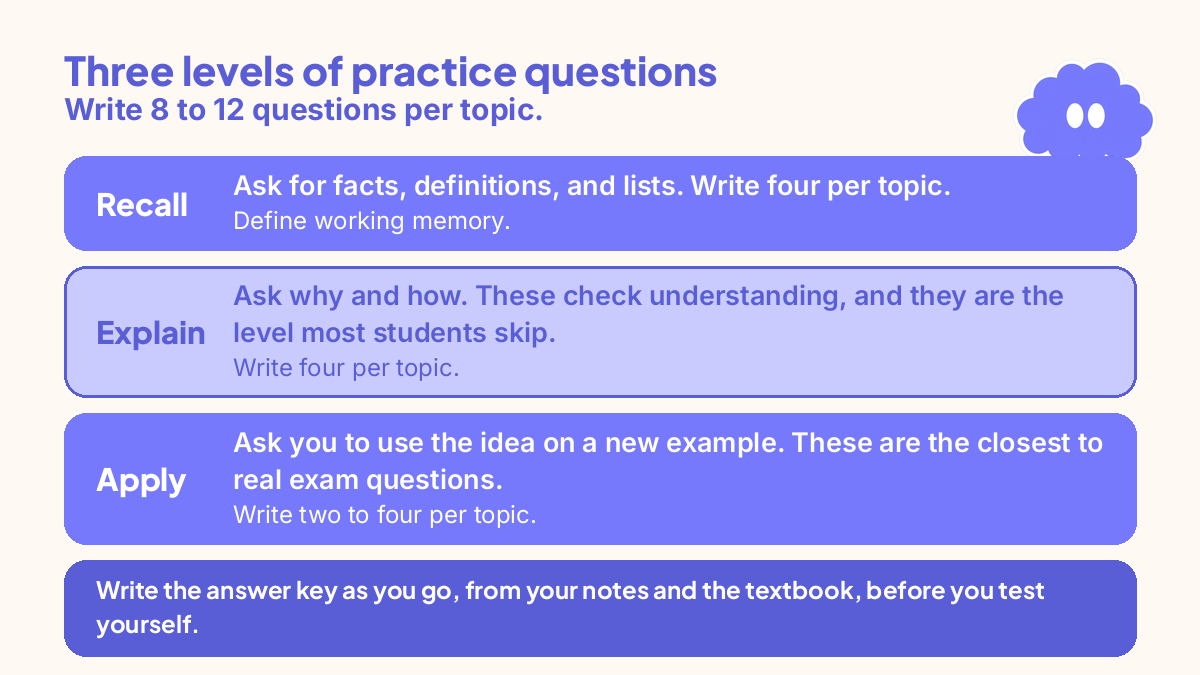
Use three levels for each topic. Recall questions ask for facts, definitions, and lists. “Define working memory.” “List the four stages of the model.” These check whether the knowledge is there at all. Write four per topic.
Explain questions ask why and how. “Explain why the model predicts that rehearsal alone does not move information into long-term memory.” These check understanding, and they are the level most students skip. Write four per topic.
Apply questions ask you to use the idea on a new example. “A student re-reads the same chapter five times and still fails. Use the model to explain why, and say what she should do instead.” These are the closest to real exam questions. Write two to four per topic.
Write the answer key as you go, from your notes and the textbook, before you test yourself. The key is short: three or four bullet points per question, each one a point a good answer must contain. That key becomes your rubric in Step 4. If you cannot write the key, learn the topic first and come back.
Keep the questions on one page per topic, or on flashcards. The flashcard system that works shows how to organise cards so the hard ones come back sooner.
Step 3: Answer from memory under timed conditions
Testing only works if the notes are closed. Open the question page, close everything else, set a timer, and write your answers. No peeking, no checking mid-answer, no “just one look at the slide”. The moment you look, the test stops telling you the truth.
Time yourself like the real exam. If the exam gives 45 minutes for a short-answer section, practise in 45-minute blocks. If you do not know the exam timing, use 25 minutes per set of 8 to 12 questions. The timer stops you polishing one answer for 20 minutes while the rest go untested.
Write full answers, not bullet points, for the explain and apply questions. A bullet list lets you skip the hard part, which is connecting the ideas in sentences. Short answers are fine for recall questions.
Do one topic per session at first, then mix topics once the questions exist. The retrieval practice system for students explains why testing from memory beats re-reading, and this step is that system with questions you wrote yourself. When the timer ends, stop. Unfinished answers are data: they show which topics are slow.
Step 4: Mark your answers without a mark scheme
No mark scheme means you build the marking yourself, before you look at your answers. Your answer key from Step 2 is the rubric. Compare each answer with its key, point by point, and score it: full, partial, or miss.
Full means every point in the key is in your answer. Partial means some points are there and some are missing. Miss means the answer is wrong, blank, or about the wrong thing. Write the score next to each answer. Do not award yourself marks for effort or for writing a lot. A long answer that misses the key point is a miss.
Then run the source check. Open the lecture slides, the textbook, and your notes. Check every partial and miss against the source, and write the correct point in a different colour next to your answer. This is where the learning happens: you see exactly what you left out, next to the wrong answer.
Then run the teacher check, once a week. Take your two weakest answers to a tutor, a seminar, or an office hour, and ask: “What would a good answer to this add?” Two is enough, and tutors answer two properly. Write down what they say, and add it to your answer key. The past paper system for exams relies on the official mark scheme for this step. When there is no scheme, the teacher check is the closest replacement.
Step 5: Log every error and re-test it after two days
Every partial and miss goes into an error log. One line per error: the topic, the question, what you got wrong, and the correct point. Keep it on one page. The log is the most valuable page you own in the last week, because it lists exactly what the exam can still catch you on.
Fix the gaps the same day. Re-learn the point from the source, in 10 to 15 minutes. Do not re-read the whole chapter. Read the one slide or page that holds the missing point, then close it and say the point aloud from memory. If you can say it, it is fixed for now.
Re-test every logged error after two days. Write the same question again, from memory, with the notes closed. If you get it right, cross it off the log. If you get it wrong again, test it again in two more days. An error that survives two re-tests is a topic to learn from scratch, not a fact to memorise. Go back to the lecture and the textbook.
In the last week, the error log becomes your revision plan. Test the whole log, in timed sets. This is the same job a mock exam does with past papers: a timed test, an honest mark, and a fix list.
A worked example: one week of revision with no past papers
Your situation: second-year psychology student, one exam in six days, no past papers published for the module. Four topics: memory, attention, perception, and language. Lectures and slides available, textbook available, one office hour on Thursday.
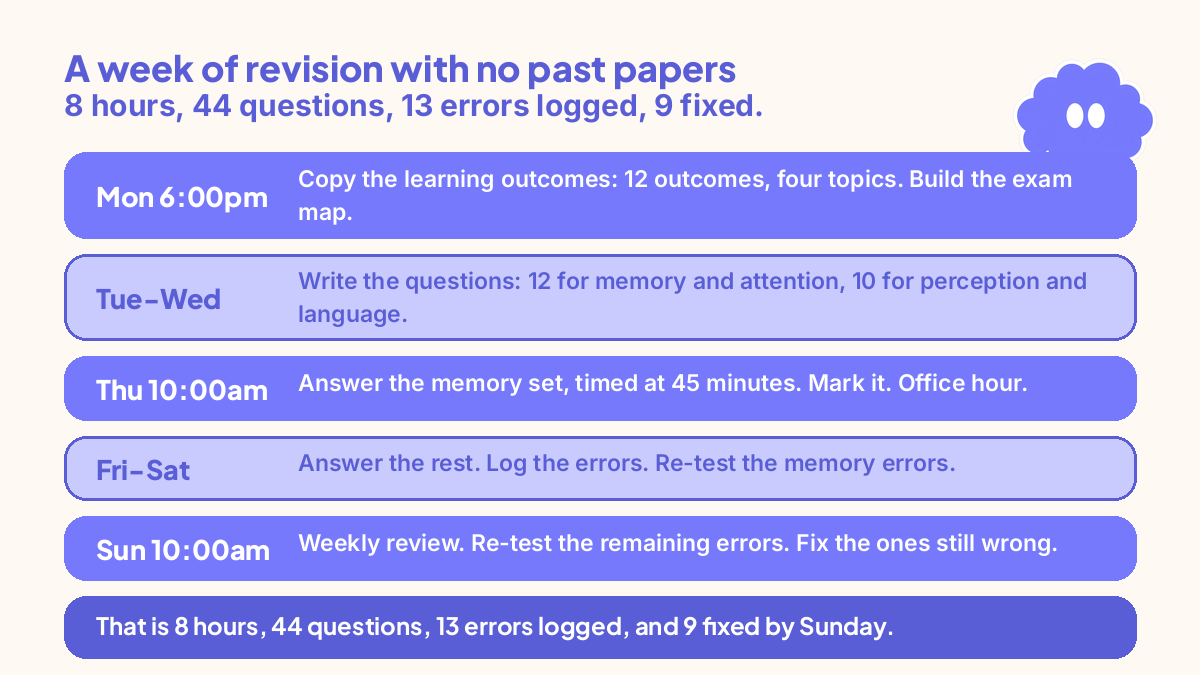
- Monday 6:00-7:30pm: Step 1. Copy the learning outcomes from the module handbook: 12 outcomes across four topics. List the lecture headings. Mark memory and attention as core topics. Build the exam map on one page.
- Tuesday 6:00-7:30pm: Step 2, memory and attention. Write 12 questions each: four recall, four explain, four apply. Write the answer keys.
- Wednesday 6:00-7:30pm: Step 2, perception and language. Write 10 questions each, with answer keys. 44 questions in total.
- Thursday 10:00-10:45am: Step 3, memory. Answer all 12 questions from memory, timed at 45 minutes. 11:00-11:30am: Step 4. Mark against the rubric: 7 full, 3 partial, 2 miss. Source check on the 5 weak answers. 2:00-2:30pm: office hour. Take the two weakest answers, ask what a good answer would add, and update the keys.
- Friday 6:00-7:30pm: Step 3, attention and perception. Answer both sets from memory, timed. Mark both. Log 9 errors in total. Fix the 5 memory errors in a 15-minute session before bed.
- Saturday 10:00-11:30am: Step 3, language. Answer all 10 questions, timed. Mark. Log 4 more errors. 11:30am-12:00pm: Step 5. Re-test the 5 memory errors. Four are right now, one stays on the log.
- Sunday 10:00-11:00am: weekly review. Re-test the remaining errors from attention, perception, and language. 11:00-11:30am: fix the ones still wrong, and write the exam-week plan.
That is 8 hours, 44 questions, 13 errors logged, and 9 fixed by Sunday.
When it goes wrong
You cannot find the learning outcomes. Ask the lecturer, or use the assessment description and the exam format instead. If neither exists, use the lecture headings and the textbook chapter titles as your topic list. A topic list built from headings is better than no list at all.
Your questions are all recall questions. That means you are copying your notes instead of thinking about the exam. For each topic, take two recall questions and rewrite them as explain questions: add “why” or “how”, or ask for a comparison. Then write one apply question using a new example. If you cannot write one, you have found a gap in understanding, not a gap in question writing.
You keep peeking at your notes during the test. Put the notes in another room for 25 minutes. If you peek once, the test for that topic is spoiled, so mark the whole set as untested and do it again tomorrow. The back-on-track system for a bad study day covers the same rule: one bad session is a bad session, not a failed system.
You mark yourself too generously. Use the three-point score and the rule: if in doubt, give partial. Then check the partials against the source, and take the two worst to your tutor. Generous marking feels kind and costs marks in the exam.
The error log keeps growing and never shrinks. That means you are logging errors but not fixing them. Stop writing new questions for two days. Spend those sessions on the log only: re-learn each point, re-test it, and cross it off. A log of 30 unfixed errors is a list of worries. A log of 5 errors you re-test every two days is a plan.
Weekly review checklist
Use this checklist at the end of each revision week, in writing, in 15 minutes.
- How many questions did you write this week, and for which topics?
- How many did you answer from memory, under timed conditions?
- What is on the error log, and how many errors did you fix and cross off?
- Which topic has the most errors, and what will you do about it this week?
- Did you use the teacher check this week, and what did it change in your answer keys?
- Are the core topics tested at all three levels, or are some levels still missing?
Downloadable infographic spec: one vertical image, title “Revise with no past papers”, with the five steps from “The system in short” and the six review questions above, in Thynq cream, Cloud Purple, Dark Purple and pink, with the Cloud mascot. Text taken word-for-word from this article.
What this system is not
This system does not replace past papers where they exist. If papers are published, use them: they are the real format, timing, and standard. Where there are none, this system is the replacement.
It does not promise grades. Writing your own questions cannot guarantee the exam asks the same ones. What it guarantees is that you tested yourself on every outcome, found the gaps, and fixed them before exam day.
It is not a substitute for learning the material. If you cannot write an answer key for a topic, you do not know it yet. Learn it first, then test it. Fit this system inside a revision timetable that works, and inside the wider plan in how to revise for exams without cramming.
Sources
- Roediger, H. L., & Karpicke, J. D. (2006). Test-enhanced learning. Psychological Science, 17(3), 249-255. Students who recalled a passage remembered more a week later than students who restudied it.
- Dunlosky, J., et al. (2013). Improving students’ learning with effective learning techniques. Psychological Science in the Public Interest, 14(1), 4-58. Only practice testing and distributed practice rated high utility; rereading and highlighting rated low.
For the full system behind this method, start with the exam week plan for students.
Questions
Can I revise well without past papers?
Yes, if you replace the paper with a system of your own. Turn the learning outcomes and lecture headings into practice questions, answer them from memory under timed conditions, and mark them against your notes and the course materials. The testing effect still works when you write the questions yourself, because the learning happens in the recall, not in the paper.
How do I write my own practice questions?
Start from the learning outcomes and the lecture headings, not from your notes. Write three levels for each topic: recall questions that ask for definitions and facts, explain questions that ask why and how, and apply questions that ask you to use the idea on a new example. Aim for 8 to 12 questions per topic, and write the answer key from your notes before you test yourself.
How do I mark my answers without a mark scheme?
Use three checks. First, a rubric you write in advance: what a full answer must contain, in three or four bullet points. Second, a source check: compare your answer with the lecture slides, the textbook, and your notes, and mark anything missing or wrong. Third, a teacher check: take your two weakest answers to a tutor or seminar and ask what a good answer would add.
How many practice questions should I write per topic?
Write 8 to 12 questions per topic: four recall, four explain, and two to four apply. Fewer than eight and the test misses too much of the topic. More than twelve and writing the questions eats the time you need for answering them. If a topic is small, eight is enough. If it is a core topic, go to twelve.