The direct answer
How to revise geography for exams is a system, not a reading list. Triage your specification into know, shaky, and unknown. Build one evidence bank card per case study. Learn the content by testing yourself from memory, practise map and data skills every week, and finish with timed past papers.
Geography revision fails in a specific way. Students read the textbook, feel they know it, then sit the exam and cannot turn what they read into an answer. The exam asks for evidence, for a process explained in order, and for data read from a map or a graph. Reading alone practises none of those. This system practises all three, for GCSE and A-level shapes alike.
The system in short
- Triage the specification in 60 minutes: mark every topic know, shaky, or unknown, and build the study list from the unknown and shaky topics.
- Build a case-study evidence bank: one card per case study, five lines each, location, process, evidence, consequence, response.
- Learn the content by retrieval: close the notes, write or say what you remember, then check in a different colour.
- Practise map and data skills for 30 minutes a week: grid references, scale, graphs, and data response questions from past papers.
- Learn the fieldwork enquiry and the issue evaluation as processes you can describe step by step.
- Test under timed conditions with past papers, mark against the mark scheme, and put every lost mark on the next week’s list.
Step 1: Triage the specification before you revise anything
Print or copy your specification topic list. Do not start with chapter one. Start with the list.
Give every topic one mark: know, shaky, or unknown. Know means you could explain it without notes. Shaky means you remember parts but not the sequence. Unknown means the heading looks new. A topic you read twice is not a topic you know.
Your study list is the unknown topics first, then the shaky ones. The know topics get one short re-test a week, nothing more. This is the same triage logic as a revision timetable that works, built from what you cannot yet do rather than the order of the textbook.
If there are more than six unknown topics, split big ones: “rivers” becomes “river processes”, “river landforms”, and “flooding and management”. A topic you can finish in one 50-minute session is the right size.
Step 2: Build the case-study evidence bank
Case studies are where geography marks are won and lost. The exam does not ask you to list them. It asks you to use one as evidence for a point. That needs a different kind of note.
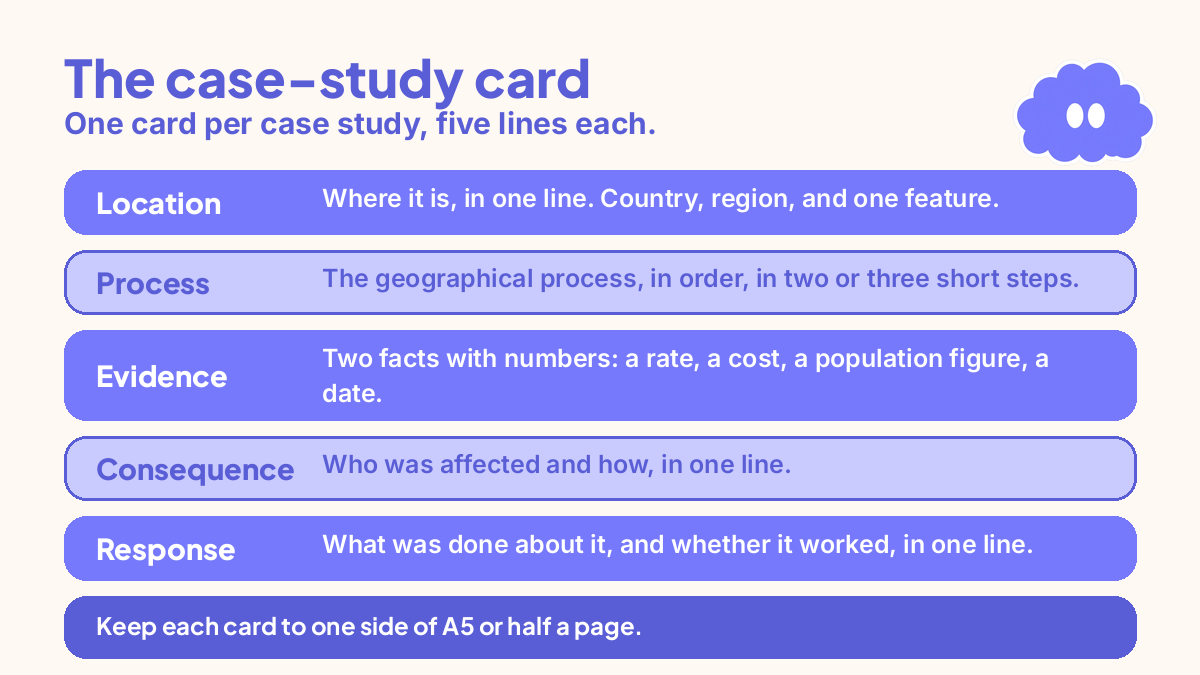
Make one card per case study. Each card has exactly five lines.
- Location: where it is, in one line. Country, region, and one feature that fixes it in your mind.
- Process: the geographical process, in order, in two or three short steps.
- Evidence: two facts with numbers: a rate, a cost, a population figure, a date. Numbers make the evidence checkable.
- Consequence: who was affected and how, in one line.
- Response: what was done about it, and whether it worked, in one line.
Keep each card to one side of A5 or half a page. Longer than that, it is a textbook page, not a revision card, and you will not test yourself from it.
Learn the cards by covering the lines. Read the location, then say the process, evidence, consequence, and response from memory. Check in a different colour. A card you can reproduce from the location alone is one you can use in the exam.
Test the cards in pairs. Take two case studies from different topics and ask which one answers a question about flooding, and which about coastal management. Choosing the right case study is a skill the exam tests, and it only improves when you practise choosing.
Step 3: Learn the content by testing yourself, not by re-reading
Re-reading feels like learning because the words look familiar. The test is simple: close the notes and explain the topic. If you cannot, you do not know it yet, however many times you read it.
For each topic, use this 50-minute block: read for 10 minutes, close the notes and write or say everything you remember for 15 minutes, check in a different colour for 10 minutes, then re-test the gaps for 15 minutes. Draw the diagram from memory if the topic has one.
Dunlosky and colleagues (2013) rated only practice testing and distributed practice as high utility; re-reading was rated low. Roediger and Karpicke (2006) showed students who recalled a passage remembered more a week later than students who restudied it.
Space the re-tests: the day you learn a topic, again two days later, and again a week later. Cepeda and colleagues (2006) showed spacing beats massing, and the best gap grows with how long you need to remember the material. The memorisation system for heavy syllabuses sets out the same spacing routine in full.
Step 4: Practise map and data skills every week
Skills questions are the marks students lose while knowing the content. A six-mark map question and a four-mark data question can be worth more than a whole case study paragraph, and they are lost by students who never practised them.
- Grid references and scale. Four-figure and six-figure references, measuring distance with the scale bar, and working out direction from one feature to another. Ten minutes, one map extract, three questions.
- Reading graphs and data. Bar charts, line graphs, choropleth maps, and proportional symbols. Practise describing the pattern first, then the data that supports it: the highest value, the lowest value, and one comparison.
- Data response. Read the resource, underline the command word, and answer only what it asks. “Describe” wants the pattern. “Explain” wants the reason. “Evaluate” wants both sides and a judgement.
For every skills question, write the answer, then check it against the mark scheme. Mark schemes are precise: they name the number, the place, or the pattern that earns the mark. If your answer says “it increased a lot” and the mark scheme wants “from 12 to 38”, you have found the gap. Write the exact phrasing it wants on your gaps list. If map skills are your weakest area, do them first in the week, when you are freshest.
Step 5: Learn fieldwork and issue evaluation as processes
Fieldwork and issue evaluation look different from the rest of the course, and students often leave them until last. Both are processes you can learn as a sequence of steps you can describe without notes.
For fieldwork, learn the enquiry as six steps: question, method, data, presentation, analysis, conclusion.
If your fieldwork was cut short or cancelled, use what you did, however little, and the data your teacher gave you. Write up the enquiry question, the method, and one finding you can explain. If you have no fieldwork data at all, ask your teacher what the exam will expect, and learn the method as a process you can describe step by step.
For issue evaluation, the skill is weighing evidence. Practise with one issue at a time: read the resources, list the arguments for and against in two columns, and write a judgement in three sentences. The first states your answer. The second gives the strongest evidence for it. The third names the strongest argument against it and says why your answer still holds.
Step 6: Test under timed conditions and mark honestly
Past papers are the last step, not the first. They work once the content is learned, because then they test application, timing, and exam technique. Used too early, they only show what you have not learned yet.
Run one timed paper, or one timed section, each week in the last four weeks before the exam. Set the real time limit: no notes, no phone, no pausing the clock. Use the past-paper system for exams for the full routine, and the mock exam system for treating a timed paper as a rehearsal rather than a test of your worth.
Mark the paper against the mark scheme the same day. For every mark lost, write one line on the gaps list: the topic, the question type, and the fix. Sort lost marks into three piles: content you did not know, case study evidence you could not use, and technique, such as running out of time or misreading the command word. Put the biggest pile on next week’s study list first.
The technique pile is the cheapest to fix. If you lost marks to time, practise the timing: 1 mark takes about 1 minute, so a 9-mark question gets 9 minutes, then move on. If you lost marks to command words, write the four on a card, describe, explain, assess, evaluate, with one line each on what each asks for, and read it before every paper.
A worked example: one week of geography revision, four weeks before the exam
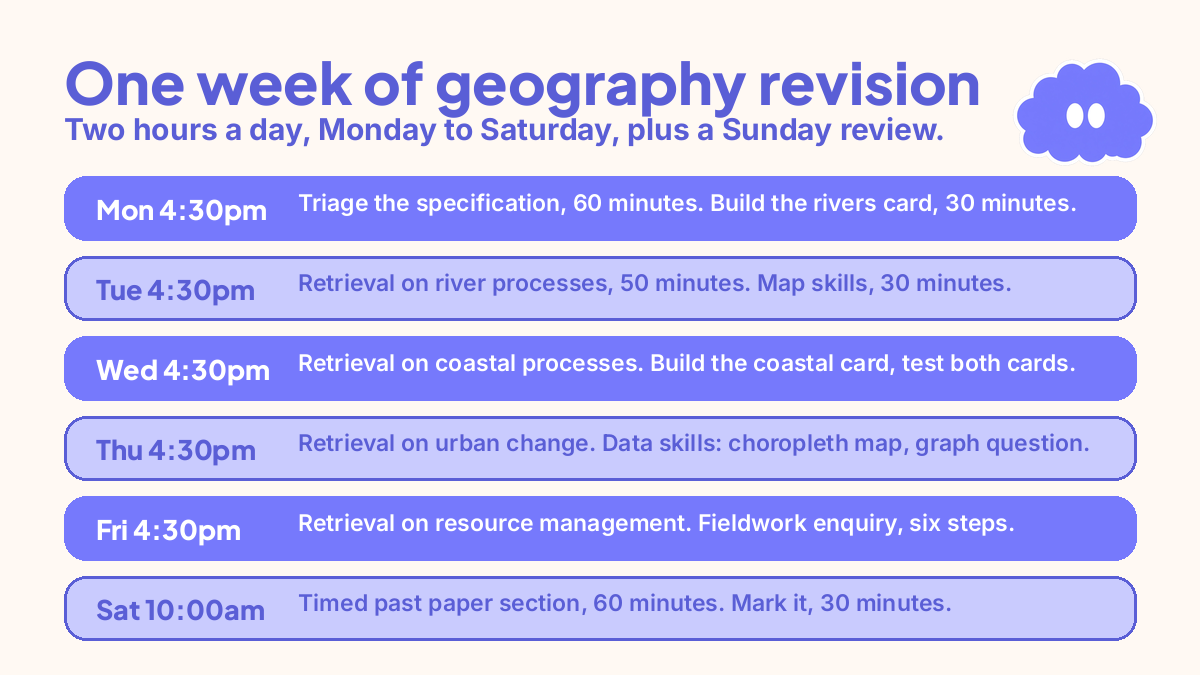
Your situation: GCSE student, four weeks to the exam. Topics: rivers, coasts, urban change, and resource management. Case studies: one river flooding, one coastal, one city example. Map skills are weak. Two hours a day, Monday to Saturday, plus a Sunday review.
- Monday, 4:30-6:30pm: triage the specification, 60 minutes, then build the rivers case-study card, 30 minutes, and test it from the location line, 15 minutes. Gaps: river landforms, flood management terms.
- Tuesday, 4:30-6:00pm: retrieval block on river processes, 50 minutes: close and write, then check, then map skills, 30 minutes: six-figure grid references and scale on a past paper extract, three questions, then mark.
- Wednesday, 4:30-6:00pm: retrieval block on coastal processes, 50 minutes, then build the coastal case-study card, 30 minutes, then test both cards from memory, 15 minutes.
- Thursday, 4:30-6:00pm: retrieval block on urban change, 50 minutes, then data skills, 30 minutes: one choropleth map and one graph question from a past paper, then mark against the mark scheme.
- Friday, 4:30-6:00pm: retrieval block on resource management, 50 minutes, then fieldwork enquiry, 30 minutes: write the six steps from memory, then check against your fieldwork notes.
- Saturday, 10:00-11:30am: timed past paper section, 60 minutes, then mark it, 30 minutes. Lost marks: 4 content, 3 evidence, 2 technique. The evidence pile goes on next week’s list first.
- Sunday, 10:00-10:30am: weekly review: re-test the two weakest cards and plan next week.
When it goes wrong
You have too many case studies to learn. Cut the list to the ones your specification requires, plus one spare per topic. Learn those properly. A spare you can use beats three you can only name.
You keep re-reading instead of testing yourself. Set a timer for 15 minutes and close the notes before it starts. Write what you remember, then check. If the page stays blank, write the topic headings first, then one fact per heading.
Map skills keep costing you marks. Move the skills session to the start of the week and do it twice a week for two weeks, 20 minutes each time. Short, frequent practice fixes skills faster than one long session. Check every answer against the mark scheme and copy the exact phrasing it wants.
You run out of time in timed papers. Practise the 1-mark, 1-minute rule for two weeks. Write the time limit at the top of each question before you start, and move on when it ends, even mid-sentence. Finishing the paper beats a perfect first answer and a blank last page.
You cannot remember the numbers in your case studies. Reduce each card to two numbers only, and learn them as a pair: the rate and the cost, or the population and the date. Say them aloud three times, then write them from memory an hour later.
Weekly review checklist
Use this checklist at the end of each revision week, in writing, in 20 minutes.
- Which topics moved from unknown to shaky, or from shaky to know, this week?
- Which case-study cards can I reproduce from the location line alone?
- What did the map and data skills session show, and what exact phrasing did the mark scheme want?
- Which lost marks from the timed paper are now fixed, and which are still on the gaps list?
- What is the biggest pile for next week: content, evidence, or technique?
- What one change will I make to next week’s plan, and what stays the same?
Downloadable infographic spec: one vertical image, title “How to revise geography for exams”, with the six steps from “The system in short” and the six review questions above, in Thynq cream, Cloud Purple, Dark Purple and pink, with the Cloud mascot. Text taken word-for-word from this article.
What this system is not
This system is not a shortcut around learning the content. It does not promise grades, and it does not replace your specification. It turns reading into recall, and recall into answers that use evidence.
It is also not a cramming plan. If the exam is in three days, use the system for revising without cramming to protect the time you have, and run the retrieval and skills steps first. The full system needs weeks.
Sources
- Dunlosky, J., et al. (2013). Improving students’ learning with effective learning techniques. Psychological Science in the Public Interest, 14(1), 4-58. Only practice testing and distributed practice rated high utility; re-reading and highlighting rated low.
- Roediger, H. L., & Karpicke, J. D. (2006). Test-enhanced learning. Psychological Science, 17(3), 249-255. Retrieval practice beat restudying after a delay.
- Cepeda, N. J., et al. (2006). Distributed practice in verbal recall tasks: a review and quantitative synthesis. Psychological Bulletin, 132(3), 354-380. Spaced practice beat massed practice; the optimal gap grows with the retention interval.
For the full system behind this method, start with how to build a study system that fits your life.
Questions
How do I revise geography case studies?
Build one evidence bank card per case study, with five lines: location, process, evidence, consequence, and response. Test yourself from the card headings, not from the full card. One strong case study you can use as evidence beats three you can only name.
How much time should I spend on map skills when revising geography?
Give map and data skills one short session a week, about 30 minutes, from the start of your revision. Practise grid references, scale, and reading graphs from past papers, not from a textbook chapter. Skills marks are lost by students who know the content but never practised the questions.
Should I revise geography topic by topic or mix topics?
Mix them after the first pass. Learn one topic at a time, then test yourself on two topics together so you have to choose the right case study and the right process for each question. Mixed testing is harder, and it is closer to what the exam asks you to do.
What do I do if my geography fieldwork was cancelled or cut short?
Use the fieldwork you did, however short, and the data your teacher gave you. Write up the enquiry question, the method, and one finding you can explain. If you have no fieldwork data at all, ask your teacher what the exam will expect, and revise the fieldwork method as a process you can describe step by step.