The direct answer
How to revise English literature is to build a small quote bank you can recall closed book, then turn those quotes into timed paragraphs from short plans. List your texts and question types, test each quote with its method and meaning, drill paragraphs before full essays, and practise unseen poetry as a separate timed task.
You know the texts. You have read them and filled pages of notes. Then the exam asks about one character or one theme, with no text in front of you, and the quotations you recognised will not come back in the right order. That is the English literature trap: recognising a quotation is not recalling it, with its method and meaning, when the book is closed.
This article is written for GCSE and A level in Britain, where the exams are closed book. Set texts, paper structures, and coursework arrangements differ by board and by school, so work from your own specification throughout. Whether your question is how to revise English literature GCSE papers or how to revise English literature A level papers, the task is the same: argue from evidence you can recall. A closed-book retrieval system gets you there. It is built on testing yourself from memory before you check anything. Dunlosky and colleagues rated practice testing and distributed practice as the only two high-utility techniques out of ten in 2013, and rereading as low.
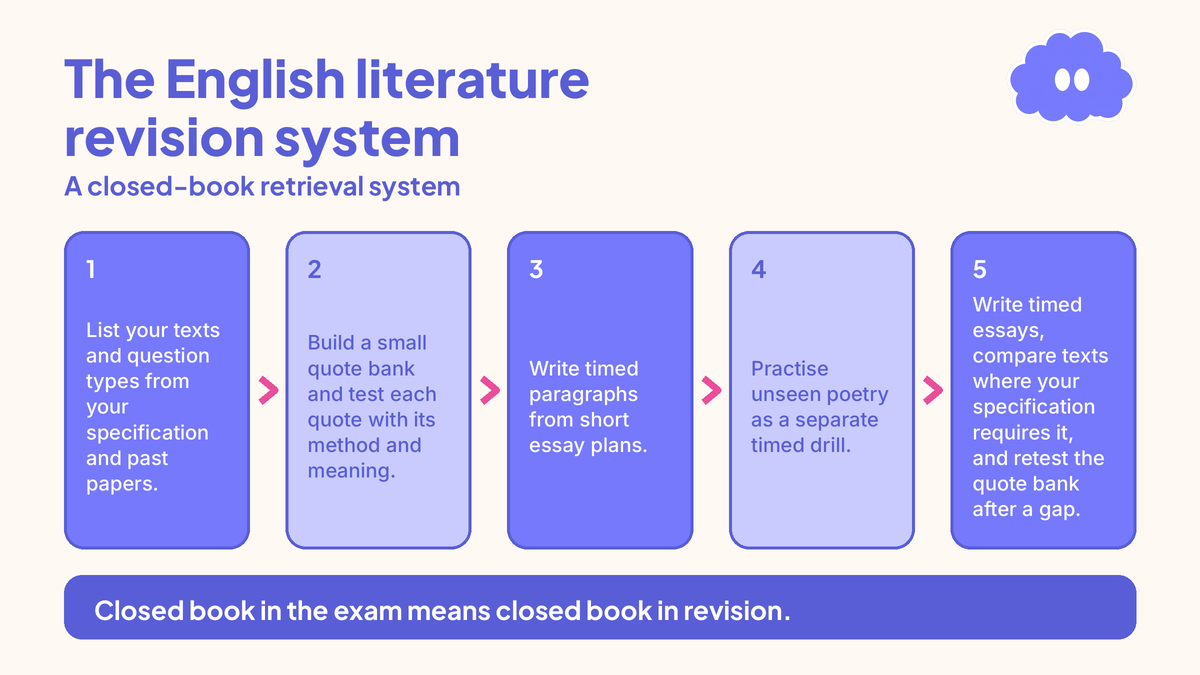
The system in short
- List your texts and question types from your specification and past papers.
- Build a small quote bank and test each quote with its method and meaning.
- Write timed paragraphs from short essay plans.
- Practise unseen poetry as a separate timed drill.
- Write timed essays, compare texts where your specification requires it, and retest the quote bank after a gap.
Step 1: List your texts and question types
Open your specification, not your notes. Write down every text you will be examined on, one page per text. Your list might include a play, a novel, and a set of poems. It might not. Use only the list your specification gives you.
On each page, write the characters and themes the specification and past papers ask about. Look at three past-paper questions for that text and note the types: one character, one theme, a relationship, how a writer presents an idea. GCSE English literature revision and A level English literature revision both start here. What differs is what your specification asks for, so read yours.
Leave the rest of each page blank for the quote bank in step 2 and the plans in step 3. If a text will not fit on one page, you have copied notes instead of listing what the exam asks. Start again, shorter. Give each text a fixed weekly slot, using a revision timetable that starts from your real hours. Two texts a week, tested twice each, beats five skimmed once.
Step 2: Build a small quote bank and test it from memory
Closed book in the exam means closed book in revision. For each text, choose three or four short quotations per character or theme, no more, and pick quotations you can use for more than one question. Aim for four words or fewer: a short quotation is easier to recall and easier to place inside your own sentence.
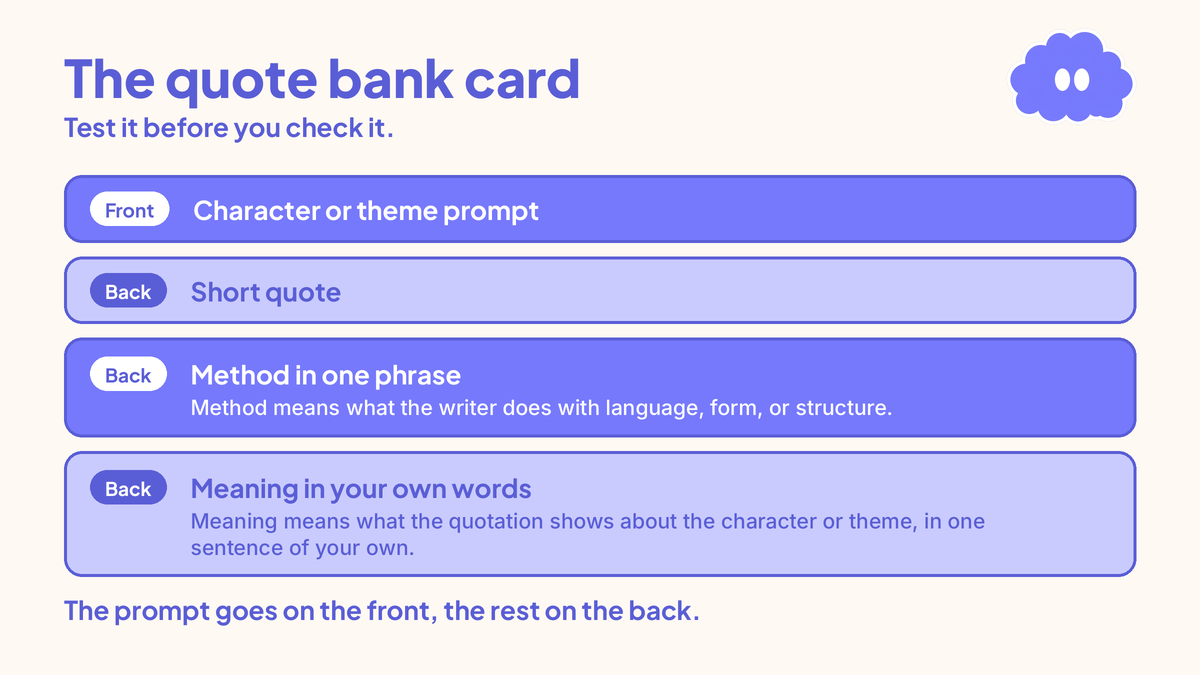
The quote bank card has four parts. Write each entry in the same shape:
- Character or theme prompt
- Short quote
- Method in one phrase
- Meaning in your own words
The prompt goes on the front, the rest on the back. Method means what the writer does with language, form, or structure. Meaning means what the quotation shows about the character or theme, in one sentence of your own. A card with only a quotation is a list. With method and meaning added, it is evidence you can use.
Test the quote bank from memory, one prompt at a time. Read the prompt, say or write the quotation, method, and meaning, then turn the card over. Test it before you check it. Missed cards go back into the pile for the same session, and again tomorrow. Recalled cards wait two or three days. Roediger and Karpicke showed in 2006 that students who recalled a passage remembered more a week later than students who restudied it.
Keep the bank small. Twenty cards you can recall beat sixty you recognise. When a quotation survives three clean tests on different days, test it weekly. When one keeps failing after a week, replace it with a shorter quotation, or drop that moment. This is the same loop as a flashcard system built on one question per card: one prompt, one answer from memory, then the check. On a screen, the free flashcard maker runs the same loop, with missed cards coming back sooner.
Step 3: Write timed paragraphs from plans
A quotation you can recall is not yet a paragraph, so drill paragraphs before essays. Start with an essay plan. For one past-paper question, spend five minutes: your answer in one sentence, three paragraphs, one quotation per paragraph with its method beside it. No plan, no paragraph.
Then write one paragraph in twelve minutes, closed book, in four moves: an argument sentence, the quotation inside your own sentence, analysis of the method, and a link back to the question. Add context only where it explains the method or the meaning, in one or two sentences. If the paragraph argues without it, leave it out.
Write two paragraphs per session, from two different plans. Check each against the mark scheme, or against your plan, on three points only: did the argument sentence answer the question, did the method analysis say what the writer does, and did the paragraph return to the question. Rewrite the weaker paragraph the next day, from memory, in twelve minutes. The gap turns a copy into a test. Five plans in one session teaches you to choose evidence fast. The essay exam system for timed planning sets out the same plan-first routine in full.
Step 4: Practise unseen poetry as a separate drill
Unseen poetry needs its own drill. With a set text, you recall prepared evidence. With an unseen poem, you build evidence from a poem you have never seen, under time. Give it its own slot once a week.
Run the drill in four timed parts, using a poem from a past paper. Read the poem twice in five minutes. Annotate for ten minutes: methods you can name, structure, lines you would quote. Plan for five minutes: your answer in one sentence, three points, one quotation per point. Then write in the time your specification allows, and stop when it ends. Do not guess that time from another board.
Check the response against the mark scheme. Note one method you missed and one strong point, write both on the plan, and file it. Next week, use a different poem. Reusing the same poem turns an unseen drill into a set-text drill. Use timed past papers, marked honestly for fresh poems, and keep this drill separate from set-text sessions. One poem a week, properly checked, keeps the skill warm.
Step 5: Write timed essays, compare texts, and retest after a gap
When paragraphs hold up under time, move to full essays. Write one timed essay a week, closed book, from a plan made that day, on a question you have not planned before. Mark it the same day. Rewrite only the weakest paragraph the next day, from memory.
History argues from causes, while English literature argues from textual evidence. The history revision system shows the same plan-first habit: decide the answer before you write, then let the evidence carry it.
If your specification requires comparison between texts, practise it as its own move, not as two essays joined together. Pair points across the texts: one point, evidence from the first text, evidence from the second, and one sentence on what the comparison shows. Write one comparison paragraph in twelve minutes before a full comparison essay. If your course includes coursework comparing texts, keep it separate and check your specification for how it is assessed.
Retest the quote bank after a gap, every week, for every text. Cepeda and colleagues showed in 2006 that spaced practice beat massed practice, and the best gap grows with how long you need to remember the material. Try testing each text the next day, then after three days, then after seven days: a starting point, not a rule from the research. Missed cards come back tomorrow. Clean cards wait longer.
A worked example: a Tuesday evening, three weeks before the exam
Your situation: GCSE English literature revision, one play to revise this evening, ninety minutes after dinner, exam in three weeks.
6:30-6:45, quote bank test. Fifteen cards, tested from memory. Eleven recalled cleanly. Four missed: two methods forgotten, one quotation half remembered, one meaning vague.
6:45-7:00, fix the four cards. Ten minutes, text open, only for the four missed cards. One method relearned in one phrase, one quotation shortened from seven words to three, two meanings rewritten in plainer words. The text closes again.
7:00-7:05, break. Stand up, water, no phone.
7:05-7:20, one essay plan. A past-paper question on one theme. Five minutes on the plan: answer, three paragraphs, one quotation each. Ten minutes checking every quotation in the plan survived the test.
7:20-7:45, two timed paragraphs. Twelve minutes each, closed book, from the plan. The first holds. The second drifts into retelling the plot, and is marked to rewrite tomorrow.
7:45-8:00, log and plan. Tomorrow: rewrite the weak paragraph from memory, and retest the four fixed cards. Thursday: one unseen poem, thirty minutes. Saturday: retest all fifteen cards, and plan for the novel.
Ninety minutes produced what rereading never does: eleven quotations confirmed, four fixed, one plan, two paragraphs, and two jobs for tomorrow. How to revise for English literature exam day itself is the same loop: test, plan, write, check, retest.
When it goes wrong
Your quote bank has sixty cards and you know none of them properly. Cut it to three or four per character or theme, test the smaller set until it holds, then add one card at a time. A small bank you can recall is a system. A large bank you recognise is a pile of notes.
You re-read the text and call it revision. Close the book, test the quote bank, and write a paragraph from a plan. If you cannot recall the quotation or build the paragraph, the reading has not taught you yet.
You forget a quotation mid-paragraph and freeze. Do not stop. Describe the moment in your own words, name the method if you can, and finish the paragraph. Practise this recovery in timed paragraphs, so it is a habit before the exam.
Context takes over the essay. Use the two-sentence rule: one or two sentences of context per paragraph, only where it explains the method or the meaning, then back to the text. If the paragraph argues without the context, cut it.
You skip unseen poetry because the set texts feel more urgent. Keep the weekly slot, even if it is only thirty minutes. One poem a week, timed and checked, keeps the cold-reading skill alive.
Weekly review checklist
Copy this list and use it each week:
- Can I recall every quote in the bank, with its method and meaning, without looking?
- How many timed paragraphs did I write this week, and how many came from plans I made first?
- Which text or theme still has the thinnest evidence, and what will I add next week?
- Did I practise one unseen poem this week, under time, and check it against the mark scheme?
Downloadable infographic spec: one vertical image, title “The English literature revision system in five steps”, with the five steps from “The system in short”, the rule, closed book in the exam means closed book in revision, and the four weekly review questions, in Thynq cream, Cloud Purple, Dark Purple and pink, with the cloud mascot. Text taken word-for-word from this article.
What this system is not
It is not a promise of a grade, and it is not a substitute for reading the texts. You need to know what happens and how the writing works, and that comes from reading and class discussion. This system turns that knowledge into recall and argument.
It is not English language revision. Language papers test reading and writing on unseen material differently, and this system is built for set texts, quotations, and unseen poetry. It is not a claim that every board asks the same questions. Your specification decides your texts, timings, and question types, and it wins over this article.
Sources
- Dunlosky, J., et al. (2013). Improving students’ learning with effective learning techniques. Psychological Science in the Public Interest, 14(1), 4-58. Only practice testing and distributed practice rated high utility; elaborative interrogation, self-explanation and interleaved practice rated moderate; rereading rated low.
- Roediger, H. L. & Karpicke, J. D. (2006). Test-enhanced learning. Psychological Science, 17(3), 249-255. Students who recalled a passage remembered more a week later than students who restudied it.
- Cepeda, N. J., et al. (2006). Distributed practice in verbal recall tasks. Psychological Bulletin, 132(3), 354-380. Spaced practice beat massed practice; the best gap grows with how long the material must be remembered.
For the full system behind this method, start with how to build a study system that fits your life.
Questions
Do I need to memorise long quotations?
No. Short quotations are easier to recall under time and easier to place inside a sentence. Choose four words or fewer where you can, learn the method and the meaning with each one, and test the set from memory. A short quotation you can recall and explain beats a long one you half remember.
What do I do if I forget a quote in the exam?
Keep writing and do not stop to hunt for the exact words. Describe the moment in your own words, name the method if you can remember it, and keep the argument moving. Check with your teacher before the exam how your specification and mark scheme treat paraphrase and short quotations, so you know the rule for your own paper.
How do I revise unseen poetry?
Practise it as a separate timed drill, not as an extra at the end of a session on your set texts. Read a poem you have not studied, annotate method and structure, write a short plan, then write your response under time. Check it against the mark scheme, note one method you missed, and use a different poem next time.
How do I use context without letting it take over the essay?
Use one or two sentences of context per paragraph, and only where it helps explain the method or the meaning of the evidence. State the contextual point, link it to the quotation in front of you, then return to the text. If a paragraph works without the context, cut the context and keep the analysis.