
The direct answer
How to revise economics for exams is a system built around what the exam actually marks: definitions you can state, diagrams you can draw, chains of analysis you can build, and evaluation you can defend. Triage the specification by question type, build a diagram bank, learn chains, practise evaluation, and test under timed conditions.
The system in short
- Triage the specification by question type: definitions, diagrams, chains, evaluation, calculations, and data response, and mark each topic strong, shaky, or weak for each skill.
- Build a diagram bank: one page per diagram, drawn from memory, labelled in full, with the two-sentence story the diagram tells.
- Learn chains of analysis: every argument as three or four linked steps, each step one sentence, joined by because, so, and therefore.
- Practise evaluation as a routine: one point for, one point against, a judgement, and an it depends on line.
- Work data response questions with the extract-first routine: read the data, underline the command word, answer only what is asked.
- Test under timed conditions with past papers, mark against the mark scheme the same day, and put every lost mark on the gaps list.
Step 1: Triage the specification by question type
Do not start with chapter one. Start with the specification and a blank sheet.
List every topic, then give each topic a mark for each of the six skills the exam tests: definitions, diagrams, chains of analysis, evaluation, calculations, and data response. Use three marks only: strong, shaky, or weak. Strong means you could do it now, without notes, in exam conditions. Shaky means you know parts but would hesitate. Weak means you could not start.
Your study list is the weak skills first, then the shaky ones. The strong skills get one short re-test a week, nothing more. This is the same triage logic as a revision timetable that works, built from what you cannot yet do rather than the order of the textbook.
Step 2: Build a diagram bank you can draw from memory
Diagrams carry marks in economics in a way they do not in most subjects. A correct diagram with labels can earn marks even when the writing around it is thin, and a missing or wrong diagram caps what an essay can score. So the diagram bank is the first thing to build, not the last.
Make one page per diagram. Each page has the diagram, drawn by hand, with every axis labelled, every curve named, and every shift shown with an arrow. Under it, write two sentences: what the diagram shows, and what changes when the curve shifts. Keep each page to one side of A4. Longer than that, it is a textbook page, not a revision page, and you will not test yourself from it.
Learn the diagrams by drawing them from memory. Look at the page, close it, draw the diagram on a blank sheet, then check in a different colour. Do this for three diagrams a day, and rotate them so each one comes up again after two days and again after a week. A diagram you can draw from memory, with labels, is one you can use in the exam. A diagram you can only recognise when you see it is not.
Step 3: Learn chains of analysis, not paragraphs
An economics essay is not a paragraph about a topic. It is a chain: one thing causes another, which causes another, which produces a result. The examiner follows the chain. If a link is missing, the chain breaks and the marks stop.
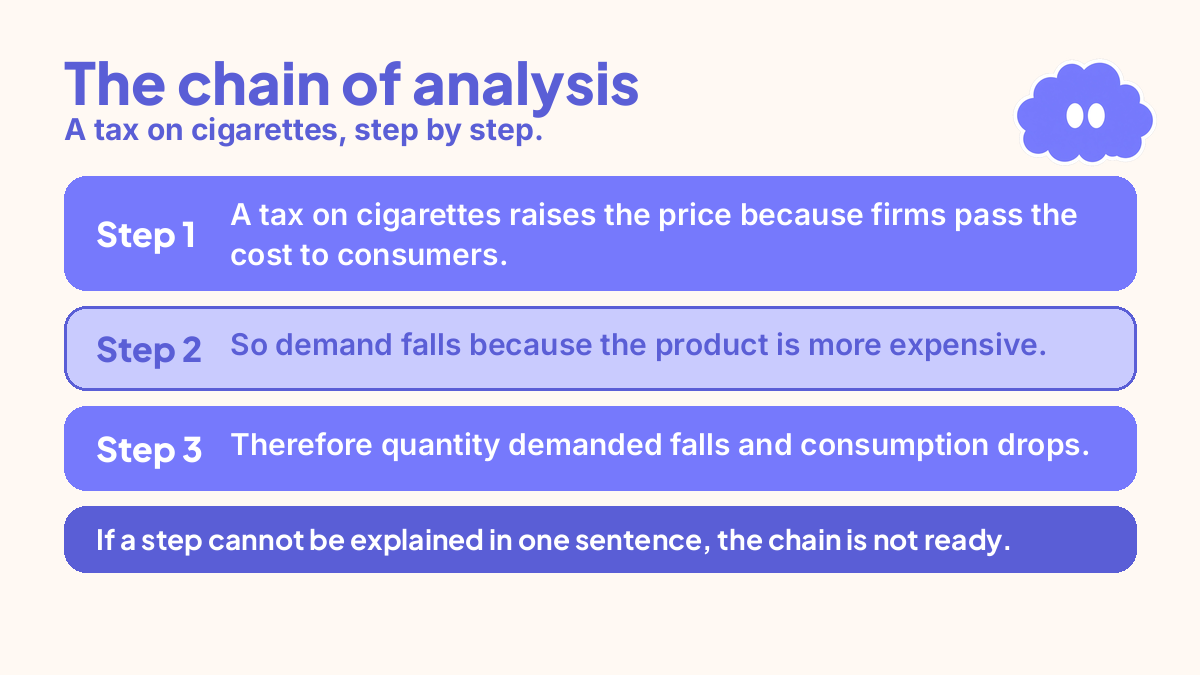
Write every chain as three or four steps. Each step is one sentence. Join them with because, so, and therefore. For example: a tax on cigarettes raises the price because firms pass the cost to consumers, so demand falls because the product is more expensive, therefore quantity demanded falls and consumption drops. That is a chain. It is short, it is testable, and it can be written from memory.
Learn chains the same way you learn diagrams. Write the first step, cover the rest, and say the next step from memory. Then check. If a step cannot be explained in one sentence, the chain is not ready: go back to the notes, find the missing mechanism, and rewrite it.
Test the chains in pairs. Take two topics and ask which chain answers a question about a minimum price and which answers a question about a subsidy. Choosing the right chain is a skill the exam tests, and it only improves when you practise choosing. The retrieval practice system for students explains why testing yourself this way beats re-reading, and the research behind it is clear: Roediger and Karpicke (2006) showed students who recalled a passage remembered more a week later than students who restudied it.
Step 4: Practise evaluation as a routine
Evaluation is where the top marks live, and it is where most students lose them. The reason is simple: evaluation feels like something you either have or you do not, so students wait for inspiration in the exam. Treat it as a routine instead, and it becomes practisable.
The routine has four parts. First, one point in favour of the argument, with a reason. Second, one point against it, with a reason. Third, a judgement: which side matters more, and why, in one or two sentences. Fourth, an it depends on line that names the condition that would change your answer: the time period, the size of the change, the elasticity, or the country context.
Practise the routine on one question a day, in 15 minutes, without writing a full essay. Write the question at the top, the four parts underneath, and stop. After a week you will have seven evaluations, and you will start to see that the same moves repeat: short run versus long run, small firms versus large firms, one country versus another. Those are the moves the exam rewards.
Step 5: Work data response questions with the extract first
Data response questions punish students who read the question before the data. They write a general answer about the topic and miss what the extract actually shows. The fix is a routine: extract first, question second.
Read the extract and the data before you read the question. Underline every number that changes, every trend, and every definition the extract gives you. Write three quick notes in the margin: what went up, what went down, and what stayed the same. This takes three minutes and it changes the answer completely, because now you are answering about the data in front of you, not about the topic in general.
Then read the question and underline the command word. “Describe” wants the pattern in the data. “Explain” wants the reason behind the pattern. “Analyse” wants a chain. “Evaluate” wants both sides and a judgement. Answer only what the command word asks. If the question says describe, do not evaluate. If it says evaluate, do not stop at description.
Step 6: Test under timed conditions and mark honestly
Past papers are the last step, not the first. They work once the diagrams, chains, and evaluation routine are learned, because then they test application, timing, and exam technique. Used too early, they only show what you have not learned yet.
Run one timed paper, or one timed section, each week in the last four weeks before the exam. Set the real time limit: no notes, no phone, no pausing the clock. Use the past-paper system for exams for the full routine, and the mock exam system for treating a timed paper as a rehearsal rather than a test of your worth.
Mark the paper against the mark scheme the same day. For every mark lost, write one line on the gaps list: the topic, the question type, and the fix. Sort lost marks into three piles: content you did not know, diagrams or chains you could not produce, and technique, such as running out of time or misreading the command word. Put the biggest pile on next week’s study list first.
About half of your revision time should be past papers once the content is learned, and almost none before that. The revision planner tool can hold the weekly plan, and the past-paper tracker tool keeps a record of which papers you have done and what each one showed. Dunlosky and colleagues (2013) rated only practice testing and distributed practice as high utility; re-reading was rated low. Cepeda and colleagues (2006) showed spacing beats massing, and the best gap grows with how long you need to remember the material.
A worked example: five weeks of economics revision, two hours a day
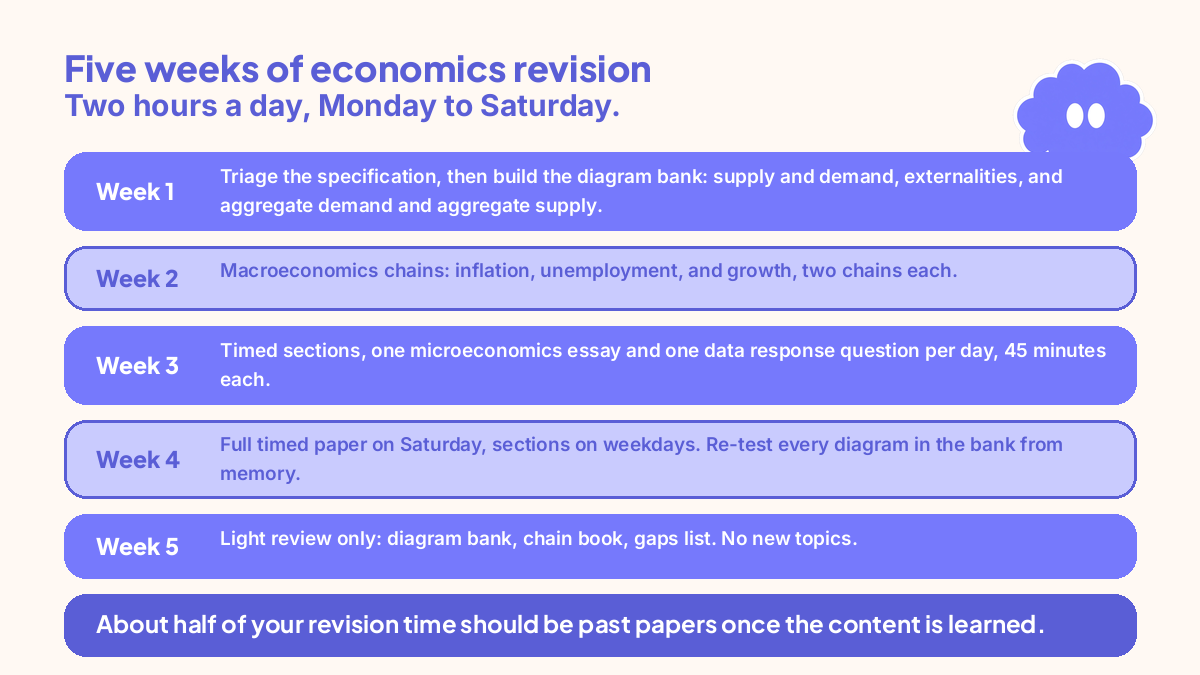
Your situation: A-level student, five weeks to the exam. Two papers: microeconomics and macroeconomics. Weakest areas: diagrams for market failure, evaluation in essays, and data response calculations. Two hours a day, Monday to Saturday, plus a Sunday review.
- Week 1, Monday to Wednesday: triage the specification, 60 minutes, then build the diagram bank: supply and demand, externalities, and aggregate demand and aggregate supply, one page each, drawn from memory and checked. Gaps: externalities diagram labels, aggregate supply shifts.
- Week 1, Thursday to Saturday: write the chain book for market failure and government intervention, two chains per topic, then practise evaluation on one question a day, 15 minutes, using the four-part routine. First evaluation is thin on evidence; add one elasticity number to each.
- Week 2, Monday to Wednesday: macroeconomics chains: inflation, unemployment, and growth, two chains each. Draw the Phillips curve from memory three times. Practise percentage change and elasticity calculations, 20 minutes a day.
- Week 3, Monday to Saturday: timed sections, one microeconomics essay and one data response question per day, 45 minutes each, marked the same day. Gaps list: 5 diagram marks, 4 evaluation marks, 3 technique marks. The diagram pile goes on next week’s list first.
- Week 4, Monday to Saturday: full timed paper on Saturday, sections on weekdays. Re-test every diagram in the bank from memory. Re-write the three weakest evaluations with evidence added.
- Week 5, Monday to Wednesday: light review only: diagram bank, chain book, gaps list. One timed data response question on Tuesday. No new topics. Wednesday evening: pack the exam bag and stop.
When it goes wrong
You can describe a topic but cannot build a chain. Go back to the diagram for that topic and draw it from memory. The diagram shows the mechanism. Write the chain from the diagram, one step per arrow, then say it aloud. If you still cannot, the gap is a definition: learn the definition first, then rebuild the chain.
Your diagrams are right in your notes and wrong in the exam. You are recognising them, not reproducing them. Draw each one from a blank page three times a week, not from your notes. Check in a different colour and note the exact label you missed. The missed label is the revision.
Your evaluation is one sentence that says “however, it depends”. That is not evaluation. Use the four-part routine on paper, every day, for two weeks. One point for, one point against, a judgement, and an it depends on line with a named condition. Short daily practice fixes evaluation faster than writing more essays.
Weekly review checklist
Use this checklist at the end of each revision week, in writing, in 20 minutes.
- Which topics moved from weak to shaky, or from shaky to strong, on each of the six skills?
- Which diagrams in the bank can I draw from memory with every label correct?
- Which chains can I write from the first step alone, and which still need the notes?
- What did the evaluation practice show, and which judgement needs better evidence?
- Which lost marks from the timed paper are now fixed, and which are still on the gaps list?
- What one change will I make to next week’s plan, and what stays the same?
Downloadable infographic spec: one vertical image, title “How to revise economics for exams”, with the six steps from “The system in short” and the six review questions above, in Thynq cream, Cloud Purple, Dark Purple and pink, with the Cloud mascot. Text taken word-for-word from this article.
What this system is not
This system is not a shortcut around learning the content. It does not promise grades, and it does not replace your specification. It turns reading into diagrams, chains, and judgements you can produce under time pressure.
It is also not a cramming plan. If the exam is in three days, use the system for revising without cramming to protect the time you have, and run the diagram bank and chains steps first. The full system needs weeks.
Sources
- Dunlosky, J., et al. (2013). Improving students’ learning with effective learning techniques. Psychological Science in the Public Interest, 14(1), 4-58. Only practice testing and distributed practice rated high utility; re-reading and highlighting rated low.
- Roediger, H. L., & Karpicke, J. D. (2006). Test-enhanced learning. Psychological Science, 17(3), 249-255. Retrieval practice beat restudying after a delay.
- Cepeda, N. J., et al. (2006). Distributed practice in verbal recall tasks: a review and quantitative synthesis. Psychological Bulletin, 132(3), 354-380. Spaced practice beat massed practice; the optimal gap grows with the retention interval.
For the full system behind this method, start with how to build a study system that fits your life.
Questions
How should I revise economics diagrams?
Build one page per diagram in a diagram bank, and redraw each one from memory until you can label every axis, curve, and shift without looking. Say the story the diagram tells in two sentences as you draw it. A diagram you can draw from memory is one you can use in the exam.
What is a chain of analysis in economics?
A chain of analysis is a short sequence of cause and effect: one point leads to a mechanism, which leads to a consequence. Write each chain as three or four linked steps, using because, so, and therefore. If a step cannot be explained in one sentence, the chain is not ready.
How do I get better at evaluation in economics essays?
Practise evaluation as a routine, not as inspiration. For each argument, write one point in favour, one point against, and a judgement that says which side matters more and why. End with an it depends on line that names the condition that would change your answer.
How much of my economics revision should be past papers?
About half of your revision time once the content is learned, and almost none before that. Learn a topic first with the diagram bank and chains, then test it with timed questions from past papers. Mark every paper the same day and put every lost mark on your gaps list.