
The direct answer
How to present your thesis research at a conference? Treat the talk as a different document from your paper: check your slot length, write one sentence that states your finding, cut about two-thirds of the paper, build one slide per minute, and rehearse out loud three times. A 15-minute slot holds 12 minutes of speaking and one finding said twice.
Most first conference talks fail in the same way: the speaker starts from the paper, tries to fit all of it in, runs out of time during the results, and skips the conclusion while the chair holds up a card. Nobody remembers the finding. The fix is accepting that a listener hears each sentence once, while a reader can go back.
The system in short
- Check your slot length and how much of it is questions, then work out your speaking time.
- Write your one-finding sentence before you open your slide software.
- Convert the paper section by section, cutting about two-thirds of it, and budget minutes and words.
- Build slides for listening: one slide per minute, and every headline a full-sentence claim.
- Rehearse out loud three times with a stopwatch, and mark two cut slides you can drop live.
- Meet the session chair, learn the time cards, test the tech, and prepare five hard questions with backup slides.
Step 1: Check your slot and work out your speaking time
Find your slot length first, because it drives every other decision. Most contributed talks are 10, 12, 15, or 20-minute slots, and the slot usually includes questions. Check the programme or email the organisers, because this number is not always printed clearly.
Then do the arithmetic. Conference talks run at about 130 to 150 words per minute, slower than conversation, because of slide changes, pauses on figures, and technical terms. At that rate, 12 minutes of speaking holds about 1,600 to 1,800 words. If your paper is 6,000 words, it has to lose about 70 percent of its words to become a 12-minute talk.
Step 2: Write your one-finding sentence, then cut the paper
Before you open your slide software, write one sentence that states what you found and why it matters: “We found [result] in [system or population], which means [implication for the field].” Say it twice, once in your first minute and once as your final line. Everything in between is there to make the room believe it. If a slide does not support that sentence, it belongs in the backup deck, not the talk.
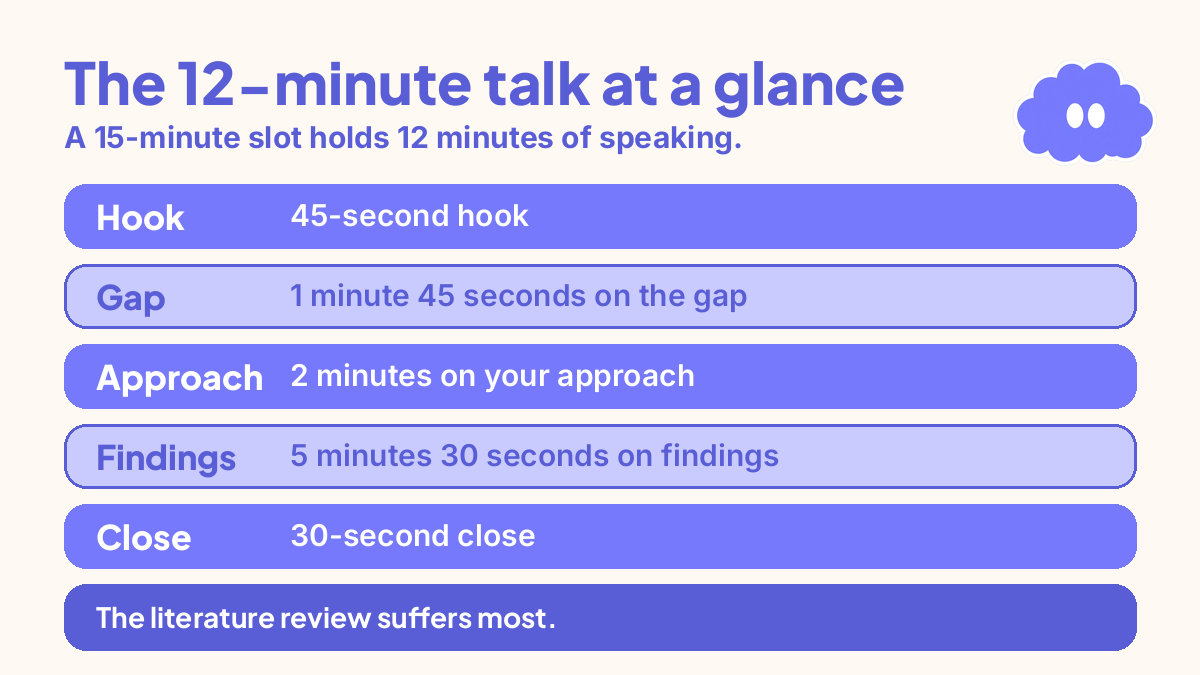
Now convert the paper section by section, cutting hardest where readers need detail but listeners do not. For a 12-minute talk, use roughly these shares: a 45-second hook, 1 minute 45 seconds on the gap, 2 minutes on your approach, 5 minutes 30 seconds on findings, 1 minute 30 seconds on what the findings mean, and a 30-second close. The literature review suffers most: name the gap in one sentence and move on. How to write a thesis introduction shows how to state it. Methods are the second trap, so put protocol details in backup slides; How to write a thesis methodology covers what the chapter must prove. How to write a research abstract uses the same discipline, one sentence per move.
Step 3: Build slides for listening, not for reading
Give every slide a full-sentence headline that states its point, and fill the body with visual evidence: a figure, a diagram, a photo, not a bullet list. Compare a topic headline, “Results: recall scores”, with an assertion headline, “Short sessions beat long ones for recall after a week”. The topic version makes the audience work out the point from the chart. The assertion version tells them what to see, so the chart becomes evidence for a claim instead of a puzzle, and the headline is your speaking cue.
Cap your slides at about one per minute of speaking time, so 10 to 12 slides for a 12-minute talk. Treat that as a ceiling: a dense results figure can take two or three minutes, and a build animation counts as several slides. Count spoken minutes per slide, not slides. For results figures, enlarge axis labels, delete panels you will not discuss, and highlight the one bar or line you are talking about. Skip the outline slide.
Step 4: Rehearse out loud three times with a stopwatch
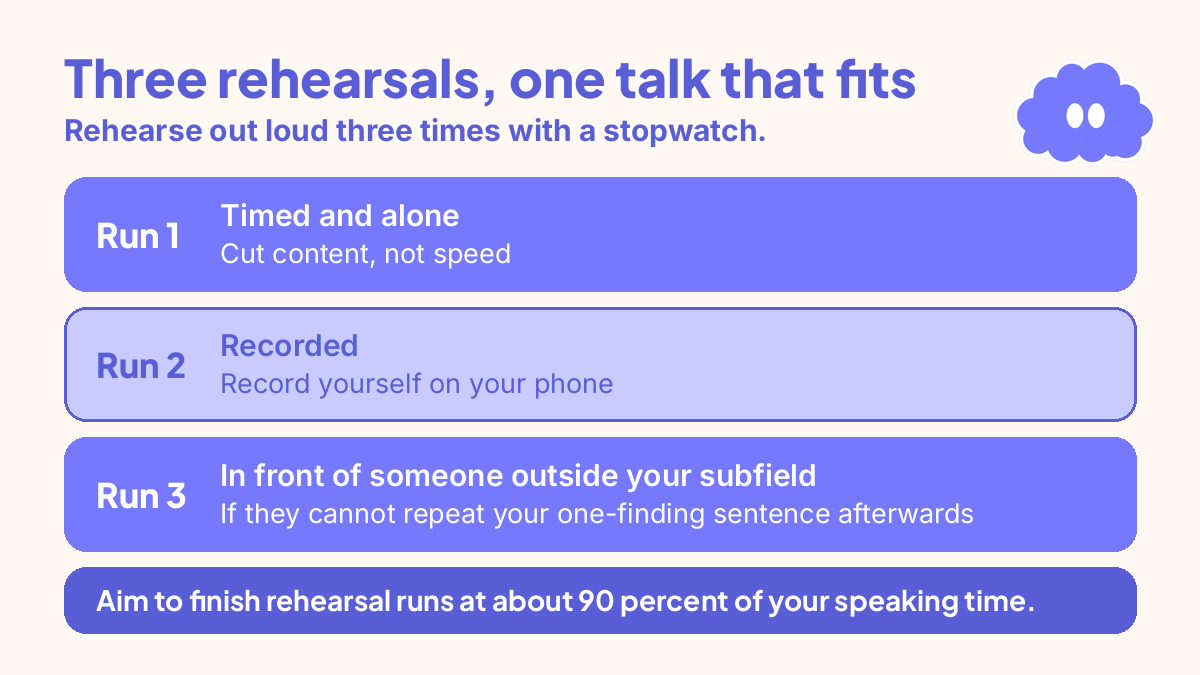
Rehearse out loud, standing up, with a stopwatch running, and do at least three full runs. Silent read-throughs do not count, because reading in your head runs much faster than speaking. Run 1 is timed and alone: speak the whole talk out loud and write down the time at each checkpoint. Cut content, not speed. Run 2 is recorded: record yourself on your phone and watch it back once. Run 3 is in front of someone outside your subfield. If they cannot repeat your one-finding sentence afterwards, the talk is not delivering it.
Aim to finish rehearsal runs at about 90 percent of your speaking time, around 10 minutes 45 seconds for a 12-minute talk. Live talks tend to stretch, and that margin absorbs it. Script and memorise just two parts word for word: your first 45 seconds and your last 30. Write the planned clock time on your speaker notes at three checkpoints: the start of the findings, the start of the meaning section, and the close. Mark two cut slides you can drop live. If you are a minute behind at the findings checkpoint, skip one.
Step 5: Meet the chair, learn the time cards, test the tech
Arrive at the session room at least 10 minutes before it starts and introduce yourself to the session chair. Confirm three things: how they will signal time, whether they will cut you off at zero, and whether questions come after each talk or at the end of the session. Many chairs use time cards showing minutes remaining, often 5, 2, 1, and 0. Ask whether the countdown runs against your speaking time or the whole slot including questions, because that changes what “2” means by three minutes.
Decide in advance what you will do at each card. At 5, check your checkpoint and skip a cut slide if you are not into the findings yet. At 2, move to your meaning slide. At 1, go straight to your closing slide. At 0, stop. Finish your sentence, say thank you, and take questions. While you are with the chair, test your slides on the room’s computer, check that videos play, and find out where the clicker and microphone are.
Step 6: Prepare for questions, and for the poster version
Expect questions on three things: your methods, your sample, and the limitation you did not mention. Before the conference, write down the five hardest questions a reviewer could ask, and prepare a backup slide for any that need a figure or a number. Put backup slides after your closing slide, so they appear only if someone asks. In the room, repeat the question so everyone hears it, answer in one or two sentences, and stop. For a long technical answer, offer to continue later. Prepare two lines. When you do not know: “We did not measure that. My guess would be X, but I would want to check before saying it with confidence.” When someone has found a real limitation: “That is the main limitation of this design, and it is why the next study uses Y.” How to prepare for a thesis defence covers the same question skills in more depth.
If you are presenting a poster instead of a talk, treat it as a series of very short spoken presentations. Prepare two versions: a 30-second pitch for someone walking past and a 2-minute walkthrough for someone who stops. Many visitors decide within a few seconds whether to stop, so the first line has to carry the finding. The poster should support your explanation and still be complete enough to learn from if you are away. Stand next to it and open with your one-finding sentence.
A worked example: a 15-minute talk on a Tuesday in June
Your situation: You are a second-year PhD student in psychology, testing whether 25-minute revision blocks beat two-hour blocks for recall after a week. You have a 15-minute slot at a small conference on Tuesday at 11.00, and your paper is 6,400 words long.
Monday, the week before, you check the programme: 15 minutes total, 12 of speaking, 3 of questions. You write your one-finding sentence: “We found that students who revised in 25-minute blocks recalled more after a week than students who revised in two-hour blocks, which means short sessions beat long ones for this material.” The budget is 1,600 words.
Tuesday to Thursday, you convert the paper. The literature review becomes one sentence: “Nobody has tested block length against a one-week delay in this subject.” The method becomes one schematic and one sentence. The results become two findings, each with one figure: short blocks win by 11 percentage points after a week, most of all for the hardest material. The figures come from How to write a thesis results chapter, cut to one figure each. The discussion covers what the findings mean and the one limitation, a sample of 48 students.
Friday, you build 11 slides, every headline a full sentence, plus two backup slides after the close.
Saturday, run 1, timed and alone: 14 minutes 20 seconds. You cut the second findings slide to a single sentence. Run 2, recorded: 12 minutes 10 seconds. Run 3, in front of a labmate: 11 minutes 50 seconds, and she repeats your finding back to you.
Tuesday, you arrive at 10.45, meet the chair, and learn the cards run against speaking time. You test the slides and clip on the microphone. At 11.00 you open with your first 45 seconds, memorised. At the 2-minute card you move to the meaning slide, and at 11 minutes 40 seconds you close with the one-finding sentence. A question about the sample of 48 comes up, and you show the backup slide.
When it goes wrong
Your first rehearsal runs four minutes over. Do not speak faster. Cut content, and cut the literature review first, then a secondary finding. A talk that fits at 90 percent of your speaking time in rehearsal is a talk that fits live.
The tech fails in the first minute. Keep talking while someone fixes it. Say your one-finding sentence, then describe the first figure in words. If the slides will not come back, give the talk without them: you rehearsed the argument, not the slides. Bring the PDF copy and the USB stick.
You blank on a slide. Pause, look at the headline, and say the headline aloud. The headline is a full sentence, so saying it gives you the next sentence for free. If you still cannot find it, move to the next slide and say so plainly.
A question is hostile, or you do not know the answer. Repeat the question, answer in one or two sentences, and stop. If you do not know, say so and offer your best guess clearly labelled as a guess. If the questioner keeps pushing, offer to continue at the coffee break. Never argue with the room.
Nobody visits your poster. Stand next to it, watch for eye contact, and open with the 30-second pitch when someone slows down. If the session is quiet, walk the room and visit other posters: people notice who shows interest, and they return it.
Weekly review checklist
Review your talk once a week in the month before the conference.
- Do I know my slot length, my speaking minutes, and my word budget?
- Can I say my one-finding sentence without looking at my notes?
- Have I cut the paper to the word budget?
- Does every slide have a full-sentence headline?
- Have I done three rehearsals out loud with a stopwatch, and marked two cut slides?
- Have I met the chair, learned the time cards, and prepared five hard questions?
Downloadable infographic spec: one vertical image, title “Present your thesis research at a conference”, with the six steps and the six weekly review questions, in Thynq cream, Cloud Purple, Dark Purple and pink, with the cloud mascot. Text taken word-for-word from this article.
What this system is not
This system is not a substitute for knowing your research. A timed plan cannot rescue a talk built on a finding you cannot state in one sentence. If you cannot write the one-finding sentence, the problem is the argument, and the fix is in the thesis, not in the slides. How to write a thesis conclusion is the place to sharpen it.
It is not a promise that the talk will go well. Tech fails, questions are hostile, and nerves do strange things to timing. The system gives you margins: a word budget, rehearsal runs at 90 percent, cut slides, backup slides, and prepared lines. Margins give you somewhere to go when problems arrive.
It is not a guide to writing the paper. The paper and the talk are different documents, and this system starts where the paper ends. If the paper is not written yet, write it first.
Sources
- Theorator. How to Present Research at a Conference: A Timed Plan, 2026. Supports 130 to 150 words per minute, cutting two-thirds of the paper, one slide per minute, three rehearsals, and the time-card plan.
- Bourne, P. E. (2007). Ten simple rules for making good oral presentations. PLoS Computational Biology. Cited in the Theorator guide above; supports keeping to about three take-home points.
- Garner, J., and Alley, M. (2013). How the design of presentation slides affects audience comprehension. International Journal of Engineering Education. Cited in the Theorator guide above; supports full-sentence headlines over bullet lists.
Questions
How long should a conference talk be?
As long as your slot, minus the questions. A 15-minute slot usually means 12 minutes of speaking and 3 minutes of questions, about 1,600 words at 130 to 150 words per minute. Check the programme or email the organisers, because the slot length drives every other decision.
How many slides should a conference talk have?
About one slide per minute of speaking time, so 10 to 12 slides for a 12-minute talk. Treat that as a ceiling, not a target: a dense results figure can take two or three minutes, and a build animation counts as several slides. Count spoken minutes per slide, not slides.
Should I read my paper at a conference?
No. A conference talk is a different document from your paper, with its own word budget and its own structure. A paper of 6,000 words has to lose about 70 percent of its words to become a 12-minute talk. Read the paper and nobody remembers the finding; say the finding twice and build the talk around it.
What do I do if I run out of time during a conference talk?
Use the cut slides you marked in advance. If you are a minute behind at the findings checkpoint, skip one and keep going. At the two-minute card, move to your meaning slide. At the one-minute card, go straight to your closing slide and say your one-finding sentence. Never race through the last third.