
The direct answer
A research abstract is five moves in about 200 words: one sentence of background, one sentence stating the aim, two lines of method, the main result with its key evidence, and one sentence saying what it means. Write it last, after the thesis is done, and cut every sentence that does not do one of those five jobs. If a sentence is not background, aim, method, result, or meaning, it does not belong.
An abstract is the most-read part of your thesis, and the shortest. Your supervisor reads it first. An examiner reads it before the first chapter. A stranger deciding whether to read your work reads only this.
That is fixable, because an abstract is not a small thesis. It is a summary with a shape, and the shape is always the same.
The system in short
- Write the abstract last, after the conclusion is written.
- Draft five moves: background, aim, method, result, meaning.
- Give the result the most words. It is the reason anyone reads.
- Use plain words. No jargon the reader needs a dictionary for.
- Cut every sentence that does not do one of the five jobs.
- Read it aloud, check it against the thesis, and count the words.
The abstract is a summary of the introduction’s promise: How to write a thesis introduction shows how to make that promise first.
Write the abstract last, after the ending is set — How to write a thesis conclusion is the step before it.
Step 1: Write it last, and write the five moves in order
Do not write the abstract first. You cannot summarise a study you have not finished writing, and an abstract written first will describe the thesis you planned, not the thesis you wrote. Write it after the conclusion, when you know what the thesis actually says.
Draft the five moves in order, one or two sentences each.
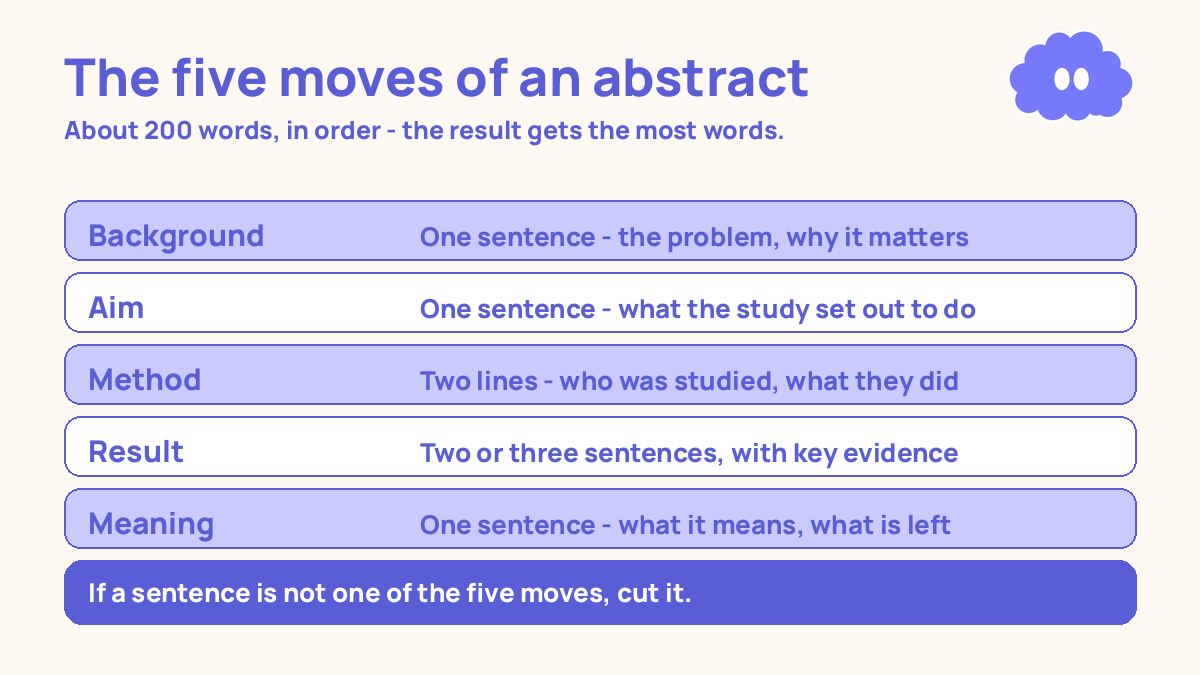
Move 1 — Background. One sentence. What is the problem, and why does it matter? “University students re-read their notes, even though testing themselves works better.” That is enough. If the background needs three sentences, you are writing an introduction, not an abstract.
Move 2 — Aim. One sentence. What did this study set out to do? “This study asked whether retrieval practice beats restudy for science students, a week after learning.” The aim names the question, not the whole thesis.
Move 3 — Method. Two lines. Who was studied, and what did they do? “200 students studied science texts, then re-read, built a concept map, or practised recall.” Enough to judge the result. If the method needs a paragraph, it belongs in the methodology chapter.
Move 4 — Result. Two or three sentences, with the key evidence. This is the move that gets the most words. “The retrieval group scored 0.67 a week later, against 0.45 for the concept-mapping group, on both recall and understanding questions.” A result without evidence is a claim. A result with evidence is a finding.
Move 5 — Meaning. One sentence. What does the result mean, and what is left? “Testing yourself beats organising notes when the goal is remembering a week later, though maps still help to plan what to study.” One sentence, no promises, no new claims.
Step 2: Give the result the most words
Count the words in your draft. If the background and method take up more than half, the abstract is upside down. The reader already knows the background — that is why they are reading your field. What they do not know is what you found.
A practical split for a 200-word abstract: background 25 words, aim 25 words, method 50 words, result 70 words, meaning 30 words. Those numbers are a starting point, not a rule. What matters is the shape: the result is the biggest block, and nothing else competes with it.
If you have two results, pick the main one for the abstract and name the second in one clause. An abstract that lists four results in four sentences has no main result, and the reader remembers none of them. One main result, stated clearly, with its evidence. The thesis holds the rest.
Step 3: Use plain words, and no citations
An abstract stands alone. A reader should understand it without opening your thesis, and without looking up another paper. That means no citations, no abbreviations you have not spelled out, and no jargon the reader needs a dictionary for.
Read each sentence and ask: would a student in another department understand this? If the sentence uses a term only your field uses, either explain it in five words or cut it. “Retrieval practice” needs a short explanation the first time: “testing yourself from memory”. After that, you can use the term. A reader who has to guess what a term means stops reading.
Write in the past tense for what you did and found, and the present tense for what it means. “200 students studied science texts” — past, because the study happened. “Testing beats restudy a week later” — present, because the finding stands.
Explaining an idea in plain words is also a test of whether you understand it. Explaining why each step works, in your own words, is a moderate-utility technique (Dunlosky et al., 2013), and a 2018 meta-analysis (Bisra et al.) found a moderate average benefit (g = 0.55) from prompting self-explanation. If you cannot explain your study simply, you have not finished thinking about it yet.
Step 4: Cut every sentence that does not do a job
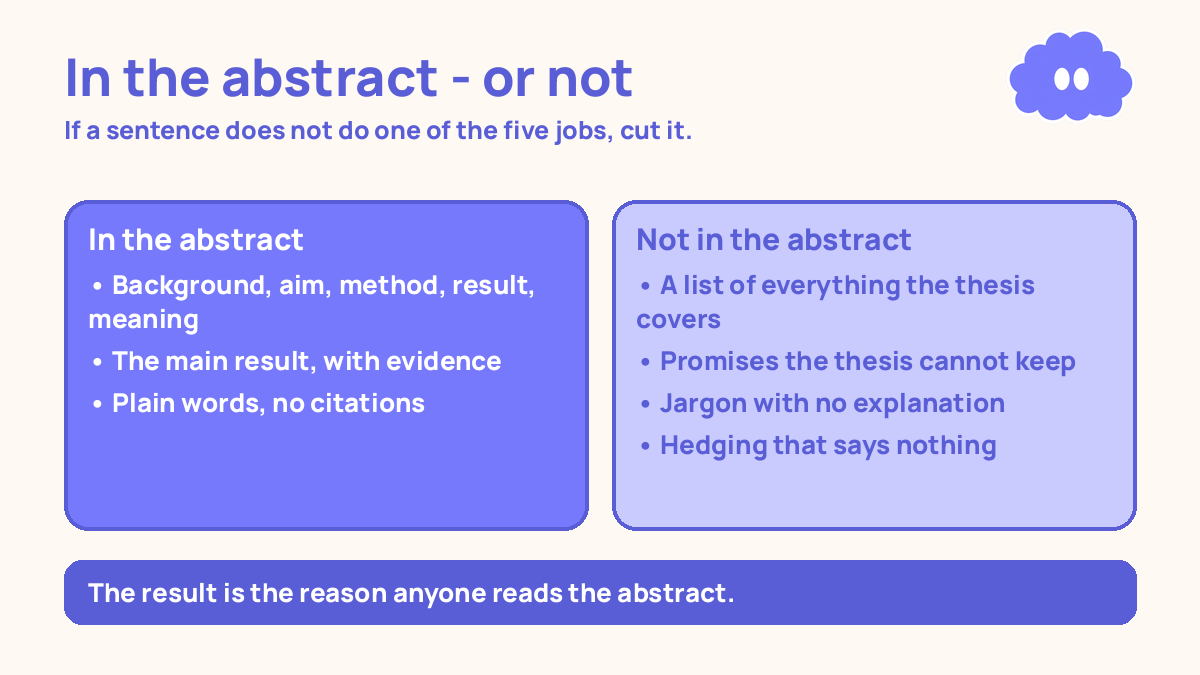
An abstract has no room for decoration. Cut the opening sentence that says the topic is important — the reader knows, or they would not be reading. Cut the sentence that lists everything the thesis covers — the contents page does that. Cut the sentence that promises the study will change the field.
Read the draft and label each sentence: background, aim, method, result, or meaning. Any sentence without a label goes. Any sentence with two labels gets split or shortened. Most first drafts lose a third of their words at this step, and every word cut makes the remaining words easier to read.
Watch for hedging that says nothing. “This study may have implications for future research” is true of every study and tells the reader nothing. Say what the implication is, or cut the sentence. “More research is needed” is true of everything. Say what research, or cut it.
Step 5: Read it aloud, check it against the thesis, and count the words
Read the abstract aloud, slowly. If you stumble on a sentence, the sentence is too long. If you run out of breath, it is two sentences pretending to be one. An abstract that is hard to say aloud is hard to read silently, and your examiner reads it silently, once, quickly.
Then check every claim in the abstract against the thesis. Does the thesis actually say what the abstract says it says? Is the number in the abstract the number in the results chapter? Does the meaning sentence follow from the result, or does it promise more than the study showed? An abstract that overstates the thesis is worse than a weak abstract — it is a promise the thesis cannot keep.
Finally, count the words and check the limit. If your department sets a limit, follow it exactly. If it does not, aim for about 200 words. Then put the abstract away for a day, read it once more, and submit it with the thesis.
The wider system this abstract sits inside is the thesis writing system that keeps moving: steady weekly writing, a weekly review, and a supervisor meeting with something real to show. The abstract is the last piece of that system, not the first.
A worked example: an abstract in five moves
Here is a complete abstract, 150 words, built with the five moves. It summarises a small study on retrieval practice and concept mapping.
Background (19 words): “University students often organise their notes into concept maps, assuming that organising material is the same as learning it.”
Aim (19 words): “This study asked whether retrieval practice — testing yourself from memory — beats concept mapping for learning science texts.”
Method (32 words): “200 students studied two science texts, then either re-read them, built a concept map, or practised free recall. A week later, all students took the same test, with verbatim and inference questions.”
Result (53 words): “The retrieval group scored 0.67 a week later, against 0.45 for the concept-mapping group, on both verbatim and inference questions — about half as much again. The advantage held even when the final test itself asked students to make a concept map. Students who mapped predicted they would do best. They did not.”
Meaning (27 words): “Retrieval is the better way to learn material, even when the test rewards mapping. Maps still help to organise what to study, but organising is not learning.”
When it goes wrong
Your abstract is 400 words and you cannot cut it. Label each sentence by its move. You will find the background is three sentences and the method is a paragraph. Cut the background to one sentence and the method to two lines. The words you save go to the result, which is the part the reader came for.
Your abstract has no result in it. You wrote the background, the aim, and the method, and ran out of words. That is the most common failure, and the fix is the same: cut the background and method first, then write the result in the space you made. An abstract without a result is a table of contents, not a summary.
Your supervisor says the abstract promises more than the thesis shows. Read the meaning sentence again. Does it follow from your result, or does it claim more? Rewrite it so it says only what the result supports. A modest meaning sentence that the thesis can defend beats a bold one that it cannot.
You wrote the abstract first and now it does not match the thesis. Rewrite it from the finished thesis, move by move. Do not patch the old abstract — the thesis changed, and the abstract must change with it. Start from the conclusion chapter and work backwards through the five moves.
Weekly review checklist
Copy this list and use it in the week you write the abstract:
- Is the abstract written after the conclusion, not before?
- Does it have all five moves: background, aim, method, result, meaning?
- Does the result have the most words, with its key evidence?
- Is there a citation, an unexplained abbreviation, or a piece of jargon? Cut or explain it.
- Does every sentence do one of the five jobs? Cut the rest.
- Does every claim in the abstract match a claim in the thesis?
- Did I read it aloud, count the words, and check the department limit?
Downloadable infographic spec: one vertical image, title “Five moves, 200 words”, with the five moves — background, aim, method, result, meaning — and the rule “the result gets the most words” — in Thynq cream, Cloud Purple, Dark Purple and pink, with the cloud mascot. Text taken word-for-word from this article.
What this system is not
It is not a promise that a good abstract will get your thesis accepted, and it is not a claim that 200 words is a rule. It is a practical shape for a summary: five moves, the result given the most space, and nothing the thesis does not say. If your department sets a different word limit or a different structure, follow it. The system survives either change, because the system is five moves in order, plain words, and an honest check against the thesis — not a word count.
Sources
- Dunlosky, J., et al. (2013). Improving students’ learning with effective learning techniques. Psychological Science in the Public Interest, 14 (1), 4–58. Self-explanation was rated moderate utility.
- Chi, M. T. H., et al. (1989). Self-explanations: how students study and use examples. Cognitive Science, 13(2), 145–182. A small observational study of 8 students; the best problem solvers generated far more explanations.
- Bisra, K., et al. (2018). Inducing self-explanation: a meta-analysis. Educational Psychology Review, 30(3), 703–725. Prompting self-explanation produced a moderate average benefit (g = 0.55).
- Karpicke, J. D. & Blunt, J. R. (2011). Retrieval practice produces more learning than elaborative studying with concept mapping. Science, 331(6018), 772–775. Retrieval beat concept mapping by about half as much again a week later (means 0.67 vs 0.45).
Questions
How long should a research abstract be?
Aim for about 200 words, unless your department sets a limit. If it sets one, follow it exactly. An abstract that runs long gets cut, and an abstract that runs short usually misses the result.
Should I write the abstract first or last?
Last. You cannot summarise a study you have not finished writing. Draft it after the conclusion is written, when you know what the thesis actually says.
Do I cite references in an abstract?
No. An abstract stands alone, and a reader should not need another paper to understand it. If a sentence only makes sense with a citation, rewrite the sentence.
What is the most common mistake in an abstract?
Writing the background and the method, and running out of words before the result. The result is the reason anyone reads the abstract. Give it the most space.