
The direct answer
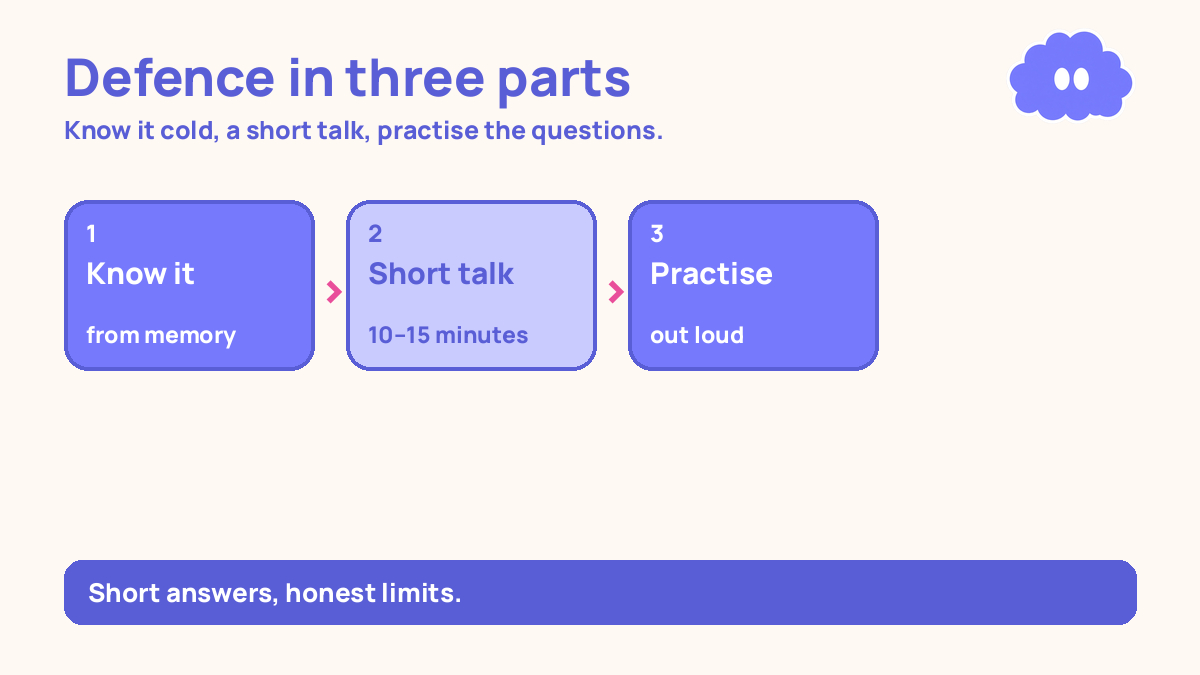
A thesis defence is a conversation about your own research: your choices, your limits, and your results. Prepare in three parts. First, know the thesis cold — the question, the method, the findings, and the limits — so you can state each one from memory. Second, prepare a ten-to-fifteen-minute talk that summarises the thesis. Third, practise answering questions out loud, with a mock panel if you can, until your answers are short and plain.
Your thesis is written. Now you have to stand up and talk about it, in front of people who have read it carefully and will ask you questions about it. That is a different skill from writing, and it frightens most students more than the writing did.
The fear is misplaced. A defence is not an exam with a pass mark for every question. It is a check that the thesis is yours, that you understand it, and that you can defend the choices you made. An honest “I don’t know” is a better answer than a confident guess.
The system in short
- Know the thesis cold: state the question, the method, the findings, and the limits from memory.
- Prepare a ten-to-fifteen-minute talk: question, method in one minute, findings, meaning.
- List the twenty questions you most dread, and draft a short answer to each.
- Practise out loud, standing up, with a timer — alone first, then with a mock panel.
- Prepare for the hard questions: the limits, the method choice, and what you would change.
- Plan the day: sleep, timing, slides, and what to bring.
A defence is an oral exam with a thesis attached: the Oral exam system for students covers the answering itself.
Step 1: Know the thesis cold
Before you prepare a talk, make sure you know the thesis. Close the document and state four things from memory: the research question in one sentence, the method in two sentences, the main findings in three sentences, and the limits in two sentences. If you cannot, you do not know the thesis well enough yet.
Dunlosky and colleagues rated practice testing as one of only two high-utility learning techniques in their 2013 review. Roediger and Karpicke found in 2006 that students who recalled material remembered more a week later than students who restudied it. Reading your thesis for the fifth time feels like knowing it. Stating the question, the method, and the findings from memory, out loud, is the honest check.
Pay special attention to the numbers. Know the key counts: how many people, how many messages, how many interviews, and the main finding in numbers. Examiners ask about numbers, and a student who has to look them up mid-answer looks like a student who does not know their own study.
Step 2: Prepare a short talk
Prepare a talk of ten to fifteen minutes, unless your department says otherwise. The talk is a summary, not a second thesis. Four parts, in order: the question, the method in one minute, the findings, and what they mean.
The method gets one minute. The examiners have read the methodology chapter. The findings get the most time, because they are what the thesis is about. The meaning gets the last two minutes, because it is what the examiners will ask about.
Memorise the structure, not the words. Know the four parts, the first sentence, and the last sentence. A talk memorised word for word sounds read, and one forgotten line can stop it. A talk you know in outline survives a wobble.
Practise the talk with a timer, standing up, three times. Fifty minutes with a ten-minute break is a practical timer, not a prescription — the 25-minute Pomodoro length was Francesco Cirillo’s practical choice, not a number from cognitive science. If the talk runs over fifteen minutes, cut a finding, not the meaning.
Step 3: List the twenty questions you dread
Write down the twenty questions you most dread, and draft a short answer to each. Start with the obvious ones: Why this method? Why this sample? What are the limits? What would you do differently? Then add the hard ones: the result that contradicts earlier work, the finding that is weak, the choice your supervisor questioned.
Draft the answers short. Two or three sentences each, in plain words. An answer that runs for a minute is an answer that has lost the question. If you cannot answer a question in three sentences, you do not understand it well enough yet.
Use if-then plans for the hardest questions. Decide the cue and the action in advance, instead of deciding in the moment. Gollwitzer and Sheeran found across 94 studies that if-then plans raised goal attainment by a medium-to-large amount (d = 0.65) over holding the goal alone.
Step 4: Practise out loud, with a mock panel
Practise answering questions out loud, standing up, with a timer. Alone first: read a question from your list, answer it in under a minute, and note where you rambled. Then with a mock panel: two or three people who ask the questions and tell you what they heard.
Get feedback on the practice, not just on the talk. Rowland found in a 2014 meta-analysis of 61 studies that testing beat restudying by a medium amount (g = 0.50), and that feedback mattered: with feedback the effect was larger (g = 0.73) than without it (g = 0.39). Ask your mock panel three things: did I answer the question, was the answer short enough, and did I sound sure?
Practise the silence too. When a hard question comes, pause before you answer. A five-second pause looks like thinking. A rushed answer looks like panic. Practise pausing: hear the question, repeat it back in your own words to check you understood it, then answer.
Step 5: Prepare for the hard questions
Three kinds of question cause the most trouble, and all three can be prepared for. The limits question: “What are the limits of your study?” Answer with the limits you named in the discussion, each with what it means. The method question: “Why did you choose this method?” Answer with the reason, not the label. The change question: “What would you do differently?” Answer with one real change, and why.
Step 6: Plan the day
Plan the defence day the way you planned the thesis: in advance, in writing. Sleep the night before. Diekelmann and Born found in a 2010 review that sleep improves the consolidation of what was learned. A short night before a defence does not make you sharper.
Dress the way your department expects. The talk is ten to fifteen minutes. The questions are the rest.
A worked example: two weeks, a ready defence
You have two weeks and a finished thesis. Your target is a defence you can give standing up, on time, with short answers to the hard questions.
| Week | Day | Job | Minutes |
|---|---|---|---|
| 1 | Monday | State the question, method, findings, limits from memory | 30 |
| 1 | Tuesday | Draft the talk: question, method, findings, meaning | 50 |
| 1 | Wednesday | List the twenty dreaded questions, draft short answers | 50 |
| 1 | Thursday | Practise the talk standing up, with a timer, twice | 40 |
| 1 | Friday | Practise answers out loud, alone, ten questions | 40 |
| 2 | Monday | Mock panel: talk plus questions, with feedback | 60 |
| 2 | Tuesday | Fix the answers that failed, practise them again | 40 |
| 2 | Wednesday | Second mock panel, shorter, with new questions | 45 |
| 2 | Thursday | Rest. Sleep. Check the room, the slides, the timing | 30 |
| 2 | Friday | Defence day | — |
Week one is preparation. Monday is a memory day: close the thesis and state the four things out loud. If you cannot, the week is spent learning the thesis, not preparing the talk. Tuesday and Wednesday are writing days: the talk and the twenty answers. Thursday and Friday are practice days, alone, standing up, with a timer.
Week two is rehearsal. Monday is the first mock panel: the talk, then questions, then feedback. Ask the panel the three questions: did I answer it, was it short enough, did I sound sure? Tuesday is fixing day: rewrite the answers that failed, and practise them again.
Thursday is rest. No new preparation. Check the room, the slides, and the timing, and sleep. Friday is the defence. Arrive early, eat, and bring the card with the five numbers.
When it goes wrong
You memorised the talk word for word. One forgotten line stops you, and the talk falls apart. Memorise the structure instead: the four parts, the first sentence, the last sentence.
Your answers are too long. Every answer runs for two minutes, and the examiners stop listening. Cut each answer to two or three sentences. If you cannot answer in three sentences, you do not understand the question well enough yet.
You defend the thesis as if it were perfect. Every limit is denied, every choice is the only possible one. Admit the limits and explain what they mean. A student who admits the limits looks like a researcher.
You guess when you do not know. An examiner asks a question you cannot answer, and you invent one. Say “I don’t know” instead, and add what you do know that is closest. Guessing is the one answer that damages a defence.
Weekly review checklist
Copy this list and use it each week while you prepare:
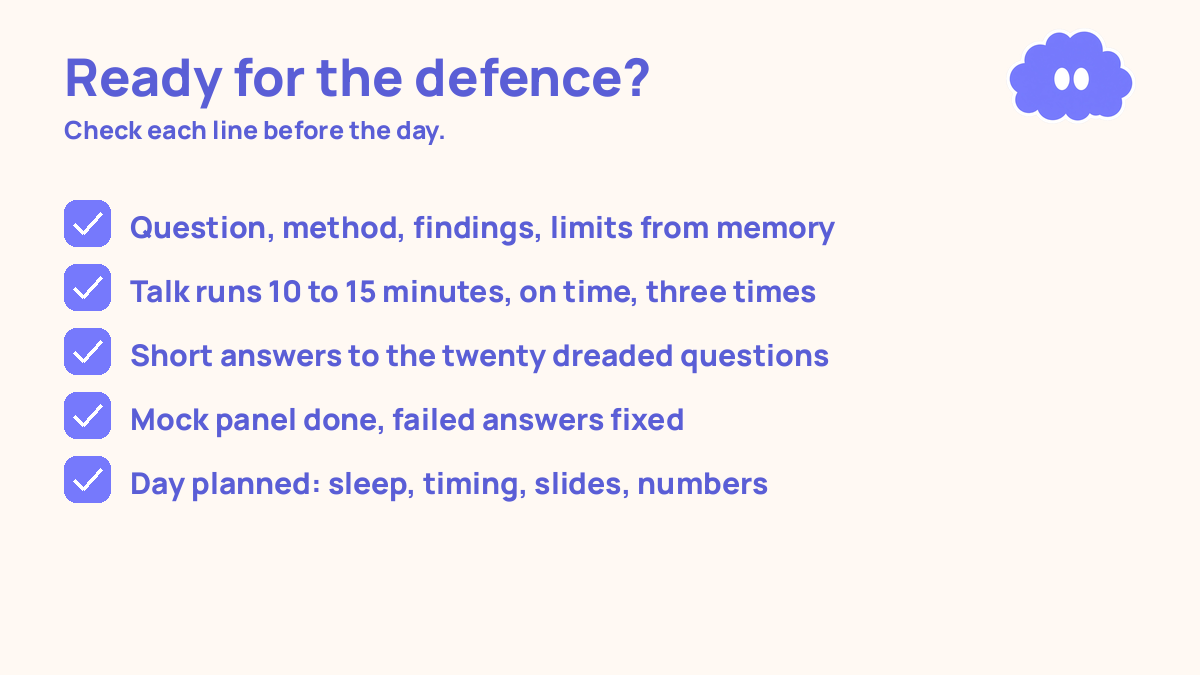
- Can I state the question, method, findings, and limits from memory, standing up?
- Does the talk run ten to fifteen minutes, on time, three times in a row?
- Do I have short answers to the twenty questions I dread most?
- Have I practised with a mock panel, and fixed the answers that failed?
- Is the defence day planned: sleep, timing, slides, and the card with the five numbers?
Downloadable infographic spec: one vertical image, title “Defence preparation in three parts”, with the three parts — know it cold, a short talk, practise the questions — plus the rule “short answers, honest limits”, in Thynq cream, Cloud Purple, Dark Purple and pink, with the cloud mascot. Text taken word-for-word from this article.
What this system is not
It is not a promise that preparation guarantees a pass, and it is not a set of tricks for fooling examiners. It is a way to know your own research well enough to talk about it clearly, answer questions honestly, and stop when the questions end. A prepared defence shows the examiner you understand the work. It cannot make a thesis pass that the written work does not support.
Sources
- Dunlosky, J., et al. (2013). Psychological Science in the Public Interest, 14 (1), 4-58. Only practice testing and distributed practice received a high utility rating.
- Roediger, H. L., & Karpicke, J. D. (2006). Science. Students who recalled a passage remembered more a week later than students who restudied it.
- Rowland, C. A. (2014). Psychological Bulletin, 140(6), 1432-1463. Testing beat restudying (g = 0.50); with feedback the effect was larger (g = 0.73) than without it (g = 0.39).
- Gollwitzer, P. M., & Sheeran, P. (2006). Advances in Experimental Social Psychology, 38, 69-119. If-then plans raised goal attainment (d = 0.65) across 94 studies.
- Diekelmann, S., & Born, J. (2010). Nature Reviews Neuroscience, 11 (2), 114-126. Sleep improves the consolidation of what was learned.
- Cirillo, F. — Pomodoro Technique, late 1980s. The 25-minute length was Cirillo’s practical choice, not a number derived from cognitive science.
For the whole thesis, start with the thesis writing system that keeps moving, which treats the defence as the last step of the thesis, not a separate exam.
Questions
How long should my defence talk be?
Ten to fifteen minutes, unless your department says otherwise. The talk is a summary, not a second thesis. State the question, the method in one minute, the findings, and what they mean — then stop and take questions.
What if I do not know the answer to a question?
Say so, plainly, and say what you do know that is closest to it. ‘I do not know, but the data I have suggests…’ is a good answer. Guessing, or pretending to know, is the one answer that damages a defence.
What if an examiner disagrees with my method?
Listen, repeat their concern back to show you understood it, then give your reason for the choice. A method choice with a reason is defensible even if the examiner would have chosen differently. A choice with no reason is not.
Should I memorise my talk word for word?
No. Memorise the structure — question, method, findings, meaning — and the first and last sentences. A memorised talk sounds read, and one forgotten line can stop it. A talk you know in outline survives a wobble.