The direct answer
How to prepare for your thesis viva: reread the whole thesis as an examiner would, prepare a five-minute spoken summary, practise your answers aloud, and run at least one mock viva. A viva is the oral examination where you defend your thesis in front of examiners who have already read it.
The examiners test three things: whether the work is yours, whether you know the field, and whether the thesis meets the standard. If you can explain your aims, method, findings and limitations in your own words, you are most of the way there.
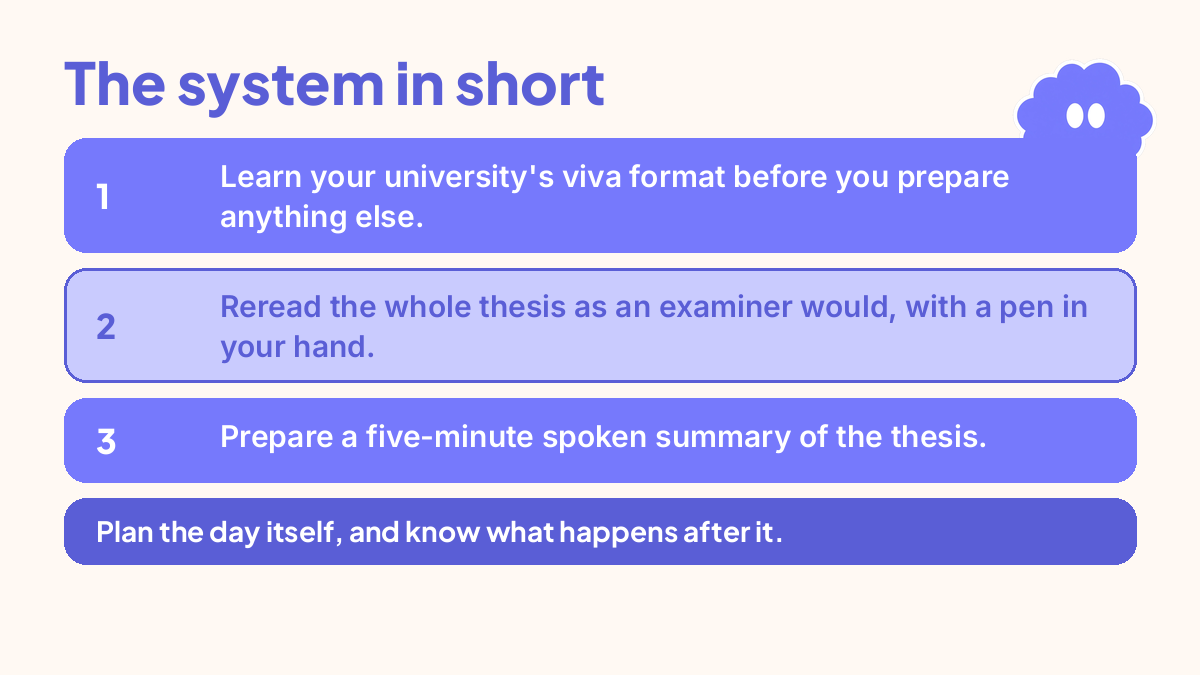
The system in short
- Learn your university’s viva format before you prepare anything else.
- Reread the whole thesis as an examiner would, with a pen in your hand.
- Prepare a five-minute spoken summary of the thesis.
- Practise answers aloud to the questions examiners actually ask.
- Run at least one mock viva with your supervisor or your peers.
- Plan the day itself, and know what happens after it.
Step 1: Learn your university’s viva format before you prepare anything else
A UK viva is usually a private conversation with two examiners, one internal and one external, and your supervisor normally does not attend. But the format varies: some vivas are online, some in person, some allow an observer or a chair, and some give you the examiners’ names weeks ahead. Find the format out first, because it changes what you prepare.
Ask your supervisor three questions, in one meeting, and write the answers down. First, who are the examiners, and what do they work on? Second, is the viva in person or online, and who else will be in the room? Third, how long does it usually run, and what happens straight after?
Then read your university’s own viva guidance: it tells you how the outcome is decided, what corrections mean, and what happens if the examiners disagree. The How to prepare for a thesis defence covers the public defence common in the United States, a different event from a UK viva.
Step 2: Reread the whole thesis as an examiner would, with a pen in your hand
You wrote the thesis, but you have not read it as an examiner will. An examiner looks for the argument, the gaps, and the places where a claim outruns the evidence. Reread it that way, from the first page to the last, with a pen in your hand, and give yourself three or four days. Do not skim the chapters you remember best.
As you read, mark four things: every claim that needs a reference, and whether the reference is there; every place where you chose one method and not another; every limitation you already know about; and every number, date and name. By the end, you should have a list of weak spots, and that list is the most useful document you will make in this preparation.
Pay special attention to three chapters: the introduction, because it states the aims; the methodology, because it is where the “why this method” questions come from; and the conclusion, because it states the contribution. The How to write a thesis conclusion is worth rereading now, while you still have time to tighten it. Keep the annotated copy, and bring it to the viva with the list of weak spots.
Step 3: Prepare a five-minute spoken summary of the thesis
The most common opening question in a viva is some version of “summarise your thesis in a few minutes”. It sounds easy, and it is the question most students answer worst, because they try to summarise 80,000 words in five minutes and end up listing chapters. Prepare it in advance, and practise it until it sounds like a conversation.
A good five-minute summary has four parts: the problem, in two sentences; the method, in two sentences; the findings, three things in three short sentences; and the contribution, in two sentences. That is about 300 words, spoken slowly.
Write it down, then say it aloud, then cut it. The first draft will be too long. Cut the background, the literature, and the detail: the examiners have read the thesis, so they do not need a tour of it. Practise it standing up, without notes, three or four times, and time it. If it runs past six minutes, cut a sentence. If it runs under four, add one. Practise the shape of it, not the exact words.
Step 4: Practise answers aloud to the questions examiners actually ask
Examiners ask about the same things in most vivas: aims, methodology, findings, conclusions, contribution, and limitations. They are checking that you understand your own work and can defend the choices you made. So practise the answers aloud, in full sentences, before the day.
Start with the six questions that come up most often: your original contribution, why this topic, why this method and not another, the limitations, what you would change if you started again, and what has been published since you submitted. Write one paragraph for each, in your own words, and say each one aloud twice. The limitations paragraph matters most: an honest limitation, stated clearly, is stronger than one the examiners have to find for themselves.
Then practise the follow-up. Examiners rarely stop at the first answer: they ask “why” twice, and the second “why” is where unprepared students struggle. Take your answer to “why this method” and ask yourself why again, and then once more. If you cannot answer, that is a weak spot for the list from Step 2. Practise aloud, not in your head: answers that sound clear in your head often fall apart when spoken. The How to handle supervisor feedback on a thesis is a useful companion, because the examiners’ questions often echo your supervisor’s earlier feedback.
Step 5: Run at least one mock viva with your supervisor or your peers
A mock viva is the single best preparation you can do, and it is the one students most often skip. It is a rehearsal of the event itself: sitting across from someone, answering questions you did not write, and staying calm when a question is hard. Run at least one, two weeks before the real viva.
Ask your supervisor to run it, or a postdoctoral researcher, or two PhD peers. Give them your thesis a week ahead, and the list of weak spots from Step 2, so they can aim at the soft places. Ask them to open with the five-minute summary, then the six questions from Step 4, then “why” twice on each answer. Ninety minutes is enough.
After the mock, do two things. First, write down every question you could not answer, or answered badly, and prepare a proper answer for each one: those are the questions your real examiners are likely to ask. Second, ask the mock examiners what your answers sounded like: did you sound sure, did you ramble, did you answer the question that was asked? If your supervisor cannot run a mock, ask two peers, and run one for them in return. One mock is the minimum.
Step 6: Plan the day itself, and know what happens after it
A viva typically lasts between one and four hours, and most take around two hours. At Cambridge, a viva normally runs 90 minutes to three hours. Plan for two hours: the length says nothing about the outcome. A short viva can mean the examiners are satisfied, and a long one can mean they are interested.
The day before, do the logistics: confirm the time, the room or the video link, and who will be there. Charge your laptop if the viva is online, and test the connection. Lay out the annotated thesis, the list of weak spots, and a notebook. Eat properly, and sleep. Do not reread the thesis the night before: a late-night reread will only find typos you cannot fix.
On the day, arrive early, and bring water. Answer the question that was asked, not the one you prepared for. If you do not understand a question, ask the examiner to repeat it. If you do not know an answer, say so, and say what you do know that is closest to it. Examiners respect an honest “I do not know” more than a confident guess. After the viva, the examiners decide the outcome: a pass, or minor or major corrections. The How to handle thesis corrections after your viva explains that process in detail. Most vivas end in corrections, and corrections are not a failure.
A worked example: three weeks to a viva
Your situation: PhD student, viva in three weeks. Your thesis is on how Year 10 pupils revise for science GCSEs: 40 pupils, interviews and a short survey, three schools. One internal and one external examiner, in person, and your supervisor does not attend. You have not opened the thesis since you submitted it two months ago.
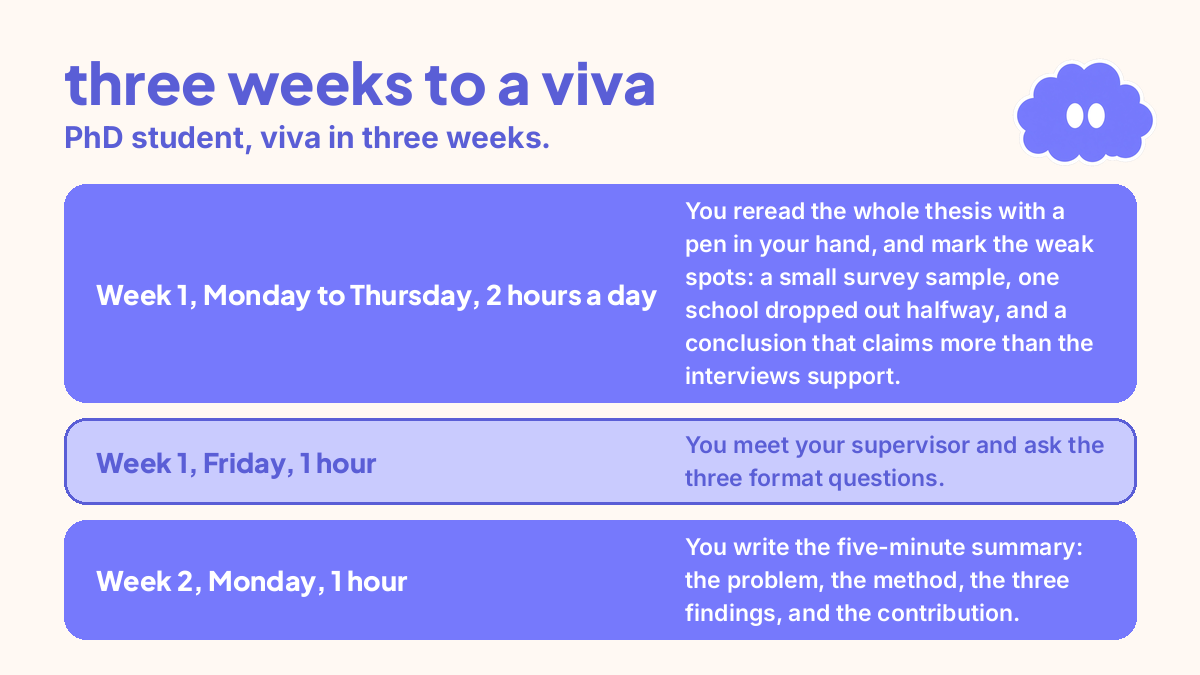
- Week 1, Monday to Thursday, 2 hours a day: You reread the whole thesis with a pen in your hand, and mark the weak spots: a small survey sample, one school dropped out halfway, and a conclusion that claims more than the interviews support.
- Week 1, Friday, 1 hour: You meet your supervisor and ask the three format questions. The viva is in person, two hours, in the department, and you ask your supervisor to run a mock viva in week 2.
- Week 2, Monday, 1 hour: You write the five-minute summary: the problem, the method, the three findings, and the contribution. You say it aloud three times, standing up, and cut it from seven to five minutes.
- Week 2, Tuesday to Thursday, 1 hour a day: You write one paragraph for each of the six common questions, and say each one aloud twice.
- Week 2, Friday, 90 minutes: The mock viva. Your supervisor opens with the summary, asks the six questions, and follows up with “why” twice. You cannot answer why you chose interviews over a larger survey, and you ramble on the contribution. You write both down.
- Week 3, Monday, 1 hour: You prepare proper answers for the two failed questions: interviews showed how pupils actually revise, which a survey could not, and the contribution is now one sentence, not four.
- Week 3, Tuesday, 1 hour: You run a second mock with two PhD peers. This time you answer the method question cleanly, the summary takes five minutes, and you stop rambling.
- Thursday, the viva, 2 hours: The examiners open with the summary, then ask about the small sample, the dropped school, and the contribution. You answer from the list, honestly, and say “I do not know” once, when they ask about a paper published after you submitted. They ask you to wait 20 minutes, then call you back in: minor corrections, due in three months.
The preparation took about 15 hours over three weeks, and the thesis passed after three months of corrections.
When it goes wrong
You have only a week before the viva. Read the introduction, the methodology and the conclusion, then prepare the five-minute summary and the six answers. Run one short mock viva with a peer.
You freeze on a question in the viva. Pause, and ask the examiner to repeat the question. If you still cannot answer, say what you do know that is closest to it, and be honest about the gap.
An examiner disagrees with your method. Do not defend it by repeating it louder. Explain why you chose it, what it gave you, and what its limits are.
You discover a mistake in the thesis during the reread. Note it, and prepare an answer for it. Examiners respect a student who found their own mistake and can explain it. Do not hide it, and do not rewrite the thesis: the viva is the place to discuss it.
The viva runs much longer than two hours. Do not panic. A long viva can mean the examiners are interested, not that you are failing. Drink water, answer the question that was asked, and keep going. If the long questions are about your findings, revisit How to write a thesis discussion chapter.
Weekly review checklist
- Do I know the format: who the examiners are, in person or online, and how long it usually runs?
- Have I reread the whole thesis as an examiner would, and do I have a list of weak spots?
- Can I give the five-minute summary aloud, without notes, in five minutes?
- Have I practised answers aloud to the six common questions, including the limitations?
- Have I run at least one mock viva, and prepared answers for the questions I could not answer?
- Are the logistics sorted: time, room or link, annotated thesis, water, and a notebook?
Downloadable infographic spec: one vertical image, title “How to prepare for your thesis viva”, with the six steps from “The system in short” and the six review questions above, in Thynq cream, Cloud Purple, Dark Purple and pink, with the Cloud mascot. Text taken word-for-word from this article.
What this system is not
It is not a way to pass a viva on a thesis you do not understand: the preparation only works if you did the work. It is not a script: the summary and the six answers are preparation, not lines to recite, and a memorised answer sounds worse than a thought-through one. It does not cover a public defence, which is a different event. And it does not promise a pass: most vivas end in corrections, and the system prepares you for the conversation and the corrections, not for a guaranteed outcome.
Sources
- Prospects, “How to pass your PhD viva” (prospects.ac.uk). Read 22 November 2026. Supports the viva format and preparation in this article: the private conversation with two examiners, the one to four hour length, the questions examiners ask, and the mock viva.
- University of Cambridge, viva guidance. Read 22 November 2026. Supports the Cambridge timing in this article: a viva normally runs 90 minutes to three hours.
For the full system behind this method, start with How to build a study system that fits your life.
Questions
How long does a PhD viva last?
A PhD viva typically lasts between one and four hours, and most take around two hours. At Cambridge, a viva normally runs 90 minutes to three hours. Plan for two hours.
What questions do examiners ask in a viva?
Examiners ask about your research aims, methodology, findings, conclusions, contribution, and limitations. Common openings are: summarise your thesis in a few minutes, what is your original contribution, why did you choose this topic and method, what are the limitations, and what would you change if you started again.
Does my supervisor attend my viva?
Normally not. A UK viva is usually a private conversation with two examiners, one internal and one external, and your supervisor does not attend. Check your university’s rules, because the format varies.
What happens after a viva?
The examiners decide the outcome, which can be a pass, or minor or major corrections. If corrections are needed, you get a list and a deadline, and you work through them one by one.