
The direct answer
To handle thesis corrections after your viva, wait for the formal examiners’ report, then turn it into a numbered checklist sorted into required changes, suggested changes, and questions. Work the list in order, one item a day, and track every change so the examiner can see it. Most candidates get corrections, and they are a normal part of passing.
The viva ends, and then the real work starts: a list of changes, a deadline, and a thesis you have not looked at for weeks. Some students start the same day, in a panic, and rewrite chapters the examiners never asked them to touch. Others leave the list in a drawer for a month, then discover the deadline is closer than they thought.
The system in short
- Wait for the formal report, and read it twice before touching the thesis.
- Turn the report into a numbered checklist, sorted by required, suggested, and unclear.
- Ask your supervisor about the unclear items before you start.
- Work the list in order, one item at a time, and track every change.
- Read the whole thesis once more, top to bottom, before resubmitting.
- Send the corrected thesis with a list of corrections that shows every change.
Step 1: Wait for the formal report, and read it twice before touching the thesis
The examiners’ report is the only list that counts. It arrives as a formal decision letter, usually a few days to a few weeks after the viva, and it states the outcome, the deadline, and the corrections. Notes you took in the viva are useful, but they are not the list: examiners sometimes drop a point they raised in the room, and sometimes add one they did not mention.
When the report arrives, read it twice. The first read is for the outcome and the deadline: write the deadline in your diary and work backwards from it, keeping the last week free for the final read and the submission. The second read is for the corrections themselves, one by one, with a pen. Mark each item as required or suggested as you go, and mark anything unclear as a question.
Most candidates get corrections, and most of them are minor. The guide to preparing for a thesis defence covers the viva itself; this article starts where that one ends, with the list in your hand and the clock running.
Step 2: Turn the report into a numbered checklist, sorted by required, suggested, and unclear
Copy every correction out of the report and into a single numbered list, in your own words, one item per line. Do not work from the report itself: it is written to explain the examiners’ thinking, not to be worked through, and items hide in its paragraphs. A numbered list shows how much work there really is, which is usually less than the report feels like.
Sort the list into three groups. Required changes go first: these must be done, and the examiner will check them. Suggested changes go second: these need a written response, either the change or a reasoned explanation of why you did not make it. Unclear items go third: anything you do not understand, anything that contradicts another item, and anything that seems to ask for new research. Give each item a rough size: small, medium, or large. Most lists are mostly small items with one or two large ones.
Keep the list in one place, with four columns: the number, the correction in your words, the size, and the status. The status starts as “not started” for every item. This is the document you will send back with the thesis, so start it now.
Step 3: Ask your supervisor about the unclear items before you start
Take the unclear items to your supervisor before you change a word. Your supervisor knows the examiners and the regulations, and can tell you which items are routine and which ones need care. Bring the numbered list, not the report.
Ask three questions about each unclear item: what exactly is the examiner asking for, is it required or suggested, and who checks it, the internal examiner, the external, or both? At Cambridge, the joint report states who receives the corrected thesis; at Edinburgh, the internal examiner certifies the corrections. Do not contact the examiner directly: if a correction needs clarification, your supervisor or your department asks on your behalf.
If an item asks for new research, say so in this meeting, and ask whether it is really required: major corrections do not normally need new research, and an item that looks like it does is often a badly worded request for a clearer explanation of what you already have. The guide to handling supervisor feedback covers how to have this conversation well.
Step 4: Work the list in order, one item at a time, and track every change
Work the required items first, smallest to largest, one item at a time, and mark each one done the moment it is done. A list of 30 items with 25 small ones becomes a list of 5 in two days, and that changes how the whole job feels. Large items go after, when the list is short. Do not rewrite a chapter because one item in it bothers you: fix the item, and leave the rest alone.
Track every change as you make it. Use tracked changes, so the examiner can see exactly what moved, and keep a clean copy alongside it. For each item, write one line in the list of corrections: the item number, what you changed, and the page it is on. Examiners read this list before they read the thesis, and a clear list with page numbers gets a quick approval.
Set a daily target, not a weekly one: one item a day is enough for most lists. If an item takes longer than a day, break it into smaller pieces and write them down: a chapter rewrite becomes an outline, then a draft, then a revision, each with its own line.
Step 5: Read the whole thesis once more, top to bottom, before resubmitting
When every item is marked done, read the whole thesis from the first page to the last, in order, on paper if you can. Corrections break things: a changed paragraph can contradict a sentence three pages later, and a rewritten section can leave a reference to a paragraph that no longer exists. Only a full read catches these.
Read for three things: consistency, do the numbers, terms, and claims match across chapters; flow, does each corrected section still lead into the next one; and the small things, typos the corrections introduced, references that no longer match, page numbers that moved. Fix as you go, but do not start new rewriting: if the full read finds a problem the examiners never raised, fix it quietly and add one line to the corrections list.
This read takes a day for most theses. The guide to editing and proofreading a thesis covers the mechanics; the point here is the timing, after the corrections are done, not before.
Step 6: Send the corrected thesis with a list of corrections that shows every change
Submit the corrected thesis with two things: the thesis itself, in the format your university asks for, and the list of corrections, showing every item, what you changed, and where it is. Send both to the person the report names. Submit before the deadline, not on it: a submission system that fails on the last day is a failure you cannot fix in time.
After submission, the examiner checks the corrections and confirms the award, or asks for further changes. If further changes come back, they go on the same list as new items, and the same system runs again. This is rare for minor corrections, and it is not a failure.
A worked example: 24 corrections, three months, one working student
Your situation: PhD student, viva in October, outcome: pass with minor corrections. The report lists 24 items: 18 small, 4 medium, 2 large. Deadline: three months from the decision letter, 15 January. You work part-time, 15 hours a week.
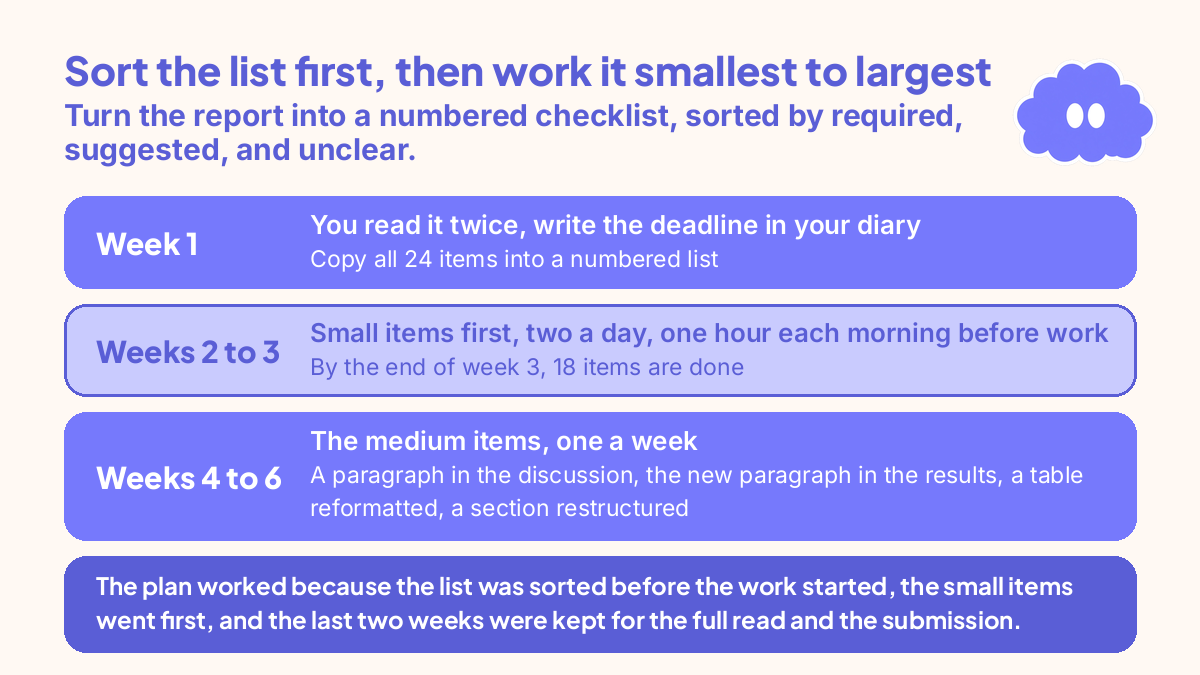
- Week 1: The report arrives on a Monday. You read it twice, write the deadline in your diary, and copy all 24 items into a numbered list: 20 required, 3 suggested, 1 unclear, asking for a new table in the results chapter.
- Week 1, Wednesday: You meet your supervisor with the list. The unclear item is suggested, not required: a paragraph explaining the result will do instead of the table. It becomes a medium task instead of a large one.
- Weeks 2 to 3: Small items first, two a day, one hour each morning before work: typos, references, unclear sentences, a missing citation. By the end of week 3, 18 items are done.
- Weeks 4 to 6: The medium items, one a week: a paragraph in the discussion, the new paragraph in the results, a table reformatted, a section restructured. Each gets a line in the corrections list, with the page number, as soon as it is done.
- Weeks 7 to 9: The two large items: a rewritten conclusion section, two pages, drafted in week 7 and revised in week 8, and a reworked literature review paragraph in week 9. Tracked changes on throughout.
- Week 10: The full read, top to bottom, on paper. You find three small problems the corrections introduced: a figure on the wrong page, a reference to a deleted paragraph, and a table number that no longer matches. All three fixed and added to the list.
- Week 11: The suggested items get their written responses: two changes made, one explained with a reason. The list is finished, 24 items, every one with a page number.
- Week 12: Submission, two weeks before the deadline, to the internal examiner as the report named. The thesis and the list go together.
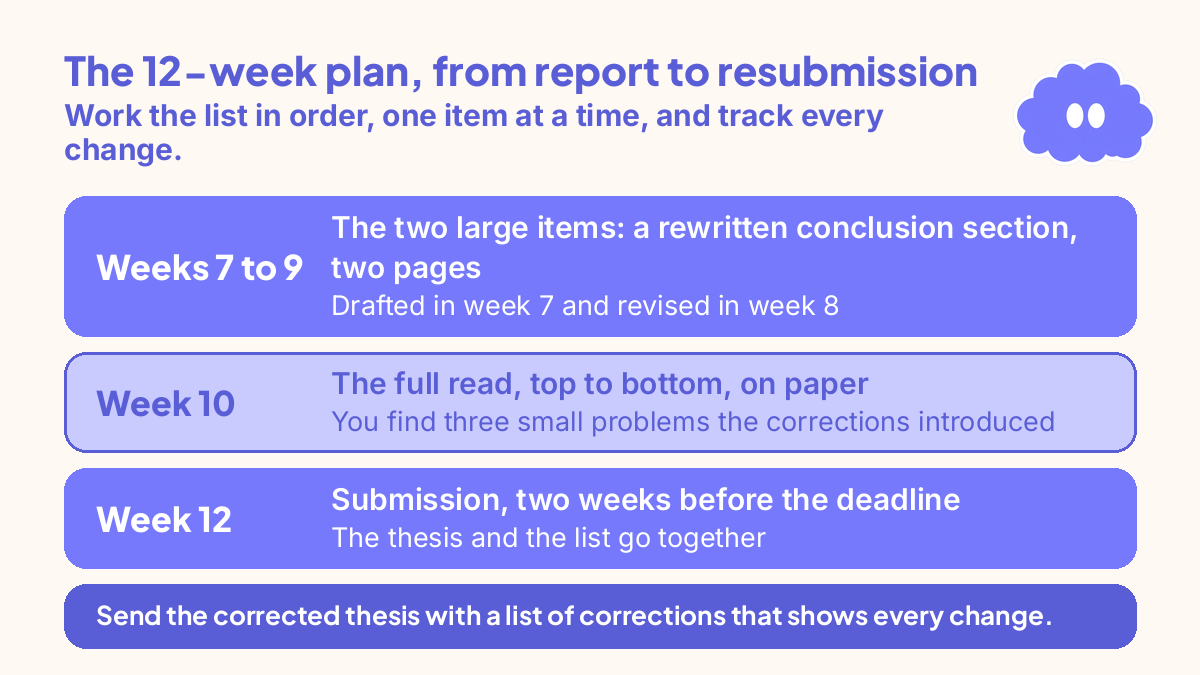
The plan worked because the list was sorted before the work started, the small items went first, and the last two weeks were kept for the full read and the submission.
When it goes wrong
The deadline is shorter than you expected. Some universities give three weeks for minor corrections at MPhil level, not three months. Read the decision letter the day it arrives and plan backwards from the deadline. If it is genuinely impossible, ask your supervisor about an extension the same week.
You disagree with a required correction. Talk to your supervisor before you do anything, and ask them to seek clarification from the examiner on your behalf. Never contact the examiner directly, and never simply ignore a required change: an ignored required item is the fastest way to have the thesis sent back.
The list keeps growing. Every correction can reveal another problem, and a list of 24 can become a list of 30. That is normal: new items go on the list as new numbers, and the daily target stays one item a day. What breaks the system is rewriting chapters instead of fixing items.
You cannot face the thesis again. After a viva, the thesis can feel like a document you never want to see. Start with the smallest item on the list, one typo, one reference, and stop after an hour. The second day is easier than the first.
The examiner asks for more changes after resubmission. Add them to the list as new items, work them the same way, and resubmit. This is not a failure: the examiner wants one more thing clear.
Weekly review checklist
- How many items are done, and how many are left, by size?
- Did I work the list in order, or did I start rewriting a chapter?
- Are the tracked changes on, and is the corrections list up to date with page numbers?
- Is there an unclear item I still need to ask my supervisor about?
- Am I on track for the deadline, with the last week kept free for the full read?
- What is the one item I will do first tomorrow?
Downloadable infographic spec: one vertical image, title “How to handle thesis corrections after your viva”, with the six steps from “The system in short” and the six review questions above, in Thynq cream, Cloud Purple, Dark Purple and pink, with the Cloud mascot. Text taken word-for-word from this article.
What this system is not
It is not a way to avoid corrections: almost every candidate gets them, and a list of 24 items is normal, not a failure. It is not a second viva: the corrections are checked on paper, and the examiner is looking for the changes, not for a new argument. It does not replace your university’s regulations, which state your deadline, your outcome, and who checks the corrections: those rules win over anything in this article. And it does not make the corrections easy; it makes them finite, visible, and done one item at a time.
Sources
- University of Cambridge, Examination outcome: process following the viva. Read November 2026. Supports the minor and major correction deadlines (three months and six months for PhD degrees) and the rule that the examiners’ joint report states who receives the corrected thesis.
- University of Edinburgh, Thesis corrections. Read November 2026. Supports the three-month minor correction period, the six-month period for additional work, and the rule that the internal examiner certifies corrections.
- Dunlosky, J., et al. (2013). Improving students’ learning with effective learning techniques. Psychological Science in the Public Interest, 14(1), 4-58. Supports the daily, spaced working pattern in Step 4 rather than a last-week rush.
For the wider thesis system behind this one, start with How to write a thesis conclusion.
Questions
How long do I get for thesis corrections after a viva?
It depends on your university and the size of the corrections. At Cambridge, minor corrections for a PhD take three months and major corrections take six months; Edinburgh gives three months for minor corrections and normally six months for further work. Your formal decision letter states your deadline, and that letter is the only date that counts.
What is the difference between minor and major corrections?
Minor corrections are editorial fixes and small weaknesses: typos, unclear sentences, a missing reference, a small addition. They do not need new research. Major corrections ask for larger changes, such as rewriting a chapter or adding an analysis, but they do not normally need a second viva. Revise and resubmit is a separate outcome that does need re-examination.
Should I start corrections before I get the examiners’ report?
No. Wait for the formal report, because it is the only list that counts. Notes you took in the viva help, but examiners sometimes drop a point they raised in the room, and sometimes add one they did not mention. Starting early means doing work that may not be required, and missing work that is.
What do I do if I disagree with a correction?
First, check whether it is required or suggested: required changes must be made, suggested ones need a written response. If you think a required change is wrong, talk to your supervisor before you do anything, and ask them to seek clarification from the examiner on your behalf. Never contact the examiner directly.