
The direct answer
A new year study reset is a one-week rebuild of your study system for January. You review last term in writing, sort the backlog into do, defer, and drop, clear out old notes, rebuild the timetable from your real hours, re-test what you forgot from memory, and ramp up slowly across the first week back.
January feels like a fresh start, and that feeling is the trap. Most January advice is a list of resolutions: new planner, new routine, new you. None of it tells you what to do on Monday at 5pm when you are tired and three subjects are waiting. A new year study reset is not a resolution. It is six jobs, done in order, in one week.
This post is the January seasonal reset, distinct from the separate reusable new term reset, which covers any term boundary in January or September. That article is the system you run whenever a new term starts. This one is the January version: the same six jobs, shaped for January timetables, January deadlines, and the first week back after the Christmas break.
The system in short
- Review last term in writing in 45 minutes: one thing to keep, one to fix, one to stop.
- Triage the backlog into do, defer, and drop. Keep no more than five items on the Do list.
- Clear out desk, notes, and files in 75 minutes. Archive last term in one place.
- Rebuild the timetable from real January hours, with seven 25-minute starter blocks in week one.
- Re-test three key topics from memory, and use the gaps as your study list.
- Run the first-week ramp, with a working-student variant for shifts and tired evenings, then hand over to the weekly review.
Step 1: Review last term in writing
Set a timer for 45 minutes and take one page. Answer at term scale: which subjects held up, which times kept failing, and what will not carry forward.
- What got finished last term, and what is still unfinished?
- Which study times and places worked, and which kept failing?
- What broke most sessions: late starts, phone checks, or tasks too big?
- What is different this January: subjects, class times, work hours, or deadlines?
One or two lines per prompt is enough. If you cannot answer a prompt, write “not sure” and move on.
Finish with three lines: one thing to keep, one to fix, and one to stop. Keep each line about the system: “Keep the 7:30am start” is useful, “Try harder” is not.
This review is the January study plan in miniature: it tells you what to keep before you build anything new. Stop after 45 minutes. A full page is enough to triage and rebuild.
Step 2: Triage the backlog into do, defer, and drop
The backlog is everything unfinished from last term. List it all on one page in 30 minutes, and do not start any of it yet.
Sort every item with one decision.
| Decision | Rule | Example |
|---|---|---|
| Do | Still assessed, or needed for the next topic, and due within three weeks. | Biology lab report due 16 January. |
| Defer | Matters later, not in week one. Give it a date and a file place. | Chapter 7 for March. File for 2 February. |
| Drop | No longer assessed, superseded, or never used. | September notes rewrite, unopened all term. |
Cap the Do list at five items. If it holds more, move the rest to Defer with dates in weeks two and three.
Put a date on every Do item. Keep week one light: no more than two Do items, each under 30 minutes. If an exam is less than three weeks away, keep only what the exam will ask.
Step 3: Clear out last term’s notes and files
Clear out in three timed parts, 75 minutes in total: desk, paper, digital. The test is simple: sit down, open the first task, and start within 2 minutes.
Desk, 15 minutes. Take everything off it, then put back only what the next session needs. The rest goes in a box out of sight.
Paper notes, 30 minutes. Keep only notes you can test yourself from. Archive last term’s notes in one labelled box or folder, and recycle duplicates and loose scraps. If you did not open a set of notes last term, archive it.
Digital files, 30 minutes. Make one folder called Last term for old files, and one folder per subject for this term. Rename the three files you will open most, and close every tab from last term.
Buy nothing during this step. Shopping is the January version of re-reading: it feels like progress and changes nothing.
Step 4: Rebuild the timetable from real January hours
A January timetable is not a revision timetable. No exam date drives the plan yet, so the first job is to discover what the new week looks like.
Write down the fixed commitments: class times, work shifts, travel, meals, and sleep. Add new deadlines as soon as you know them.
Count only gaps of 25 minutes or more. A 10-minute gap is not a study block. It is a break.
Place seven 25-minute starter blocks: one on Monday, one on Tuesday, two on Wednesday, two on Thursday, and one on Friday. Leave two evenings free. Put them on a weekly study planner with the subject and task in each block.
Fix the timetable after week one, not during it. Note which blocks happened, then change it once, on Sunday.
If your January week is shaped by shifts, build from the rota instead: blocks go on the mornings and evenings it leaves free. The working-student variant in Step 6 shows how.
Step 5: Re-test forgotten material from memory
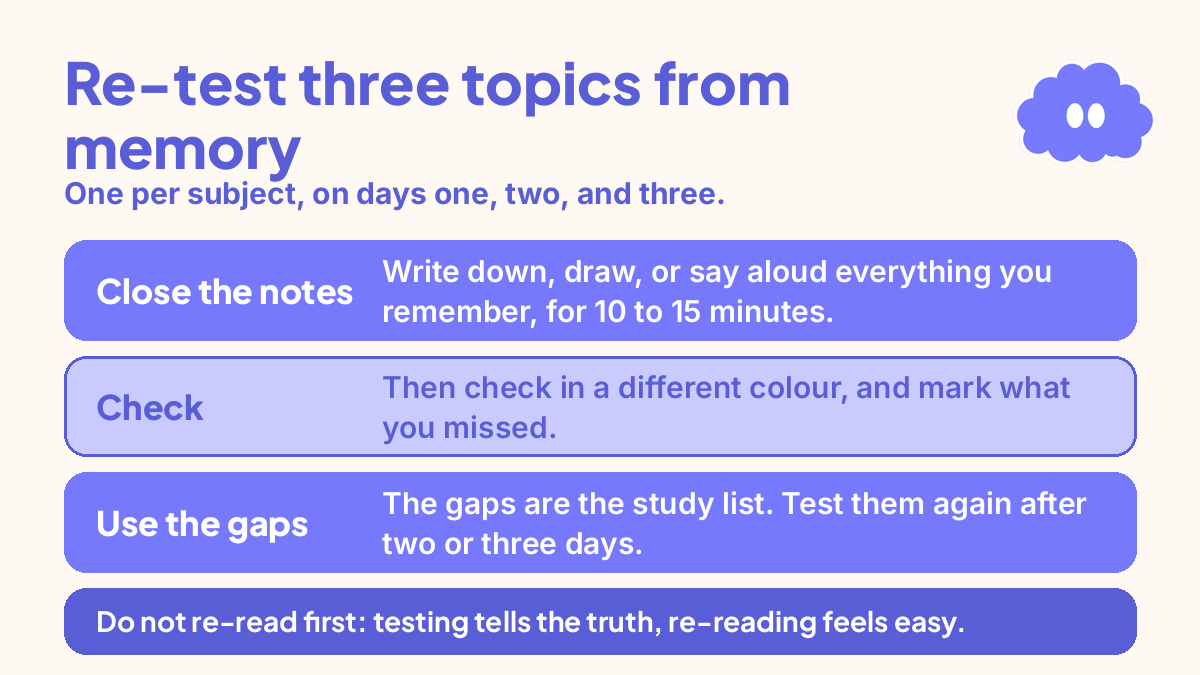
Check what survived the Christmas break before new material. Pick three key topics from last term that the new term builds on, one per subject. Test each one from memory in a 25-minute block, on days one, two, and three. The gaps are the study list.
Close the notes first. Write down, draw, or say aloud everything you remember, for 10 to 15 minutes. Then check in a different colour, and mark what you missed. If you cannot start at all, read the guide to starting when you cannot start and use its first 5-minute move, then come back to the test.
Do not re-read first: testing tells the truth, re-reading feels easy. If you remember almost nothing, put the topic on the Do list as a fresh learning task, with a date. That is the reset doing its job.
Dunlosky and colleagues found in 2013 that only practice testing and distributed practice received a high utility rating, and re-reading was rated low. Roediger and Karpicke showed in 2006 that students who recalled a passage remembered more a week later than students who restudied it. Cepeda and colleagues showed in 2006 that spacing beats massing.
Test the gaps again after two or three days: 10 minutes of recall, then a check. If the same gaps appear twice, give the topic a full block in week two.
Step 6: Run the first-week ramp, then hand over
When you get back on track studying after a break, the ramp matters more than the first day: one block first, two blocks midweek, Friday light.
Monday and Tuesday: one 25-minute block each, re-testing only. Wednesday and Thursday: two 25-minute blocks each, one re-test and one new topic, with a 5-minute break between blocks. Friday: one 25-minute block, plus 15 minutes to tidy next week’s tasks.
Write each day’s task the night before, in one line, with a verb and a finish line. “Biology, cell respiration, 15 minutes of recall, then check” is a task. “Study biology” is not. If a block moves twice, drop it and do the next block as planned.
Working-student variant: if you work shifts, run the ramp on your rota, not on the Monday to Friday shape above. On work days, do one 25-minute block only, before the shift or in the first hour after it, never late at night when you are already tired. On days off, do two blocks with a proper break. Use the weekend for the one catch-up block you actually missed, not for a full catch-up day. The study system for students with a full-time job sets the shape, the two-hour study system for working students fits the short evenings, and the weekend study plan for working students covers the catch-up without eating the whole weekend.
From week two, hand the system over to the weekly study review system. Do not run a second reset in week two. The review is the running system now, inside the wider study system that fits your life.
A worked example: a new year study reset in the first week back in January
Your situation: college student, three subjects: biology, history, and maths. Classes run Monday to Friday, 9:00am to 3:30pm. Part-time job on Saturday, 9:00am to 1:00pm. Eleven unfinished items from last term, no new timetable yet, and a biology lab report due 16 January.
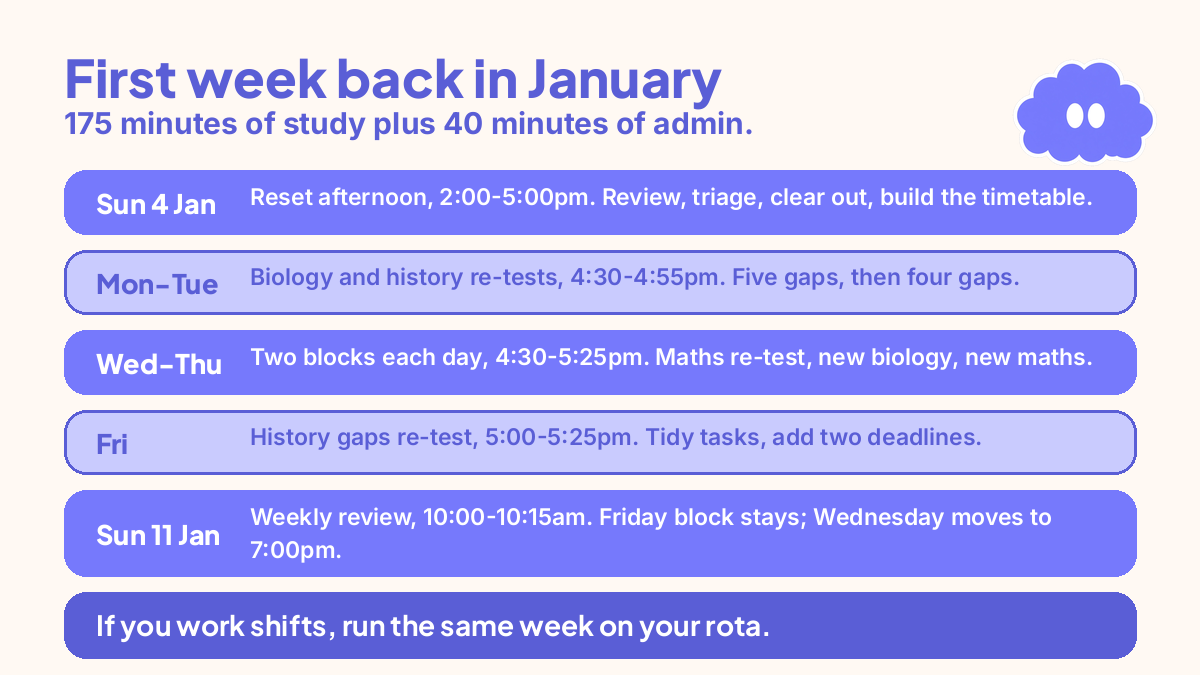
- Sunday 4 January, 2:00-5:00pm: reset afternoon. Review, triage 11 items into 4 Do, 5 Defer, and 2 Drop, clear out in 75 minutes, and build the timetable.
- Monday 5 January, 4:30-4:55pm: one block. Biology re-test, cell respiration, 15 minutes of recall, then check. Five gaps listed.
- Tuesday 6 January, 12:30-12:50pm: backlog admin. Send biology lab report corrections. 4:30-4:55pm: one block. History re-test, causes of the First World War, 15 minutes of recall, then check. Four gaps listed.
- Wednesday 7 January, 4:30-5:25pm: two blocks. Maths re-test, differentiation, five problems from memory, then check. New biology topic, inheritance, six questions.
- Thursday 8 January, 12:30-12:50pm: backlog admin. Submit the maths problem set. 4:30-5:25pm: two blocks. Biology gaps re-test, 10 minutes of recall, then check. New maths topic, integration basics, three problems.
- Friday 9 January, 5:00-5:25pm: one block. History gaps re-test, 10 minutes of recall, then check. 5:25-5:40pm: 15 minutes to tidy tasks and add two new deadlines.
- Saturday 10 January: job 9:00am to 1:00pm. No study block. Rest.
- Sunday 11 January, 10:00-10:15am: weekly review. Friday block stays at 5:00pm. Wednesday second block moves to 7:00pm.
That is 175 minutes of study plus 40 minutes of admin, with three topics re-tested and two new topics started.
If you work shifts, run the same week on your rota: one block on work days, two on days off.
When it goes wrong
You cannot face the review. Shrink it to 20 minutes and three prompts: what got finished, what kept breaking, and what is different this January. Write one line per prompt and stop.
The Do list will not shrink below ten items. Apply the Drop rule again, and move everything due after three weeks to Defer, with a date.
You re-read instead of re-testing. Close the notes and set a timer for 10 minutes. Write down what you remember, then check. If the page stays blank, write the topic headings first, then one fact per heading.
You miss a whole day in week one. Do the next session as planned, with no make-up work and no doubling. The back-on-track system for a bad study day covers that rule in full.
The new timetable fails three days in a row. Cut back to one 25-minute block a day, at the best time, for three days. Then add the second block on one day only.
January feels like a fresh start, so you plan a new life instead of a new week. That is the resolution trap. A new year study reset changes one timetable and one habit at a time. One week is a test, not a transformation. Keep the test small.
Weekly review checklist
Use this checklist at the end of week one, in writing, in 15 minutes.
- Did each starter block happen at its planned time?
- Which re-tested topics still have gaps, and when will you test them again?
- What is left on the Do list, and what moves to Defer or Drop now?
- Which new deadlines appeared, and are they on the timetable?
- What one part of the timetable needs to change for week two?
- Is last term’s material archived, or is it still mixed with this term’s notes?
Downloadable infographic spec: one vertical image, title “New year study reset”, with the six steps from “The system in short” and the six review questions above, in Thynq cream, Cloud Purple, Dark Purple and pink, with the Cloud mascot. Text taken word-for-word from this article.
What this system is not
A new year study reset is a rebuild, not a fresh start. It does not erase last term, and it does not promise grades. It sorts what last term left behind, rebuilds the week around real hours, and checks what you still remember.
It is not a revision timetable, or a daily habit on its own. Exam season needs its own countdown plan, and a daily anchor needs weeks to hold. It is not a whole-life reset, except for the desk and files that block the next session. And it is not the new term reset: that is the separate reusable system for any term boundary, while this one is the January seasonal post.
If you have not studied for a while, start smaller: one 25-minute re-test a day for a week, until starting feels ordinary. Then run the full reset.
Sources
- Dunlosky, J., et al. (2013). Improving students’ learning with effective learning techniques. Psychological Science in the Public Interest, 14(1), 4-58. Only practice testing and distributed practice received a high utility rating; rereading was rated low.
- Roediger, H. L., & Karpicke, J. D. (2006). Test-enhanced learning. Psychological Science, 17(3), 249-255. Retrieval practice beat restudying after a delay.
- Cepeda, N. J., et al. (2006). Distributed practice in verbal recall tasks: a review and quantitative synthesis. Psychological Bulletin, 132(3), 354-380. Spaced practice beat massed practice.
For the full system behind this reset, start with the Thynq study system pillar.
Questions
How is a new year study reset different from a new term reset?
The new year reset is the January seasonal version: it runs once, in the first week back after the Christmas break. The new term reset is the separate reusable system for any term boundary, January or September. Use this one in January, and the other one whenever a new term starts.
How long does a new year study reset take?
Allow one afternoon for the review, triage, and clear-out, plus 30 minutes to build the new timetable. The re-testing and ramp then run inside normal study sessions across week one. Do not stretch the reset across two weeks.
Do I need to buy a new planner for January?
No. A new planner does not fix a timetable that never fitted your week. Use the calendar or notebook you already have. If your old planner still has blank pages, use those first.
What if I work shifts and cannot study every evening?
Build the timetable from your shift pattern, not from an ideal week. Place blocks on the evenings and mornings you actually have free, keep them to 25 minutes, and use the working-student variant in Step 6.