The direct answer
If your thesis involves people, their data, or their records, you almost certainly need ethics approval before you collect anything. Build the application as one package: protocol, participant information sheet, consent form, the exact questions you will ask, recruitment material, and a data management plan. Submit it at least two months before fieldwork starts, and expect one round of changes.
Most students treat the ethics application as a form to fill in at the last minute. It is the first full draft of your method, and each document forces a decision: who you will ask, what you will ask them, what could go wrong, and what happens to their words afterwards.
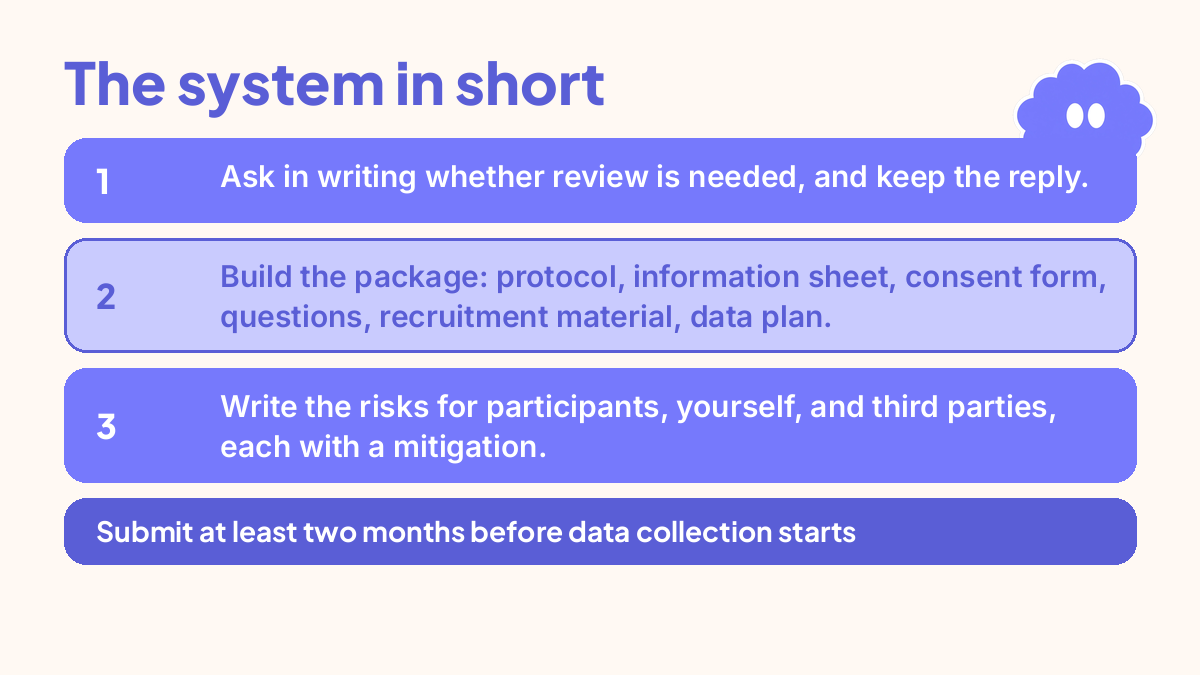
The system in short
- Ask in writing whether review is needed, and keep the reply.
- Build the package: protocol, information sheet, consent form, questions, recruitment material, data plan.
- Write the risks for participants, yourself, and third parties, each with a mitigation.
- Get your supervisor to review the full package before you submit it.
- Submit at least two months before data collection starts.
- Plan for a revise-and-resubmit round, and answer every comment point by point.
Step 1: Ask in writing whether review is needed
Do not guess whether your study needs review. Email the committee office before you write anything else, describe the study in two sentences, and ask whether it needs full review, light-touch review, or none at all. Keep the reply with the application: your supervisor and examiner may both ask for it.
Committee names differ by country. In the UK it is usually a research ethics committee; in the US it is usually an institutional review board, often called an IRB. Search your university website for the name plus your department, or ask your supervisor. State the facts plainly: who the participants are, what you will ask them to do, how long it takes, and whether you will record them.
Three outcomes are possible: full review of the whole package, light-touch review on a shorter form, or no review needed. If the reply says no review is needed, save it as a PDF with the date visible, and mention it in your methods chapter in one sentence.
Step 2: Build the package
The application is a package, not a single form, so build each document before you open the submission portal.
Start with the protocol: a two to four page summary in plain language covering the question, why it matters, who the participants are, what you will ask them to do, how long it takes, and how you will analyse what you collect. The system for How to write a thesis methodology shows how the protocol grows into the full chapter.
Next, the participant information sheet and the consent form. The sheet is what a participant reads before agreeing: what the study is, what taking part involves, the risks, that it is voluntary, that they can withdraw, and how their data will be stored. Keep it to two pages. The consent form is one page of short statements the participant ticks: they read the sheet, participation is voluntary, they agree to be recorded, they know how their data will be used.
Then the exact questions you will ask: the interview guide, question by question, or the full questionnaire. The guide for How to plan research interviews for a thesis explains how to build it in five phases.
Then the recruitment material and the data management plan. Recruitment material is every message a potential participant will see: email, poster, social media post, spoken invitation script. Say who you are looking for and what taking part involves. The system for How to recruit participants for your thesis research covers the invitation, and it needs approval as part of this package, so write it now. The data plan is one page: what data you will collect, where it will be stored, who can see it, how it will be anonymised, and when it will be deleted.
Step 3: Write the risks and mitigations
Most weak applications fail on risks: one risk, usually distress, and one mitigation, usually that the participant can stop. Write the risks in three groups, and give each risk a mitigation that actually reduces it.
First, risks to participants. Distress is real, but it is rarely the only one. A participant can be embarrassed by a question, worried that their employer will see their answers, or tired after a long interview. Name the mitigation for each: questions are optional, answers are anonymised before analysis, interviews stop at any point.
Second, risks to yourself: interviewing alone in a building you do not know, travelling to meet strangers, or handling data that could upset you. Name the mitigation for each: interviews in a public room during working hours, a supervisor who knows where you are, a check-in message after each interview. If your study involves a sensitive topic, say who you will talk to afterwards.
Third, risks to third parties. Your participants talk about other people: colleagues, managers, patients, family members. Those people did not consent to your study, and their names may appear in recordings or transcripts. Name the mitigation: remove names and identifying details during transcription, do not quote anything that could identify a third party, and store recordings where only you can hear them.
A table works well: risk on the left, mitigation on the right, about ten rows for an interview study.
Step 4: Get your supervisor to review the full package
Send the whole package to your supervisor before you submit it, not after. A supervisor who sees it first can catch the mistakes a committee will send back: a question that does not match the research question, a consent form that promises more than the sheet offers, a data plan that names no storage. Those are cheap fixes before submission and expensive delays after it.
Give your supervisor a fair deadline: two weeks is reasonable for a full package; two days is not. Send one email with every document attached, and name your submission date. Ask two things: does the method match the question, and is anything missing that the committee will ask for? The guide to How to handle supervisor feedback on a thesis shows how to ask for feedback that you can actually act on.
Read the feedback once, then leave it for a day before acting on it. If a comment is unclear, ask one short question back. Then read the whole package once more, checking that the participant numbers, interview length, and storage plan match in every document.
Step 5: Submit at least two months before data collection starts
Submit the application at least two months before the first interview, survey, or observation. Low-risk applications can come back in three to four weeks, but a revise-and-resubmit round adds two to four weeks, and a committee that meets monthly can add a further month.
Work backwards: if the first interview is on 1 June, the application goes in by 1 April. If the committee meets on the 15th and your application arrives on the 16th, it waits a full month. Submit a week before the meeting. Decide the submission date in advance, because a fixed date with a fixed action beats a vague intention (Gollwitzer and Sheeran, 2006).
Do not collect any data before approval arrives, not even a pilot: a pilot interview with a real participant is data collection. A practice run with a friend is not, because their answers will not appear in the thesis. While you wait, read the literature, draft the analysis plan, and build the transcription template.
When approval arrives, read the letter carefully. Approval usually comes with conditions: use the approved versions, report any changes before you make them, and report any problems during fieldwork. Save the letter with the application.
Step 6: Plan for a revise-and-resubmit round
Most first applications come back with changes, and that is normal. A revise-and-resubmit is not a rejection: the committee found gaps and wants them fixed. Plan for it in your timetable.
Common revision requests are predictable: a clearer information sheet, a consent form that matches it, a leading or vague question, a stronger data plan, or a risk section that names a risk you missed. Check your package for those five things. The proposal system in How to write a thesis proposal covers the same habit of checking the predictable objections first.
When the comments arrive, read them all before you change anything, then answer them point by point: what you changed, which document, and where. If you disagree, say so politely and give a reason, but do not ignore it.
Resubmit promptly: a week is reasonable for a short list, and a month suggests the application has been forgotten. If a comment needs your supervisor, ask them within two days. The second review is usually faster, because the committee is checking your changes rather than reading the whole package again.
A worked example: eight weeks to an ethics submission
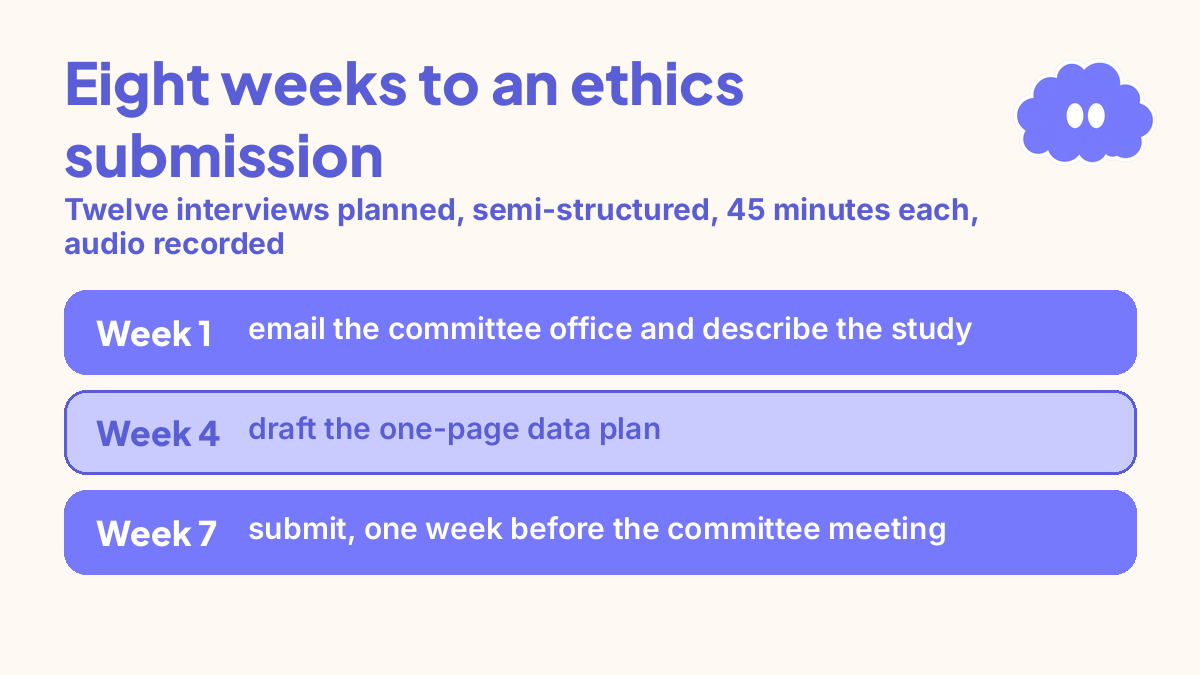
Your situation: Masters student, thesis on how newly qualified nurses experience their first six months on a ward. Twelve interviews planned, semi-structured, 45 minutes each, audio recorded. Eight weeks to your ethics submission deadline, and no documents written yet.
- Week 1, Monday 9:00: email the committee office and describe the study: 12 newly qualified nurses, 45-minute interviews about their first six months, audio recorded and transcribed. Tuesday 10:00: read the committee guidance and download the form and templates.
- Week 2, Monday to Wednesday, 9:00 to 11:00 each day: Draft the four-page protocol: question, why it matters, 12 nurses from two wards, 45-minute interviews, thematic analysis. Thursday 9:00: draft the 10-question interview guide, with no questions asking for patient details.
- Week 3, Monday 9:00 to 11:00: draft the two-page information sheet, plain language, read aloud once. Tuesday 9:00: draft the one-page consent form, six tick-box statements. Wednesday 9:00: draft the recruitment email and poster.
- Week 4, Monday 9:00: draft the one-page data plan: recordings on an encrypted drive, transcripts anonymised within one week, recordings deleted after transcription, transcripts kept for two years. Tuesday 9:00: write the risk table, 10 rows, each with a mitigation.
- Week 5, Monday 9:00: send the full package to the supervisor with a two-week deadline and a list of the six documents. Tuesday to Friday: read the literature and draft the analysis plan.
- Week 6, Tuesday 9:00 to 12:00: Make the supervisor’s changes, then check the numbers match: 12 nurses, 45 minutes, two wards.
- Week 7, Monday 9:00: final read of the package, checking the consent form matches the information sheet. Tuesday 10:00: submit, one week before the committee meeting.
- Week 8: Build the transcription template, test the recorder with a classmate for 10 minutes, and draft the analysis codes.
Twelve interviews at 45 minutes is 540 minutes, or 9 hours of recording, and transcription at roughly four hours per hour of recording is about 36 hours.
When it goes wrong
The committee says your study needs full review and you expected a light touch. Ask what makes it full review, usually a vulnerable group or identifiable data, and build the full package.
Your supervisor returns the package with major changes two days before submission. Move the submission date, not the quality, and submit to the next meeting.
You realise the information sheet promises something the consent form does not mention. Fix the mismatch before submission, even if it costs a day: committees check the two documents against each other first.
The committee asks for a change that conflicts with your supervisor’s advice. Email your supervisor with the exact comment quoted, and ask which version to use. Do not guess.
Approval takes longer than two months and fieldwork must move. Email the committee office for a realistic date, then tell your supervisor in the same week. Move analysis and writing forward so the delay costs fieldwork days, not thesis days. Never collect data while you wait.
Weekly review checklist
- Which one document will I finish this week: protocol, information sheet, consent form, questions, recruitment material, or data plan?
- Does every number match across documents: participants, minutes, wards, storage period?
- Does the consent form promise only what the information sheet actually says?
- Have I named a risk for participants, myself, and third parties, each with a mitigation?
- Has my supervisor seen the full package, and have I answered every comment?
- Is submission still two months before the first interview, and before the next committee meeting?
Downloadable infographic spec: one vertical image, title “How to write a thesis ethics application”, with the steps, ask in writing whether review is needed, build the package, write the risks and mitigations, get supervisor review, submit two months before data collection, plan for revise-and-resubmit, and the review questions, what document will I finish this week, do the numbers match, does the consent form match the information sheet, have I named risks for all three groups, has my supervisor seen the package, is submission two months before fieldwork, in Thynq cream, Cloud Purple, Dark Purple and pink, with the cloud mascot.
What this system is not
It is not legal advice, and it is not a substitute for your committee’s guidance, which overrides anything here. It does not guarantee approval, and it does not promise that a revise-and-resubmit will not happen. Most first applications come back with changes, and this system plans for that rather than pretending otherwise. It does not cover approval from outside the university, such as hospital or school approval, which can take longer.
Sources
- Gollwitzer, P. M., and Sheeran, P. (2006). Implementation intentions and goal achievement: A meta-analysis of effects and processes. Advances in Experimental Social Psychology, 38, 69-119. Supports fixing a submission date in advance.
- How to write a thesis methodology, How to plan research interviews for a thesis, How to recruit participants for your thesis research, and How to write a thesis proposal (Thynq).
Questions
Do I need ethics approval for my thesis?
Yes, in almost every university, if your thesis involves people, their personal data, or their records. That includes interviews, surveys, observations, and secondary data that can identify someone. Ask the committee in writing before you assume you are exempt.
How long does ethics approval take?
Plan for at least two months from submission to approval, and longer if the committee asks for changes. Low-risk applications can come back in three to four weeks, but a revise-and-resubmit round adds another two to four weeks. Submit early so a delay does not move your fieldwork.
What goes in a thesis ethics application?
The package is a protocol, a participant information sheet, a consent form, the exact questions you will ask, your recruitment material, and a data management plan. Add a risk section covering participants, yourself, and third parties, with a mitigation for each risk.
What happens if the committee asks for changes?
Most first applications come back with changes, and that is normal. Read each comment, change the document it refers to, and reply point by point saying what you changed and where. Resubmit promptly.