
The direct answer
Recruiting participants for your thesis research starts with a one-page brief: who exactly you need, how many, where they spend time, what they will do, and what they get. Pick channels that match the population, write the invitation in plain language, screen against criteria written in advance, and plan retention. Never recruit before ethics approval.
Most recruitment fails for boring reasons, not dramatic ones. The invitation goes to the wrong people, or it goes out too late, or it promises something the study cannot deliver. Each of those is fixable in an afternoon, before it costs you weeks.
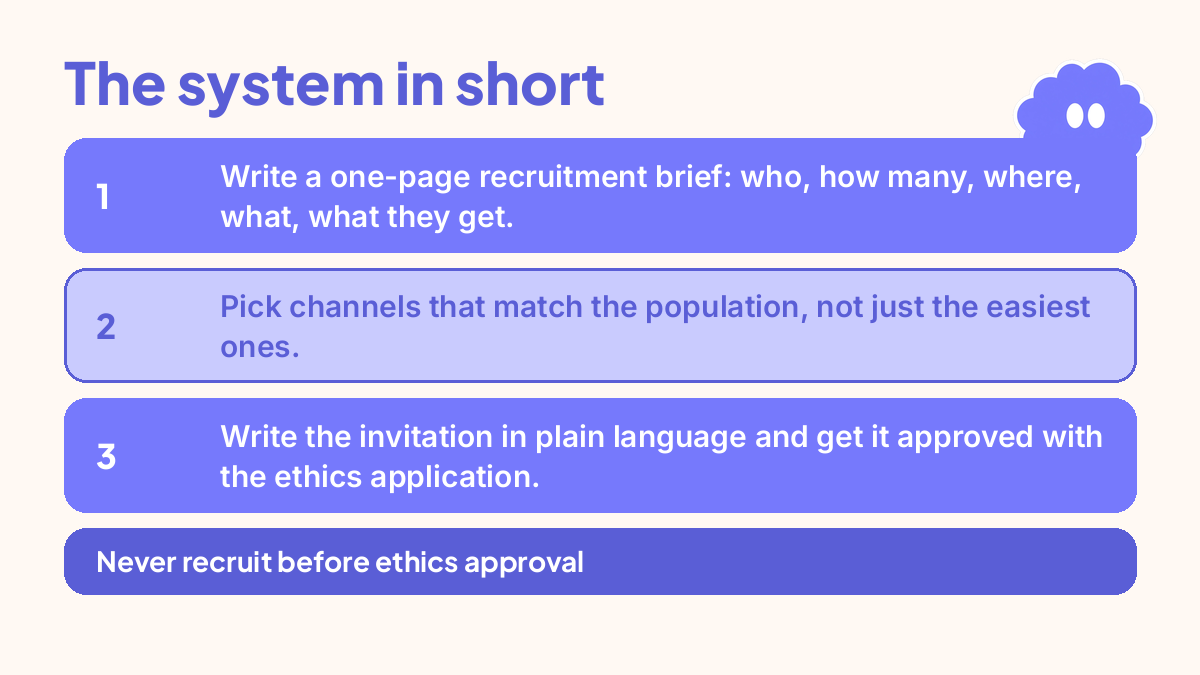
The system in short
- Write a one-page recruitment brief: who, how many, where, what, what they get.
- Pick channels that match the population, not just the easiest ones.
- Write the invitation in plain language and get it approved with the ethics application.
- Screen against criteria written in advance and keep a screening log.
- Plan retention: reminders, thank-yous, and a clear end.
- Never recruit before ethics approval.
Step 1: Write a one-page recruitment brief
Write the brief before you contact anyone. One page, five lines, each specific enough that a stranger could use it. Who exactly: not “students” but “second-year undergraduates, aged 18 to 21, who have used the university counselling service once or more”. How many: the number your supervisor agreed, and the larger number you will invite. Where they spend time: the lectures, societies, clinics, workplaces, or online groups where they already are. What they will do: the task, the time, and whether it is recorded. What they get: payment, a voucher, or a summary of findings, stated honestly.
Specificity is what makes the rest of the system work. A vague brief produces vague invitations, and vague invitations produce the wrong people or no people at all. If you cannot fill in one of the five lines, solve that with your supervisor first.
Check the brief against your method before you move on. The system for How to write a thesis methodology shows how the sample fits the design, and the numbers must match: the brief, the ethics application, and the methods chapter should all name the same population and target. If the ethics application says 20 interviews and the brief says 30, fix the mismatch now.
Step 2: Pick channels that match the population
Go where your population already spends time, not where it is easiest for you. That is the whole rule. A department poster finds your coursemates, not the shift workers or patients your study needs. Each channel finds a different slice, and the slice is the sample.
List three channels before you pick one. For each, write who it reaches, how many, and what permission you need. A lecture announcement reaches 200 students in ten minutes but needs the lecturer’s permission. A clinic poster reaches the right people slowly and needs the manager’s written agreement. An online group reaches thousands but needs the moderator’s permission and attracts people outside your criteria.
Permission first, posting second. Ask in writing, keep the reply, and name the channel in your ethics application: the committee approves the material and the places it will appear. A channel used without permission can be shut down mid-study. If a channel needs a gatekeeper, tell them what the study is, what you need, and when, in one short message.
Mix channels when one will not reach your number: two slow channels that reach the right people beat one fast channel that reaches the wrong ones. Keep the mix small: three channels you can manage beats six you cannot.
Step 3: Write the invitation in plain language
Write the invitation the way you would explain the study to a friend: who you are, what the study is, who you are looking for, what taking part involves, how long it takes, and what they get. Two hundred words at most, no jargon, no acronyms.
Put the practical facts first, not the theory. People decide in seconds whether to read on, and they decide on time, effort, and reward. “30-minute survey, then a 45-minute interview, £10 voucher” decides faster than three paragraphs about the literature. The research question belongs in the information sheet, not the invitation.
Get the invitation approved with the ethics application. Every version, the email, the poster, the social media post, the spoken script, goes into the package, and only the approved versions go out. The system for How to write a thesis ethics application covers the full package, so write the invitation now rather than after approval.
Ask your supervisor to check the recruitment material before it goes out, even after ethics approval. The guide to How to handle supervisor feedback on a thesis shows how to ask for that check: one email, the material attached, and two specific questions.
Step 4: Screen against criteria written in advance
Write the screening criteria before the first reply arrives, and decide them in advance rather than inventing them as replies come in: deciding in advance turns good intentions into consistent action (Gollwitzer and Sheeran, 2006). Criteria are the five lines of your brief turned into yes-or-no questions: second-year undergraduate, aged 18 to 21, used the counselling service, available for a 45-minute interview. Four yeses and the person is in. Anything else and they are out, politely.
Screen everyone the same way, in the same order, with the same questions. A short screening form, five questions, two minutes, does the job for most studies. If a criterion is unclear, ask your supervisor before you change it, and note the change in your log.
Keep a screening log from the first day. One row per person who replies: date, channel, answers to the five questions, in or out, and why. The log does three jobs: it shows your supervisor and examiner that the sample was built fairly, it tells you which channel works, and it stops you re-contacting someone you already turned down.
Step 5: Plan retention
Recruiting someone is not the same as keeping them. A participant who agrees and then disappears costs the same time as one who never replied. Three habits keep most people: a reminder, a thank-you, and a clear end.
Send one reminder, politely, three days before the interview or the survey deadline. One reminder, not three: a second feels like pressure, and pressured participants give short answers or withdraw. If they do not reply, mark them withdrawn in the log and move on.
Thank everyone who takes part, the same day if you can. A short message, two lines, naming what they did and when they will hear the outcome. If you promised a voucher, send it the same day. If you promised a summary, note the date and keep it. A kept promise is why the next student who asks that population gets a yes.
Give the study a clear end, and say it in the invitation. “The study closes on 30 June” tells people the deadline is real. When the study closes, close it: stop recruiting, thank the last participants, and tell your supervisor the final number the same week.
Step 6: Never recruit before ethics approval
Do not contact potential participants, send invitations, or run a pilot with real participants before ethics approval arrives. This is the one rule with no exceptions, and breaking it can mean the data cannot be used. A pilot interview with a real participant is data collection; a practice run with a friend is not, because their answers will not appear in the thesis.
While you wait, prepare everything that does not need approval. Finalise the brief. Line up the channels and get the gatekeepers’ permission in writing. Draft the invitation and the screening form. Build the log. A prepared researcher starts recruiting the day approval arrives.
When approval arrives, check the letter before you send anything. Approval usually names the approved versions of the material and the approved channels: use only those. If you want to add a channel or change the wording, tell the committee first in a short amendment request. Using a new channel without telling them is a problem you will explain to an examiner.
If approval takes longer than planned, tell your supervisor the new date in the same week, and move analysis and writing forward. Never close the gap by starting early.
A worked example: 20 undergraduates, a survey and an interview
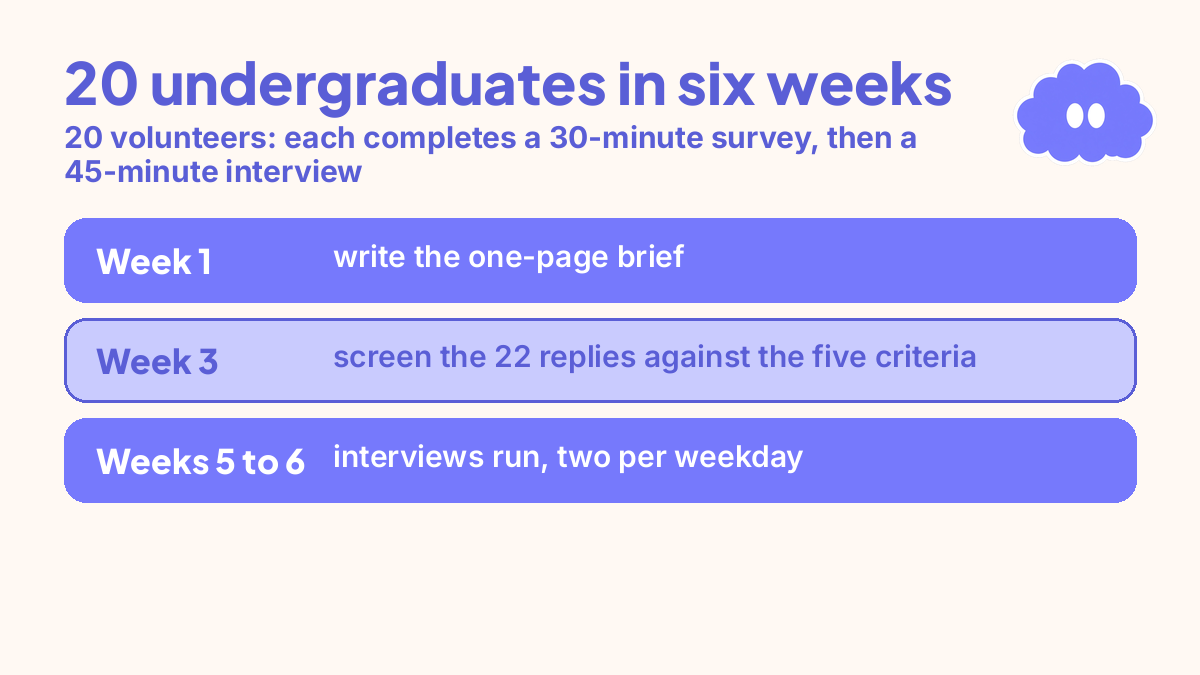
Your situation: Masters student, thesis on how undergraduates use the university counselling service. You need 20 volunteers: each completes a 30-minute survey, then a 45-minute interview. Six weeks to recruit, and ethics approval arrived yesterday.
- Week 1, Monday 9:00 to 11:00: write the one-page brief. Who: second-year undergraduates, aged 18 to 21, who used the counselling service once or more. How many: 20 participants, invite 60. Where: two lectures, one society email, one poster in the waiting room. What: 30-minute survey, then a 45-minute recorded interview. What they get: a £10 voucher and a summary in September.
- Week 1, Tuesday 9:00 to 11:00: write the screening criteria, five yes-or-no questions, and build the log. Wednesday 9:00 to 10:00: write the invitation, 180 words, plain language, time and voucher first. Thursday 9:00: send the brief, invitation, and screening form to your supervisor.
- Week 2, Monday 9:00: supervisor approves the material. Ask the two lecturers for five minutes at the end of their lectures, ask the society to send the email, ask the counselling manager for written permission for the poster. Wednesday 9:00: announcements made, email sent, poster up. Friday 17:00: 22 replies in the log.
- Week 3, Monday to Friday, 9:00 to 10:00 each day: screen the 22 replies against the five criteria. Fourteen pass, eight do not. Book interview slots for weeks 5 to 6, two per weekday. Send one reminder three days before each interview.
- Week 4, Monday 9:00: second round. Ask the lecturers for a second announcement and the society for a second email. Friday 17:00: 19 more replies, 11 pass. Total in the log: 41 replies, 25 pass, 20 booked, five held as spares.
- Weeks 5 to 6: interviews run, two per weekday, 10:00 to 10:45 and 11:00 to 11:45, 20 interviews in 10 weekdays. Surveys completed the day before each interview. Thank-you message and £10 voucher sent the same day. Friday of week 6: study closes, final number reported: 20 participants, 41 replies screened, five spares never needed.
Twenty surveys at 30 minutes is 600 minutes, or 10 hours of participant time. Twenty interviews at 45 minutes is 900 minutes, or 15 hours of recording. Transcription at roughly four hours per hour of recording is about 60 hours. The log shows the rate: 41 replies from 60 invitations, 25 pass screening, 20 take part. The interviews follow the system for How to plan research interviews for a thesis, and the transcripts go to How to analyse qualitative data for your thesis.
When it goes wrong
Nobody replies in the first week. Check the channel before you blame the population. Does the invitation say the time, the task, and the reward in the first three lines? If not, rewrite it, get the new version approved, and try a second channel in the same week.
Participants agree, then do not turn up. Send the reminder three days before, with the date, time, and link in the first line. If someone misses twice, mark them withdrawn and contact a spare from the log.
A gatekeeper withdraws permission halfway through. Thank them, stop using that channel the same day, and tell your supervisor. Move the effort to the channels that still work. Do not argue: the relationship matters more than the channel.
You are short of your target with two weeks left. Tell your supervisor now, not in two weeks. A shortfall discussed early has options.
Someone you screened out complains. Reply politely, thank them, and explain that the study needs a specific group. Do not share other people’s screening answers, and do not change the criteria for one person.
Weekly review checklist
- Is the brief still specific: who, how many, where, what, what they get?
- Which channel brought the most replies this week, and the best fits?
- Is the invitation the approved version, with time and reward first?
- Does the log show every reply, with a reason for every in and out?
- How many are booked, how many are spares, and how many are still needed?
- Has anything changed that needs an amendment?
Downloadable infographic spec: one vertical image, title “How to recruit participants for your thesis research”, with the steps, write a one-page recruitment brief, pick channels that match the population, write the invitation in plain language, screen against criteria written in advance, plan retention, never recruit before ethics approval, and the review questions, is the brief specific, which channel brought the most replies, is the invitation approved, does the log show every reply, how many are booked, has anything changed, in Thynq cream, Cloud Purple, Dark Purple and pink, with the cloud mascot.
What this system is not
It is not a way to buy participants or to pressure people into taking part. Payment, where your university allows it, is a thank-you for their time, not a purchase of their answers, and anyone can withdraw at any point. It is not a shortcut around ethics approval, and it is not a guarantee of a full sample. It does not cover paying recruitment agencies or using commercial panels, which need separate approval and a budget. It turns a vague hope for volunteers into a brief, channels, an invitation, a log, and a number you can count each week.
Sources
- Gollwitzer, P. M., and Sheeran, P. (2006). Implementation intentions and goal achievement: A meta-analysis of effects and processes. Advances in Experimental Social Psychology, 38, 69-119. Supports deciding screening criteria in advance.
- How to write a thesis methodology, How to write a thesis ethics application, How to plan research interviews for a thesis, and How to analyse qualitative data for your thesis (Thynq).
Questions
How many participants do I need for my thesis?
It depends on your method and your question, not on a magic number. Agree a provisional target with your supervisor before ethics approval: many student interview studies use 8 to 20 people, and surveys need more.
Can I recruit participants before ethics approval?
No. Do not contact potential participants, send invitations, or run a pilot with real participants before approval arrives. You can prepare the invitation and the list of channels while you wait, but nothing goes out until the committee says yes.
Where do I find participants for my thesis?
Go where your population already spends time, not where it is easiest for you. That can be a lecture, a society, a clinic waiting room, a workplace, or an online group, with permission. Match the channel to the people, and get the invitation approved first.
What do I do when participants drop out?
Plan for it: recruit more people than your target, keep a screening log, send one polite reminder, and thank everyone who takes part. If numbers fall short, tell your supervisor early.