
The direct answer
Write one question that names the people or setting, the thing you are studying, and the relationship you want to understand. A research question is specific, researchable with data you can get, arguable rather than answerable by a quick search, and small enough to finish in time. Start with your topic, narrow it, then test the draft against five checks.
Learning how to write a research question for your thesis starts with understanding what the question does. It is not a title, and it is not a topic. It is the one sentence your whole thesis exists to answer. It decides what you read, what data you collect, and what your chapters argue. A vague question produces a vague thesis, because every later decision inherits the vagueness. A clear question does the opposite: it makes each decision easier.
This article starts where topic choice ends. Picking a topic is a different job, covered in How to choose a thesis topic. Here, you already have a topic. The work is turning it into one question you can actually answer, testing it honestly, and knowing what to do when it changes halfway through.
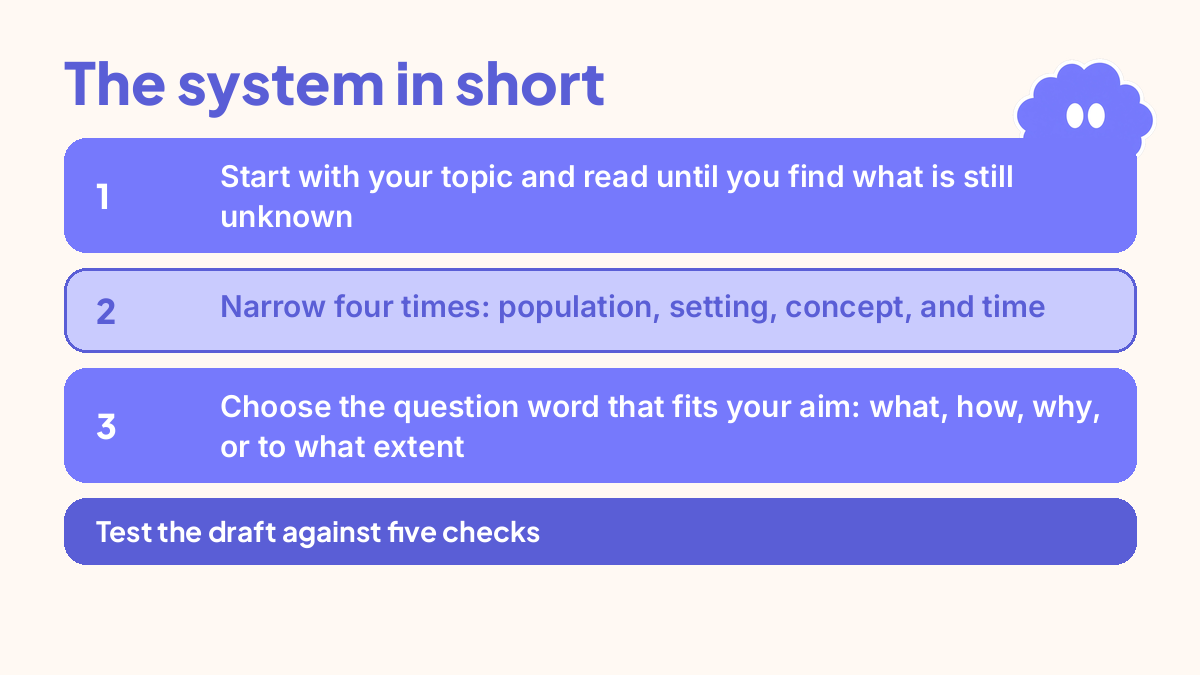
The system in short
- Start with your topic and read until you find what is still unknown.
- Narrow four times: population, setting, concept, and time.
- Choose the question word that fits your aim: what, how, why, or to what extent.
- Draft one main question and no more than three sub-questions.
- Test the draft against five checks: specific, researchable, arguable, feasible, and relevant.
- Take it to your supervisor, keep every version, and revise when the evidence demands it.
Step 1: Start with the topic and read for the gap
You already have a topic. Now read around it until you can say what is still unknown. Start with recent review articles and the limitations sections of recent studies, because both name what has not been done yet. Read five to ten papers, not fifty. For each one, write one sentence: what it found, and what it did not answer. After five papers, a pattern appears.
Write the gap down as two sentences. The first says what is known. The second says what is not known, and why it matters. For example: “We know weekly feedback improves student marks in large lectures. We do not know whether it changes motivation for first-year students in small seminar groups.” Those two sentences are the raw material for your question. If you cannot write them, you have not read enough yet. Go back and read five more papers.
Do not skip this step by drafting a question from the topic alone. A question written without reading is usually either already answered or impossible to answer, and you find out which one months later. How to do a systematic literature search shows how to turn your topic into search terms and screen results the same way every time.
Step 2: Narrow four times
A topic is too broad to answer. Narrow it four times, and write each narrowing down. First, population: who exactly are you studying? Not students, but first-year business students. Second, setting: where? One university, one hospital ward, three schools in one city. Third, concept: what exactly are you studying? Not motivation in general, but motivation as measured by attendance and assignment completion. Fourth, time: when? One term, one placement, one academic year.
Each narrowing should cut the scope in half or more. Write the four narrowings as a list, and check that each one is a real choice, not a vague phrase. “Students in higher education” is not a narrowing. “First-year business students at one university” is. The list becomes the spine of your question, and later of your methodology chapter, because each narrowing is a decision your methods must honour.
Step 3: Pick the question word that fits your aim
The first word of your question decides what kind of answer you need, so choose it on purpose. Each question word points to a different kind of study.
Use what when you need to describe something: “What strategies do first-year students use to manage deadlines?” Use how when you need to explain a process or a change: “How does weekly tutor feedback affect the motivation of first-year business students?” Use why when you need reasons: “Why do mature students leave part-time degrees?” Use to what extent when you need a measured relationship: “To what extent does class size affect participation in seminars?”
Avoid questions that can be answered yes or no. “Does feedback improve motivation?” can be answered with one word, and a thesis cannot be built on one word. Turn it into a how or to what extent question, and the study opens up. Also avoid questions that ask what should be done: “What should universities do about dropout?” That is a policy question, not a research question. Reword it to ask what happens, how it happens, or why it happens.
Step 4: Draft one main question, then sub-questions
Write the main question as one sentence, using the four narrowings from Step 2 and the question word from Step 3. Put it at the top of a blank page, on its own. Read it aloud. If you stumble, the sentence is too long or too tangled. If you cannot repeat it from memory after reading it once, it is too complicated. A good research question is simple enough to say in one breath.
Now decide whether you need sub-questions. A sub-question answers one part of the main question, and nothing else. If your main question asks how feedback affects motivation, your sub-questions might ask how students experience it, how their attendance changes, and how their marks change. Keep sub-questions to three at most. If you need more than three, your main question is still too broad. Narrow it again instead of adding more questions.
Write each sub-question under the main question, and check that each one serves the main question directly. A sub-question that could stand alone as its own thesis is a sign you have two projects, not one. Cut it. How to write a thesis proposal shows how the question, the gap, and the method fit together in five sections.
Step 5: Test the draft against five checks
Run your draft question through five checks, and be honest about the answers. A question that fails a check is a draft that needs one more round.
First, specific: does the question name the people, the setting, and the concept? If any of those are missing or vague, add them. Second, researchable: can you answer it with data you can actually get, by collecting it or by reading existing sources? If the data does not exist and you cannot collect it, the question must change. Third, arguable: does the question need original work to answer, or could someone answer it with one search? If one article answers it, it is not a thesis question. Fourth, feasible: can you answer it in the time and with the resources you have? Count the participants, the weeks, and the cost. If the numbers do not fit, narrow further. Fifth, relevant: does the answer matter to your field, or to the people you are studying?
Two frameworks can help: FINER, from Hulley and colleagues, and PICO, from Richardson and colleagues. Use them as checklists, not as rules. If your question passes all five checks, it is ready for your supervisor. If it fails one, fix that one thing and test it again.
Step 6: Take it to your supervisor and keep every version
Take the question to your supervisor as soon as it passes the five checks, not when it feels perfect. It will never feel perfect, and waiting wastes weeks. Send it in writing, with the two gap sentences from Step 1 and the four narrowings from Step 2, so your supervisor can see how you got there. Ask one direct question: “Is this question answerable in the time I have, with the data I can get?”
Expect several rounds of revision. Supervisors change questions for good reasons: the scope is too big, the data is not available, or the question has already been answered. Each round makes the question stronger, and each version is worth keeping. Save every draft with a date, in one document, so you can show how the question developed. That record becomes the story your introduction tells about how the thesis found its question. How to handle supervisor feedback on a thesis covers how to sort feedback into fix, discuss, or ask.
A worked example
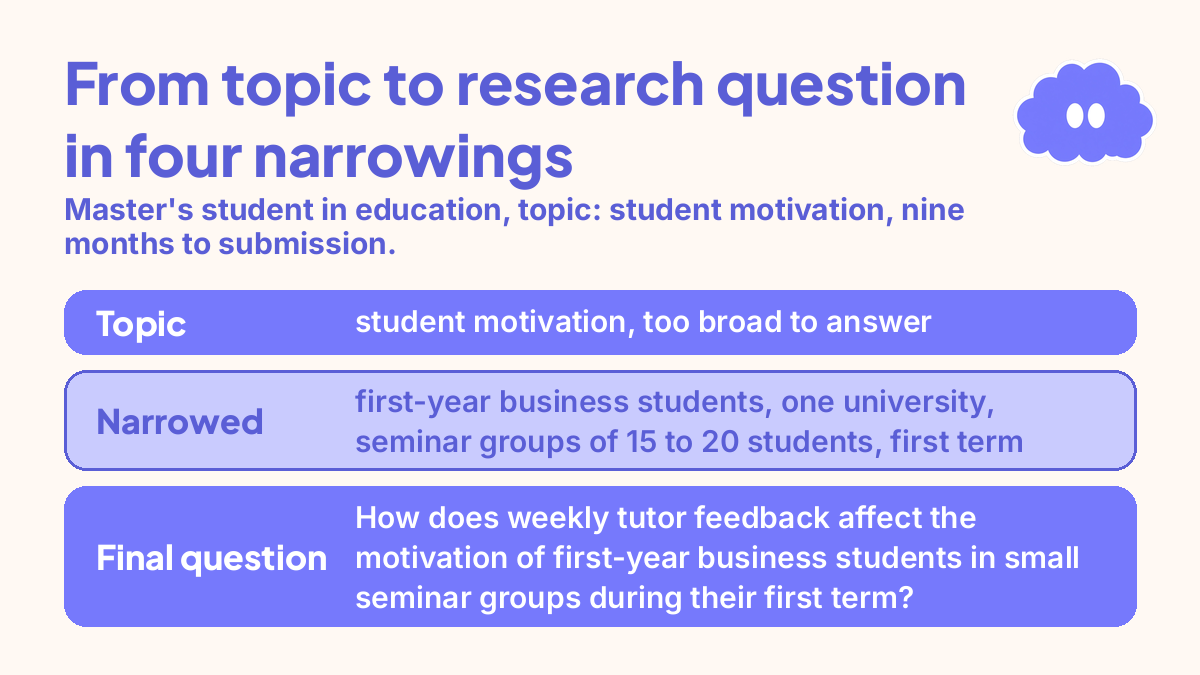
Your situation: You are a master’s student in education. Your topic is student motivation. You have nine months to submit a 15,000-word thesis. You have read eight papers on feedback and motivation.
- Topic: Student motivation. Too broad to answer, and already studied for decades.
- After reading: Most studies look at large lectures, and almost none look at small seminar groups. The gap is feedback and motivation in seminars.
- Narrowing one, population: First-year business students, not students in general.
- Narrowing two, setting: One university, seminar groups of 15 to 20 students.
- Narrowing three, concept: Motivation as shown by attendance and assignment completion.
- Narrowing four, time: The first term, 12 weeks.
- Question word: How, because you want to explain a change.
- Draft question: “How does weekly tutor feedback affect the motivation of first-year business students in small seminar groups during their first term?”
- Five checks: Specific, yes. Researchable, yes: attendance records and assignment marks exist, and you can interview six students. Arguable, yes: no study has tested this in small seminars. Feasible, yes: 12 weeks fits your nine months. Relevant, yes: the department is reviewing its feedback policy.
- Supervisor round: Your supervisor asks you to define “weekly tutor feedback” precisely, so you add “written feedback within 48 hours of submission”. The final question is 24 words long.
When it goes wrong
Your question is really three questions. This is the most common failure, and you can spot it by counting the question words. If your draft has two or three question words, or an “and” joining two different studies, split it. Pick the half that matters most and make it the main question. Turn the other half into a sub-question, or save it. One question, answered well, beats three questions answered thinly.
Your question has already been answered. You find the paper that answers it, months into the thesis. Do not panic. Read it closely: does it answer your question exactly, with your population, your setting, and your concept? Usually it answers a nearby question, not yours. If it does answer yours, narrow one more time: a different population, a different setting, or a different time period. A new narrowing is a new question.
You cannot get the data. The participants will not take part, the records are not available, or the ethics committee says no. Change the question to fit the data you can get. Swap the population for one you can reach, or swap collected data for existing records. Tell your supervisor the same week, in writing, with the old question, the new question, and one paragraph on what changed. How to read research papers for a thesis can help here.
Your question keeps changing every week. A question that changes weekly is a sign the topic is still too broad. Stop drafting and go back to Step 1. Read five more papers, rewrite the two gap sentences, and narrow again. Do not take a new draft to your supervisor until it has survived a full week without changing.
Weekly review checklist
- Can I say my research question in one breath, from memory?
- Does it name the population, the setting, the concept, and the time?
- Which of the five checks is weakest this week, and what will fix it?
- What did I read this week, and did it change the gap or the question?
- Has my supervisor seen the current version, and what did they actually say?
- What is the one change I will make to the question next week?
Downloadable infographic spec: A vertical 1000x1500 infographic in Thynq colours with the cloud mascot, titled “How to write a research question for your thesis”, listing the six steps of the system and the six weekly review questions, word for word from this article.
What this system is not
This system is not a way to write a research question in one sitting. A good question takes two to four weeks of reading, narrowing, and revision, and rushing it costs months later. If your supervisor wants a draft by the end of the month, give them a draft, clearly labelled as one, and keep revising it.
It is also not a guarantee that the question will never change. Most thesis questions change at least once, usually when the data or the literature pushes back. That is normal research, not failure.
Sources
- McCombes, S. (2023, November 21). Writing Strong Research Questions: Criteria and Examples. Scribbr. Supports the criteria for a strong research question.
- University of Guelph Library. Write a Research Question: Six Steps to Writing a Research Question. Accessed 24 November 2026. Supports moving from a broad topic to a specific question.
- Hulley, S. B., Cummings, S. R., Browner, W. S., Grady, D. G., and Newman, T. B. (2013). Designing Clinical Research. Fourth edition. Supports the FINER criteria for testing a research question.
- Richardson, W. S., Wilson, M. C., Nishikawa, J., and Hayward, R. S. (1995). The well-built clinical question: A key to evidence-based decisions. ACP Journal Club, 123(3), A12-A13. Supports the PICO structure for clinical questions.
For the full system behind this method, start with how to build a study system that fits your life.
Questions
How long should a thesis research question be?
One sentence, usually between 15 and 30 words. If your question runs to two sentences, it is probably two questions, and you should split it or drop one half. A single sentence forces you to choose what matters. Your supervisor should be able to read it once and repeat it back to you.
Can a thesis have more than one research question?
Yes, but only one main question. A thesis can also have two or three sub-questions, each answering one part of the main question. If you have two main questions that do not depend on each other, you have two theses. Pick one, and turn the other into a sub-question or drop it.
What is the difference between a thesis topic and a research question?
A topic is an area, and a research question is a question about that area. Student motivation is a topic. How does weekly tutor feedback affect the motivation of first-year business students is a research question. The topic tells you where to look. The question tells you what to find out.
What do I do if my research question changes during my thesis?
Change it in writing, with a reason, and tell your supervisor the same week. Write the old question, the new question, and one paragraph on what changed and why. Keep every version. A question that changes because the evidence demands it is good research. A question that changes every week is a sign the topic is still too broad.