
The direct answer
Pick one contribution from your thesis, choose the target journal before you rewrite a word, then build a new outline around that one argument and rewrite each section for journal readers, in four weeks, with a word budget for every section.
A thesis and a journal article are different kinds of writing, and that is why pasting chapters into a template fails. A thesis is written to prove to examiners that you can do the research: it shows all the background, all the method, and all the reading. An article is written to share one finding with busy readers in a field: it makes one point, shows the evidence for it, and stops. The system below turns one chapter into one article in four weeks, with a word budget for each section, a worked example, and a plan for what to do when reviewers say no.
The system in short
- Find the paper inside the thesis: list every finding, then pick the one that can stand on its own.
- Choose the target journal before you rewrite, and read its author instructions and three recent papers.
- Build a new outline around one argument, with a word budget for each section, and start a fresh document.
- Rewrite each section for journal readers: cut the background, compress the method, and make the figures stand alone.
- Check overlap, authorship, and permissions before you submit, including your university’s rules and the journal’s policy on thesis work.
- Review weekly for 15 minutes: words written, sections finished, and what the next week must complete.
Step 1: Find the paper inside the thesis
List every research question, dataset, method, and major finding in your thesis, one line each. Then, for each possible article, write its contribution in one sentence: using this method, we found this result, which changes how readers understand this problem. The sentence is the test. If you cannot write it in one sentence, the finding is not ready to be an article yet.
Pick the strongest one. A strong paper has a distinct question, enough evidence to support it, a clear link to the existing literature, and a journal audience you can name. For a bachelor’s or master’s thesis, that is usually one article from the strongest chapter. For a PhD, it is often two to four articles, one per major study or chapter. Do not try to convert the whole thesis. A thesis of 20,000 to 80,000 words becomes an article of 3,000 to 8,000 words, which means cutting 60 to 80 per cent of the text, and the cutting only works if one contribution survives it.
If two findings are tangled together, pick the one with the cleaner evidence and leave the other for a second article. One article, one claim. That rule is what keeps the paper readable, and it is the rule reviewers check first. If you are still deciding which chapter to use, How to write a thesis results chapter and How to write a thesis discussion chapter show what each chapter must contain before it can stand alone.
Step 2: Choose the target journal before you rewrite
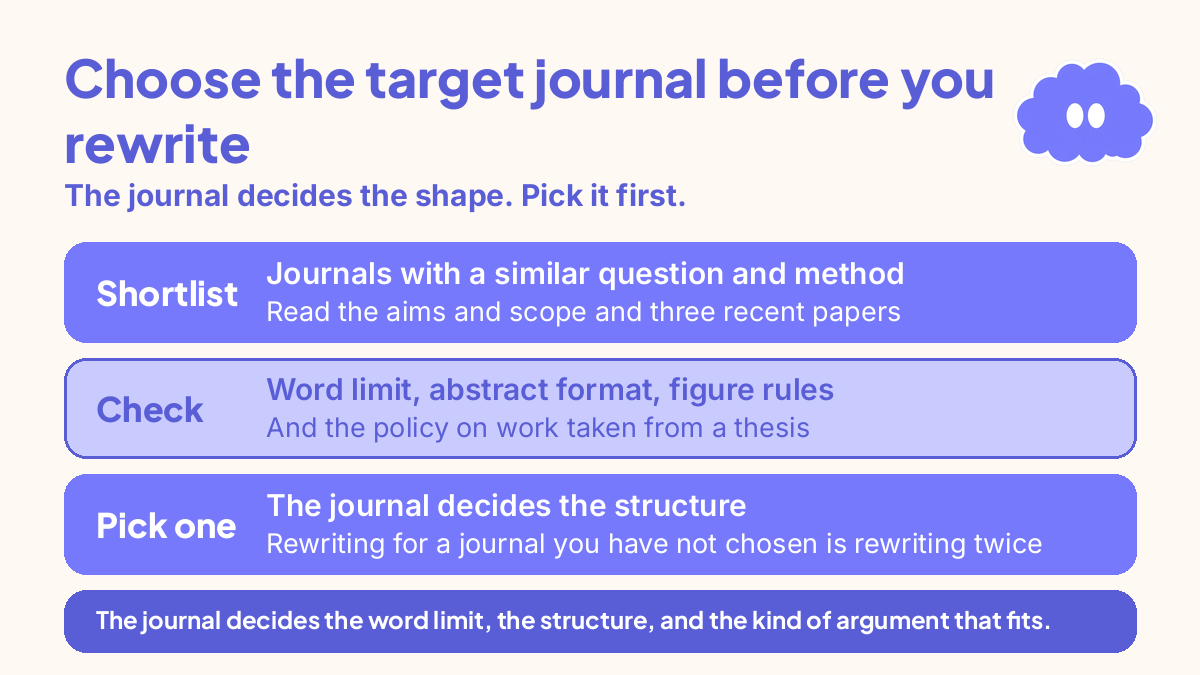
Shortlist journals that have published work with a similar question, method, and audience, then read the aims and scope, the author instructions, and two or three recent papers from each one. Pick one target before you rewrite, because the journal decides the word limit, the structure, the reference style, and the kind of argument that fits. Rewriting for a journal you have not chosen is rewriting twice.
Check four things in the author instructions: the word limit, the abstract length and format, the figure and table rules, and the policy on work taken from a thesis. Some journals ask you to say the article comes from a thesis. Some want a statement about prior publication. All of them want the manuscript in their format, and formatting after writing is slower than formatting as you go.
Step 3: Build a new outline around one argument
Start a completely new document. Do not copy the chapter into a template and start deleting, because the thesis structure will keep pulling the article back toward proving competence instead of sharing a finding. In the new document, write the outline first: one line for the problem, one line for the gap, one line for the contribution, then one line per section.
Give each section a word budget, and write the budget at the top of the outline. For a 6,000-word article, a workable split is: introduction 800 words, literature or background 700, method 800, results 1,800, discussion 1,400, conclusion 500. The budget is what stops the introduction from eating the results. When a section hits its budget, stop and move on.
Then gather the material. Search your thesis for every passage, table, and figure connected to the one contribution, and copy them into the new document as raw material. Mark clearly what is copied and what is new, so you never mistake a thesis paragraph for article text. The copied material is ingredients, not dinner.
Step 4: Rewrite each section for journal readers
Rewrite, do not cut and paste. The introduction keeps only what justifies your specific question, not the general history of the field. The literature section becomes three to five paragraphs of problem, gap, and contribution, not a chapter. The method keeps what a reader needs to repeat the work and trust the result, and moves the rest to a supplement or an appendix. The results show the evidence for the one claim, in the order the argument needs, not the order the thesis used.
Redesign the figures so each one makes sense without the text. Journal readers skim figures first, and a figure that needs three paragraphs of explanation is a figure that will be skipped. Give each figure a title that states the finding, not the topic, and check that the axes, labels, and legend are readable at the size the journal will print them.
Write the abstract last, even though it appears first. It must state the problem, the method, the finding, and why it matters, in the journal’s word limit. If you cannot fit the contribution into the abstract, the paper’s focus is still too wide. For the abstract itself, How to write a research abstract covers the four-part shape journals expect.
Step 5: Check overlap, authorship, and permissions before you submit
Before you submit, check three things. First, your university’s rules: some universities restrict publishing before the viva, and some require a statement that the article comes from a thesis. Second, the journal’s policy on thesis-derived work: most journals do not count a thesis held in a university repository as prior publication, but do not assume it. Read the policy, and if it is unclear, ask the editor. Third, overlap: if parts of the thesis are already published, such as a conference paper, say so in the cover letter and explain what is new.
Agree authorship with your supervisor before you submit, not after. The usual pattern is that the student is first author and the supervisor is a co-author, but it varies by field and by how much the supervisor contributed to the analysis and writing. A short conversation now prevents a difficult one later. And check the figures and tables for permissions: if a figure is reproduced from someone else’s work, you need permission, and the journal will ask for proof.
Run a final submission check against the author instructions: word count, reference style, figure files, declarations, and the cover letter. The cover letter should say, in two or three sentences, what the paper contributes and why it fits this journal. It is the editor’s first read, and it should sound like the paper’s one-sentence contribution, not like a summary of the thesis.
Step 6: Review weekly for 15 minutes
Each week, spend 15 minutes on three questions. First, how many words are written, and which sections are finished? Second, is the paper still about one contribution, or has it started to grow back into a thesis? Third, what must next week complete, and is the four-week plan still on track?
The four-week plan is: week one, choose the journal and write the outline with word budgets; week two, write the results and method, and redesign the figures; week three, write the introduction and discussion, and compress the literature; week four, write the abstract and conclusion, check the rules, and submit. If a week slips, move the plan, not the standard. For the writing rhythm behind the plan, Thesis writing system that keeps moving covers the daily habit that carries a long project.
A worked example: one results chapter becomes one article in four weeks
Your situation: Master’s student, thesis of 24,000 words, results chapter on a survey of 180 students about study habits and grades. Target journal wants 5,000 to 6,000 words. Supervisor agrees you are first author and they are second.
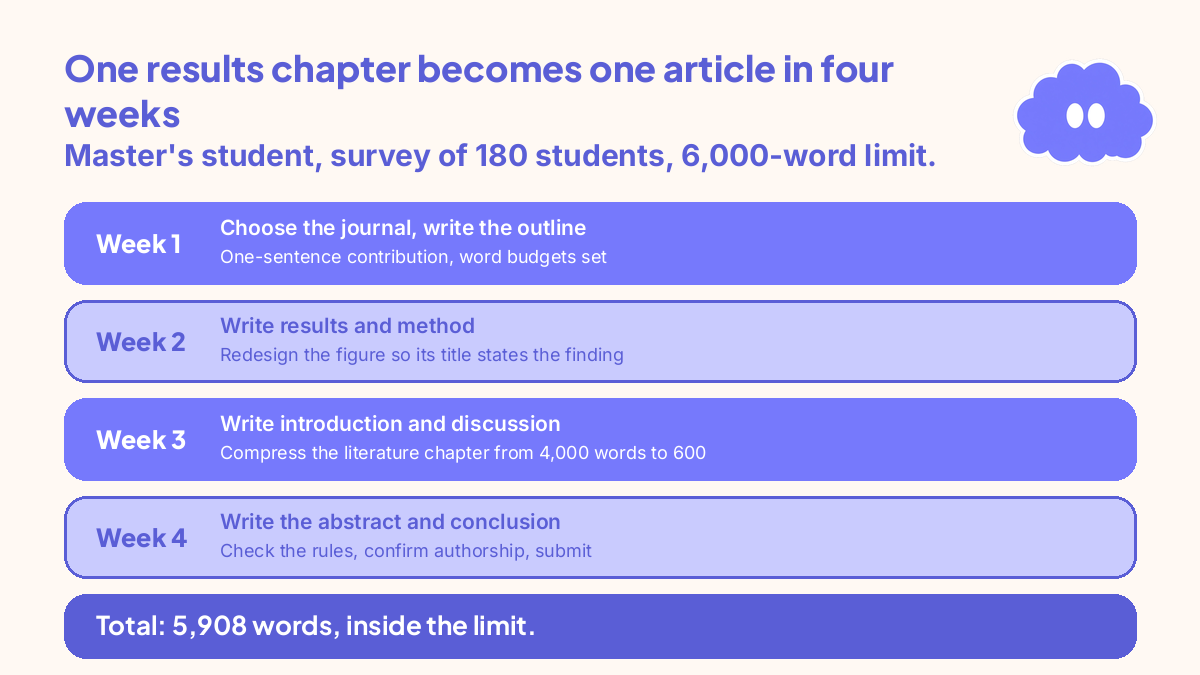
- Week 1: List the findings: three survey results, two interview themes, one comparison with earlier work. The one-sentence contribution: “Using survey data from 180 students, we found that testing yourself from memory predicts exam marks better than hours studied, which changes how study advice should be given.” Choose the journal, read three recent papers, note the 6,000-word limit and the 200-word abstract. Outline with budgets: introduction 700, background 600, method 700, results 1,700, discussion 1,300, conclusion 400, abstract 200.
- Week 2: Write results and method from the new outline. Results: three tables, one figure, 1,650 words. Method: 680 words, with the survey questions moved to a supplement. Redesign the figure so its title states the finding: “Students who tested themselves scored higher at every level of hours studied.”
- Week 3: Write introduction and discussion. Introduction: 690 words, problem, gap, contribution, no general history. Discussion: 1,280 words, what the finding means, what it does not prove, and two limits stated honestly. Compress the literature chapter from 4,000 words to 600.
- Week 4: Write the abstract, 198 words, and the conclusion, 390 words. Check the university rules on publishing after the viva, check the journal’s thesis policy, confirm authorship with the supervisor, and submit with a three-sentence cover letter. Total: 5,908 words, inside the limit.
When it goes wrong
You cannot find one contribution, only several small ones. The thesis may be a survey of a topic rather than an argument, and that is common. Pick the finding with the clearest evidence and the clearest audience, and build the article around it. The other findings can become a second article, or stay in the thesis. A paper with one clear claim beats a paper with five half-made ones.
The draft keeps growing back toward thesis length. Check the word budgets. The section that is over budget is usually the introduction or the literature section, because those are the places where thesis habits live. Cut them to budget and move the extra material to a supplement. If the results section is over budget, you are trying to report too much, and the fix is to cut a finding, not to ask for more words.
A reviewer says the paper is just a thesis chapter. That is the most common rejection for thesis articles, and it means the audience shift did not happen. Read the reviewer comments for what they point at: usually the introduction, the method, or the discussion still reads like it is proving competence. Rewrite those sections for a reader who wants the finding, not the proof, and resubmit to the next journal on your list.
Weekly review checklist
- Is the paper still about one contribution, stated in one sentence?
- How many words are written, and which sections are finished against their budgets?
- Does each figure make sense without the text, and does its title state the finding?
- Have you checked the university rules and the journal’s policy on thesis work?
- Is authorship agreed with your supervisor, and is the cover letter written?
- What must next week complete, and is the four-week plan still on track?
Downloadable infographic spec: one vertical image, title “How to turn your thesis into a journal article”, with the six steps from “The system in short” and the six review questions above, in Thynq cream, Cloud Purple, Dark Purple and pink, with the Cloud mascot. Text taken word-for-word from this article.
What this system is not
It is not a guarantee of publication. No system can promise that, and a journal’s decision depends on the finding, the field, and the reviewers, not only on the writing. It is not a shortcut: cutting 60 to 80 per cent of a thesis and rewriting the rest is real work. What it does is narrower: it turns one chapter with one strong finding into one article, in four weeks, with a word budget that keeps the paper the size a journal wants.
Sources
- Researcher.Life. How to convert your thesis into a journal article: examples, steps, checklist. Read November 2026. Cutting the text by 60 to 80 per cent, choosing the journal before drafting, and one article per strong chapter.
- Proof-Reading-Service.com. Helpful tips for turning a thesis or dissertation into journal articles. Read November 2026. A thesis chapter and a journal article are different forms; the article must make one focused contribution quickly.
- iWeaver AI. How to convert a thesis to a research paper: a complete step-by-step guide. Read November 2026. Choose one research question and target journal, rewrite for the journal’s readers, and check overlap and permissions.
For the conclusion this article builds on, read How to write a thesis conclusion. For the discussion chapter behind it, read How to write a thesis discussion chapter.
Questions
How do I turn my thesis into a journal article?
Pick one contribution, choose the target journal before you rewrite, then build a new outline around that one argument and rewrite each section for journal readers. Do not paste thesis chapters into a journal template. A thesis proves you can do the work; an article shares one finding.
How long should a journal article from a thesis be?
Most journals want 3,000 to 8,000 words, against a thesis of 20,000 to 80,000 words. That means cutting 60 to 80 per cent of the text. Check your target journal’s limit before you start, because the limit decides how much of each chapter survives.
Which chapter of my thesis should become a journal article?
The chapter with the strongest single finding that can stand on its own, with enough evidence to support it and a clear audience in one journal. For a master’s thesis that is usually one chapter; for a PhD it is often one chapter per article, two to four articles in total.
Can I publish from my thesis if it is already in my university repository?
Usually yes, but check two things first: your university’s rules on publishing before or after the viva, and the target journal’s policy on thesis-derived work. Most journals do not count a thesis in a repository as prior publication, but do not assume it. Check before you submit.