The direct answer
To learn how to turn your syllabus into a revision checklist, copy each syllabus heading as one topic per line, test yourself briefly on each topic, mark it know, shaky or do not know, then revise weakest topics first and re-test them on set dates before the exam.
A syllabus tells you what the exam can ask. It does not tell you what you can already answer. Most students revise in syllabus order, which spends equal time on strong and weak topics and hides the topics never tested.
A checklist fixes that in one page. Each line is a topic you can test, each rating comes from a short test, and the order of work is weakest first. Re-test dates then check that a revised topic stayed learned.
The system in short
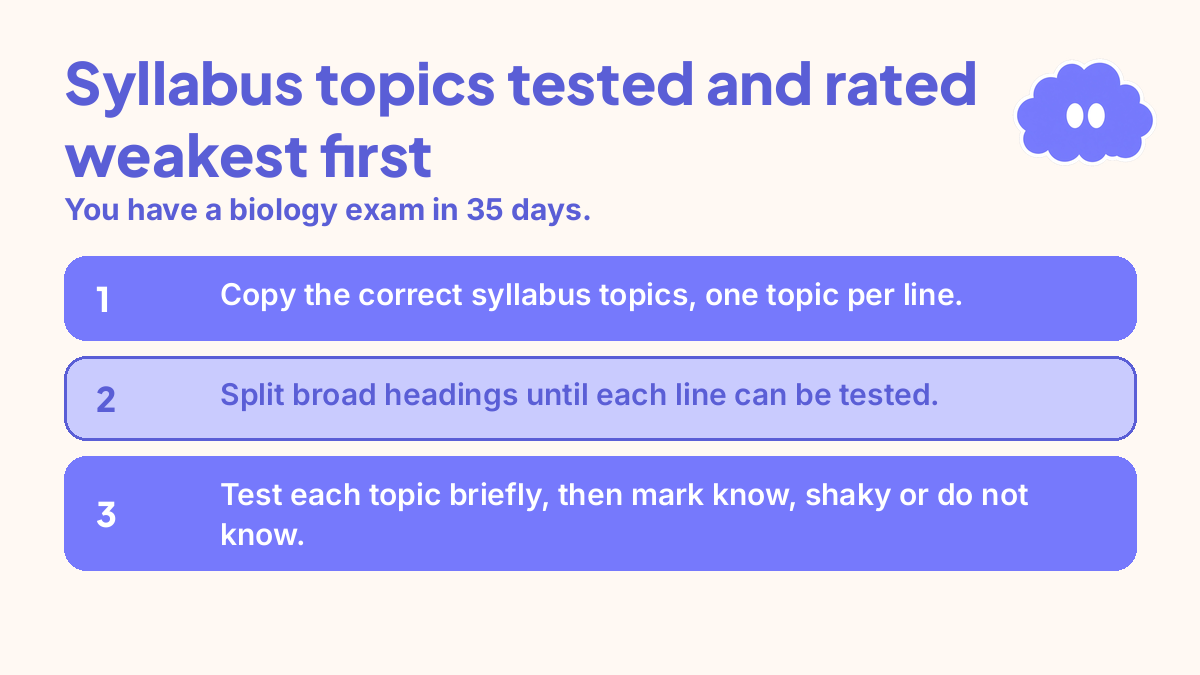
- Copy the correct syllabus topics, one topic per line.
- Split broad headings until each line can be tested.
- Test each topic briefly, then mark know, shaky or do not know.
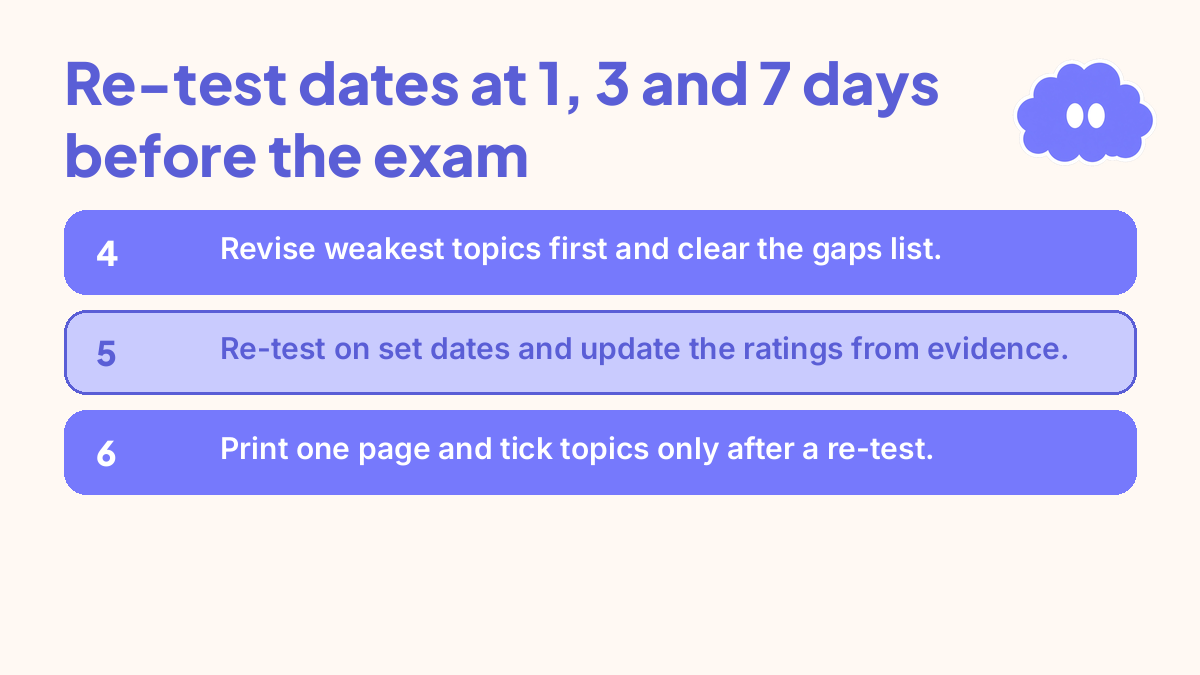
- Revise weakest topics first and clear the gaps list.
- Re-test on set dates and update the ratings from evidence.
- Print one page and tick topics only after a re-test.
Step 1: Start from the correct syllabus
Find the syllabus for your exact qualification, subject and exam year. Check the code and year before you copy anything. A similar course can have different topics and rules. If your school gave you a course outline, use that first.
Read the contents page, then find the subject content section. Note the paper structure and command words such as describe, explain, compare and calculate. A topic is not ready until you can answer in the form the exam expects.
Copy the headings into a plain list, one topic per line. Keep the official wording close enough that you can find the matching lesson or textbook section later. Do not add topics from a revision website unless they appear in your own syllabus.
Step 2: Split broad headings into testable topics
A heading such as electricity or cells is too broad to rate. You cannot honestly mark it know, because it contains several ideas at different levels of strength. Split each broad heading into smaller topics drawn from the syllabus wording. For electricity, that might mean current, potential difference, resistance calculations and circuit diagrams as separate lines.
Use one test for each line: could you close your notes and produce the key points or a worked calculation for this line alone? If not, split it again. The aim is lines you can check in one short session.
Keep each line as an action where you can. Revise cells gives you nothing to check. Draw and label a plant cell from memory gives you a clear pass or fail.
While you split, note where each topic lives in your materials. A topic with no material is a gap for Step 4. If a resource covers only part of a topic, mark that limit now.
Step 3: Test first, then mark know, shaky or do not know
Do not rate topics by how familiar the heading looks. Familiarity comes from reading, and reading is a weak guide to what you can produce under exam conditions. Test each topic briefly before you mark it. Give each line two to four minutes: close your notes, write the main points from memory, and check them against your material.
Mark know only when you produced the key points without help. Mark shaky when you needed prompts, mixed up two ideas or left out a step that matters. Mark do not know when you could not start, or when your answer was mostly guesswork. Be plain with yourself here. A kind rating now becomes a surprise later, when there is less time to fix it.
Thynq has a revision checklist generator that follows this order. You paste topics one per line, up to 60 topics, and bullets or numbering are tidied for you, with repeats listed once. You then mark each topic know, shaky or do not know. The checklist is ordered weakest first, with a gaps list for topics that still need attention. Use it if you want the sorting done for you, or copy the same order onto paper.
Work through the whole list in one or two sittings. At three minutes per topic, 40 topics take about 120 minutes of testing. Do not revise during this pass. The job is measurement only.
If you want a fuller test for a topic you marked shaky, write everything you remember on a blank page before you check it. The method in Blurting method for students: write down everything you remember gives you a clean record of what you produced without prompts, which makes the next rating easier to defend.
Step 4: Revise weakest first and clear the gaps list
Start revision at the top of the weakest first list. Do not know topics come before shaky topics. Within the same rating, choose the topic that appears most often in past papers or carries the most marks, where that information is given.
For each weak topic, do one focused session. Read the material once, close it and test yourself again. End by writing what you got wrong. That error note starts the next session on the same topic.
Clear the gaps list alongside weak topics. A gap can be a topic with no material or no rating. Find missing material from course resources first. If you cannot find it, add the topic to a questions list for your teacher.
Keep a simple record of scores as you test. The approach in how to track your past paper scores to find weak topics shows whether a topic is weak once or weak every time. The same topic weak in three tests needs more practice or help from your teacher.
Step 5: Set re-test dates and update ratings from evidence
A topic you revised today can feel solid today and fade within a week. Set re-test dates when you finish a topic, not when you remember to worry about it. Use gaps of 1 day, then 3 days, then 7 days when your exam is far enough away. The checklist generator uses the same pattern and shortens the gaps when 28 days or fewer remain. Re-test dates are never set on or after the exam date, because a check after the exam helps no one.
At each re-test, test before you look at your notes. If you pass cleanly, move the rating up. If you miss the same point again, keep the rating where it is and schedule another short session on that point only. Ratings move from evidence, not from time spent. An hour of rereading with no test changes nothing on the checklist.
This spacing is the practical side of spaced repetition system for students: short checks spread over days, each based on recall. Roediger and Karpicke found that memory tests improved later retention compared with restudying, which is why each re-test starts with notes closed.
Fit re-tests into your week before you add new topics. The planning method in how to make a revision timetable that works can hold both without letting new topics push re-tests out.
Step 6: Print one page and tick only after a re-test
Print the checklist as one A4 page, or download it as an image if you revise away from a desk. One page matters. A checklist spread over five pages gets left in a bag. A single page can sit on your desk, travel in a folder and show the whole subject at a glance. Ticks you make in the generator are saved in your browser, so you can return to the same list on the same device.
Tick a topic only after a passed re-test, never after reading about it. The tick means you produced the answer without help on a later day. If a ticked topic fails a later re-test, remove the tick and move the topic back into the weak group. That small honesty keeps the page trustworthy.
Review the page once a week. Count the topics in each rating and check the re-tests due in the next seven days. The wider habit is covered in how to revise for exams without cramming. For a marked check of full answers, Use AI to mark your past paper answers shows which topics still lose marks.
A worked example: 40 topics, 35 days to the exam
Your situation: You have a biology exam in 35 days. Your syllabus list has 40 topics after splitting broad headings. You can study on 5 days each week, with 2 sessions of 45 minutes on each study day.
On day 1 you paste the 40 topics into the checklist, one per line. Two repeats are listed once, so the final list holds 38 topics. You test each topic for about 3 minutes: 114 minutes in total, split into two sittings of 57 minutes.
The ratings are 12 know, 15 shaky and 11 do not know. Those groups add to 38 topics. Three topics have no material, so they go on the gaps list. You find material for two and add the third to your teacher questions list.
From day 3 you revise weakest first. You have 5 study days per week and 2 sessions per day, which gives 10 sessions per week. Over the first 3 weeks that is 30 sessions. You use 11 sessions for the do not know topics, 15 sessions for the shaky topics and 4 sessions for re-tests that fall due. The 30 sessions cover the 26 weak topics with 4 sessions left for re-tests, so the plan fits the time you have.
Each revised topic gets re-test dates at 1 day, 3 days and 7 days. A topic revised on day 3 is re-tested on day 4, day 6 and day 10. A topic revised on day 20 is re-tested on day 21, day 23 and day 27. No re-test falls on day 35 or later, because day 35 is the exam. In the final week you run mixed past paper questions and update ratings from the marks you lose. You print the one page checklist each Sunday and tick only the topics that passed a re-test that week.
When it goes wrong
You rate topics by familiarity. Headings you have seen many times feel known, even when you cannot produce the answer. Test before every rating change. If you did not write or say the answer from memory, the rating stays.
Your lines are still too broad. A line covering a whole chapter will sit at shaky for weeks, because part is strong and part is weak. Split it and rate each part on its own.
You keep adding topics from other sources. Shared lists can include topics from another exam board or year. Check every added line against your own syllabus. If it is not listed there, remove it.
Re-tests pile up and you skip them. Skipped re-tests turn the checklist into a record of what you once read. Cut new topics for one week, clear overdue re-tests in short sessions and restart the pattern.
You tick topics after reading. A tick after reading proves nothing. Remove those ticks, re-test with notes closed and tick again only where you pass.
Weekly review checklist
Copy this list and use it each week:
- How many topics sit at know, shaky and do not know today?
- Which weak topics did I test this week, and what did the tests show?
- Which gaps still have no material or no rating?
- Which re-tests fall due in the next seven days?
- Did every tick this week follow a passed re-test?
- What one change will I make next week: a split topic, a cleared gap or an earlier re-test?
Downloadable infographic spec: one vertical 1000x1500 image in Thynq colours with the cloud mascot, title “How to turn your syllabus into a revision checklist”, with the six steps “Copy the correct syllabus topics, one topic per line”, “Split broad headings until each line can be tested”, “Test each topic briefly, then mark know, shaky or do not know”, “Revise weakest topics first and clear the gaps list”, “Re-test on set dates and update the ratings from evidence” and “Print one page and tick topics only after a re-test”, plus the six weekly review questions above. Text word-for-word from this article.
What this system is not
It is not a promise of a grade, and it does not teach topics you have never met. A checklist organises revision and exposes gaps. You still need lessons, explanations and practice questions to learn the material itself. It is also not a substitute for your teacher guidance on optional units, coursework rules or changes to your exam year. If the checklist and your teacher disagree, follow your teacher and update the list.
The system also cannot rate topics for you. Ratings are only as honest as the tests behind them. The value of the page comes from the tests, the order and the re-tests, not from the ticking itself.
Sources
- Studote Editorial Team. How to read your exam board syllabus. Studote, 2026. Supports checking the correct specification, splitting headings into observable tasks and noting command words and assessment structure.
- CastIQ. How to Use a Syllabus as a Checklist: Map Every Topic to Your Study Material. CastIQ, 2026. Supports rating topics, treating topics without material as gaps and updating ratings after practice tests.
- Roediger, H. L. and Karpicke, J. D. (2006). Test-enhanced learning: taking memory tests improves long-term retention. Psychological Science, 17(3), 249-255. Supports testing from memory rather than restudying alone.
Questions
How detailed should each checklist line be?
Each line should name one topic you could test in one short session. If a line covers a whole chapter, split it until you could say what a correct answer would include. Lines that are too broad hide gaps.
How do I rate a topic honestly?
Test before you rate. Close your notes, write or say the key points from memory, then mark know only if you produced them without help. Mark shaky if you needed prompts and do not know if you could not start.
What if my syllabus has more than 60 topics?
Split the list by paper or by unit and build one checklist at a time, starting with the nearest exam. Work through the first list, then repeat the same steps for the next list rather than forcing everything onto one page.
When should I re-test a topic I have revised?
Re-test after 1 day, then 3 days, then 7 days when time allows. If 28 days or fewer remain, use shorter gaps. Never set a re-test on or after the exam date.