
The direct answer
The blurting method for students is simple: pick one topic, close the book and your notes, take a blank page, and write down everything you remember about that topic. Then open your notes and check what you wrote in a different colour — tick what is right, add what is missing, correct what is wrong. Then, after a gap, blurt the gaps only. That is the whole method. It works because writing from memory is a test, and the check in another colour shows you exactly what you do and do not know.
Why the blurting method for students beats re-reading
The exam is in two weeks. You have read your notes three times. They feel familiar. Every page makes sense while you are looking at it. Then you sit down to a past paper and the page goes blank.
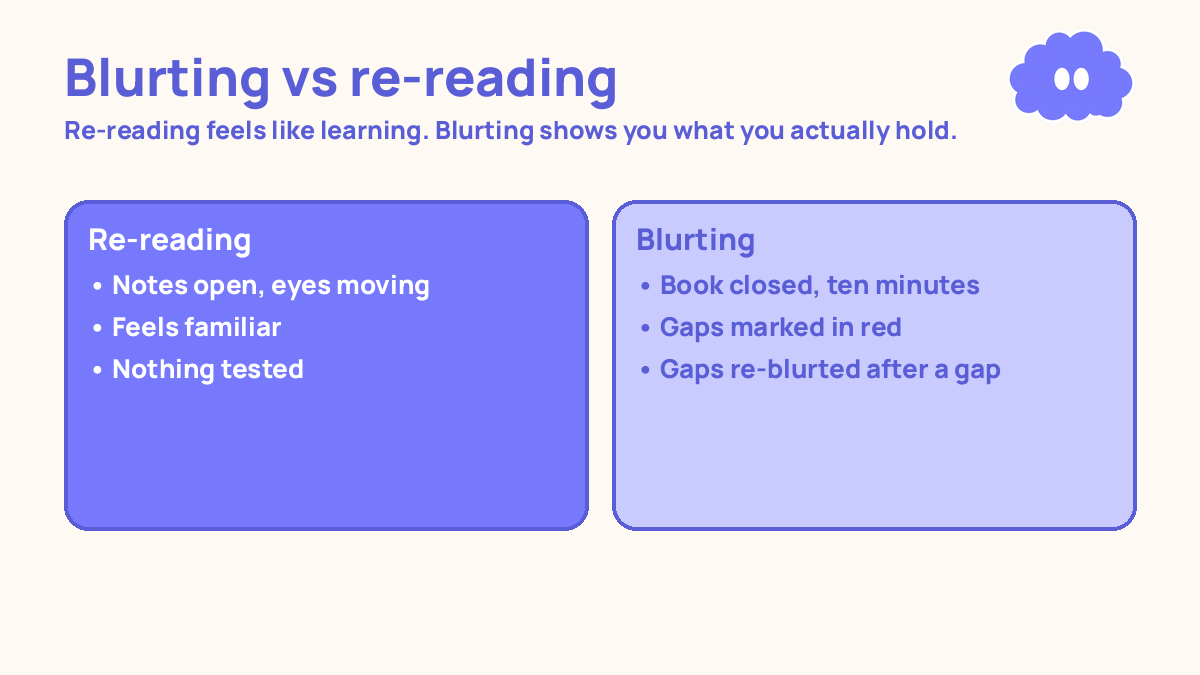
That is the trap re-reading sets: familiarity feels like knowledge, right up until the moment you need to produce the words from nothing. Blurting is the fastest way to break that trap. Ten minutes, one topic, a blank page, and the truth about what you actually hold.
The research behind it is the testing effect. In 2014, Rowland’s meta-analysis across 61 studies found testing yourself beat restudying (g = 0.50), with 81% of comparisons showing a benefit. Feedback mattered: with feedback the effect was larger (g = 0.73) than without it (g = 0.39). Blurting is a recall format with feedback built in — the check in another colour. Roediger and Karpicke showed the same pattern in 2006: recall beat restudy a week later.
The system in short
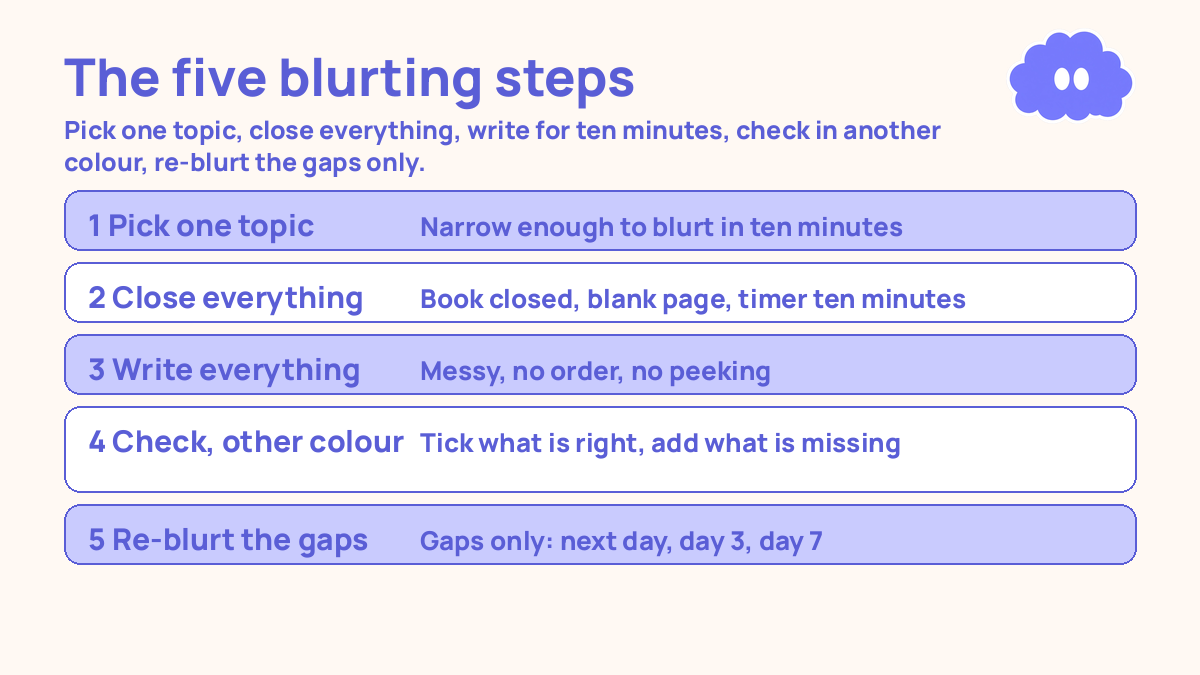
- Pick one topic, narrow enough to blurt in ten minutes. One process, one chapter section, one set of causes — not a whole subject.
- Close everything. Book closed, notes closed, phone in another room. Blank page, pen, timer set for ten minutes.
- Write everything you remember. Messy, no order, no structure, no peeking. Diagrams, terms, steps, numbers — whatever comes.
- Check in another colour. Open your notes and go through what you wrote: tick what is right, correct what is wrong, add what is missing.
- Re-blurt the gaps only. After a gap — the next day, then after three days — blurt the missing pieces again, not the whole topic.
Step 1: Pick one topic, narrow enough for ten minutes
Do not blurt “biology”. Do not even blurt “cell division”. Blurt “the stages of mitosis” or “what the light reactions produce”. One topic means one thing you could explain in three minutes. If the topic takes more than ten minutes to write down, it is two topics. Split it and take the first half now, the second half tomorrow.
Write the topic at the top of the blank page before you start. That line is the boundary: everything you write has to belong to that topic. Narrow is honest. Wide is a way of hiding the gaps inside a flood of easy material.
Choose the topic you are least sure about first. Blurting what you already know teaches you nothing.
Step 2: Close everything and set the timer
Close the book. Close the notes. Put the phone in another room. Blank page, pen, timer set for ten minutes. The closed book is the whole method: if the source is open, you are copying, not recalling, and the blurt tells you nothing.
Ten minutes is a hard limit. Without a timer, you write a little, get stuck, open the book “just to check one thing”, and the test is over.
If ten minutes feels too short, the topic is too big or you know less of it than you thought. Split the topic, or accept the short blurt and let the check step show you the gaps.
Step 3: Write everything you remember, messy and unordered
Write. Whatever comes, in whatever order it comes. Terms, steps, numbers, diagrams, half-remembered phrases. Do not organise it. Do not make it neat. Do not stop to think about structure. The blurt is a brain dump, not an essay. Neatness is the enemy here: every second spent making it look good is a second not spent remembering.
Do not stop when you get stuck: write “the step after X — can’t remember” and keep going. The gaps are the point. And do not peek: one look at the notes and everything after it is copying, and copying feels like remembering.
When the timer rings, stop. Ten minutes of honest recall beats thirty minutes of neat writing that was really copying.
Step 4: Check in another colour
Open your notes. Go through what you wrote, line by line, in a different colour pen. Tick what is right. Cross out and correct what is wrong. Add what is missing, in the other colour, so the additions stand out. The two colours are the whole feedback system: black is what you knew, the other colour is what you did not.
Be strict with the ticks. “Almost right” is wrong: if you wrote “the light reactions make glucose” and the truth is they make ATP and NADPH, cross it out and write the correction. Generous marking is how a blurt becomes another way of lying to yourself.
Count the gaps, not the ticks. Write them as a short list at the bottom of the page: “What NADPH does. The order of the mitosis stages. Why the plant needs ATP.” That list is your next blurt.
Step 5: Re-blurt the gaps only
Come back the next day and blurt the gaps only — the three items on the list, not the whole topic. Ten minutes, same rules, then check in the other colour again.
Then again after three days, then after seven. That 1-3-7 pattern is a practical starting schedule, not a research rule. Cepeda and colleagues showed in 2006 that spacing beats massing, and the best gap grows with how long you need to remember the material.
Do not re-blurt the whole topic every time: the parts you got right are learned for now. When a gap survives two blurts, change the approach — read that one section again, explain it aloud, or ask someone. A gap that survives three blurts is an understanding problem, and more blurting will not fix it.
Once a blurt shows you the gaps, turn each gap into a question. The quiz maker keeps those questions, tests you on them in a shuffled order, and saves your best score, so the next blurt has something to beat.
A worked example: a Sunday morning, three topics, 9:00–10:30am
It is Sunday. Your biology test is on Friday. You have three topics: the cell cycle, mitosis, and meiosis. You have your notes, a blank pad, two pens, and a timer.
9:00–9:15 — Blurt 1: the cell cycle. Ten minutes writing, everything you remember. Five minutes checking in red: four ticks, three missing pieces, one wrong term. The gaps, listed at the bottom: what controls whether a cell divides, and what the checkpoints check.
9:15–9:30 — Blurt 2: mitosis. Ten minutes writing. Five minutes checking: five ticks, two missing stages, one stage in the wrong order. The gaps: the order of prophase and metaphase, and what happens in anaphase.
9:30–9:45 — Blurt 3: meiosis. Ten minutes writing, five checking: three ticks, four missing pieces. The gaps: why meiosis has two divisions, and which one halves the chromosome number.
9:45–10:00 — Break. Stand up, water, look out of the window. No notes.
10:00–10:30 — Re-blurt the gaps. You blurt the three gap lists together: ten minutes writing, five minutes checking. Two of the seven gaps are now right. Five remain, written on a fresh page dated Monday.
| Time | What you do | What it gives you |
|---|---|---|
| 9:00–9:45 | Three blurts, 15 minutes each | Seven gaps, listed in red |
| 9:45–10:00 | Break, no notes | Rest, so the re-blurt is a real test |
| 10:00–10:30 | Re-blurt the gaps only | Two gaps closed, five left for Monday |
| Monday 7:00pm | Blurt the five gaps | The gaps that survive are understanding problems |
When it goes wrong
You peek. You get stuck, open the notes “just for one thing”, and the blurt is over. Fix it by making the peek impossible: notes in a drawer, phone in another room, timer on. If you peek, stop and start again tomorrow.
You blurt everything every time. You re-blurt the whole topic on Monday, Wednesday, and Friday, including the parts you already know. Fix it with the gap list: the second blurt covers the gaps only.
You make it neat. You spend the ten minutes organising, drawing boxes, and rewriting, and you remember half as much. Fix it by banning neatness: messy, unordered, no structure. The blurt is a brain dump. The neat version comes later, when you write the answer properly — and only for the parts you got wrong.
You never check. You blurt, feel good about how much you wrote, and file the page away without opening the notes. Fix it by making the check part of the same session: ten minutes writing, five minutes checking, every time. Feedback nearly doubled the benefit of testing.
Weekly review checklist
Copy this list and use it each week:
- How many topics did I blurt this week, and how many did I only re-read?
- Which gaps survived two blurts, and what will I do differently about them?
- Did I check every blurt in another colour, or file some away unmarked?
- Did I re-blurt the gaps after a gap, or only in the same sitting?
Downloadable infographic spec: one vertical image, title “Write down everything you remember”, with the five steps: pick one topic, close everything, write for ten minutes, check in another colour, re-blurt the gaps only, plus the rule “black is what you knew, the other colour is what you did not”, in Thynq cream, Cloud Purple, Dark Purple and pink, with the cloud mascot. Text taken word-for-word from this article.
What this system is not
It is not a replacement for learning the material in the first place. Blurting tests what you hold; it cannot put new material in. If the first blurt is blank, that is not a failure — but the fix is to go and learn the topic, not to blurt a blank page three times. Read the section, take Cornell notes on it, explain it aloud, and then blurt it. It is also not the whole of retrieval practice. Blurting is one move inside that system. Flashcards, past papers, and questions from memory are the other moves, and a good revision week uses more than one.
Sources
- Rowland, C. A. (2014). The effect of testing versus restudy on retention: a meta-analytic review of the testing effect. Psychological Bulletin, 140(6), 1432-1463. Testing beat restudy (g = 0.50), 81% of comparisons; with feedback g = 0.73, without feedback g = 0.39; recall formats beat recognition.
- Roediger, H. L. & Karpicke, J. D. (2006). Test-enhanced learning. Psychological Science, 17(3), 249-255. Students who recalled a passage remembered more a week later than students who restudied it.
- Cepeda, N. J., et al. (2006). Distributed practice in verbal recall tasks. Psychological Bulletin, 132(3), 354-380. Spaced practice beat massed practice; the best gap grows with how long the material must be remembered.
- Dunlosky, J., et al. (2013). Improving students’ learning with effective learning techniques. Psychological Science in the Public Interest, 14(1), 4-58. Practice testing rated high utility; re-reading rated low.
For the full system behind this method, start with how to build a study system that fits your life.
Questions
How is blurting different from retrieval practice?
It is one move inside retrieval practice. Retrieval practice covers many ways of testing yourself — flashcards, past papers, questions from memory. Blurting is one specific move: close the book and write down everything you remember about one topic, then check it.
How long should a blurting session take?
About 15 minutes per topic: 10 minutes to write, 5 to check against your notes. Three topics is a 45-minute session. If one topic takes 30 minutes to blurt, it is too big — split it and take the first half.
What if I remember almost nothing?
Then the blurt did its job: it showed you the gap honestly. Read the notes once, close them, and blurt again the same day. A blank first blurt is not a failure. It is the most useful kind, because it tells you exactly where to start.
Should I blurt with a timer?
Yes. Ten minutes per topic, timer on. Without a timer, blurting drifts into re-reading: you write a little, open the book to check one thing, and the test is over. The timer keeps the book closed until the writing is done.