
The direct answer
How to study while fasting during Ramadan is a system built around your energy, not against it. Map your energy for three days before the month starts, build a timetable around suhoor and iftar, put hard tasks in your peak windows, and protect your sleep with a split-night plan.
The system in short
- Map your energy for three days before Ramadan starts: note when you feel sharp and when you fade, and find your two peak windows.
- Build a Ramadan timetable around prayer times: a suhoor block, a midday light block, and a post-iftar block, with rest in between.
- Sort study by energy: hard tasks like new topics and problem solving go in peak windows, light tasks like flashcards and re-reading go in low windows.
- Protect sleep with the split-night plan: sleep after taraweeh, wake for suhoor, study early, and nap for 20 to 30 minutes in the afternoon.
- Handle exams during Ramadan by front-loading: finish the heavy learning before the month, and use Ramadan for testing, review, and consolidation.
- Review weekly and adjust: check which blocks happened, which failed, and move the work to the windows that actually work.
Step 1: Map your energy for three days before Ramadan
Do not guess your energy windows. Measure them. Three days before Ramadan starts, keep a simple energy log: every two hours, write one number from 1 to 5 for how sharp you feel, and one line for what you were doing. It takes two minutes a day.
Most fasting students find the same pattern: sharp in the one to two hours after suhoor, fading in the late afternoon before iftar, and sharp again one to two hours after iftar, once the meal has settled. But your pattern may differ. If you study best late at night, your peak may be after taraweeh. If you are a morning person, the suhoor block may be your best hour of the whole day. The log tells you the truth about your own energy, and the timetable is built from it, not from someone else’s.
Write down the two peak windows and the two low windows. The peaks get the hard work. The lows get rest or light work. Everything else in the system follows from this one page. If you skip this step, you will build a timetable for a person who does not exist, and it will fail.
Step 2: Build a Ramadan timetable around prayer times
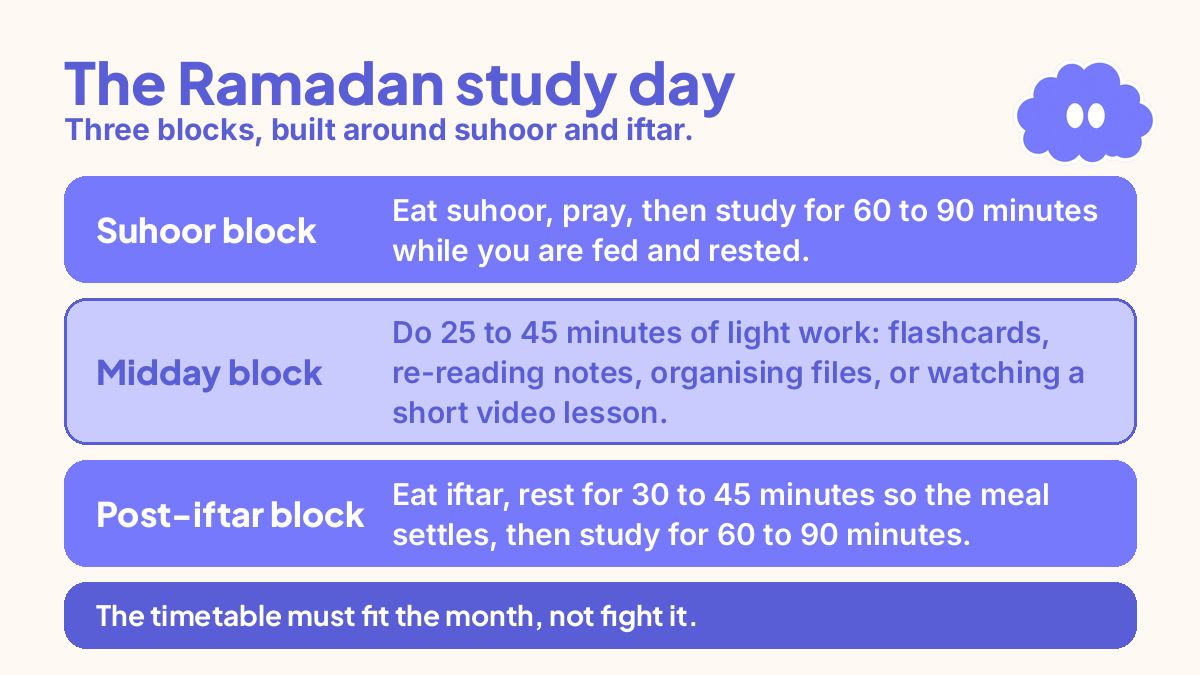
A normal timetable is built around school hours. A Ramadan timetable is built around suhoor and iftar, because those are the anchors of the day. Build three study blocks and protect the rest between them.
The suhoor block is the first study block of the day. Eat suhoor, pray, then study for 60 to 90 minutes while you are fed and rested. This is the best block for the hardest subject of the day. If you have school, this block may be short, 30 to 45 minutes before you leave. Use it for one hard task, not three.
The midday block is a light block. In the late morning or early afternoon, when energy is still reasonable, do 25 to 45 minutes of light work: flashcards, re-reading notes, organising files, or watching a short video lesson. In the late afternoon, when energy is lowest, stop studying. Rest, pray, help at home, and wait for iftar. Studying through the lowest hours teaches you nothing and costs you the evening.
The post-iftar block is the second study block. Eat iftar, rest for 30 to 45 minutes so the meal settles, then study for 60 to 90 minutes. This block is for the second-hardest task of the day, or for testing what you learned in the morning. If you pray taraweeh, study before it or after it, not instead of it. The timetable must fit the month, not fight it.
Step 3: Sort study by energy, not by subject
The rule is simple: hard tasks go in peak windows, light tasks go in low windows. The mistake is to sort by subject, so a hard topic lands in a tired hour and nothing sticks.
Hard tasks are: learning a new topic, solving problems, writing an essay, and working through a past paper. These need your full attention, and they belong in the suhoor block or the post-iftar block. Give each hard task one block, not two, and finish it before you start the next one.
Light tasks are: testing yourself with flashcards, re-reading notes, copying up neat notes, organising files, and watching a short video lesson. These belong in the midday block or in the last 20 minutes of a peak block, when your energy is fading. They keep the day moving without draining you.
Step 4: Protect sleep with the split-night plan
Sleep is the part of Ramadan study that fails first, because suhoor breaks the night. The fix is to plan the night as two sleeps with a study block between them, instead of trying to keep a normal night and losing sleep every day.
The plan is: sleep after taraweeh, wake for suhoor, study in the early morning, go to school or university, nap for 20 to 30 minutes in the afternoon, and sleep again after taraweeh. The nap is part of the plan, not a failure. Set an alarm for it, keep it under 30 minutes, and take it in a dark, cool room. A nap longer than 30 minutes leaves you groggy and steals the evening.
Keep the same wake time every day, including weekends. A regular wake time is the single most useful sleep habit in Ramadan, because it stops the whole month drifting later each night. Eat suhoor every day, and make it count: protein, complex carbohydrates, and fruit, with water. Skipping suhoor makes the next day harder in a way that no study technique can fix. Drink water at iftar, before bed, and at suhoor: dehydration feels like tiredness, and tiredness feels like not being able to concentrate.
Step 5: Handle exams during Ramadan by front-loading
If your exams fall during Ramadan, the work must move earlier. Ramadan is a consolidation month, not a learning month. Finish the heavy learning before it starts, and use the month itself for testing, review, and timed practice.
Four weeks before Ramadan, list every topic and mark it learned, shaky, or new. The new topics get finished before the month starts, even if that means two extra hours a day for two weeks. The shaky topics become the Ramadan study list. The learned topics get one short re-test a week, nothing more.
During the month, test yourself every day in the peak blocks, and use the low blocks for flashcards and notes. Run one timed past paper a week, in the post-iftar block, under real time limits. The past-paper system for exams and the system for revising without cramming both work during Ramadan if you move the hard sessions into the peak windows and keep the light sessions short.
Step 6: Review weekly and adjust the timetable
Ramadan changes as it goes on. The days get longer or shorter, your energy shifts, and the timetable that worked in week one may not work in week three. Review it every week, in writing, in 20 minutes, and adjust it.
Each week, check the energy log against the timetable. Which blocks happened at their planned time, and which did not. Which peak window is still a peak, and which has faded. Which hard tasks got done, and which kept sliding. Move the work to the windows that actually work, and stop scheduling hard tasks in windows that fail three days in a row.
If a whole week fails, the problem is usually the timetable, not you. Cut the plan by a third: two blocks a day instead of three, one hard task instead of two, and a longer nap. A smaller plan that happens beats a bigger plan that does not. The weekly study planner for students sets out the same weekly review habit, and the study timer tool can hold the 25-minute blocks while you work.
A worked example: one week of Ramadan study, with exams in May
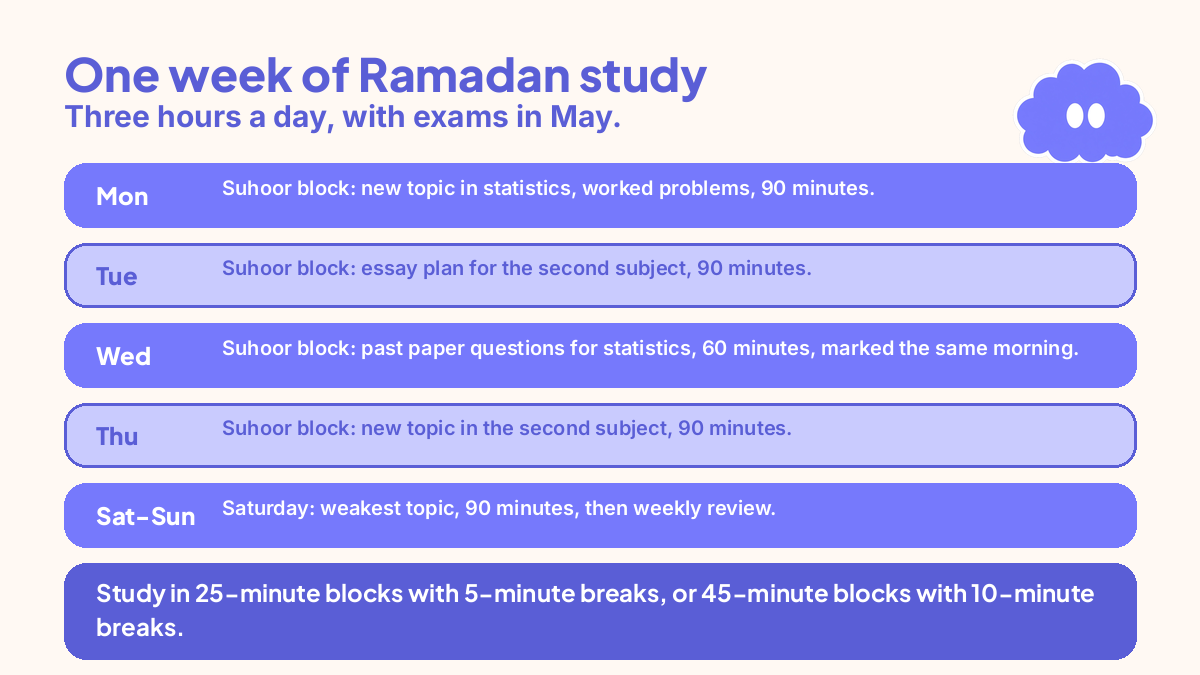
Your situation: University student, second year, exams in May. Ramadan runs through February and March. Three hours of study a day is the target. Suhoor is at 5:00am, iftar at 6:30pm. Lectures run 9:00am to 3:00pm.
- Monday, 5:30-7:00am: suhoor block. Hard task: new topic in statistics, worked problems, 90 minutes. Then lectures. Afternoon nap 4:00-4:25pm. Post-iftar block 7:15-8:45pm: test the statistics problems from memory, then flashcards for the second subject.
- Tuesday, 5:30-7:00am: suhoor block. Hard task: essay plan for the second subject, 90 minutes. Midday light block 12:30-1:00pm: flashcards on the bus and at lunch. Post-iftar block 7:15-8:45pm: write the essay introduction and first paragraph.
- Wednesday, 5:30-7:00am: suhoor block. Hard task: past paper questions for statistics, 60 minutes, marked the same morning. Afternoon nap 4:00-4:25pm. Post-iftar block 7:15-8:45pm: review the marked paper, put every lost mark on the gaps list.
- Thursday, 5:30-7:00am: suhoor block. Hard task: new topic in the second subject, 90 minutes. Midday light block 12:30-1:00pm: re-read notes. Post-iftar block 7:15-8:45pm: test the new topic from memory, 30 minutes, then organise files.
- Saturday, 6:00-7:30am: suhoor block, longer, no lectures. Hard task: the weakest topic from the week, 90 minutes. Afternoon nap. Post-iftar block 7:15-8:45pm: weekly review in writing, 20 minutes, then plan next week.
- Sunday: rest day. One light block only, 30 minutes of flashcards in the morning. Sleep, family, and no hard tasks.
When it goes wrong
You fall asleep in the suhoor block. Go to bed earlier, not later. The suhoor block only works if the night before was long enough. If you cannot sleep earlier, shorten the block to 45 minutes and move the hard task to the post-iftar block. A short block that happens beats a long one you sleep through.
The late afternoon is unusable and you feel guilty about it. Stop scheduling study there. The late afternoon before iftar is the lowest energy hour of the day, and rest is the right use of it. Move the work to the morning and the evening, and use the afternoon for rest, prayer, and family.
You keep missing suhoor and the next day is a write-off. Set two alarms, and prepare suhoor the night before so it takes five minutes. Eat protein and complex carbohydrates, and drink water. A missed suhoor is not a small thing: it decides the next day.
Weekly review checklist
Use this checklist at the end of each week of Ramadan, in writing, in 20 minutes.
- Which study blocks happened at their planned time, and which did not?
- Are my two peak windows still peaks, or has one faded?
- Which hard tasks got done this week, and which kept sliding?
- Did the split-night sleep work, and did I nap for 20 to 30 minutes?
- What did the testing show: which topics are now solid, and which are still shaky?
- What one change will I make to next week’s timetable, and what stays the same?
Downloadable infographic spec: one vertical image, title “How to study while fasting during Ramadan”, with the six steps from “The system in short” and the six review questions above, in Thynq cream, Cloud Purple, Dark Purple and pink, with the Cloud mascot. Text taken word-for-word from this article.
What this system is not
This system is not a way to study the same hours while fasting as you do when you are not. It does not promise grades, and it does not replace rest. It moves the work to the hours when your mind is fresh, and it protects the hours when it is not.
It is also not medical advice. If you feel unwell while fasting, rest and seek medical advice, and talk to your teacher about your deadlines. Fasting is a religious observance, and your health comes first. The system works around the fast; it never asks you to push through illness.
Sources
- Roediger, H. L., & Karpicke, J. D. (2006). Test-enhanced learning. Psychological Science, 17(3), 249-255. Retrieval practice beat restudying after a delay; short testing sessions work as well as long ones.
- Dunlosky, J., et al. (2013). Improving students’ learning with effective learning techniques. Psychological Science in the Public Interest, 14(1), 4-58. Only practice testing and distributed practice rated high utility; re-reading and highlighting rated low.
- Uskudar University (2026). Tips from an expert for efficient studying during Ramadan. Guidance from an educational counsellor on energy windows after suhoor and after iftar, short study intervals, and compensating broken sleep with daytime naps. The energy windows and the nap advice in this article follow that guidance.
For the full system behind this method, start with how to build a study system that fits your life.
Questions
When is the best time to study during Ramadan?
The best times are usually the one to two hours after suhoor, when you are fed and rested, and the one to two hours after iftar, once you have eaten and rested. Map your own energy for three days before the month starts, because your peak windows may differ from someone else’s.
Should I study less during Ramadan?
Study differently, not necessarily less. Move hard tasks like new topics and problem solving into your peak energy windows, and move light tasks like flashcards and re-reading notes into the low-energy hours. Shorter sessions of 25 to 45 minutes work better than long ones while you are fasting.
How do I sleep enough during Ramadan and still study?
Use a split-night plan: sleep after taraweeh, wake for suhoor, study in the early morning, and take a 20 to 30 minute nap in the afternoon. Keep the same wake time every day, and protect the nap as part of the plan, not as a failure.
What if my exams fall during Ramadan?
Front-load the heavy revision before the month starts, so Ramadan becomes a consolidation month of testing and review rather than new learning. In the exam week itself, use your peak window for the hardest subject, keep the exam-day routine the same, and tell your teacher or invigilator that you are fasting.