The direct answer
Overtime is a decision, not a weather event. Before the week starts, decide which extra hours you will accept and which you will refuse, protect the study blocks that sit closest to deadlines, and run a minimum week of 80 minutes when overtime eats the rest.
The trap with overtime is that each extra shift feels small on its own. One late finish here, one extra Saturday there, and by Friday you have worked ten extra hours and studied none. The money is real, and for many students it is needed, so this system does not tell you to refuse all overtime. It gives you a rule for deciding, a minimum week that survives the worst weeks, and a way to protect exam week before it arrives.
The system in short
- Set your overtime rule before the week starts: when you say yes, when you say no, and how many extra hours is too many.
- Protect two blocks: the block before the nearest deadline and one block on your day off. Overtime can take the rest.
- Run the minimum week when overtime lands: two 30-minute test sessions and one 20-minute review, all from memory.
- Use the gaps overtime leaves: before a shift, on a break, on the bus, in the 20 minutes after you get home.
- Tell your manager your exam dates two weeks early, in writing where you can, and name the days you cannot work extra.
- Review on Sunday for 15 minutes: how many extra hours you worked, what study survived, and whether the rule needs changing.
Step 1: Set your overtime rule before the week starts
Decide the rule on Sunday, before anyone asks you for extra hours, because in the moment you will say yes to almost anything. The rule has three parts. First, a weekly cap: the most extra hours you will accept in one week, such as four. Second, a no list: the shifts you never accept, such as the night before an exam or the day a big assignment is due. Third, a yes list: the overtime you will take gladly, such as a quiet Sunday shift when you have no deadline that week.
If the money from overtime is essential, say so honestly in the rule. A rule that pretends you do not need the money will break the first time rent is due. For the wider question of fitting study around paid work, How to study with a part-time job sets out the weekly shape this rule sits inside.
Step 2: Protect two blocks and let overtime take the rest
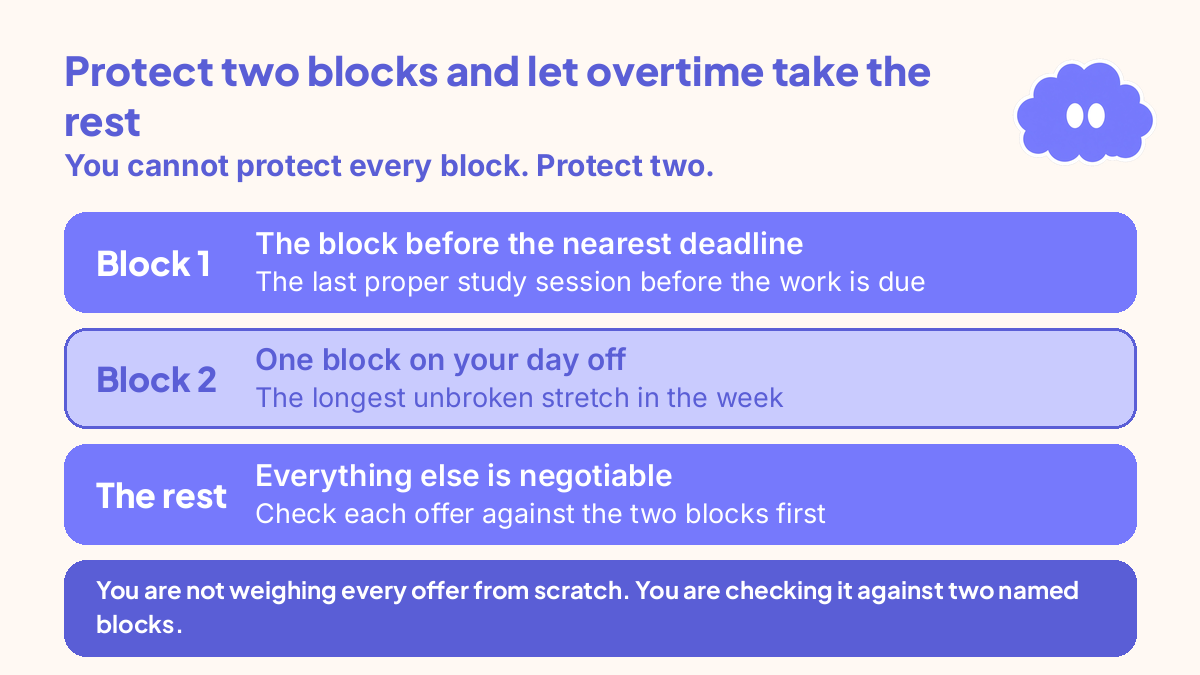
You cannot protect every study block from overtime, and trying to will fail. Protect two. The first is the block before the nearest deadline or exam: the last proper study session before the work is due. The second is one block on your day off, the longest unbroken stretch in the week. Everything else is negotiable.
Tell yourself, and your manager if it helps, that these two blocks are fixed. When overtime is offered, check it against the two blocks first. If it clashes with one of them, the answer is no, or the shift moves. If it clashes with anything else, the answer can be yes. This is what makes the decision fast: you are not weighing every offer from scratch, you are checking it against two named blocks.
If overtime takes a block that was not protected, do not try to win it back the same day. Move the task to the next free gap, or shrink it to a 20-minute test session, and move on. The plan survives by bending, not by fighting every change.
Step 3: Run the minimum week when overtime lands
When overtime has taken most of the week, drop to the minimum week: 80 minutes, in three sessions. Two 30-minute sessions testing yourself from memory on the most important topic, and one 20-minute review of what you got wrong. That is all. It is deliberately small, because a tired student after a long shift will do 30 minutes of testing, but will not do two hours of reading.
The minimum week works because testing from memory is the most useful thing you can do in a short session. Reading notes for 30 minutes feels productive but fades fast. Writing down everything you remember about a topic, then checking it, shows you exactly what you know and what you have forgotten, and it sticks. If you want the method behind it, read Blurting method for students: write down everything you remember. It is the same test in its simplest form: close the book, write everything you remember, check it in a different colour.
Do the three sessions on different days if you can, and never stack them into one long session on Sunday night. Spreading them out is what makes 80 minutes hold a whole week of material. If you can only manage two sessions, do those two and skip the review. Two is still a week. Zero is a lost week.
Step 4: Use the gaps overtime leaves
Overtime does not take every minute. It takes the big blocks and leaves the small gaps: twenty minutes before a shift, a lunch break, the bus home, the half hour after you get in before you fall asleep. Those gaps are too small for new material, but they are exactly right for testing and review.
Match the task to the gap. A 10-minute gap holds ten flashcards or one practice question. A 20-minute gap holds a test from memory on one topic, or a review of yesterday’s mistakes. A 30-minute gap before a shift holds a short timed practice. Do not try to learn a new chapter in a 15-minute gap. You will rush, retain nothing, and conclude that short sessions do not work. Short sessions work when the task fits the time.
Keep your flashcards or practice questions on your phone, ready to open, so a gap becomes a session without any setup. If the gap is on your lunch break, How to study on your lunch break shows how to use it without eating into the rest you also need.
Step 5: Tell your manager your exam dates two weeks early
Exam week is the one week overtime must not touch, and the way to protect it is to say so early, clearly, and in writing where your workplace allows it. Two weeks before the exam, tell your manager the dates and name the days you cannot work extra. Not “I have exams soon”, which is easy to forget, but “My exam is on Thursday 12 December, and I cannot work extra on Wednesday 11 or Thursday 12 December.”
Put it in writing if you can: a short message or an email, so there is a record. If your manager agrees, confirm it back in one line. If overtime is offered in exam week anyway, refuse it once, clearly, and offer an alternative: “I cannot do extra that week, but I can cover the Saturday after.” Offering an alternative week costs you nothing and makes the no much easier to accept.
If your manager will not agree to protect exam week, plan around it instead of fighting it. Run the minimum week, use the gaps, and book the exam morning off as holiday if you can. And if asking for time feels hard, How to ask your boss for study time has the exact words for the conversation, including what to do when the answer is no.
Step 6: Review on Sunday for 15 minutes
On Sunday, or on your first free evening, spend 15 minutes on three questions. First, how many extra hours did you work this week, and did you stay inside the cap you set? Second, what study survived, and did the two protected blocks hold? Third, does the rule need changing: is the cap too high, too low, or in the wrong place?
Write the answers in two or three lines. If you worked twelve extra hours and studied nothing, the rule failed, and the fix is a lower cap or a stronger no list, not more willpower. If you worked six extra hours and the minimum week ran, the system worked, and the same rule can run again. When work gets busy for a longer stretch, how to keep studying when work gets busy covers the slower grind that overtime often turns into.
A worked example: an overtime week before a deadline
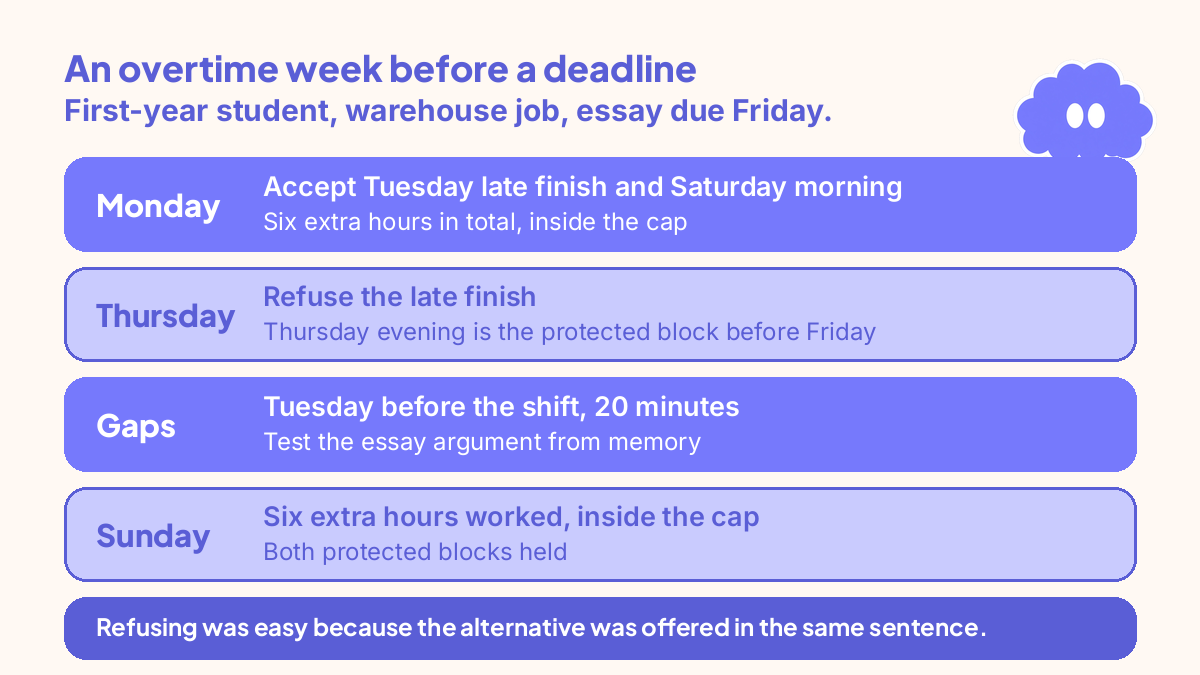
Your situation: First-year student, part-time job in a warehouse. Essay due Friday. On Monday the manager asks for overtime: late finishes Tuesday and Thursday, plus Saturday morning. Normal study week is six hours. Overtime rule for the week: at most six extra hours, never the night before the deadline, yes to Saturday morning.
- Monday, five minutes: Accept Tuesday late finish and Saturday morning, six extra hours in total. Refuse Thursday late finish, because Thursday evening is the protected block before the Friday deadline. Offer Friday afternoon instead, after the essay is in.
- Protected blocks: Thursday 6.00 to 8.00, essay final draft and reference check. Sunday 10.00 to 12.00, the day-off block, for the reading the essay depends on. Overtime can take everything else.
- Minimum week: The week still runs above the minimum, so no need to drop to it. But the short sessions fill the gaps: Tuesday before the late shift, 20 minutes testing the essay argument from memory. Wednesday lunch break, 15 minutes of flashcards on key terms. Saturday after the morning shift, 30 minutes reviewing the draft against the marking criteria.
- Thursday: Late finish refused, essay block runs as planned. Draft finished by 8.00, references checked, essay submitted Friday morning with an hour to spare.
- Sunday review: Six extra hours worked, inside the cap. Both protected blocks held. The rule worked. Note for next time: refusing Thursday was easy because the alternative, Friday afternoon, was offered in the same sentence.
When it goes wrong
You said yes to overtime in the moment and lost the protected block. Do not try to win the whole week back. Run the minimum week, move the deadline task to the next free gap, and fix the rule: next time, check the rule before answering, and give yourself a sentence to buy time, such as “Let me check my study plan and confirm in an hour.”
Overtime has run for three weeks and you are exhausted. That is not a study problem, it is a load problem. Cut the cap in half for the next two weeks, tell your manager you need a normal week, and run the minimum week until you recover. Pushing through exhaustion costs more study than it buys in pay.
Your manager keeps offering overtime in exam week despite being told. Say no once, clearly, and in writing. Then stop negotiating the same week twice. If the pressure continues, talk to your tutor or student support about what your rights are in your workplace, because the answer varies by contract and country, and guessing is not a plan.
The minimum week feels too small to matter. It matters because it keeps the material warm and the habit alive. Eighty minutes of testing from memory holds more than six hours of tired rereading. The week after overtime ends, you restart from warm material, not from zero.
Weekly review checklist
- How many extra hours did you work, and did you stay inside the cap?
- Did the two protected blocks hold, and which deadline did they protect?
- Did the minimum week run, or did overtime cancel study completely?
- Which gaps did you actually use, and which ones went to scrolling or sleep?
- Did you say yes to overtime you should have refused, and what will you say next time?
- Are the exam dates told to your manager yet, and are they in writing?
Downloadable infographic spec: one vertical image, title “How to study when you work overtime”, with the six steps from “The system in short” and the six review questions above, in Thynq cream, Cloud Purple, Dark Purple and pink, with the Cloud mascot. Text taken word-for-word from this article.
What this system is not
It is not a reason to refuse all overtime. The money is real, and for many students it pays the rent, so a system that pretends otherwise would be ignored by the first week. It is not a promise that you can work unlimited extra hours and still study well, because you cannot. It does not fix a manager who will not respect a no, or a contract that makes overtime compulsory, and it does not replace knowing your rights at work. What it does is give you a rule you set when you are thinking clearly, two blocks worth defending, and a minimum week that keeps study alive when overtime takes the rest.
Sources
- Dunlosky, J., et al. (2013). Improving students’ learning with effective learning techniques. Psychological Science in the Public Interest, 14(1), 4-58. Only practice testing and distributed practice rated high; rereading and highlighting rated low.
- Roediger, H. L., & Karpicke, J. D. (2006). Test-enhanced learning. Psychological Science, 17(3), 249-255. Recallers remembered more a week later than restudiers, though restudiers felt more confident immediately.
- Cepeda, N. J., et al. (2006). Distributed practice in verbal recall tasks. Psychological Bulletin, 132(3), 354-380. Spaced practice beat massed practice; the optimal gap grows with how long you need to remember.
For the tired evenings overtime creates, read How to study when you are tired after work. For the rota changes that often come with it, read How to study when your rota changes.
Questions
How do I study when overtime takes my study time?
Decide before the week starts which overtime you will accept and which you will refuse, using the rule in Step 1. Then run the minimum week: two 30-minute test sessions and one 20-minute review, all from memory. Overtime shrinks the week; it should not cancel it.
Should I say no to overtime as a student?
Say no when the overtime would take the last study block before a deadline or an exam, or when you have already worked extra hours that week and are too tired to learn. Say yes when the money matters and the study can move to another day. The rule, not the guilt, should decide.
What is the minimum study week when I work overtime?
Eighty minutes: two 30-minute sessions testing yourself from memory, and one 20-minute review of what you got wrong. Do them in the gaps overtime leaves, such as before a shift or on a break. That is enough to keep the material warm until a normal week returns.
How do I protect exam week from overtime?
Tell your manager two weeks before the exam which days you cannot work extra, and name the dates. Put the exam dates in writing if your workplace allows it. If overtime is offered in exam week anyway, refuse it once, clearly, and offer an alternative week when you can help.