
The direct answer
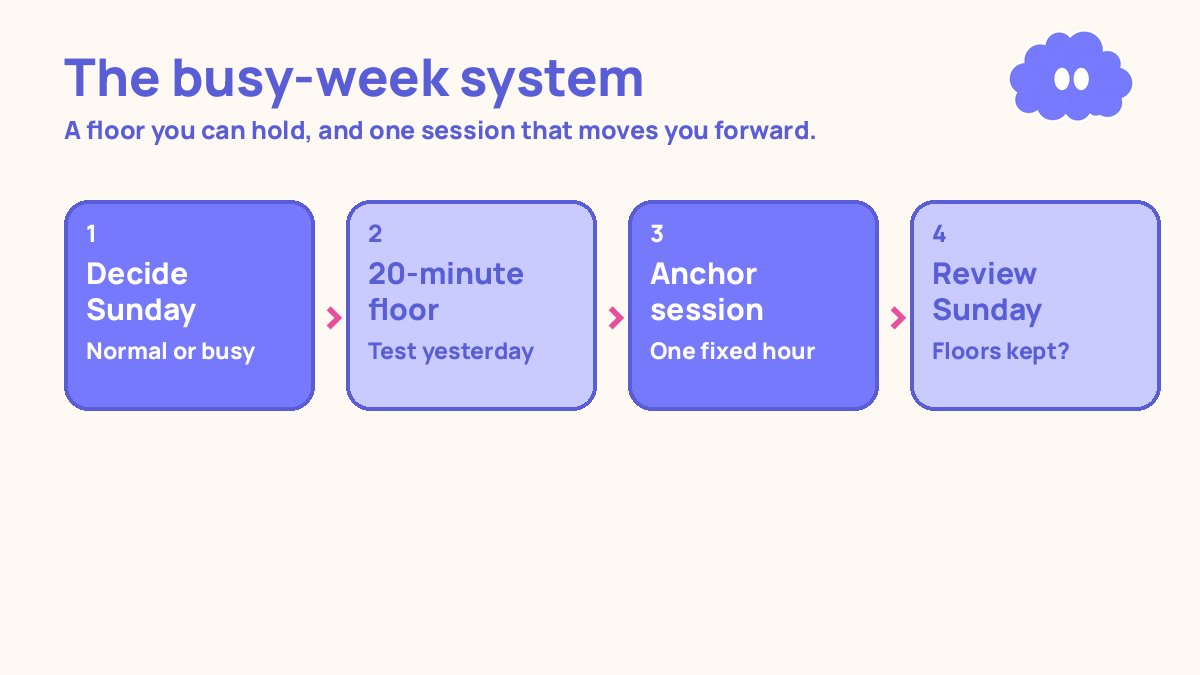
When work gets busy, cut your study down to a 20-minute daily minimum and one longer anchor session a week — and keep both, no matter what. The 20 minutes is for testing yourself on yesterday’s material, not for learning anything new. The anchor session is one fixed hour, same day and time each week, for the hardest topic. That is the whole system: a floor you can hold, and one session that keeps you moving forward.
You do not need a new planner or a motivational speech. You need a smaller plan that survives a busy week, and a rule for what happens when even the smaller plan breaks.
Why busy weeks kill study plans
A normal study plan assumes your week looks like last week. A busy week at work breaks that assumption. You stay late, you come home tired, and the two-hour evening session you planned does not happen. Then it does not happen the next night either, and by Thursday you have stopped trying, because the plan already feels lost.
The mistake is not that you missed a session. The mistake is that the plan had no smaller version. A plan with only one size — full speed or nothing — fails the first time life gets in the way.
So this system has two sizes built in from the start. There is the normal week, which is the two-hour study system for working students, and there is the busy week, which is this article. You switch between them on Sunday night, before the week starts, not on Wednesday when you are already behind.
The system in short
- On Sunday night, look at the week ahead and decide: normal week or busy week. One honest look at your work rota is enough.
- In a busy week, the daily floor is 20 minutes, spent testing yourself on yesterday’s material. No new topics, no long reading.
- Keep one anchor session: one fixed hour, same day and time each week, for your hardest topic.
- Write an if-then plan for the floor: when you finish dinner, you sit down for 20 minutes. No decision needed in the moment.
- On Sunday, review the week in five minutes: how many floors did you keep, and is next week normal or busy?
If work has already eaten your revision time, start with How to revise when you are behind before you try to add more hours.
Step 1: Decide on Sunday, not on Wednesday
Every Sunday night, before the week starts, look at your work rota and ask one question: is next week a normal week or a busy week? A busy week is one where you will work late at least twice, or work a weekend day, or carry a deadline that will eat your evenings.
If it is a busy week, say so and switch to the busy plan now. Do not wait until Wednesday to admit it. The switch is not a failure. It is the system working as designed. A busy plan you follow beats a normal plan you abandon by Thursday.
Step 2: The 20-minute floor
The floor is 20 minutes a day, and it has one job: keep the material alive. You spend it testing yourself on what you studied yesterday or last week. Close the book, write down what you remember, then check. Or answer five questions from memory. Or explain one idea out loud in your own words.
Do not use the floor for new material. New material needs fresh attention, and a busy week has none to spare. The floor is maintenance, and maintenance is enough. In a 2013 review, Dunlosky and colleagues rated ten common study techniques, and only two received a high utility rating: practice testing and distributed practice. Testing yourself is one of the two best-supported things you can do — and it fits in 20 minutes. It also protects the habit: a daily behaviour takes a median of 66 days to feel automatic, with a range of 18 to 254 days, and missing one day does not reset it (Lally et al., 2010).
Step 3: The anchor session
One hour, once a week, same day and same time, for your hardest topic. This is the anchor session, and it is the only long session in a busy week. Everything else is the floor.
Pick the day when you are least likely to be called in. For most working students that is a weekend morning — Saturday or Sunday, before the day fills up. Put it in your calendar as a fixed appointment. An anchor that moves every week is not an anchor.
Use the hour for the topic you are most afraid of falling behind on. Work problems, write answers from memory, test yourself — do the hard work, not the easy reading. A meta-analysis of the testing effect found that testing yourself beat restudying by a medium amount (g = 0.50), and that the advantage was larger when you got feedback on your answers (g = 0.73 with feedback, against 0.39 without) (Rowland, 2014). So check your answers in the same session. A test with no checking is only half a test.
If the anchor session gets cancelled by work, move it once, to the next day, and do it then. If it gets cancelled twice, let it go. Do not chase a missed anchor into the following week.
Step 4: The if-then plan for the floor
The floor fails when it needs a decision. You come home tired, you look at the sofa, and you have to decide whether to study. That decision is where busy weeks win. So make the decision on Sunday, once, in if-then form: “When I finish dinner, I will sit at the table and test myself for 20 minutes.”
An if-then plan names the cue and the action in advance, so starting does not need a fresh decision. Across 94 studies, if-then plans raised goal attainment by a medium-to-large amount (d = 0.65) over holding the goal alone (Gollwitzer & Sheeran, 2006). Write the plan down and say it out loud once, on Sunday.
Pick a cue that happens every day no matter how busy work is: finishing dinner, getting home, the kettle boiling. Attach the 20 minutes to that cue, and keep the study spot ready: book open, questions written, timer on the table. If you have to hunt for your notes first, the 20 minutes will lose to the sofa.
Step 5: The Sunday review
Five minutes, every Sunday, three questions. How many of the five daily floors did I keep? Did the anchor session happen? Is next week normal or busy? Write the answers on paper, one line each. A week with four floors and one anchor is a good busy week.
A worked example: a busy week at the warehouse
You work in a warehouse. This week there is a stock-take, so you are on late shifts Monday to Thursday and a Saturday morning shift. Your normal study plan is two hours a night. This week, it will not happen. On Sunday night you switch to the busy plan.
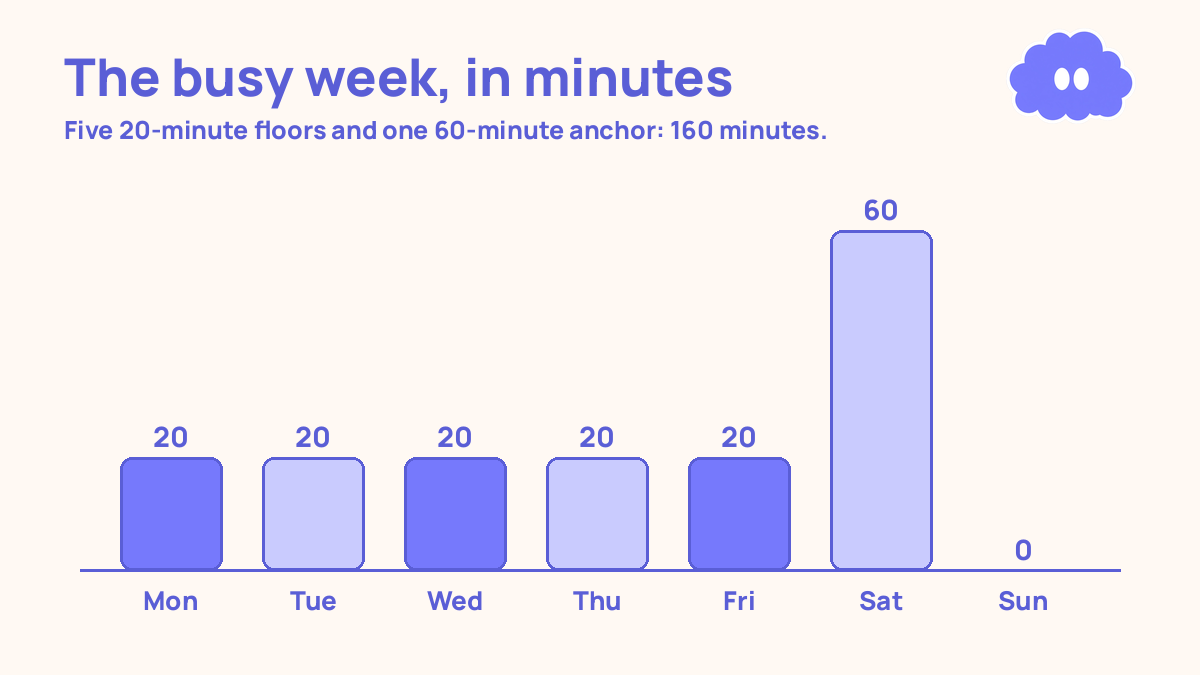
Monday–Thursday, 8:00–8:20pm — the floor: You get home at 7:30, eat, and at 8:00 you sit down for 20 minutes. Monday you test yourself on last week’s statistics questions from memory. Tuesday you rewrite the three formulas you keep forgetting, from memory, then check. Wednesday you explain one economics idea out loud. Thursday you re-test Monday’s questions. Four floors kept, 80 minutes total.
Friday, 8:00–8:20pm — the floor: Friday is a normal finish, but you keep the floor anyway. Routine beats mood. You test yourself on the week’s weakest topic. Five floors kept, 100 minutes total.
Saturday, 10:00–11:00am — the anchor session: Saturday morning, before your shift, one hour on statistics — the hardest topic. You work through ten problems, check every answer, and write down the three you got wrong to test again next Saturday. One anchor kept.
Sunday — rest, then review: No study on Sunday. Five minutes in the evening: five floors, one anchor, 160 minutes total for the week. That is far less than a normal week’s 600 minutes — but you kept every topic warm, you kept the daily habit unbroken, and on Monday you pick up the full plan without a week of catching up first.
When it goes wrong
You miss the floor three days in a row. The cue is wrong, not you. If dinner finishes at a different time every night, “after dinner” is not a cue. Pick a cue that never moves: when you walk through the front door, or when the kettle boils. Move the floor to the new cue and try again tomorrow.
The anchor session keeps getting cancelled. If work cancels it twice, stop moving it. A session that has been moved twice is not going to happen, and chasing it eats the next week too. Let it go, keep the floor, and protect next week’s anchor instead. If anchors keep failing for a month, the anchor day is wrong — try a different day, or split it into two 30-minute sessions.
The busy period never ends, and the floor becomes permanent. After three weeks at the floor, stop and look at the whole picture. Is the work always going to be this busy? If yes, rebuild the normal plan around the time you actually have — maybe that is one hour a night, not two. A smaller honest plan beats a big plan you never follow.
Weekly review checklist
Copy this list and use it each Sunday:
- Normal week or busy week next week — decided on Sunday, not on Wednesday?
- How many of the five daily floors did I keep this week?
- Did the anchor session happen, on the day and time I fixed?
- What one change will I make next week: a better cue, a different anchor day, or a shorter floor?
Downloadable infographic spec: one vertical image, title “The busy-week system”, with the two rules — a 20-minute daily floor for testing yourself, and one fixed one-hour anchor session a week — plus the three steps: decide on Sunday, use an if-then cue, review for five minutes on Sunday, in Thynq cream, Cloud Purple, Dark Purple and pink, with the cloud mascot. Text taken word-for-word from this article.
What this system is not
It is not a way to study less and learn the same amount. A busy week at the floor covers less ground than a normal week, and this system does not pretend otherwise. It is also not a promise that 20 minutes a day will get you through an exam on its own.
Sources
- Dunlosky, J., et al. (2013). Improving students’ learning with effective learning techniques. Psychological Science in the Public Interest, 14 (1), 4-58. Only practice testing and distributed practice received a high utility rating.
- Rowland, C. A. (2014). The effect of testing versus restudy on retention: a meta-analytic review of the testing effect. Psychological Bulletin, 140(6), 1432–1463. Testing beat restudying (g = 0.50); with feedback the effect was larger (g = 0.73) than without it (g = 0.39).
- Gollwitzer, P. M. & Sheeran, P. (2006). Implementation intentions and goal achievement: a meta-analysis of effects and processes. Advances in Experimental Social Psychology, 38 , 69–119. If-then plans raised goal attainment (d = 0.65) over holding the goal alone.
- Lally, P., et al. (2010). How are habits formed: modelling habit formation in the real world. European Journal of Social Psychology, 40(6), 998–1009. Median time for a behaviour to feel automatic was 66 days, range 18–254; missing one day did not measurably hurt the process.
For the full system this fits inside, start with the two-hour study system for working students, and if the whole week is packed rather than just work, read the study system for students with a busy week.
Questions
What is the smallest amount of study that still counts?
Twenty minutes a day, spent testing yourself on yesterday’s material. That is enough to keep the habit and the material alive through a busy week. It is a floor, not a target — you go back up when work calms down.
What if the busy period lasts a whole month?
Then the minimum becomes the plan, not the exception. Keep the 20-minute daily floor and the one weekly anchor session for the whole month, and review each Sunday to check nothing has slipped. A month at the minimum still beats a month at zero.
Should I learn new material in a busy week?
No. A busy week is for keeping what you already know. Test yourself on old material and review your notes. New material needs fresh attention, and a busy week does not have any to spare.
How do I restart after missing a full week?
Do not try to catch up on everything you missed. Start with one 20-minute session on the most recent topic, test yourself on it, and build back to your normal plan over three days. One missed week is a pause, not a failure.