The direct answer
To study when you work in healthcare, study on days off and before shifts, never after a long shift, and plan each week around your placement dates. Give days off the heavy learning, give shift days audio review and practice, and give post-shift evenings retrieval only or nothing. Sleep comes before study, every time.
Healthcare work has a shape other jobs do not: shifts run 12 hours or more, nights rotate, placements are fixed blocks you cannot move, and the work itself is emotionally heavy. A patient in pain, a difficult family, a death on the ward: these stay with you after the shift ends. Students who copy a 9-to-5 study plan into that shape plan evenings that never happen.
The system in short
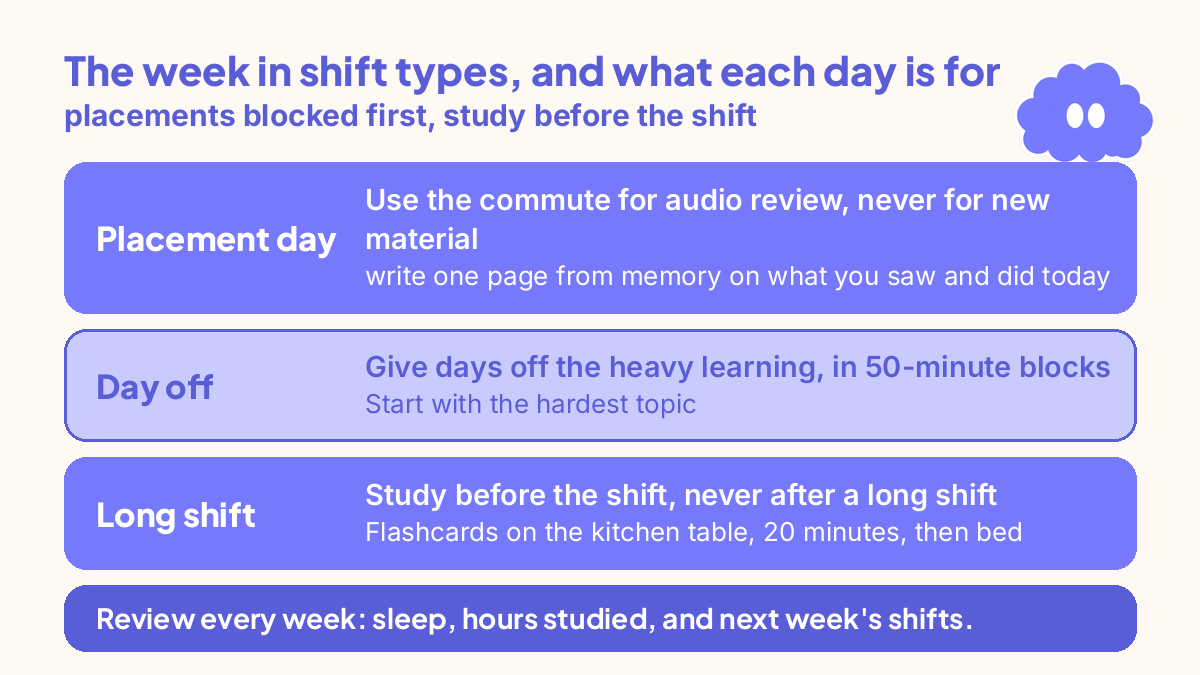
- Get your placement dates in writing and block them first.
- Study before the shift, never after a long shift.
- Use the commute for audio review, never for new material.
- Give days off the heavy learning, in 50-minute blocks.
- Keep post-shift evenings to 20 minutes of retrieval, or nothing at all.
- Review every week: sleep, hours studied, and next week’s shifts.
Step 1: Get your placement dates in writing and block them first
Placements are the fixed constraint in healthcare study. They cannot be moved, swapped, or shortened, and they usually run in blocks of days or weeks. The day your placement dates are published, get them in writing and block them in your diary before anything else. A placement week is a work week, and the study plan for that week is written around it, not through it.
For each placement block, write down the dates, the start and finish times, and the travel time. The placement week is audio review on the commute and a 20-minute debrief at home, and nothing else. The heavy learning goes in the weeks either side.
Give your manager the placement dates in writing the day you get them, with the exam dates attached, and give your tutor the same dates. The Study system for night-shift students is the right companion when a placement includes nights, because it is built around the same problem: fixed hours you cannot move.
Step 2: Study before the shift, never after a long shift
A 12-hour healthcare shift is physical and emotional work at once: hours on your feet, lifting and moving patients, concentrating through handovers, and carrying the feelings of the day home with you. By the end of it, your body is tired and your attention is spent. Studying then usually means rereading the same page three times and remembering none of it. The students who keep going in healthcare study before the shift takes their energy, not after.
So the rule is simple: the study session comes first in the day, before the shift. For a day shift starting at 8 am, that means 25 minutes before you leave. For a late shift starting at 2 pm, it means a 50-minute session in the morning, on the hardest topic of the week.
This is also why How to study when you are tired after work fits healthcare students so well: it assumes the evening is already spent, and builds the day around the hours that are still fresh. And when the shift itself runs 12 hours, the How to study after a 12-hour shift sets the same rule in more detail. If the study happened in the morning, the evening is yours to rest.
Step 3: Use the commute for audio review, never for new material
The commute is the healthcare student’s most reliable study time: it happens every shift day and needs no planning. Use it for audio review of what you already know: recorded lectures, your own voice notes, or a summary you recorded the night before. Listen once, then say the key points out loud from memory.
Never use the commute for new material. New topics need a desk, a pen, and your full attention, and a driver or a tired passenger cannot give that. Audio is for retrieval, not for learning. If you drive, keep the audio to familiar material only, and never look at a screen while driving.
Record your own summaries after a study session: three minutes, the three things you must remember, in your own words. Play that recording on the next commute. Making it is itself a test of what you know.
Step 4: Give days off the heavy learning, in 50-minute blocks
A day off in healthcare is rare, and the mistake is spending it on chores and then studying at 8 pm when the day is gone. Protect the morning of every day off for the heavy learning: new topics, essays, and anything you have not seen before, in 50-minute blocks with a 10-minute break.
Start with the hardest topic, not the easiest: the fresh mind is available at 9 am on a day off, not at 9 pm on a shift day. Work in this order: read once and close the book, write what you remember, then check and fix the gaps. If you finish the morning’s blocks early, stop.
Healthcare study is heavy on facts that must be exact: drug doses, anatomy, infection control, procedures. The Flashcard system that works is built for exactly this kind of material: learn in the block, then test yourself with the cards the next day. Keep the afternoon of a day off free.
Step 5: Keep post-shift evenings to 20 minutes of retrieval, or nothing at all
A post-shift evening means you get home tired, hungry, and carrying the day with you. The rule is 20 minutes of retrieval or nothing, and nothing is the right choice more often than students think. Retrieval means flashcards or questions on what you already know, for 20 minutes, then bed. It is not new material, not an essay, and not a past paper.
Put the flashcards on the kitchen table before you leave, so coming home means picking them up, not deciding what to do. If even 20 minutes feels impossible, skip it and go to bed.
On emotionally hard days, shorten the session instead of skipping the system. Do ten minutes of retrieval, write one line in your notebook about what happened if it helps, and stop. The work is physical, and the How to study when your job is physical work makes the same point: the body sets the limit, and the system respects it.
Step 6: Review every week
Spend ten minutes on your first day off each week, and ask: how many hours did I sleep, and how many did I study? Did the pre-shift sessions happen? Did the day off hold the heavy learning? Is the misses list getting shorter? Where do next week’s study hours go?
The review catches the two healthcare failure modes early: sleep debt, and the placement squeeze. If your review shows two weeks of short nights and no study, the answer is sleep first, not more study. If a placement block is coming and the weeks either side hold no heavy learning, move the learning now.
End the review by writing next week’s sessions into the diary, next to the shifts and placement days. That is the system: placements blocked first, study before the shift, audio on the commute, heavy learning on days off, retrieval after long shifts, review every week.
A worked example: a placement week with two long shifts
Your situation: Third-year nursing student, part-time healthcare assistant, 20 hours a week. This week: Monday day off, Tuesday 12-hour shift 7 am to 7 pm, Wednesday placement 8 am to 4 pm, Thursday placement 8 am to 4 pm, Friday day off, Saturday 12-hour shift 7 am to 7 pm, Sunday off. Exam in six weeks, weakest subject is pharmacology.
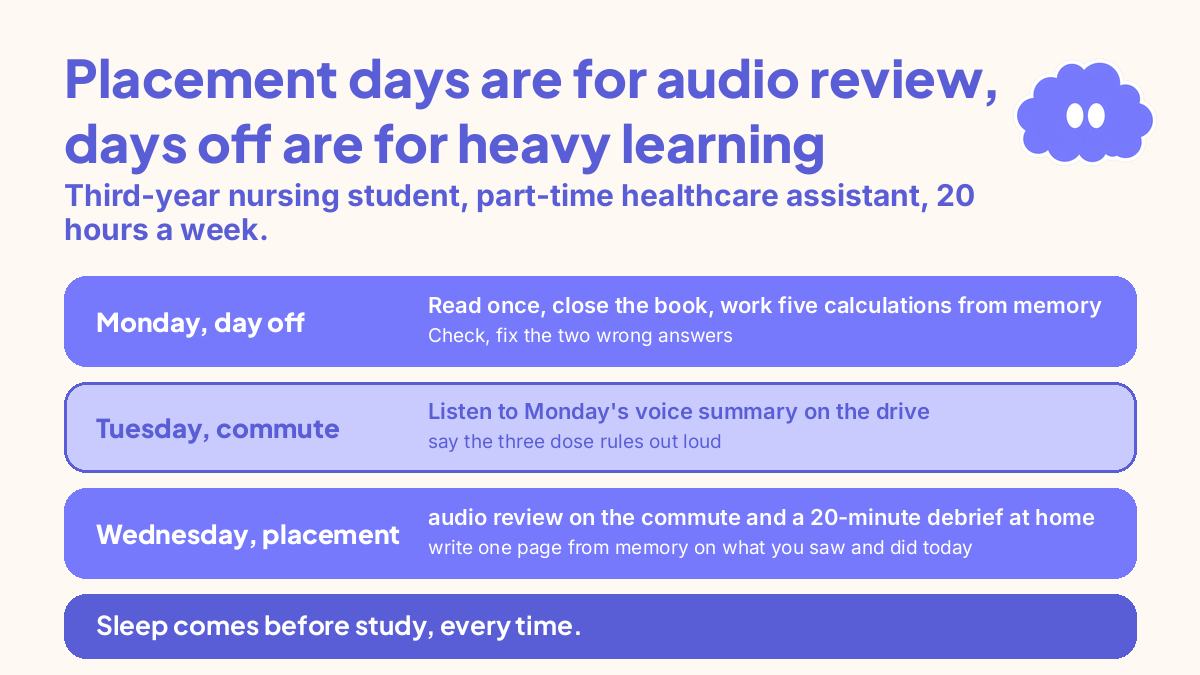
- Monday, day off, 9.00 to 9.50: Pharmacology, new topic, drug calculations. Read once, close the book, work five calculations from memory. Check, fix the two wrong answers, write them in the misses notebook.
- Monday, 10.00 to 10.50: Pharmacology again, same topic. Five more calculations from memory, all right this time, then record a three-minute voice summary of the dose rules.
- Tuesday, 6.30 to 6.55: 12-hour shift. 25 minutes before you leave: five practice questions on drug calculations, from memory, marked before you leave. Two wrong, both about unit conversion; they go in the misses notebook.
- Tuesday, commute: Listen to Monday’s voice summary on the drive, then say the three dose rules out loud at the car park. No new material.
- Tuesday, 7.30 pm: Home, long shift done. Flashcards on the kitchen table, 20 minutes, then bed. Nothing new.
- Wednesday, placement, commute: Audio review only: the voice summary again, plus a recorded lecture on infection control. On the ward, no study, only work.
- Wednesday, 4.30 pm: Home from placement. 20-minute debrief: write one page from memory on what you saw and did today, then check it against your notes. This is the day’s study.
- Thursday, placement, same pattern: Same pattern as Wednesday: audio on the commute, work on the ward, 20-minute debrief at home.
- Friday, day off, 9.00 to 9.50: Infection control, new topic. Same pattern: read once, close, write from memory, check.
- Saturday, 6.30 to 6.55: 12-hour shift. 25 minutes: the misses notebook, read and re-tested. The two unit-conversion questions are right this time.
- Sunday, day off, 9.00 to 10.30: One 90-minute anchor: a timed practice paper, pharmacology and infection control mixed, marked the same morning. Score noted, misses added to the notebook.
The week held five and a half hours of study, all before shifts, on commutes, or on days off. The misses notebook shrank from six items to two.
When it goes wrong
A placement block lands on your only study week. Move the heavy learning to the weeks either side now, while the days off still exist. The placement week itself becomes an audio and debrief week, and that is enough.
You keep studying after 12-hour shifts and retaining nothing. Stop. The evening is not a study slot, and forcing it teaches you that study does not work. Move the session to the morning before the next shift, even if it is only 25 minutes.
A hard day on the ward leaves you too drained to study. Shorten, do not skip. Ten minutes of retrieval, one line in the notebook, then rest. If two weeks running produce no study at all, talk to your tutor before the gap grows.
Nights rotate in and your sleep breaks down. Sleep comes first, before study, every time. The Study system for night-shift students plans study around the sleep window, not against it.
You study on the ward and get pulled into work. Stop studying at work. The ward is for patients, and a textbook on the ward is a distraction for you and a problem for your supervisor. The reliable study time is before the shift, on the commute, and on days off.
Weekly review checklist
- How many hours did I sleep, and how many did I study, in sessions that actually happened?
- Did the pre-shift sessions happen, or did study slide to the evening?
- Did the commute hold the audio review, or did it turn into music and scrolling?
- Did the day off hold the heavy learning, or did chores take the morning?
- What is on the misses list, and is it getting shorter?
- Is there a placement block or an exam coming that needs dates requested now?
Downloadable infographic spec: one vertical image, title “How to study when you work in healthcare”, with the six steps from “The system in short” and the six review questions above, in Thynq cream, Cloud Purple, Dark Purple and pink, with the Cloud mascot. Text taken word-for-word from this article.
What this system is not
It is not a way to study after a 12-hour shift and still learn; nobody learns well then, and pretending otherwise wastes the evening and the sleep after it. It is not a promise that healthcare work and study fit together in placement weeks; some weeks they barely fit, and the honest answer then is audio and debriefs only, not a heroic all-nighter. It does not replace your lectures, your placement supervisor, or your course handbook. And it does not make the emotional weight of the work disappear: some days are hard, and the system plans around that instead of wishing it away.
Sources
- Dunlosky, J., et al. (2013). Improving students’ learning with effective learning techniques. Psychological Science in the Public Interest, 14(1), 4-58. Practice testing and distributed practice rated high; rereading rated low, which is why shift days use testing from memory instead of re-reading.
- Cepeda, N. J., et al. (2006). Distributed practice in verbal recall tasks. Psychological Bulletin, 132(3), 354-380. Spaced practice beat massed practice, which supports short sessions across the week instead of one long session.
- Roediger, H. L., & Karpicke, J. D. (2006). Test-enhanced learning. Psychological Science, 17(3), 249-255. Recallers remembered more a week later than restudiers, which supports testing from memory in the pre-shift hour.
For the wider working-student system behind this one, start with How to build a study system that fits your life.
Questions
How do I study when I work long shifts in healthcare?
Study on days off and before shifts, never after a long shift. Give days off the heavy learning in 50-minute blocks, give shift days short audio review on the commute and 25 minutes of practice before work, and give post-shift evenings retrieval only or nothing. Sleep comes before study, every time.
How do I study around a healthcare placement?
Treat placement days as work days: no heavy learning, only audio review on the way there and a 20-minute debrief when you get home. Put the heavy learning on the days around the placement, and ask for your placement dates in writing as soon as they are published so you can plan the weeks either side.
How do I keep studying when healthcare work is emotionally draining?
Shorten the sessions, do not skip the system. On draining days, do 20 minutes of retrieval and stop. Keep one anchor session a week that never moves, and use the weekly review to spot the weeks when the work is taking too much. If two weeks running produce no study at all, talk to your tutor before the gap grows.
Can I study on the ward or between patients?
Only in the ways your workplace allows, and only for review, never for new material. A five-minute flashcard check during a break is fine where phones are allowed; a textbook on the ward is not. The reliable study time is before the shift, on the commute, and on days off.