The direct answer
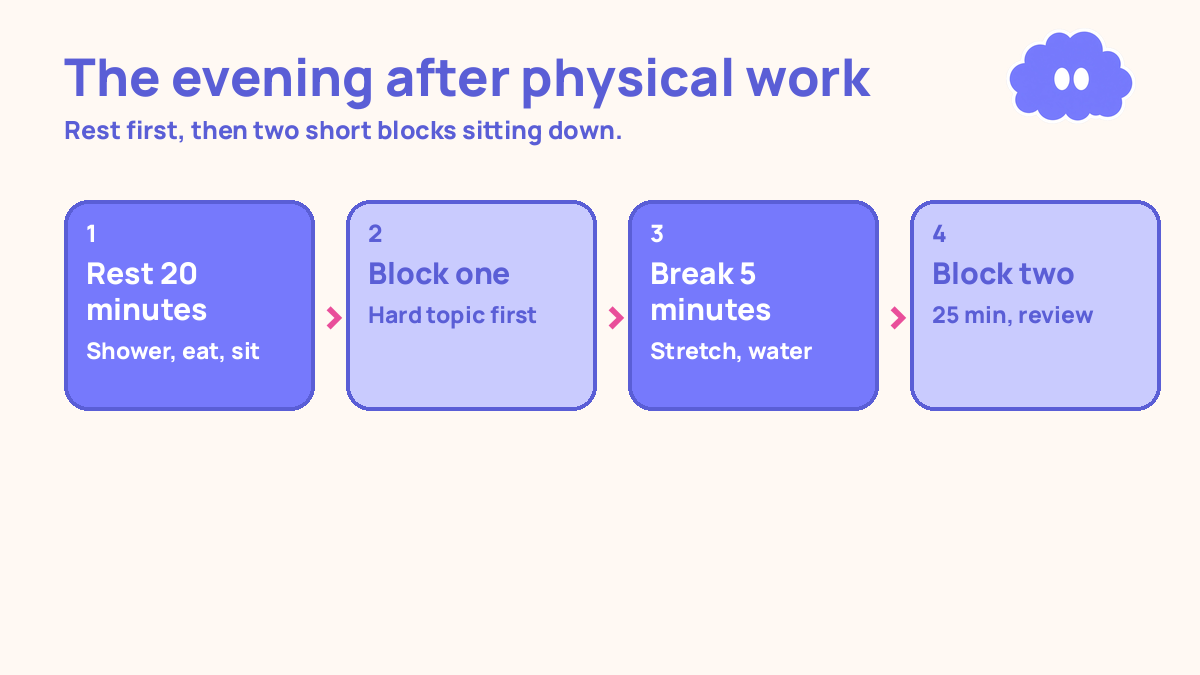
When your job is physical work, study starts with rest, not with books. Come home, shower, eat, and rest for 20 minutes. Then sit down and study in two 25-minute blocks, with a five-minute break between them, testing yourself from memory. Then stop, and let sleep do the rest. That is the whole system: rest first, two short blocks sitting down, and no studying past the point where your body gives out.
You do not need more hours or more willpower. You need a routine that accepts that your body is tired and works with that, instead of a plan that pretends you came home fresh.
Why a physical job breaks normal study plans
A normal study plan assumes you come home with a tired mind and a rested body. A physical job turns that around: you come home with a rested mind and a tired body. Your legs ache, your hands are sore, your back is stiff — and the plan says sit at a desk for two hours and write notes.
So you sit down, and after twenty minutes your handwriting falls apart, your eyes close, and you decide you are lazy. You are not lazy. You are trying to study with a body that has been working all day, in a position that hurts, for longer than it can manage.
The fix is to change the shape of the study, not the amount of effort. Short blocks, sitting down, no fine handwriting, and a rest before you start.
The system in short
- Rest first: 20 minutes when you get home — shower, eat, sit down. No books yet.
- Two 25-minute blocks, sitting down, with a five-minute break between them. That is the whole session.
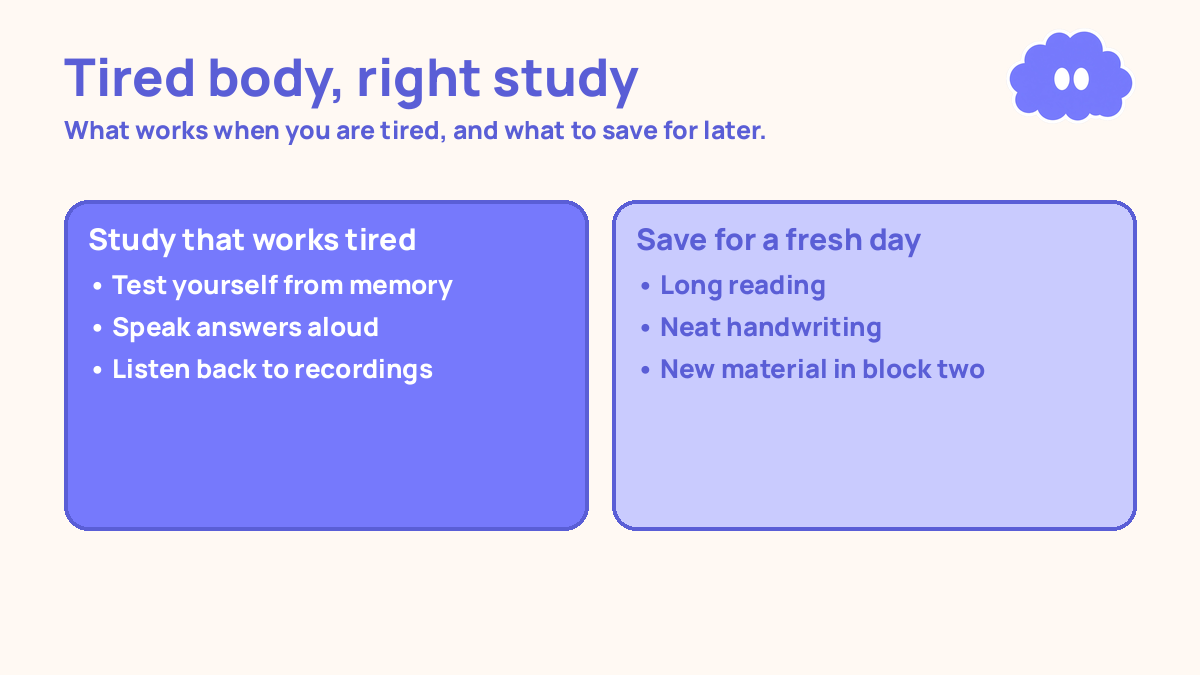
- Study that fits a tired body: test yourself from memory, speak answers aloud, listen back.
- Do the hard topic in the first block, when you have the most energy left.
- Stop at the end of the second block. Sleep is part of the system, not a reward for finishing.
Step 1: Rest first, for 20 minutes
When you get home, do not open a book. Shower, eat something, and sit down for 20 minutes. No phone, no notes, just rest. The 20 minutes is not wasted time. It is the gap between work and study, and without it the study does not work.
Your body needs the signal that work has stopped. A shower does that. Food does that. Sitting down with nothing to do does that. If you go straight from the door to the desk, your body is still in work mode — tense, alert, waiting for the next thing to lift or carry. Twenty minutes of rest lets it stand down.
Set a timer for 20 minutes if you need one. When it rings, the rest is over and the study starts. Without a timer, the rest stretches into the evening, and the study never happens.
Step 2: Two 25-minute blocks, sitting down
Two blocks of 25 minutes, with a five-minute break between them. That is 50 minutes of study, and that is the session. Not two hours. Not “until I finish the chapter”. Fifty minutes, then stop.
The 25-minute length is a practical timer, not a number from cognitive science — it was Francesco Cirillo’s practical choice, and it works because it is short enough to survive tiredness. Sit down for both blocks. Do not stand at a counter, do not lie on the bed, do not study on the sofa with the book on your knees. Sit at a table, in a chair that supports your back, with the work in front of you.
In the five-minute break, stand up, stretch, get water. Do not check your phone. Five minutes of scrolling is not a break, and it will follow you into the second block. The break is for your body, which has been sitting still after a day of moving — it needs to move a little, then sit again.
Step 3: Study that fits a tired body
A tired body changes what study works. Fine handwriting does not work — your hand is sore and your writing falls apart. Long reading does not work — your eyes close. What works is testing yourself, speaking, and listening.
Test yourself from memory. Close the book, write down what you remember — in short notes, not neat handwriting — then check. In a 2013 review, Dunlosky and colleagues rated ten common study techniques, and only two received a high utility rating: practice testing and distributed practice. Testing yourself is one of the two best-supported things you can do, and it needs no fine motor control.
Speak your answers aloud. Explain one idea in your own words, out loud, as if you were telling a colleague. Speaking works when writing does not, and hearing your own answer tells you at once whether you actually know it or are just repeating words.
Listen back when you can. Record yourself explaining a topic on your phone, then listen to it on the way to work the next morning. Your hands are free, your eyes are free, and the review happens without sitting down at all.
Step 4: Hard topic first, easy topic second
Do the hard topic in the first block, when you have the most energy left after the rest. Work problems, test yourself on the topic you are weakest on, write answers from memory and check them. A meta-analysis of the testing effect found that testing yourself beat restudying by a medium amount (g = 0.50), and that the advantage was larger when you got feedback on your answers (g = 0.73 with feedback, against 0.39 without) (Rowland, 2014). So check your answers in the same block. Use the second block for easier work: reviewing yesterday’s cards and re-testing the questions you got wrong.
Step 5: Stop, and let sleep work
When the second block ends, stop. Do not add a third block because you feel guilty. A third block after a physical shift is usually staring at the page, and staring is not studying. The session is 50 minutes, and 50 honest minutes beat two tired hours.
Go to bed at a normal time. Sleep is when the day’s learning is consolidated. Diekelmann and Born (2010) reviewed how sleep supports memory: during slow-wave sleep, patterns of brain activity from learning are re-activated, and memories are gradually moved from the hippocampus to the cortex for long-term storage. A short night after a long study day means the work was done but the consolidation was cut short. After a physical day, sleep is not a luxury. It is part of the study system.
A worked example: an evening after a building site shift
You work on a building site, 7am to 5pm, on your feet all day. You get home at 6:30pm. You have an exam in five weeks.
6:30–6:50pm — rest: You shower, eat, and sit down for 20 minutes. No books, no phone. Your body stands down from work mode.
6:50–7:15pm — block one, 25 minutes: Hard topic first. You test yourself on ten maths problems from memory, working them on paper in short notes, then check every answer. You get six right and four wrong. The four wrong ones go on tomorrow’s list.
7:15–7:20pm — break: You stand up, stretch, get water. Five minutes, no phone.
7:20–7:45pm — block two, 25 minutes: Easy work. You re-test the four problems you got wrong, then listen back to a two-minute recording of yourself explaining one idea from yesterday. You get three of the four right this time.
7:45pm — stop: Fifty minutes of study, done by quarter to eight. You eat, relax, and go to bed at a normal time. Five evenings a week at 50 minutes is 250 minutes — just over four hours — and every one of those minutes was real study, not staring.
When it goes wrong
You skip the rest and study straight from the door. The session falls apart after fifteen minutes, because your body never stood down from work. The fix is a rule: no books until the shower and the 20 minutes are done. Put the books in another room if you have to. The rest is step one, not a suggestion.
Your hands are too sore to write anything. Then do not write. Test yourself by speaking answers aloud, and record yourself explaining the topic. Speaking is a full study method, not a lesser one — and if your hands hurt, it is the method that works. Write only the shortest notes: a word, a number, a tick for right or wrong.
You fall asleep in the second block every night. The second block is too late, or the day was too long. Move the session earlier — start the rest the minute you get home, not after an hour of chores — or drop to one block on the hardest days. One honest 25-minute block beats two blocks where the second one is sleep.
You feel guilty about 50 minutes and push to two hours. The guilt is the problem, not the 50 minutes. Fifty minutes a day, five days a week, is 250 minutes of real study. Two hours a night, half asleep, is not more study — it is more sitting. Count the honest minutes, not the hours at the desk. If you want more, add a morning session on a rest day, not a third block at night.
Weekly review checklist
Copy this list and use it each Sunday:
- How many evenings did I rest first, before opening a book?
- How many two-block sessions did I complete this week?
- Which topics did I test myself on — and which ones did I only re-read?
- Did I stop at the end of the second block, or push past it?
- What one change will I make next week: an earlier rest, a different first topic, or a shorter session on the hardest days?
Downloadable infographic spec: one vertical image, title “Study after physical work”, with the evening in order — 20 minutes rest, 25 minutes hard topic, 5 minutes break, 25 minutes review, then stop and sleep — and the rule: no books until the shower and the rest are done, in Thynq cream, Cloud Purple, Dark Purple and pink, with the cloud mascot. Text taken word-for-word from this article.
What this system is not
It is not a way to study for hours after a physical shift. Fifty minutes a day is the honest amount for most people after physical work, and this system does not pretend you can do more by trying harder. It is also not a promise that short sessions alone will carry you through an exam. They keep you moving and keep the material warm. For the long sessions — the mock exams, the hard problem sets — use a rest day, when your body has recovered. And if you are tired in a different way — mentally tired after office work rather than physically tired — read how to study when you are tired after work and the evening study routine for tired students instead.
Sources
- Dunlosky, J., et al. (2013). Improving students’ learning with effective learning techniques. Psychological Science in the Public Interest, 14(1), 4-58. Only practice testing and distributed practice received a high utility rating.
- Rowland, C. A. (2014). The effect of testing versus restudy on retention: a meta-analytic review of the testing effect. Psychological Bulletin, 140(6), 1432–1463. Testing beat restudying (g = 0.50); with feedback the effect was larger (g = 0.73) than without it (g = 0.39).
- Diekelmann, S. & Born, J. (2010). The memory function of sleep. Nature Reviews Neuroscience, 11(2), 114–126. Sleep improves the consolidation of what was learned; during slow-wave sleep, learning patterns are re-activated and memories move toward long-term storage.
- Cirillo, F. — Pomodoro Technique, late 1980s. Classic cycle: 25 minutes work, 5 minutes break. The 25-minute length was Cirillo’s practical choice, not a number derived from cognitive science.
For the full system this fits inside, start with the two-hour study system for working students.
Questions
Should I study straight after a physical shift?
No. Rest for 20 minutes first — shower, eat, sit down. Studying the minute you walk in means studying with a body that has not stopped working yet. Twenty minutes of rest buys you a study session that actually works.
How long can I study after a physical job?
Two 25-minute blocks, with a five-minute break between them. That is 50 minutes of real study. A third block is usually staring at the page, and staring is not studying.
What kind of study works when my body is tired?
Testing yourself from memory, speaking answers aloud, and listening back to your own notes. All three work sitting down, need no fine hand control, and tell you honestly whether you know the material.
What if I fall asleep during the second block?
Stop and go to bed. A body that falls asleep mid-session is a body that needs sleep, not more study. Sleep consolidates what you learned — the session you did still counts, and tomorrow you start fresh.