
The direct answer
How to study after a 12-hour shift: do not study after the shift. Eat, sleep, and study the next morning before the next shift, or on your days off, when your mind is fresh enough to learn. That is the whole system.
A 12-hour shift does not leave you with a tired evening. It leaves you with nothing. The mistake most students make is treating the hour after a long shift like a normal study hour. The system below sorts your days into three kinds, gives each kind a different job, and moves all hard study to the hours furthest from the end of a shift.
The system in short
- Sort every day into work day, recovery day, or day off, and give each kind a different study job.
- Run a post-shift sequence after every 12-hour shift: eat, shower, sleep. The only study allowed is a 10-minute test from memory.
- Study before the shift, not after it: a 45-minute morning block before a day shift, or a block after your main sleep before a night shift.
- Put the hard work on your days off: two blocks, hardest task first, with a real break between them.
- Run the minimum week during a run of long shifts: three 20-minute tests, from memory, and nothing more.
- Ask for the pattern that helps: grouped shifts and days off together, using the words in Step 6. Review on Sunday for 15 minutes.
Step 1: Sort every day into work day, recovery day, or day off
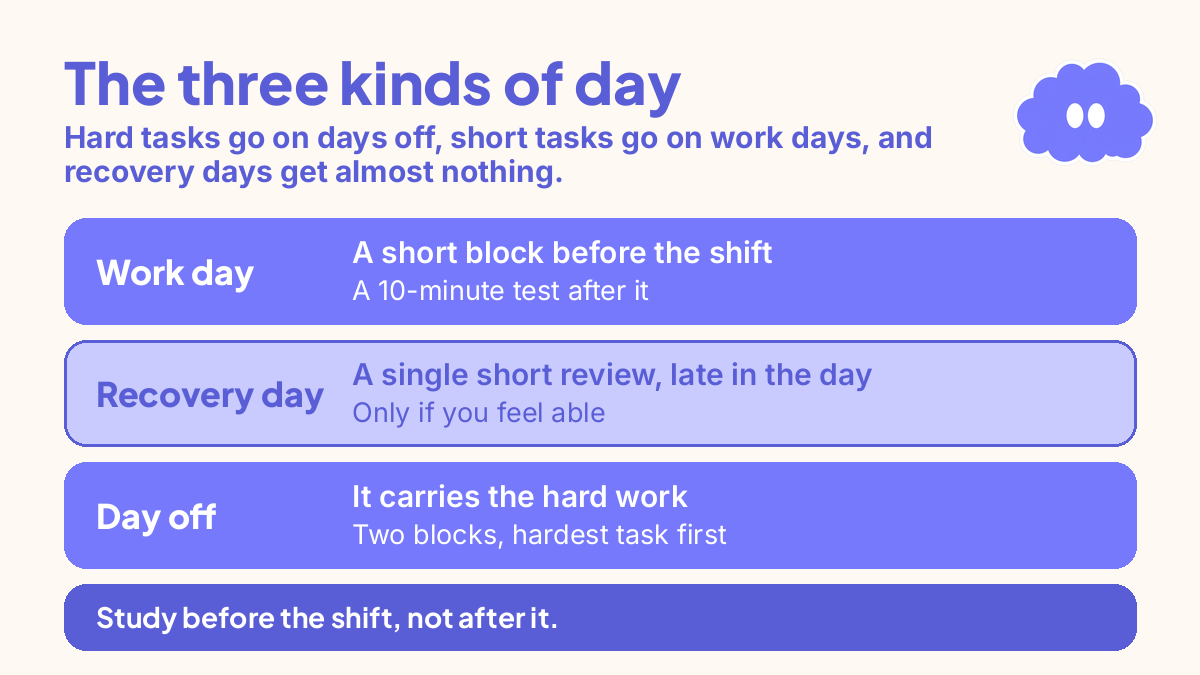
A 12-hour shift week has three kinds of day. A work day is a day with a 12-hour shift. It has one study job: a short block before the shift and a 10-minute test after it. A recovery day is the day after a run of shifts, when you are catching up on sleep. It has one job: a single short review, late in the day, only if you feel able. A day off is a day with no shift and no recovery debt. It carries the hard work.
Write the kind next to each day at the start of the week. Monday, work day. Tuesday, work day. Wednesday, work day. Thursday, recovery day. Friday, day off. Saturday, day off. Sunday, day off. Once the kinds are written down, the plan writes itself: hard tasks go on days off, short tasks go on work days, and recovery days get almost nothing.
If your shifts are nights, the kinds still work, but the clock moves. For the wider patterns of night work, the system in Study system for night-shift students covers longer night-shift cycles.
Step 2: Run a post-shift sequence, and study for 10 minutes only
After a 12-hour shift, do the same three things in the same order every time: eat a real meal, shower, and go to bed. Do not open your notes first. The sequence takes about an hour, and it is the boundary between work and rest. Without it, the shift bleeds into the evening, you stay up too late, and tomorrow starts tired.
The only study allowed after a 12-hour shift is a 10-minute test from memory. One topic, no notes, then check. Ten flashcards. Three practice questions. One diagram drawn from memory. Set a timer for 10 minutes and stop when it rings. The point is that the day ends with a small win, and the material stays warm. If you have nothing left, skip the test without guilt. A skipped test costs you 10 minutes. A failed two-hour session costs you sleep, and sleep is what tomorrow’s study depends on. For the evenings when even 10 minutes feels impossible, use the system in How to study when you are tired after work.
Step 3: Study before the shift, not after it
The best study hour in a 12-hour shift week is the hour before the shift starts, because it is the only hour when your mind is fresh and nothing has taken from it yet. For a day shift starting at 7.00, that means a 45-minute block from 6.00 to 6.45, after a short breakfast. Set the same time each work day, and put the hardest task there: new material, a problem set, an essay draft.
For a night shift, the block moves to after your main sleep. If you sleep from 8.00 to 3.00, study from 4.00 to 4.45, then eat and prepare for the shift. The rule is the same: study in the first hour you are properly awake, not the last hour before you sleep. If your job is physical work, the morning block matters even more. The system in How to study when your job is physical work covers the energy side of physical shifts.
Keep the morning block to 45 minutes and give it one task. “Revise pharmacology” is not a task. “Write the five drug classes from memory, check, re-write the two missed” is a task. When the block ends, write tomorrow’s task in the plan.
Step 4: Put the hard work on your days off
Days off carry the week. They are the only days with enough unbroken time for hard tasks, so protect them. Plan two blocks on each day off: a morning block of 90 minutes and an afternoon block of 60 minutes, with at least an hour between them for a walk, a meal, and rest. Put the hardest task in the morning block, when you are freshest. Put practice and review in the afternoon block: past paper questions and fixing the mistakes.
Do not plan a full day of study on a day off. A day off that is all study ends in exhaustion. Two blocks, three hours at most including breaks, and the rest of the day is yours. If you have three days off in a row, use the first for the hardest task, the second for practice, and the third for review and planning. If you have one day off, use it for the single most important task and let the morning blocks carry the rest.
For the wider system behind fitting study around a full-time job, How to study with a full-time job covers the weekly shape in more detail.
Step 5: Run the minimum week during a run of long shifts
Some weeks are a run: three or four 12-hour shifts in a row, with one day off at the end. In those weeks, drop to the minimum week. It is three 20-minute tests, from memory, one on each work day, plus one longer session on the first day off. It keeps the material warm and stops a hard week from becoming a lost week.
Each 20-minute test has the same shape: pick the most important topic, test yourself from memory for 15 minutes, then spend five minutes checking what you got wrong and writing down the one thing to re-test tomorrow. Do it in the morning block, before the shift.
If even the minimum week does not fit, do one 10-minute test a day for five days. The rule is simple: a run of long shifts can shrink the week, but it cannot cancel it. When the run ends, return to the full week on the first day off, starting with the hardest task, not with the backlog.
Step 6: Ask for the pattern that helps, and review on Sunday
You cannot control the length of a 12-hour shift, but you can often change the pattern around it, and the pattern matters more than any single shift. The three asks that help most are grouped shifts, days off together, and no single day off between long shifts. Grouped shifts mean your days off land together, so you get a real block of study time instead of scattered single days.
Ask with dates and a specific request. “I have an exam on 12 December. Could my shifts in that week be grouped on Monday to Wednesday, so Thursday and Friday are free to study?” If you need the words for the wider conversation, How to ask your boss for study time has a script for exactly this, including what to say when the answer is no.
On Sunday, spend 15 minutes on three questions. First, which days were which kind, and did the plan match? Second, did the morning blocks run, and did the post-shift sequence hold? Third, what must next week protect: one exam, one deadline, one day off for the hardest task?
A worked example: three 12-hour shifts, then four days off
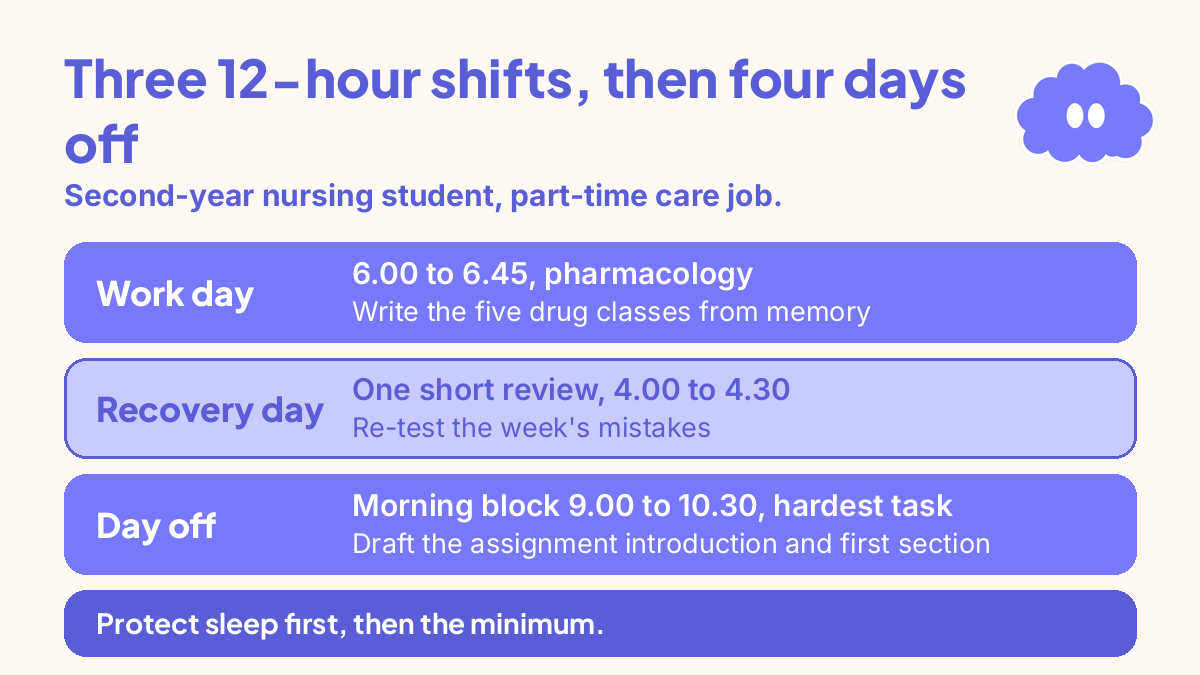
Your situation: Second-year nursing student, part-time care job. This week: 12-hour shifts Monday, Tuesday, Wednesday, 7.00 to 19.00. Thursday is a recovery day. Friday, Saturday, Sunday are days off. Exam in five weeks, weakest topic is pharmacology, and the drug-classes assignment is due in two weeks.
- Sunday night, plan the week: Write the day kinds next to each day. Morning blocks: Monday, Tuesday, Wednesday, 6.00 to 6.45, pharmacology. Day-off blocks: Friday and Saturday, 9.00 to 10.30 and 2.00 to 3.00.
- Monday, work day: Morning block 6.00 to 6.45, write the five drug classes from memory, check, re-write the two missed. Shift 7.00 to 19.00. Meal, shower, bed by 9.30. Ten-minute test at 8.45, then stop.
- Tuesday, work day: Same shape. Morning block, test the drug classes again plus one new class. Meal, shower, test, bed.
- Wednesday, work day: Morning block, practice questions on drug interactions. Meal, shower, test, bed. The run is over.
- Thursday, recovery day: Sleep until 9.00. One short review, 4.00 to 4.30: re-test the week’s mistakes, write Friday’s task in the plan.
- Friday, day off: Morning block 9.00 to 10.30, hardest task: draft the assignment introduction and first section. Afternoon block 2.00 to 3.00, past paper questions on pharmacology, mark them, note the weak areas.
- Saturday, day off: Morning block 9.00 to 10.30, finish the assignment draft. Afternoon block 2.00 to 3.00, test the whole drug-classes chapter from memory.
- Sunday, day off: Review only. Fifteen minutes: the morning blocks ran, the sequence held, the draft is done. Next week must protect Friday morning for the assignment deadline.
When it goes wrong
You try to study after a 12-hour shift and nothing goes in. Stop. That is the system telling you the evening is not a study slot. Eat, shower, sleep, and move the task to tomorrow’s morning block.
A shift overruns by two hours and the morning block disappears. Run the minimum for that day: one 10-minute test, then bed. The morning block returns tomorrow.
Your days off are scattered, one here and one there, and none of them is long enough for hard work. That is a pattern problem, not a discipline problem. Ask for grouped days off, using the words in Step 6. While you wait, use scattered days off for practice and review, and put the hardest task in the morning blocks.
You keep a normal study week during a run of long shifts and burn out by Thursday. Drop to the minimum week at the start of the run, not at the end. Three 20-minute tests and one longer session is a real week. A normal week attempted during a run is a week that fails on day two and takes your sleep with it.
You sleep badly after a night shift and the next day is gone. Protect the sleep first. Dark room, phone off, no study before the main sleep. The block after waking is the study slot, not the hour before bed.
Weekly review checklist
- Which days were work days, recovery days, and days off, and did the plan match the real week?
- Did the morning blocks run before shifts, and did they carry the hardest task?
- Did the post-shift sequence hold: eat, shower, sleep, and only a 10-minute test?
- Did the days off carry the hard work, or did they leak into chores and catching up?
- Did the minimum week run during the shift run, and was it enough to keep the material warm?
- What will change next week: grouped shifts, days off together, or a different morning block time?
Downloadable infographic spec: one vertical image, title “How to study after a 12-hour shift”, with the six steps from “The system in short” and the six review questions above, in Thynq cream, Cloud Purple, Dark Purple and pink, with the Cloud mascot. Text taken word-for-word from this article.
What this system is not
It is not a promise that 12-hour shifts stop being exhausting. They are exhausting, and some weeks the minimum week is all you will manage. It is not a way to study for hours every day in a long-shift week, and it will not work if you plan evening study after a 12-hour shift and then blame yourself when it does not happen. What it does is smaller: it moves study to the hours where your mind is fresh.
Sources
- Dunlosky, J., et al. (2013). Improving students’ learning with effective learning techniques. Psychological Science in the Public Interest, 14(1), 4-58. Practice testing and distributed practice rated high; rereading rated low.
- Cepeda, N. J., et al. (2006). Distributed practice in verbal recall tasks. Psychological Bulletin, 132(3), 354-380. Spaced practice beat massed practice.
- Roediger, H. L., & Karpicke, J. D. (2006). Test-enhanced learning. Psychological Science, 17(3), 249-255. Recallers remembered more a week later than restudiers.
- Dundes, L., & Marx, J. (2006). Balancing work and academics in college: why do students working 10 to 19 hours per week excel? Journal of College Student Retention, 8(1), 107-120. Moderate work hours were linked to better outcomes than very long hours.
For the wider working-student system behind this one, start with How to build a study system that fits your life.
Questions
Can I study after a 12-hour shift?
You can do a 10-minute test from memory, and that is all. A 12-hour shift leaves you too tired to learn new material, and an hour of staring at notes teaches you nothing. Study before the next shift or on your days off instead.
When is the best time to study if I work 12-hour shifts?
In the 45 minutes before a day shift, when your mind is fresh, and in long blocks on your days off. After a night shift, study after your main sleep, not before it. The best time is the time furthest from the end of a long shift.
How many hours can I study in a week of 12-hour shifts?
In a week with three 12-hour shifts, aim for about five hours: three 45-minute morning blocks, three 10-minute evening tests, one two-hour block on a day off, and one 30-minute review on a recovery day. That is enough to keep moving if every minute is testing from memory, not rereading.
What if my 12-hour shifts run for several days in a row?
Run the minimum week: one 20-minute test a day, from memory, on the most important topic, plus one longer session on the first day off. Do not try to keep a normal study week during a run of long shifts. Protect sleep first, then the minimum.