
The direct answer
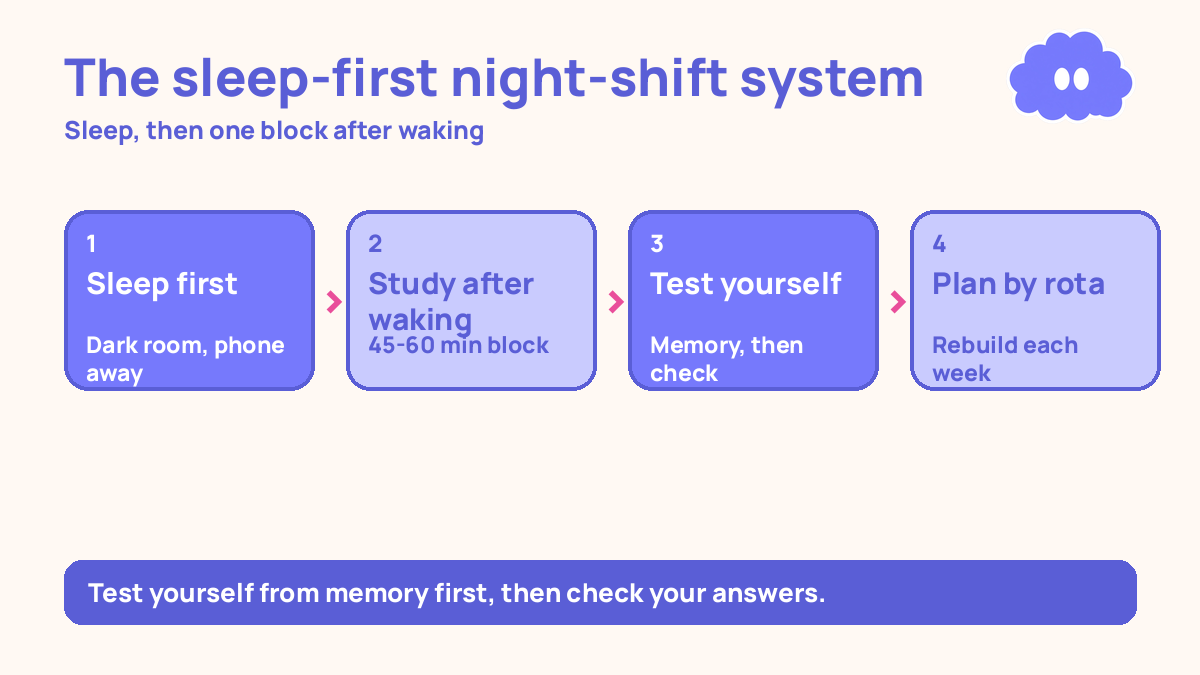
Sleep first, then study in one short block of 45 to 60 minutes after you wake, five or six days a week, testing yourself from memory and checking your answers. On days off, use one longer session of about two hours. Plan each week around your rota, keep one full rest day, and review the week in 15 minutes. That is the whole system: sleep, one block after waking, testing, and a rota-based plan.
You finish a night shift as the rest of the world wakes up. You are tired, it is daylight, and your course is waiting. The obvious move is to study now, before you sleep, while the shift is fresh in your mind. It feels efficient. It is the worst time to study.
After a night shift, your brain has been awake all night. What you read in that state goes in slowly and comes back poorly. Sleep first, then study after you wake. That single change — study after sleep, not after the shift — is the foundation of this whole system.
Night work also breaks the normal week: your rota changes and your days off move. So this system is built around the rota. Each week starts when the rota comes out, and the study plan follows it. The two-hour study system for working students is the parent system; this article adapts it for nights. If your shifts rotate, the study system for shift-work students covers the rotating pattern.
The system in short
- Sleep after every night shift, in a dark room, before you study anything.
- Study in one block of 45 to 60 minutes after you wake, five or six days a week.
- In the block, test yourself from memory first, then check your answers.
- On days off, use one longer session of about two hours, split into two blocks.
- Plan the week on the day your rota comes out, around the shifts, not over them.
- Review the week in 15 minutes: what you completed, what you got wrong, one change for next week.
Step 1: Sleep first, and protect it
Your sleep after a night shift is not wasted time. It is part of the study system. Sleep is when the day’s learning is consolidated — a short night after a long study day means the work was done but the consolidation was cut short (Diekelmann & Born, 2010). That review found sleep improves consolidation of facts as well as skills. It does not prove that a set number of hours guarantees remembering. It means study followed by short, broken sleep is worth less than the same study followed by proper sleep.
Make the room dark: curtains, an eye mask, or both. Make it quiet with earplugs or a fan. Tell the people you live with your sleep hours, and ask for those hours to be quiet hours. Put your phone on silent in another room. One study found a phone on the desk cost focus even when off, but a later replication did not find the effect, so the evidence is mixed (Ward et al., 2017). Treat “phone in another room” as a practical system, not a proven fact.
Step 2: Study in the first hour after waking
Wake up, eat something, and start studying within the first hour. This is your best hour of the day: you have slept and nothing else has claimed your attention yet. Do not spend it on messages or chores. Those things expand to fill the hour, and then the study block is gone.
Set a fixed start: “When I finish breakfast, I will sit at my desk and open yesterday’s questions.” That is an if-then plan — the cue and the action decided in advance. Research on if-then plans found they raised goal attainment by a medium-to-large amount (d = 0.65) across 94 studies (Gollwitzer & Sheeran, 2006). For a night-shift student, the value is not motivation. It is that starting needs no decision at the one hour of the day when you are actually fresh.
Keep the block to 45 to 60 minutes on workdays, one topic per block. For evenings when you are simply tired, the how to study when you are tired after work guide covers the same idea.
Step 3: Test yourself, then check
Open your notes for five minutes if the topic is new, then close them. Answer questions from memory, work problems, or write down what you remember. Then open your notes and check. Mark what you got wrong. That is the block.
In a 2013 review, Dunlosky and colleagues rated ten common study techniques, and only two received a high utility rating: practice testing and distributed practice. Re-reading was rated low. A later meta-analysis found testing yourself beat restudying by a medium amount (g = 0.50), and the advantage was larger with feedback (g = 0.73 with feedback, against g = 0.39 without it) (Rowland, 2014).
Roediger and Karpicke (2006) found students who recalled a passage remembered more a week later than students who restudied it. Feeling fluent right after re-reading is not the same as remembering a week later.
Keep a wrong-answer list: one line per question you got wrong. Test those questions again tomorrow, and again after three days. That list is your review plan.
Step 4: Plan around the rota, the day it comes out
When your rota arrives, sit down for 15 minutes and write the study week. Mark the night shifts, the days off, and the changeover days. Then place the study blocks: one block after waking on each workday, a longer session on one day off, and one full rest day.
Changeover days — the day you switch from nights to days off, or back — get no study, or one short block at most. A plan that puts a full study session on a changeover day is a plan you will break, and breaking it will feel like failure when it was really just a bad plan.
Use a practical starting schedule for review: a topic the next day, then after three days, then after seven days. This 1–3–7 schedule is a practical starting point, not a research rule. Spaced practice beats massed practice, and the right gap grows with how long you need to remember the material (Cepeda et al., 2006). On a night-shift rota the gaps will be uneven, and that is fine.
Step 5: Use days off for the long session, and keep one rest day
On a day off, study for about two hours: two blocks of 50 minutes with a 10-minute break between them. Use the first block to test the week’s topics, mixed together, and the second to learn something new.
Keep one day a week completely free of study. Not a light day. A free day. Night work is tiring in a way day work is not, and a week with no rest day is a week that ends in a crash. If your rota gives you two days off together, make one the long-study day and one the rest day. If it gives you scattered single days off, alternate them: one for study, one for rest.
A worked example: a week of four night shifts
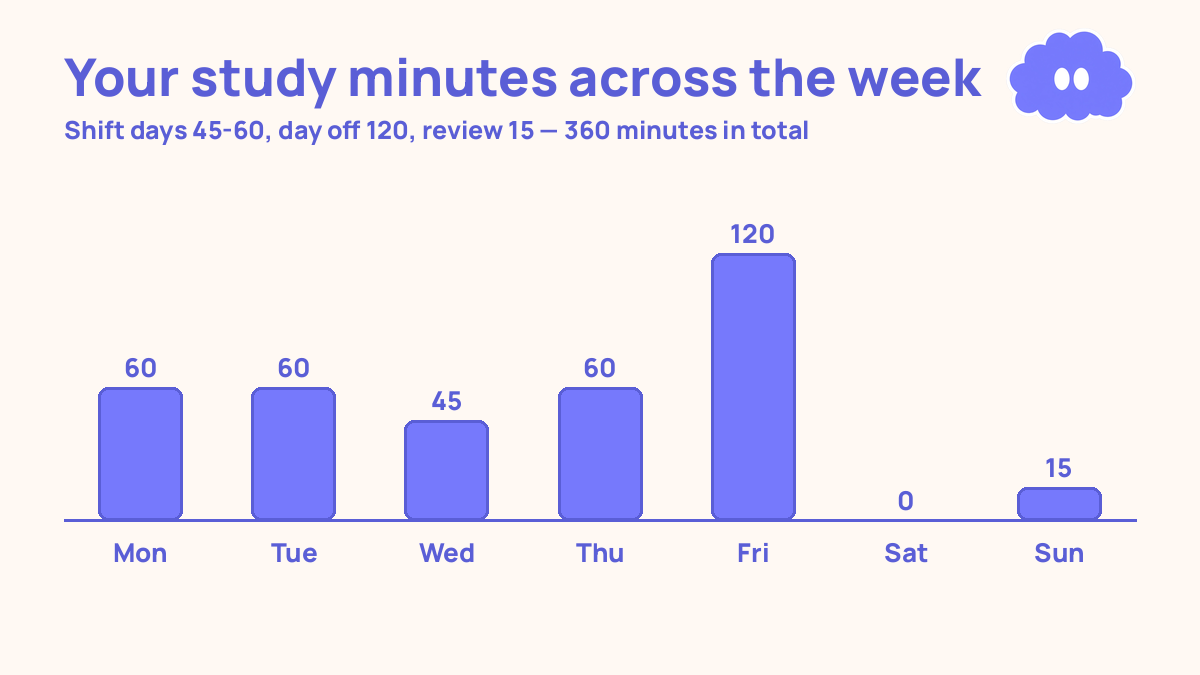
You work nights Monday to Thursday, 10pm to 6am. You sleep 7am to 2pm, wake, eat, and study at 3pm. Friday and Saturday are days off. Sunday is a rest day.
| Day | Sleep | Study | Minutes |
|---|---|---|---|
| Monday | 7am–2pm | 3:00–4:00, test last week’s topic | 60 |
| Tuesday | 7am–2pm | 3:00–4:00, test new topic, check | 60 |
| Wednesday | 7am–2pm | 3:00–3:45, review wrong answers | 45 |
| Thursday | 7am–2pm | 3:00–4:00, mixed test of both topics | 60 |
| Friday | Normal night | 10:00–12:00, long session, two blocks | 120 |
| Saturday | Normal night | No study, rest and life | 0 |
| Sunday | Normal night | 15-minute weekly review and plan | 15 |
That is 360 minutes in the week: 225 on shift days, 120 on the day off, and 15 for planning. The numbers are the plan’s own totals, not a research finding.
The system in a diagram
When it goes wrong
You study after the shift instead of sleeping, and it becomes a habit. Break it with a hard rule: no course material between the end of a shift and sleep. Put your notes out of sight before you leave for work, so they are not waiting on the table when you get home.
Daylight and noise keep waking you up. Fix the room before you blame yourself: dark curtains or an eye mask, earplugs, and a fan. Judge it by the blocks, not by how you feel at 2pm.
Your rota changes mid-week and the plan is useless. Re-plan on the day the rota changes, in 10 minutes. Move the blocks, keep the shape: short blocks after sleep, one long session, one rest day. The failure would be keeping the old plan and missing every block.
You have a run of days off and study nothing, then panic. Days off feel like free time, and free time fills itself. Fix it by booking the long session like a shift: write the time on paper the day before. A session with a time happens. A session with no time does not.
Weekly review checklist
Copy this list and use it on your rest day:
- How many study blocks did I complete this week, and which ones did I miss?
- Did I sleep before studying on every shift day, or did I study after a shift?
- Which questions are still on my wrong-answer list after three tests?
- What does next week’s rota look like, and where do the blocks go?
- What one change will I make next week: earlier start, darker room, or a different long-session day?
Downloadable infographic spec: one vertical image, title “Sleep first, study after waking”, with the sleep-then-study order, the 45–60 minute block, the memory-first rule, and the five-question weekly review, in Thynq cream, Cloud Purple, Dark Purple and pink, with the cloud mascot. Text taken word-for-word from this article.
What this system is not
It is not a promise of a grade, and it is not a claim that one hour a day is enough for every course. Some courses need more, and some rotas leave less. It is a system for doing steady work around night shifts without sacrificing sleep, and checking honestly whether that work happened. It is also not medical advice about shift work or sleep. If your sleep is badly broken, talk to a doctor.
Sources
- Dunlosky, J., et al. (2013). Improving students’ learning with effective learning techniques. Psychological Science in the Public Interest, 14(1), 4-58. Only practice testing and distributed practice received a high utility rating; rereading was rated low.
- Rowland, C. A. (2014). The effect of testing versus restudy on retention: a meta-analytic review of the testing effect. Psychological Bulletin, 140(6), 1432-1463. Testing beat restudy by g = 0.50; with feedback g = 0.73, without feedback g = 0.39.
- Roediger, H. L., & Karpicke, J. D. (2006). Test-enhanced learning. Science, 311, 648-649.
- Cepeda, N. J., et al. (2006). Distributed practice in verbal recall tasks. Psychological Bulletin, 132(3), 354-380.
- Gollwitzer, P. M., & Sheeran, P. (2006). Implementation intentions and goal achievement: a meta-analysis. Advances in Experimental Social Psychology, 38, 69-119. If-then plans raised goal attainment by d = 0.65 across 94 studies.
- Diekelmann, S., & Born, J. (2010). The memory function of sleep. Nature Reviews Neuroscience, 11(2), 114-126. Sleep improves consolidation of what was learned.
- Ward, A. F., et al. (2017). Brain drain: the mere presence of one’s own smartphone reduces available cognitive capacity. Journal of the Association for Consumer Research, 2(2). One study found a phone on the desk cost focus even when off; a later replication did not find the effect, so the evidence is mixed.
For the full system behind these blocks, start with the two-hour study system for working students. If your shifts rotate, read the study system for shift-work students, and for evenings when you are simply tired, the how to study when you are tired after work guide.
Questions
When should a night-shift student study?
After sleep, not after the shift. Study in the first hour or two after you wake, when you are freshest. Studying straight after a night shift means studying on an empty tank, and very little of it stays.
How much sleep do I need before studying?
Aim for a full sleep after each night shift, in a dark, quiet room, before you open your course. Sleep is when the day’s learning is consolidated.
What if my rota changes every week?
Plan study around the rota each week, not against it. Write the plan on the day the rota comes out, and keep it to one block on workdays.
Can I study on my days off instead?
Yes, and days off are your best study days. Use one longer session of about two hours on a day off, split into two blocks. But keep at least one short block on workdays too, so the gap never stretches to a week.