
The direct answer
How to study an online course with no deadlines: give the course a finish date, divide the modules across the weeks until that date, fix two or three study slots in your calendar, and check every Sunday whether you hit the target. A course with no dates does not run itself: you supply the dates, the slots, and the check.
The trap is not laziness. It is the feeling that the course can wait. On campus, a timetable decides when you sit down: the lecture is at 10, the seminar is on Thursday. In a self-paced course that scaffolding is gone, and a module that opens on Monday feels like it can wait until Sunday. By next week you have forgotten where you stopped.
The top results for self-paced study mostly list the same advice: set a deadline, make a schedule, stay motivated. None of them show the full system working on one course, with real numbers, a weekly check, and a rule for what to do when you drift.
The system in short
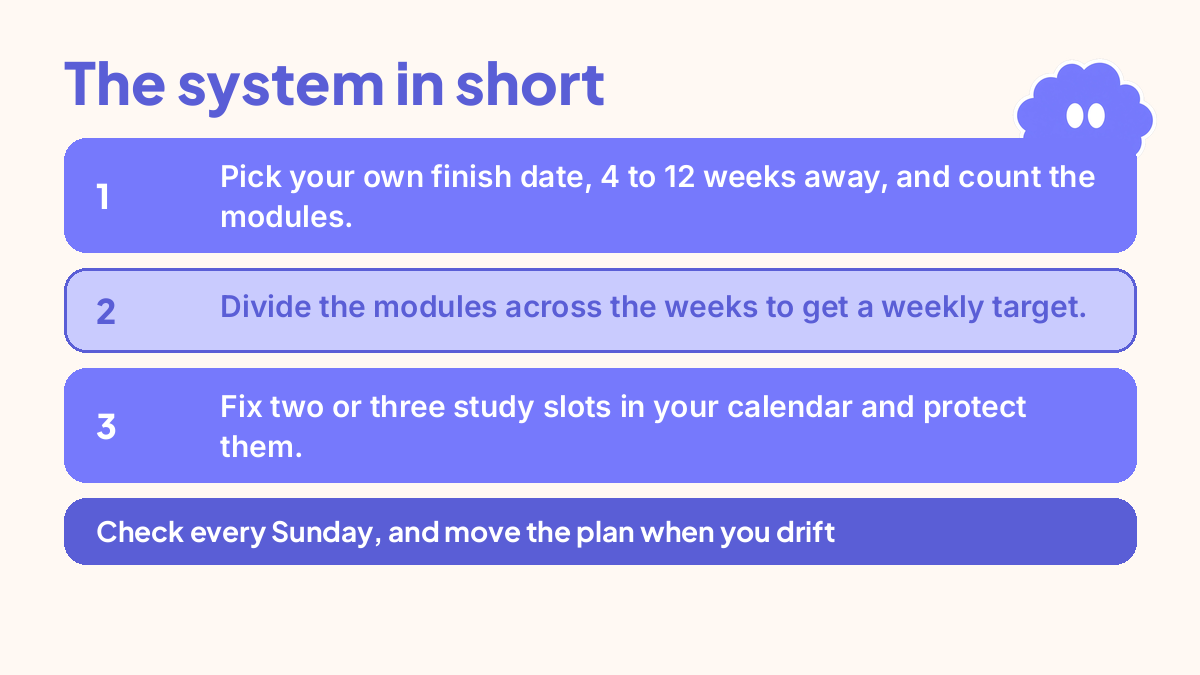
- Pick your own finish date, 4 to 12 weeks away, and count the modules.
- Divide the modules across the weeks to get a weekly target.
- Fix two or three study slots in your calendar and protect them.
- Make progress visible with a checklist you can see.
- Check every Sunday, and move the plan when you drift.
- Use the course’s quizzes and assignments as proof, not the progress bar.
Step 1: Pick your own finish date
Pick a finish date 4 to 12 weeks away, and write it on your calendar. Four weeks is right for a short course of six to eight modules. Twelve weeks is right for a long course of twenty modules or more. Longer than twelve weeks and the date stops feeling real.
Start by finding the real end date, if there is one. Some courses that advertise no deadlines still have an access period, a certificate window, or a capstone date. If access ends in ten weeks, your finish date is eight weeks, with two weeks spare.
Count the modules, lessons, and assessments, and write the numbers down. “Twelve modules, 48 lessons, 4 quizzes, 1 final project” is a course you can plan. “A big course” is not. The count takes ten minutes.
Tell one person your finish date: a partner, a friend, a study buddy, anyone who will ask about it. A date you keep to yourself is easy to move. A date someone else knows about has weight, and weight is what a course with no deadlines is missing.
Step 2: Divide the course into weekly targets
Divide the modules across the weeks until your finish date, and you have a weekly target. Twelve modules in eight weeks is one or two modules a week. The target should be a number of modules, not hours.
Set a milestone halfway through: half the course done by the halfway date. A halfway milestone tells you in week four whether you are on track, while there is still time to fix it.
Keep one week spare at the end for review and the final assessment. Use the last week to review, retake the quizzes you failed, and finish the project. That week is also your buffer if a bad week costs you a module.
Break each weekly target into lessons, and assign them to your study slots. “Module 3, lessons 1 to 4, on Tuesday” is a task you can start. “Do module 3 this week” is a wish. The weekly target tells you what to finish. The slot tells you when to do it.
Step 3: Fix two or three study slots in your calendar
A weekly target without fixed slots is a hope, not a plan. Fix two or three study slots in your calendar, at the same times each week, and protect them like class times. Tuesday and Thursday evenings from 7pm to 8:30pm, plus Saturday morning from 9am to 10:30am, is a shape that works for most people. If you only have an hour a day, How to study in one hour a day shows how to split it.
Put the slots in your calendar as real events, with a reminder. If a slot clashes with something one week, move it the same day, to another time that week. A moved slot is still a slot. A cancelled slot is a lost week.
Keep one day a week free as a buffer, and do not fill it in advance. The buffer day is for the week when a slot is lost to illness, work, or family. If the week goes well, it is a day off. If it goes badly, it is the catch-up slot, and the plan survives.
Start each slot with the same small ritual: open the course, open your checklist, and read the first task. The ritual takes one minute, and it removes the hardest part of a self-paced course, which is deciding what to do. The self-study system for online learners uses the same idea: same start time, one weekly plan, and a Sunday review.
Step 4: Make progress visible with a checklist
Make your progress visible, on paper or in a spreadsheet, where you can see it every day. List every module, lesson, quiz, and assignment, with a box to tick when it is done. Tick the box the moment you finish, not at the end of the week.
Record the finish date of each module next to its box. “Module 3, finished 2 December” is a record. The dates let you work out your real pace. Your pace tells you whether the finish date still fits.
Use the platform progress bar as well, but do not rely on it alone. A bar that says 80 percent complete measures lessons opened, not lessons learned. Completion is not the same as understanding.
Keep the checklist where you study, not in a folder you never open. A paper checklist on the desk, or a spreadsheet pinned as a browser tab, works. The point of making progress visible is that you see it without looking for it.
Step 5: Check every Sunday and move the plan when you drift
Set a 15 minute Sunday check, at the same time each week, and keep it even when the week went badly. The check has four questions: did I hit this week’s target, what did I finish, what is next week’s target, and what needs to change? Fifteen minutes, four questions, in writing. That is the whole check, and it is the same shape as the how to review what you learned online each week system.
If you hit the target, the check takes five minutes, and you move on. If you missed it, do not restart the plan. Work out how many modules are left and how many weeks remain, then spread the rest across the weeks you have. The plan moves. The finish date stays, unless the numbers say it cannot.
If the finish date no longer fits, move it by one week, and say so in writing. A finish date that moves every week is a plan that failed, and the fix is a smaller weekly target, not a later date.
Do not use the Sunday check to punish yourself. The check is a steering wheel, not a report card. A week with no study is information: the slots were wrong, the target was too big, or life got in the way. Change one thing for next week, and write it down.
Step 6: Use the quizzes and assignments as proof
A self-paced course has no teacher in the room to tell you that you misunderstood chapter 3. The quizzes and assignments are the only signal you have, so use them properly. Take every quiz when you finish its module, not at the end of the course.
Do not skip the assignments until the end. The CollegiateD guide to self-paced courses lists skipping assessments until the end as one of the common traps, alongside starting late and clicking through videos without practice. The plan here is simple: the assignment belongs to the week its module belongs to, not to the last week of the course.
When a quiz goes badly, treat it as a diagnosis, not a failure. Write down which questions you missed, and go back to the lessons that cover them. If the course lets you retake a quiz, retake it after a day, not at once. A day later, the score means something.
If the course has no quizzes, make your own check. After each module, write three questions about it from memory, answer them without your notes, then check the answers. Three questions, ten minutes.
A worked example: a 12-module course in eight weeks
Your situation: you work part-time, four days a week, and you have enrolled in a free 12-module online course on data analysis. There are no deadlines, no live sessions, and no teacher. You want to finish in eight weeks, to put the certificate on your CV before you apply for jobs in January.
You pick a finish date eight weeks away: 19 January. You count the course: 12 modules, 48 lessons, 4 quizzes, and 1 final project. You divide 12 modules by 8 weeks, which gives one or two modules a week, and you set a halfway milestone: 6 modules done by week 4.
You fix three study slots: Tuesday and Thursday from 7pm to 8:30pm, and Saturday from 9am to 10:30am. You put them in your calendar as events, and keep Sunday free as a buffer day. You make a paper checklist of all 12 modules, 4 quizzes, and the project, and pin it above your desk.
Week one goes well. You finish modules 1 and 2, and pass both quizzes on the first try. On Sunday you check: target hit. Week three is harder. A work shift moves, you lose the Thursday slot, and you finish only module 5. On Sunday you do the maths: 7 modules left, 5 weeks left, so the new target is one or two modules a week, and the finish date still fits.
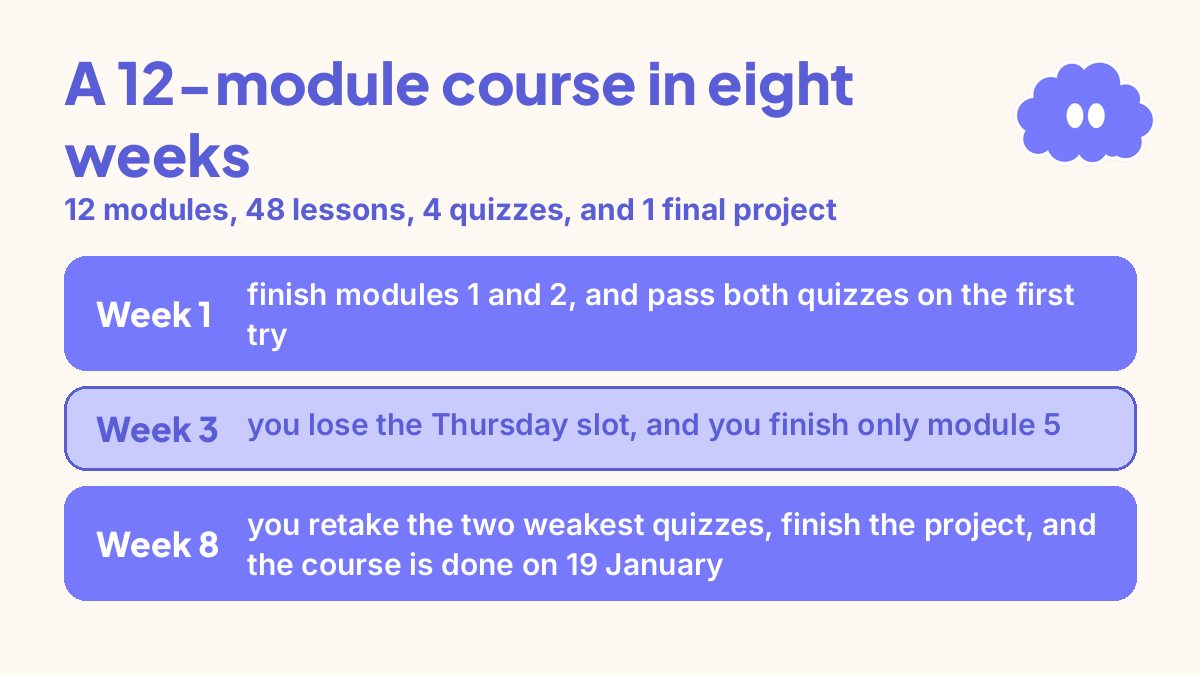
Week six brings a failed quiz. Module 8’s quiz comes back at 50 percent, and you go back to two lessons, retake it the next day, and pass. You are one module behind, so you use the buffer day that week and catch up. Week seven you finish module 12, and week eight is review: you retake the two weakest quizzes, finish the project, and the course is done on 19 January.
When it goes wrong
You never pick a finish date. The course floats, and “whenever” quietly becomes “never”. Pick a date today, even if it is a guess. A date 4 to 12 weeks away, written on your calendar and told to one person, is enough to start. You cannot steer a course that has no date at all.
You binge, then leave a gap. Four modules in one weekend feels like progress, and then two weeks pass with nothing. Long gaps make you forget the material, and catching up takes more effort than steady work. One or two modules a week, every week, beats four in a weekend and none for a fortnight.
You watch the lessons and skip the practice. Clicking through videos feels like studying, but the progress bar is not proof. If you have watched three lessons and done no exercises, you have not learned three lessons. Do the exercises in the slot, take the quiz when the module ends, and treat a skipped exercise as an unfinished module. How to study video lectures properly makes the same point: watch actively, pause, and test yourself.
You fall behind and restart the whole plan. A missed week feels like a failed course, so you throw the plan away and start again next month. Do not restart. Spread the remaining modules across the remaining weeks, and keep the finish date unless the numbers say it cannot fit.
You study alone with no check-ins. Tell one person your finish date, or join a study group for the course. How to stay accountable when studying alone gives you the shape: a daily promise, a weekly check, and one person who sees honestly whether you did it.
Weekly review checklist
- Did I hit this week’s target, and how many modules are finished in total?
- What is my real pace in modules per week?
- Does the finish date still fit, or does it need to move by one week?
- Which quizzes did I fail, and which lessons do I need to go back to?
- Did I use the buffer day?
- What is the one change I will make next week?
Downloadable infographic spec: one vertical image, title “How to study an online course with no deadlines”, with the six steps and the six weekly review questions, in Thynq cream, Cloud Purple, Dark Purple and pink, with the cloud mascot. Text taken word-for-word from this article.
What this system is not
This system is not a way to finish a course you do not care about. If the course does not serve a goal you can name, no finish date will save it. A date, a target, and a checklist cannot create motivation that is not there.
This system is not a promise. A finished course is not a learned course, and a certificate is not a skill. What this system offers is a way to finish what you start, with the learning checked as you go. For the full system behind this method, start with how to build a study system that fits your life.
Sources
- CollegiateD. Self-Paced and Flexible Courses: How to Make Them Work. CollegiateD, accessed 24 November 2026. Supports setting your own deadlines by counting units and dividing them across weeks, tracking progress visibly, keeping fixed study blocks, reviewing weekly, and the common traps of starting late, bingeing, and skipping assessments.
- UPIStudy. How to Stop Procrastinating on Self-Paced Courses. UPIStudy, accessed 24 November 2026. Supports picking a finish date 4 to 12 weeks out, weekly targets, fixed study sessions, a buffer day, and a 15-minute Sunday review.
Questions
How do I set a finish date for a course with no deadline?
Pick a date 4 to 12 weeks away, count the modules, and divide them across the weeks. Write the date on your calendar and tell one person about it.
How much should I study each week on a self-paced course?
Enough to hit your weekly target, and no more. If the course has 12 modules and you have 8 weeks, the target is one or two modules a week.
What should I do when I fall behind on a course with no deadlines?
Do not restart the plan. Work out how many modules are left and how many weeks remain, then spread the rest across the weeks you have.
How do I know I am really learning, not just finishing lessons?
Use the course’s own checks: quizzes, exercises, and assignments. A progress bar that says 80 percent complete is not proof. A quiz you can pass without your notes is.