The direct answer
Stay accountable alone by making your study visible: write down one promise each morning, do the work, mark it done where one other person can see it, and check in with that person once a week. That is the whole system. So set it up: one line a day, one person, one weekly check.
You planned to study at 7pm. At 9pm you are still scrolling, and nobody knows. That is the freedom of studying alone, and it is also the trap. When nobody checks, the easiest thing is to check nothing, and the week disappears one quiet evening at a time.
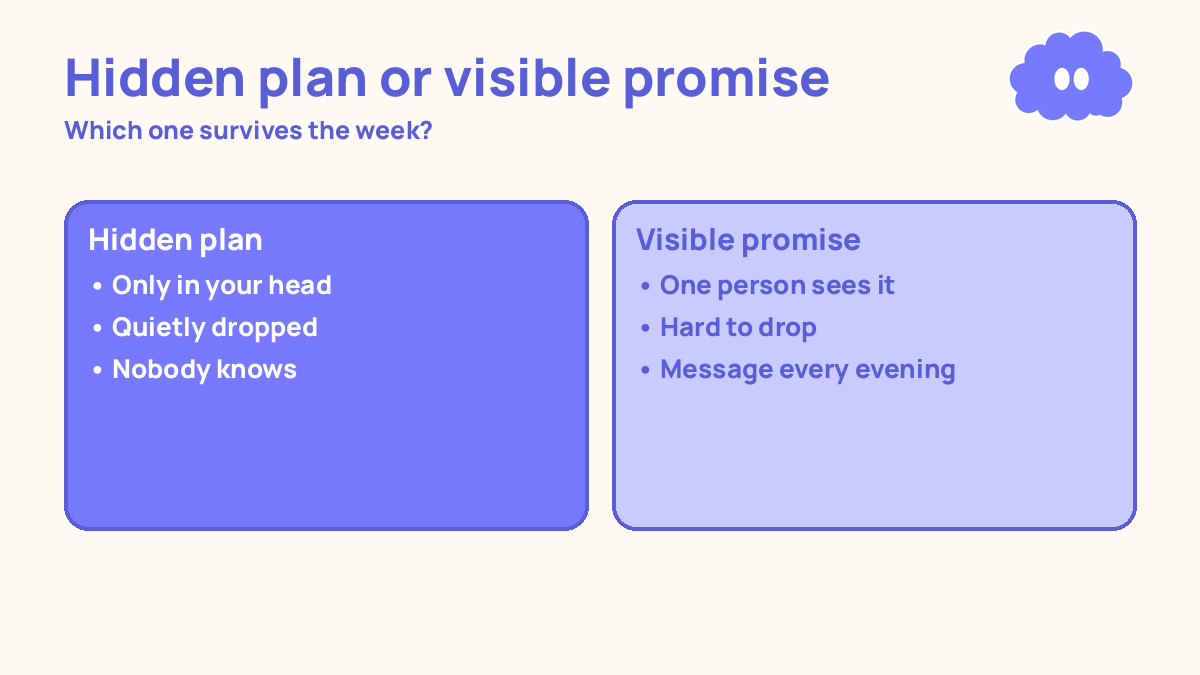
The problem is not that you lack discipline. The problem is that your plan lives only in your head, where it can be changed without anyone noticing. A plan nobody sees is a plan you can quietly drop. A plan one person sees is a promise.
This system is for a student studying alone, online, with no teacher and no class. It needs one notebook, one person, and two minutes a day. For the full self-study system, read the self-study system for online learners. For studying with no teacher at all, the no-teacher study system covers the whole solo setup.
The system in short
- Pick one accountability partner: a friend, a family member, or a teacher. Ask them, plainly.
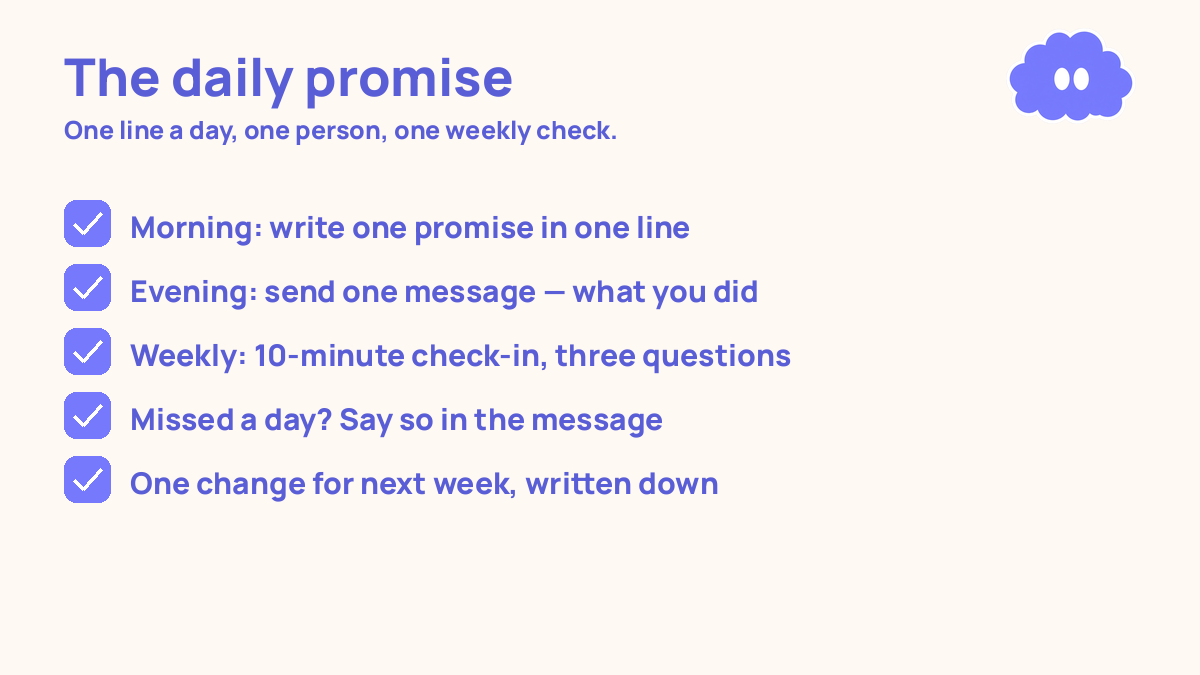
- Every morning, write one promise in one line: what you will study, and for how long.
- Study at the same time every day, and mark the promise done or not done, honestly.
- Every evening, send your partner one message: what you did, for how long, and tomorrow’s promise.
- Once a week, have a 10-minute check-in: what got done, what did not, and one change for next week.
- If you miss a day, say so in the message. A missed day you report is a missed day. A missed day you hide is the start of quitting.
Accountability works better with a person in it: How to study with a study buddy online pairs you with one.
Step 1: Pick one person and ask them plainly
Pick one person. A friend who also studies, a family member, a teacher, anyone who will read one message a day. Do not pick five people. One person who actually replies beats five who do not.
Ask them plainly, in one message: “I am studying alone and I need someone to check my work. Can I send you one message every evening about what I studied? You do not need to reply with advice. Just reply ‘seen’.” That is the whole ask.
If nobody you know can do it, use a public check-in instead. Post your daily line in a study group, a forum, or a group chat where other students post theirs. The group does the same job: your line is visible.
Step 2: One promise a day, written down
Every morning, write one promise in one line, in your notebook: what you will study, and for how long. “Study chapter 4 for one hour, and answer the five questions from memory.” One promise, not five. A day with one promise is a day you can keep. A day with five promises is a day you will fail by noon.
Decide the cue and the action in advance: “When I finish breakfast, I will write today’s promise, and when I sit down at 7pm, I will do it.” That is an if-then plan, and across 94 studies, if-then plans raised goal attainment by a medium-to-large amount (d = 0.65) over holding the goal alone (Gollwitzer and Sheeran, 2006).
Make the promise small enough to keep on a bad day. On a good day you will do more, and that is fine. The promise is the minimum, not the maximum.
Write the promise where you can see it: on the notebook, on a card on the desk, or in the message to your partner.
Step 3: Do the work, and mark it honestly
Study at the same time every day. The time matters more than the length: a fixed time is a cue, and a cue removes the daily decision. When the time comes, sit down and do the promise. If the promise is one hour, do one hour. If the promise is 10 minutes, do 10 minutes. The length is not the point. Keeping the promise is the point.
Mark it done or not done, honestly, in the notebook. A tick for done, a cross for not done, and one line about why, if it was not done. “Missed: worked late.” “Missed: too tired.” Honest marks are the data. A week of honest marks tells you the truth about your week. A week of lies tells you nothing.
Test yourself from memory as part of the work, not just at the end of it. In a 2013 review, Dunlosky and colleagues rated ten common study techniques, and only two received a high utility rating: practice testing and distributed practice. Re-reading was rated low.
If you miss the time, do the promise later the same day, even if it is shorter. A late promise kept is still kept. A promise moved to tomorrow is a promise broken.
Step 4: Send one message every evening
Every evening, send your partner one message, in three short parts: what you did, for how long, and tomorrow’s promise. “Studied chapter 4 for one hour. Answered five questions from memory, got four right. Tomorrow: chapter 5 for one hour.” That is the whole message. It takes two minutes.
Do not wait for a reply to feel accountable. The message itself is the accountability. Sending it is the act of saying, out loud, what you did. If your partner replies “seen”, that is enough.
If you missed the day, say so in the message. “Missed today. Worked late. Tomorrow: chapter 4 for 30 minutes.” A missed day you report is a missed day. A missed day you hide is the start of quitting, because hiding it once makes hiding it twice easy. The message is honest or it is useless.
Keep the messages short and regular. A long message once a week is not accountability. A short message every evening is.
Step 5: One weekly check-in, 10 minutes
Once a week, have a 10-minute check-in with your partner, by call or in person. Three questions, and nothing else: what got done this week, what did not get done, and what one change will you make next week? Ten minutes, three questions, one change.
Pick one change for next week, and only one. A smaller promise, an earlier time, a different first task. One change, written down, and sent in that evening’s message.
Mindset alone will not do this job. Across 273 studies, the link between a growth mindset and academic achievement was very weak (r = 0.10), and mindset interventions averaged a small effect (Sisk and colleagues, 2018). Believing you can improve is a small piece. A visible promise and a weekly check are the pieces that hold the week together.
A worked example: a week of promises
You study alone, online, after work. Your partner is your friend Sara. Study time is 7:00 to 8:00pm.
Monday morning — Promise. “Study chapter 4 for one hour, answer five questions from memory.” Monday evening — Message. “Studied chapter 4 for one hour. Answered five questions, got four right. Tomorrow: chapter 5 for one hour.”
Tuesday morning — Promise. “Study chapter 5 for one hour.” Tuesday evening — Message. “Studied chapter 5 for 40 minutes. Worked late, started late. Tomorrow: finish chapter 5 for 30 minutes.”
Wednesday — Promise kept. One hour, five questions, four right. Message sent. Sara replies: “Seen.”
Thursday — Missed. Work ran late, and you skipped study. Thursday evening — Message. “Missed today. Worked late. Tomorrow: chapter 5 review for 30 minutes.” Sara replies: “Seen. Tomorrow then.”
Friday — Promise kept. 30 minutes, chapter 5 review, three questions from memory. Message sent.
Sunday — Check-in, 10 minutes. You and Sara count the week: four days kept, one missed, one short. Change for next week: study at 6:30pm instead of 7:00pm, because work keeps running late. One change, written down.
When it goes wrong
You stop sending the message. This is the first sign the system is dying, and it is the most important one to catch. The message is the system. If you miss one evening, send two lines the next morning: what happened, and today’s promise.
Your partner stops replying. Ask them once, plainly: “Are you still happy to get my message each evening?” If they are not, thank them and pick someone else, or use a public check-in in a study group. A partner who does not read the message is not a partner. The system needs a witness, and a witness who is not there is not a witness.
You keep the promises but the studying is only re-reading. The promise says “study”, and re-reading counts as study in your head. Change the promise: “Answer five questions from memory” instead of “study chapter 4”. A promise with a test in it is a promise that teaches. Feedback matters too: Rowland (2014) found testing beat restudying, and the benefit was larger with feedback (g = 0.73) than without it (g = 0.39).
You miss three days in a row and feel as if you have failed. You have not. A daily habit takes weeks to feel automatic — a median of 66 days in one study, with a range of 18 to 254 — and one missed day does not reset it (Lally and colleagues, 2010). Send the message tonight: three missed days, and tomorrow’s promise, made small. Ten minutes. A small promise kept is the way back in. A big promise made in guilt is the way back out.
Weekly review checklist
Copy this list and use it each Sunday:
- How many promises did I keep this week, and how many did I miss?
- How many evening messages did I send, and how many did I skip?
- What did the misses have in common — late work, tired evenings, or promises too big?
- What one change will I make next week: a smaller promise, an earlier time, or a different partner?
Downloadable infographic spec: one vertical image, title “The daily promise”, with the three parts — one promise in the morning, one message in the evening, one check each week — and the rule “a missed day you report is a missed day”, in Thynq cream, Cloud Purple, Dark Purple and pink, with the cloud mascot.
What this system is not
It is not a promise that you will never miss a day, and it is not a claim that accountability alone will teach you the material. It is a practical system for a student studying alone who needs someone to know whether the work happened.
Sources
- Gollwitzer, P. M. & Sheeran, P. (2006). Implementation intentions and goal achievement: a meta-analysis. Advances in Experimental Social Psychology, 38, 69-119. Across 94 studies, if-then plans raised goal attainment by a medium-to-large amount (d = 0.65).
- Dunlosky, J., et al. (2013). Improving students’ learning with effective learning techniques. Psychological Science in the Public Interest, 14(1), 4-58. Only practice testing and distributed practice received a high utility rating; rereading was rated low.
- Rowland, C. A. (2014). The effect of testing versus restudy on retention. Psychological Bulletin, 140(6), 1432-1463. Testing beat restudying, and the benefit was larger with feedback (g = 0.73) than without it (g = 0.39).
- Sisk, V. F., et al. (2018). To what extent and under which circumstances are growth mind-sets important to academic achievement? Psychological Science, 29(4), 549-571. The link between a growth mindset and achievement was very weak (r = 0.10).
- Lally, P., et al. (2010). How are habits formed. European Journal of Social Psychology, 40(6), 998-1009. Median time for a behaviour to feel automatic was 66 days, range 18 to 254 days.
For the full self-study system, read the self-study system for online learners, and for studying with no teacher at all, the no-teacher study system.
Questions
How do I stay accountable when nobody checks my studying?
Make the work visible. Write down what you will do today, do it, and mark it done where someone else can see it. A plan nobody sees is a plan you can quietly drop. A plan one person sees is a promise.
What is the simplest accountability system for a solo student?
One line a day, sent to one person. Every evening, send one message: what you studied, for how long, and what you will do tomorrow. It takes two minutes, and it is the whole system.
What if I keep breaking my promises to myself?
Make the promise smaller, not bigger. A promise to study for 10 minutes is one you can keep. Three kept promises in a row rebuild trust with yourself faster than one big promise you break again.
Do I need a study buddy to stay accountable?
No. A study buddy helps, but the system works without one. A weekly check-in with a friend, a family member, or a teacher does the same job: one person, once a week, who asks what you did.