The direct answer
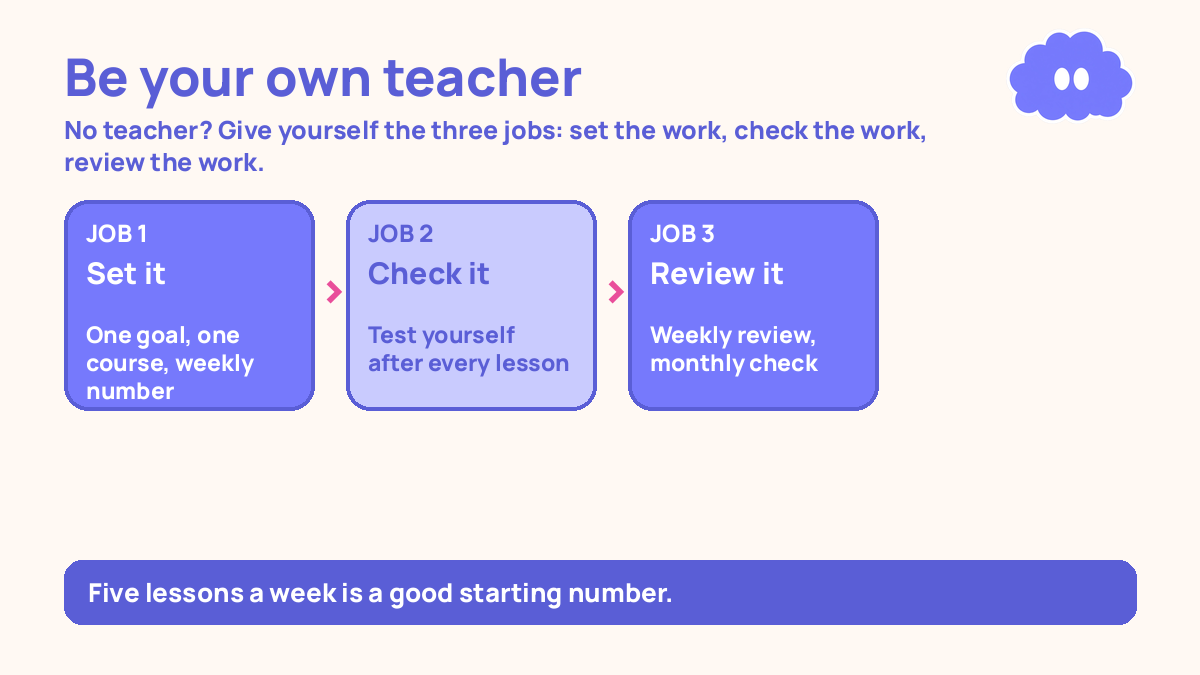
Give yourself the three jobs a teacher normally does. First, set the work: pick one goal, one course, and a weekly number of lessons. Second, check the work: test yourself after every lesson. Third, review the work: once a week, test yourself on the week’s lessons from memory and plan the next week. That is the whole system: the same three jobs, done by you, on paper, every week.
You need one course, one fixed study time, and a notebook where the plan, the checks, and the reviews all live.
What changes when there is no teacher
A teacher does more than teach. A teacher decides what comes next, tells you whether your work is right, and notices when you stop showing up. When you learn online with no teacher, all three of those jobs fall to you.
The second job — checking your work — is where self-taught learning usually breaks. Without a teacher marking your answers, it is easy to watch a lesson, feel that it made sense, and move on. That feeling is not evidence. In a 2013 review of ten common study techniques, Dunlosky and colleagues gave a high utility rating to only two: practice testing and distributed practice. Re-reading and highlighting were rated low. For a learner with no teacher, practice testing is your only marker.
The third job — noticing when you stop — is the quietest failure. There is no register, no missed class, no teacher asking where you were. A missed day becomes a missed week, and a missed week becomes a course you “meant to finish.” The fix is a weekly review with a written record: lessons done, checks passed, checks failed.
This article is the system for doing all three jobs yourself. The companion article, the self-study system for online learners, is the fuller routine this system sits inside — the same ideas, with more detail on setting up your week. The finishing side, taking one course from first lesson to last, is in how to finish an online course.
The system in short
- Pick one goal and one course. Write both down in one line each.
- Set a weekly number of lessons and a fixed daily time.
- Before each lesson, write what it should teach you, in one line.
- After each lesson, test yourself: explain it, do the exercise, or answer the questions — without looking.
- When you get stuck, write the stuck point in one sentence, then fix only that point.
- Once a week, review the week’s lessons from memory and plan the next week.
- Every four weeks, do a bigger check: redo the month’s exercises without looking.
Step 1: Pick one goal and one course
Start with the goal, not the course. Write it in one line, in plain words: “Learn enough Python to automate my weekly report.” Not “learn programming.” A goal you can picture is a goal you can plan. A vague goal is a goal you will abandon the first time a course gets hard.
Then pick one course that teaches that goal. One. If two courses look good, pick the shorter one, or the one with exercises and answers — answers matter more than production quality when there is no teacher to mark your work.
Write the goal and the course on the first page of your notebook. Under them, write the number of lessons and your weekly number. A course with 30 lessons at five a week is six weeks. Write the finish date.
Step 2: Set the work for the week
Decide the week’s work on Sunday, or whenever your week starts, and write it down: “This week: lessons 6 to 10, Monday to Friday, 7pm.” No more deciding during the week. Deciding during the week is how a lesson gets done “later.”
Give yourself two days off each week. Five lessons a week is a good starting number. If five keeps failing, drop to three. The right number is the one you actually do.
Pick a fixed time and a fixed place. After dinner at the kitchen table, or before class in the library — a slot that already exists, with a chair you can sit in every day. Put your phone in another room before you start.
Step 3: Check your own work after every lesson
This is the step that replaces the teacher’s marking. When the lesson ends, close it. Do not look at your notes. Test yourself in one of these ways:
- Explain it. Write two or three sentences in your own words, as if telling a friend. If you cannot, the lesson is not learned yet.
- Do the exercise. Do the course exercises without looking, then check your answers. Wrong answers show you exactly what to fix.
- Answer questions. If there are no exercises, write three questions about the lesson and answer them from memory the next day.
A check takes five to ten minutes. Watching tells you the lesson made sense; the check tells you whether it stayed. This is practice testing, one of the two techniques Dunlosky and colleagues rated highly in 2013, and for a learner with no teacher it does the job a marker used to do.
If the check passes, tick the lesson off and stop. If it fails, write down what failed in one line. That line is tomorrow’s first job: redo the lesson, then test yourself again. Do not move on past a failed check.
Step 4: Getting unstuck with no one to ask
Getting stuck is normal, and it is not a sign that you cannot learn the subject. It is usually a sign that one idea is missing. The fix starts with writing the stuck point down in one sentence: “I do not know what this line of code does.” A stuck point you can write down is a stuck point you can fix.
Then fix only that point. Look it up in the course text, or in one clear explanation. Try the smallest example you can: one line of code, one calculation, one diagram. If the small example works, go back to the lesson and try the check again.
If it still fails, go back one lesson. The missing idea is often behind you, not ahead of you. If a whole section stays stuck after two days, write the question down, move on, and come back to it in the weekly review.
Step 5: The weekly review and the monthly check
Once a week, spend 20 minutes reviewing. Take the week’s lessons and test yourself on each one from memory: one line per lesson, out loud or on paper. The ones you miss go on next week’s redo list. Then plan next week: which lessons, which days, what time.
This is distributed practice: the same material, met again after a gap. Cepeda and colleagues, in a 2006 review, found that spaced practice beat massed practice, and that the best gap is not fixed — it grows with how long you need to remember. A practical starting schedule is to review a lesson the next day, then in 3 days, then in 7 days — a starting point to try, not a rule from the research.
Every four weeks, do a bigger check. Pick five exercises from across the month and redo them without looking. If you can do three or four, the month’s work is holding. If you can do none, go back through your weekly review notes and redo the lessons that failed.
A worked example: a week with no teacher
A student wants to learn enough spreadsheets to handle the rota at her part-time job. She picks one course, 24 lessons, five a week at 6pm, after work, at the kitchen table.
Monday, lesson 1: she writes the target — “What a formula is.” She watches, phone in another room, then explains it in two sentences from memory. It works. Tuesday, lesson 2: the exercise is to build a small table. She does it without looking, checks it against the course answers, and finds one mistake. She fixes it and ticks the lesson off. Wednesday, lesson 3: the check fails. She writes the stuck point in one sentence — “I do not know what the dollar sign does in a formula” — looks up only that point, and tries a small example. Thursday: she redoes lesson 3, the check passes, then she does lesson 4. Friday, lesson 5, then the weekly review: five lessons, one line each, from memory. Four pass. The dollar-sign idea goes on next week’s redo list. On Sunday she writes next week’s plan: lessons 6 to 10, same time, same place.
When it goes wrong
You collect courses instead of finishing one. Five courses started, none past lesson three. Pick the one that matches your goal, write the others on a list for later, and finish the one.
You watch lessons but never test yourself. Everything makes sense while it plays, and nothing stays. The fix is the check after every lesson, done with the video closed. If you skip the check three days in a row, restart from the last lesson you actually checked.
You get stuck and stop for a week. Write the stuck point in one sentence, fix only that point, and if it still fails, go back one lesson. Stuck is a normal part of learning alone. Stopping quietly is the failure, not being stuck.
You miss the weekly review, then the next one. Without the review, there is no record, and without a record, a missed week is invisible. Do the review even if it is short: five minutes, one line per lesson, plan next week. A short review beats a skipped one.
Weekly review checklist
Copy this list and use it each week:
- How many lessons did I do this week, and how many did I plan to do?
- Which checks failed, and what exactly failed in each one?
- Which lessons do I need to redo next week?
- Can I say the main idea of each lesson in one line, from memory?
- Does next week’s plan still reach my finish date?
- What one change will I make next week?
Downloadable infographic spec: one vertical image, title “Study system for online learners with no teacher”, with the three jobs — set the work, check the work, review the work — and the seven steps — one goal and one course, weekly number and fixed time, target before each lesson, test yourself after it, write stuck points in one sentence, weekly review, monthly check — in Cream Paper, Cloud Purple, Dark Purple and pink, with the Cloud mascot. Text taken word-for-word from this article.
What this system is not
It is not a promise of a grade or a job. It is a way to do steady work and check whether it actually happened. It is not a claim that one course and five lessons a week is the right pace for every learner. It is a practical starting point. And it is not a replacement for a teacher where a teacher is available — a good teacher is worth having.
Sources
- Dunlosky, J., et al. (2013). Improving students’ learning with effective learning techniques. Psychological Science in the Public Interest, 14(1), 4-58. Only practice testing and distributed practice received a high utility rating; rereading was rated low.
- Cepeda, N. J., et al. (2006). Distributed practice in verbal recall tasks. Psychological Bulletin, 132(3), 354-380. Spaced practice beat massed practice; the best gap grows with how long you need to remember. The “next day, in 3 days, in 7 days” schedule is a practical starting point, not a rule from this paper.
- Roediger, H. L., & Karpicke, J. D. (2006). Test-enhanced learning. Science, 311, 249-250. Recalling a passage beat restudying it a week later, though restudiers felt more confident immediately.
For the fuller routine this system sits inside, read the self-study system for online learners. For turning finished lessons into a finished course, read how to finish an online course.
Questions
How do I know what to study when no teacher sets the work?
Pick one goal and one course that teaches it, then let the course set the order. Your job is not to design a syllabus. It is to follow one, one lesson a day, and to check each lesson before moving on.
How can I check my work without a teacher?
Test yourself after every lesson, do the course exercises without looking, and compare your answers with the course answers. If there are no answers, explain the idea out loud and write down where your explanation breaks.
What do I do when I get stuck with no one to ask?
Write the stuck point in one sentence first. Then look up only that point, try the smallest example you can, and if it still fails, go back one lesson. Most stuck points are one missing idea, not a whole missing topic.
How do I stay motivated without classes or deadlines?
You do not stay motivated. You stay on a routine: same time, same place, one small piece a day, and a weekly review where you can see the finished lessons add up. Motivation follows finished work, not the other way round.