The direct answer
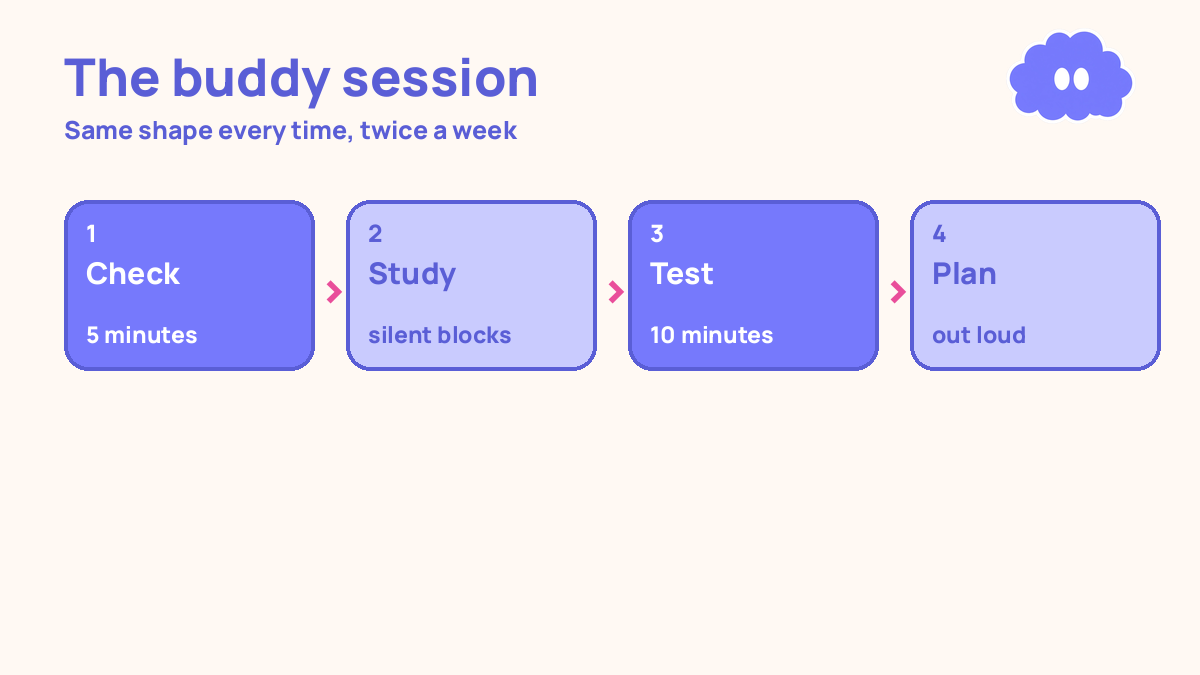
Find one buddy on the same course, meet twice a week at fixed times, and use each session the same way: check last week’s tasks, study in silence together in two 25-minute blocks, then test each other from memory for 10 minutes. End by writing down next week’s tasks. That is the whole system.
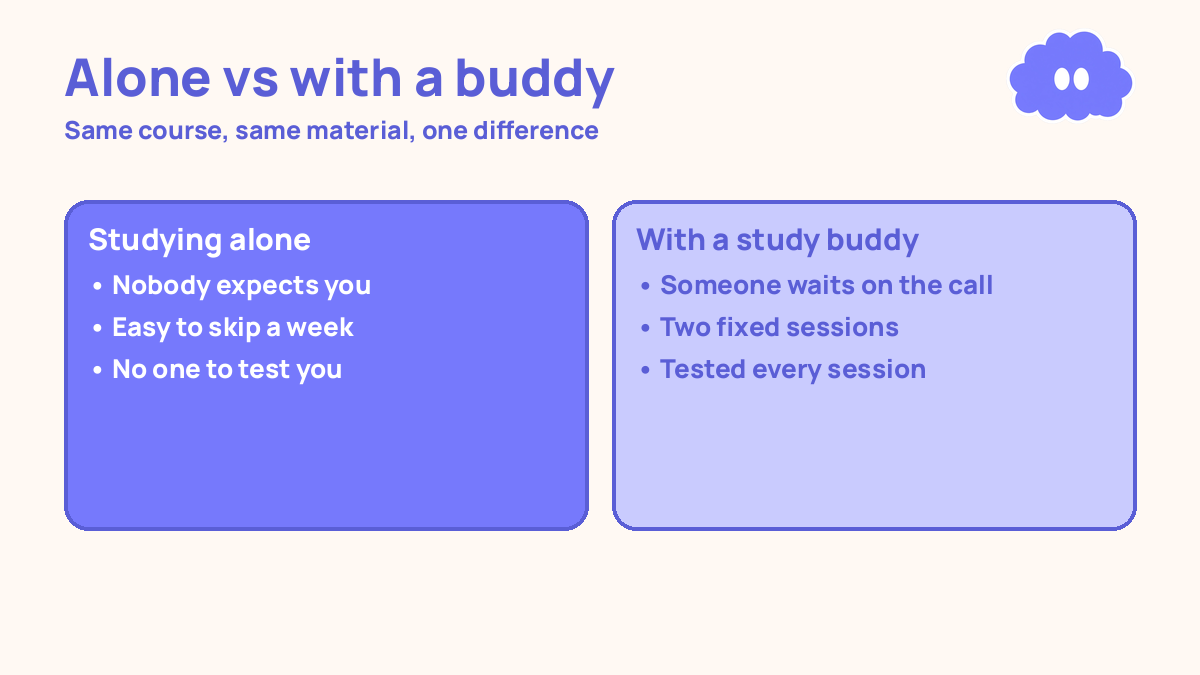
Studying alone online is quiet in the worst way. Nobody knows if you studied today. Nobody notices if you skip a week. The course does not care, the videos do not care, and by the third skipped week you have quietly stopped.
A study buddy fixes the drift, not by motivating you, but by making someone else expect you. You show up because someone is waiting on the call.
The system in short
- Find one buddy on the same course, at the same level, in a nearby time zone.
- Agree on two fixed sessions a week, 60 to 90 minutes each. Write them down.
- Before each session, each of you finishes one small task alone.
- In the session: 5 minutes checking last week’s tasks, two 25-minute silent study blocks, 10 minutes testing each other from memory.
- End every session by writing down next week’s tasks, out loud, to each other.
- If one of you misses two sessions with no message, the other sends one honest message — then moves on.
A buddy is one person; a group is a system — How to revise with a study group shows how to run one without it turning into a chat.
Step 1: Find one buddy, on the same course
One buddy is enough. Two buddies is a group, and a group needs a leader, a schedule, and a chat that never stops. One buddy needs a call link and a time.
Look in your course’s own forum, group, or chat first. Post one message: the course name, the module you are on, your time zone, and your two free times. “Doing the Python course, on module 4, in PKT, free Tuesday and Thursday evenings — anyone want a study buddy?” That is the whole post. Do not write a long introduction. The right person answers a short post.
Pick someone at your level, on the same course, in a nearby time zone. Same level matters more than same enthusiasm: if one of you is three modules ahead, the sessions become tutoring, and tutoring is not what either of you signed up for. Nearby time zone matters because a 6am session for one of you is a session that dies in week two.
Step 2: Fix two sessions a week, and protect them
Two sessions a week, at fixed times, 60 to 90 minutes each. Two is enough to keep you both moving, and few enough that neither of you dreads them. One session a week is too easy to skip — one missed week and you have not spoken for fourteen days. Three sessions a week is a part-time job.
Fix the times, not just the days. “Tuesday and Thursday, 8:00 to 9:30pm” is a plan. “Twice a week, sometime” is a wish. Put both sessions in your calendar, with a call link in the event, so neither of you has to ask where the call is.
Decide the cue and the action in advance — “when it is 8:00pm on Tuesday, I will open the call link” — instead of deciding again every week. An “if-then” plan names the cue and the action in advance, so starting does not need a fresh decision (Gollwitzer & Sheeran, 2006). Across 94 studies, if-then plans raised goal attainment by a medium-to-large amount (d = 0.65) over holding the goal alone.
Protect the sessions like classes. If something clashes, move the session to another day that week.
Step 3: Bring one finished task to each session
Each session starts with work already done. Before the call, each of you finishes one small task alone: one lesson watched, one set of questions answered, one page written. The task is small on purpose — it has to fit in the time you actually have, not the time you wish you had.
The task is the price of the session. Without it, the session starts with twenty minutes of “so, what should we do today?” and that is twenty minutes of the call gone. With it, the session starts with something real to check.
If you did not finish the task, say so in the first five minutes. Do not hide it, and do not make up an excuse. “I did not finish it — I had a busy day” is fine. The session still happens. The task just moves to next week, and the check still happens.
Step 4: The session — check, study in silence, test each other
Every session runs the same way. Same shape, every time, so nobody has to decide what to do.
First 5 minutes: check last week’s tasks. Each of you says what you finished and what you did not. Two sentences each.
Next, two 25-minute silent study blocks, with a 5-minute break between them. Cameras on, microphones off, both of you working on your own material. Silence together is the point: you are not chatting, you are not teaching, you are just in the same room, working.
Then 10 minutes of testing each other from memory. One of you asks, the other answers, then swap. Ask the questions from your notes. “What are the three steps?” “When would you use this instead of that?” Testing each other is real retrieval practice: students who recalled a passage remembered more a week later than students who restudied it (Roediger & Karpicke, 2006).
End the session by writing down next week’s tasks, out loud, to each other. One task each. Say it, write it, send it in a message after the call.
Step 5: What to do when it starts falling apart
Every buddy system wobbles. The wobble is normal. What matters is what you do in the first week of the wobble, not the fourth.
If one of you misses a session, the other sends one message the same day: “Missed you today — same time Thursday?” No guilt, no lecture, just the next time. Most misses are life, not quitting, and one message is enough to bring someone back.
If one of you misses two sessions with no message, send one honest message: “I will keep the slot open for one more week, then I will study alone. Let me know if you want to come back.” Then keep the slot open for one week, and if nobody comes, study alone. Do not chase a third week. Chasing turns a study system into a friendship rescue, and that helps nobody.
If the sessions have turned into chats — thirty minutes of talking, ten minutes of work — say so plainly. “We are chatting more than studying.
A worked example: a Tuesday and Thursday pair
You and your buddy are both on the same data analysis course, both in PKT, both free on Tuesday and Thursday evenings. Your sessions are 8:00 to 9:30pm.
| Time | Tuesday session | Thursday session |
|---|---|---|
| 8:00–8:05 | Check last week’s tasks | Check Tuesday’s task |
| 8:05–8:30 | Silent block 1: lesson 7 | Silent block 1: lesson 8 |
| 8:30–8:35 | Break | Break |
| 8:35–9:00 | Silent block 2: questions | Silent block 2: questions |
| 9:00–9:10 | Test each other: 5 questions | Test each other: 5 questions |
| 9:10–9:15 | Next tasks, out loud | Next tasks, out loud |
On Tuesday you each bring a finished task from lesson 6. On Thursday you each bring the questions from lesson 7. By the end of the week you have both finished two lessons, tested each other on 10 questions, and you both know what next week’s tasks are.
For the wider system this sits inside, start with the self-study system for online learners, the full system for learning on your own with no teacher. This article is the buddy version of that system — same course, same material, one other person expecting you twice a week.
When it goes wrong
Your buddy is three modules ahead of you. The sessions become tutoring, and tutoring is not what you signed up for. Say so plainly, and either find a buddy at your level or agree that the sessions are for the module you are both on — the one behind, not the one ahead. If that does not work, end it kindly.
One of you does the talking and the other does the work. A session where one person explains for forty minutes is a lecture, not a study session. Go back to the shape: check, two silent blocks, test each other. If the talking keeps taking over, use a timer on the screen so both of you can see it. The shape is the system. Without it, you have a chat.
You both skip a week and feel awkward coming back. The awkwardness is the problem, not the skipped week. Send the message anyway: “Missed last week — same time Tuesday?” One message, no apology, no explanation. A buddy system that needs a perfect record is a buddy system that dies at the first missed week.
You cannot find a buddy at all. The course forum gave you nothing, and the group chat is silent. Then study alone, with the same shape: two fixed sessions a week, a task before each, silent blocks, and a test at the end. The shape works alone too — the buddy only makes it harder to skip.
Weekly review checklist
Copy this list and use it at the end of each week:
- Did we meet twice this week, at the fixed times?
- Did we each bring a finished task to each session?
- How many questions did we test each other on, and what did we get wrong?
- Is the shape holding — check, two blocks, test — or has it turned into a chat?
- What one change will we make next week: a different time, a smaller task, or a stricter shape?
Downloadable infographic spec: one vertical image, title “Your study buddy system”, with one buddy on the same course, two fixed sessions a week, check last week’s tasks, two 25-minute silent blocks, 10 minutes testing each other, and next week’s tasks written down, in Thynq cream, Cloud Purple, Dark Purple and pink, with the cloud mascot. Text taken word-for-word from this article.
What this system is not
It is not a promise that a buddy will make you study, and it is not a friendship. It is a practical system for two students on the same course who both want to finish it. It works by making someone else expect you twice a week, and by giving each session a shape that survives a bad day. If the buddy stops showing up, the system is not broken — the match is over, and you find a new one or study alone with the same shape.
Sources
- Gollwitzer, P. M. & Sheeran, P. (2006). Implementation intentions and goal achievement: a meta-analysis of effects and processes. Advances in Experimental Social Psychology, 38 , 69–119. Across 94 studies, if-then plans raised goal attainment by a medium-to-large amount (d = 0.65) over holding the goal alone.
- Roediger, H. L. & Karpicke, J. D. (2006). Test-enhanced learning. Science, 311, 1539–1540. Students who recalled a passage remembered more a week later than students who restudied it.
- Lally, P., et al. (2010). How are habits formed: modelling habit formation in the real world. European Journal of Social Psychology, 40(6), 998–1009. The median time for a behaviour to feel automatic was 66 days, with a range of 18 to 254 days; missing a single day did not measurably hurt the process.
Questions
How do I find a study buddy online?
Ask in your course’s own forum, group, or chat first — someone on the same course, at the same level, in a nearby time zone. One buddy on the same course beats five buddies on five different courses.
How often should we meet?
Twice a week, at fixed times, for 60 to 90 minutes each. Two fixed sessions are enough to keep you both moving, and few enough that neither of you dreads them.
What do we actually do in a session?
Start with 5 minutes of checking last week’s tasks, then study in silence together for two 25-minute blocks, then spend 10 minutes testing each other from memory. The session ends with next week’s tasks written down.
What if my study buddy stops showing up?
After two missed sessions with no message, send one honest message: you will keep the slot open for one more week, then study alone. Do not chase a third week — find a new buddy or switch to a solo system.