The direct answer
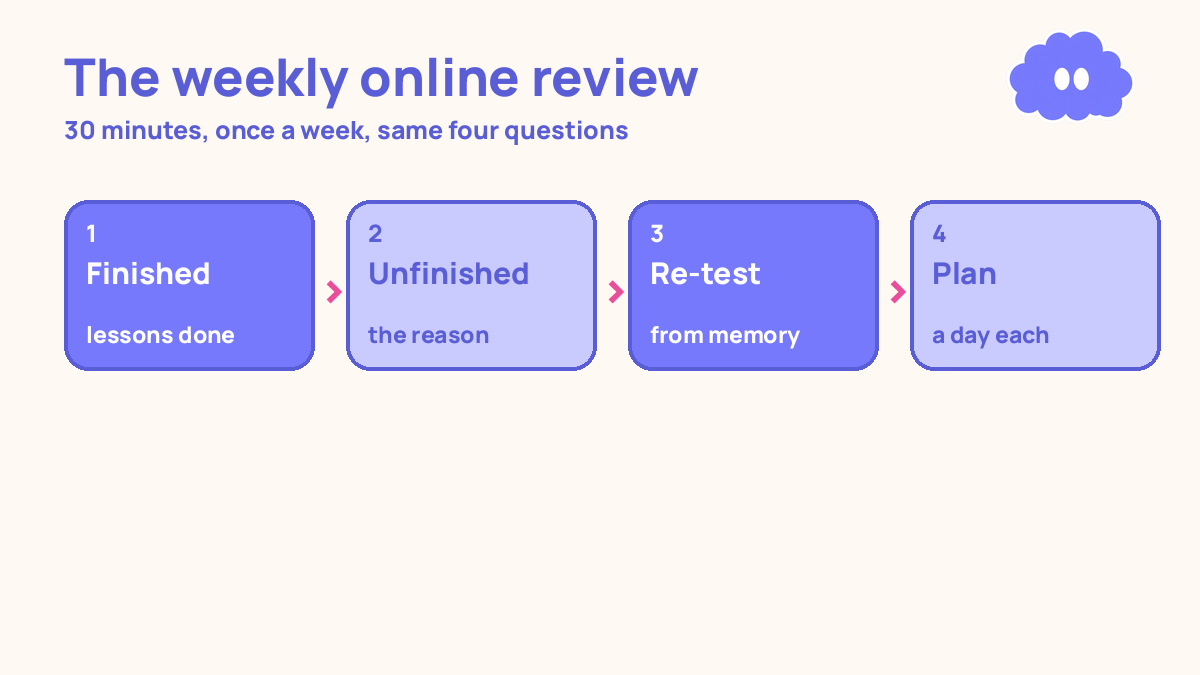
Once a week, at a fixed time, spend 30 minutes reviewing what you learned online: what you finished, what you left unfinished, what you got wrong when you tested yourself, and what is next. Re-test the weak parts from memory, then write next week’s lessons down before the week starts. That is the whole system.
Online courses do not check on you. There is no teacher asking what you did this week, no class moving on without you, no test on Friday. The course just sits there, patient and silent, while the weeks pass. You meant to finish module 4 last week. Then this week. Then next week.
A weekly review is the check that the course never gives you. Thirty minutes, once a week, same time, same questions. It is the difference between a course you finish and a course you quietly abandon. Without it, you do not know you have stopped until you have stopped for a month.
The system in short
- Pick a fixed review time. Sunday evening, 30 minutes, every week.
- Open your course and write down what you finished this week, lesson by lesson.
- Write down what you started but did not finish, and why it stopped.
- Re-test yourself from memory on this week’s material — 10 minutes, questions only.
- Write down what you got wrong. That is next week’s first job.
- Write down next week’s lessons, with the day each one happens.
The same weekly review works for free courses — see Study system for free online courses for the version with no tutor and no deadline.
Step 1: Fix the review time and keep it
Pick one time and keep it every week. Sunday evening works for most students: the week is over, the next one has not started, and you have 30 minutes to spare. If Sunday does not work, pick Saturday morning, or Friday evening. The day does not matter. The fixed time matters.
Thirty minutes is the whole review. Set a timer. If the review takes longer than 30 minutes, you are doing the week’s study inside the review instead of reviewing it. Stop, write down what is left, and do it in the week, not in the review.
Put the review in your calendar as a repeating event, with a reminder. A review that depends on remembering to do it is a review that stops in week three. You do not decide each week whether to review. The calendar decides, and you show up.
Step 2: Write down what you finished
Open the course and write down, lesson by lesson, what you finished this week. Not what you started. Not what you watched half of. Finished. A lesson is finished when you watched it or read it, and you can answer the questions about it from memory.
Write the list on one page, in your notebook or in a plain document. “Lesson 7 — finished, tested, 5 out of 6 right. Lesson 8 — watched, not tested.” That is the whole list. It takes five minutes, and it is the only honest record of the week you have.
Count the finished lessons. Write the number down. Last week it was 4, this week it is 3, next week you want 4 again.
If the number is zero, write zero. Do not skip the review because the week was empty, and do not write a smaller list to make it look better. A zero on the page is information. A skipped review is a week you will never get back, because you never looked at it.
Step 3: Write down what is unfinished, and why
Now write down what you started but did not finish. The half-watched lesson. The module you opened on Monday and never went back to. The practice set with three questions done and seven left. One line each, with the reason it stopped.
The reason matters more than the item. “Lesson 9 — stopped because the video was 90 minutes long and I had 30 minutes.” “Module 5 — stopped because I did not understand the second part.” “Practice set — stopped because I got bored.” Each reason points at a different fix: a long lesson needs splitting, a confusing part needs a question written down, boredom needs a smaller task.
Do not write reasons that blame yourself. “I am lazy” is not a reason, and it has no fix. Write what actually happened: the time ran out, the lesson was too long, the material was confusing, the phone was on the desk. Real reasons have real fixes.
Step 4: Re-test yourself from memory
This is the step that does the learning. Close the course. Take your questions from the week — the ones you wrote while studying — and answer them from memory. Ten minutes, questions only, no notes, no video.
Forgetting is steepest soon after learning, then flattens — and Ebbinghaus measured that on himself, with meaningless syllables, so quote the shape, never a percentage as a law. A short test a few days after you learned something tells you honestly what is still there and what is gone. That is why the review happens every week, not every month: a week is short enough that the test still means something.
Mark each answer right or wrong, and write the wrong ones down. The wrong ones are the review’s real output. Everything you got right can wait. Everything you got wrong is next week’s first job.
Do not re-read the lesson to check. Re-reading feels like learning, and it is not. In a 2013 review, Dunlosky and colleagues rated ten common study techniques, and only two received a high utility rating: practice testing and distributed practice. Re-reading was rated low. A review spent re-reading is a well-organised version of the weakest method. Test first, then check.
Step 5: Write next week’s plan before the week starts
The review ends with a plan, written down, before the week starts. Not a wish — a plan. Three parts, one line each:
- The unfinished lessons from this week, with the day each one happens.
- The wrong answers from the test, with the day you will re-test them.
- The new lessons for next week, with the day each one happens.
Give each lesson a day. “Lesson 9 — Monday. Lesson 10 — Wednesday. Re-test the weak questions — Friday.” A lesson with no day is a lesson that will not happen. A lesson with a day is a task, and a task is something you can do or not do — and next Sunday, you will know which one it was.
Keep the plan to what the week can actually hold. If last week you finished 3 lessons, do not plan 8 for next week. Plan 4, and finish 4. A plan you finish beats a plan you admire. The number that matters is not how much you planned.
A worked example: four weeks of a language course
You are learning a language online, one hour a day, five days a week. Your review is Sunday, 7:00 to 7:30pm. Here is what four weeks of reviews look like.
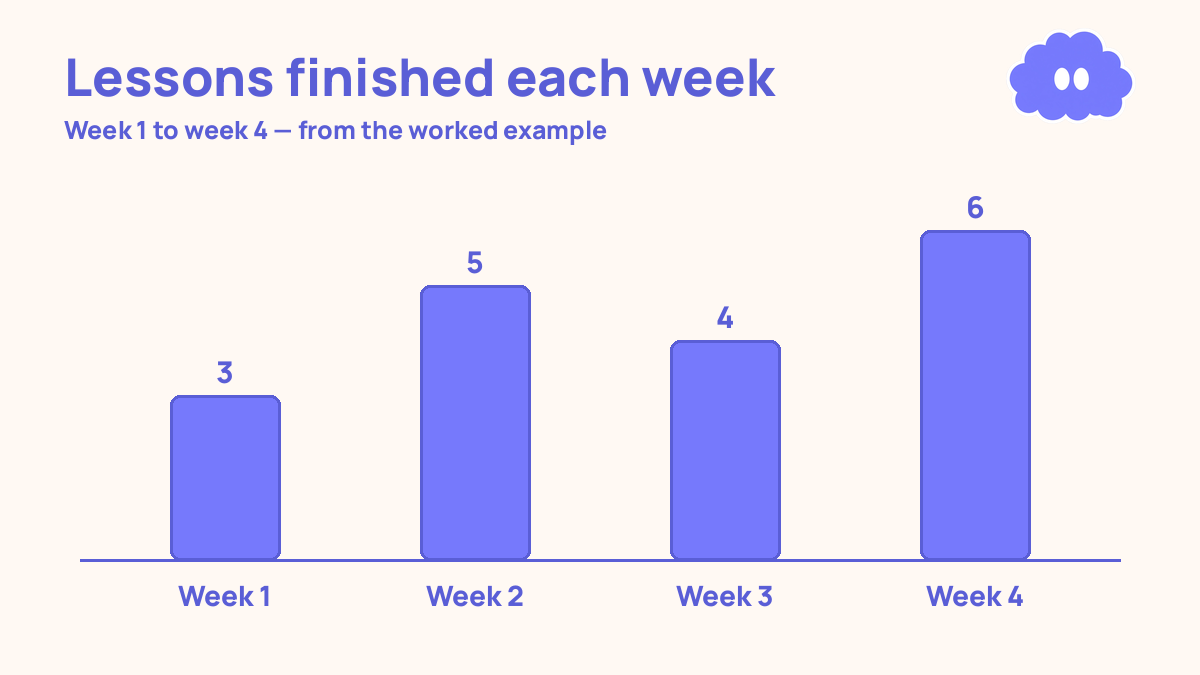
| Week | Lessons finished | Lessons left unfinished | Wrong on the re-test |
|---|---|---|---|
| Week 1 | 3 | 1 | 4 |
| Week 2 | 5 | 0 | 3 |
| Week 3 | 4 | 2 | 5 |
| Week 4 | 6 | 0 | 2 |
Week 1 is slow: 3 finished, 1 unfinished, 4 wrong on the re-test. Week 2 is better: 5 finished, nothing unfinished, 3 wrong. Week 3 dips — 4 finished, 2 unfinished, 5 wrong — because the material got harder and two lessons were long. Week 4 recovers: 6 finished, nothing unfinished, only 2 wrong.
For the wider system this sits inside, start with the self-study system for online learners, the full system for learning on your own with no teacher. For the general weekly review behind this one, read the weekly study review system — it is the same review, applied to any study, while this article is a review built for online learners, with course progress and unfinished lessons at the centre.
When it goes wrong
You keep skipping the review because the week was bad. A bad week is the week you most need the review. The review is 30 minutes, and it is the only thing that stops one bad week from becoming a bad month. Do the review even when the list is short. Especially when the list is short.
The review takes an hour because you start studying inside it. The review is for looking, not for learning. When you catch yourself re-reading a lesson during the review, stop, write the lesson on next week’s plan, and move on. The timer is the rule: 30 minutes, then stop, even if the list is not finished.
Your re-test scores are not improving. The test is telling you the study is not working. Check what you are doing in the week: if it is mostly watching, switch it to testing from memory. If you are testing but never checking the answers, start checking them the same day. And check the gap: if you test a topic the same hour you learned it, the test tells you nothing. Wait a day, then test.
You plan 8 lessons every week and finish 3. The plan is not a wish list. It is a promise to yourself, and a broken promise every week teaches you to ignore your own plans. Plan 4, finish 4, and let the number grow when the finished number grows. A plan you finish is a plan you trust.
Weekly review checklist
Copy this list and use it in every review:
- What did I finish this week, lesson by lesson?
- What did I start but not finish, and why did it stop?
- What did I get wrong on the re-test, and what will I do with it next week?
- How many lessons did I finish — and is the number going up, down, or flat?
- What is next week’s plan, with a day for each lesson?
Downloadable infographic spec: one vertical image, title “Your weekly online review”, with the fixed time, Sunday 30 minutes, what you finished, what is unfinished and why, re-test from memory, and next week’s plan with a day for each lesson, in Thynq cream, Cloud Purple, Dark Purple and pink, with the cloud mascot. Text taken word-for-word from this article.
What this system is not
It is not a promise that reviewing will make you finish the course, and it is not a report card. It is a practical system for seeing your own week clearly, once a week, in 30 minutes. It works by writing things down — finished, unfinished, wrong, next — so the drift becomes visible before it becomes a lost month. If the review shows the same unfinished lesson three weeks in a row, the system is telling you something: the lesson is too big, too hard, or not the right lesson. Split it, ask a question about it, or skip it and come back. The review does not fix the course. It shows you what needs fixing.
Sources
- Cepeda, N. J., et al. (2006). Distributed practice in verbal recall tasks. Psychological Bulletin, 132(3), 354–380.
- Dunlosky, J., et al. (2013). Improving students’ learning with effective learning techniques. Psychological Science in the Public Interest, 14 (1), 4–58. Only practice testing and distributed practice received a high utility rating; rereading was rated low.
- Ebbinghaus, H. (1885). Über das Gedächtnis (On Memory). Forgetting was steepest soon after learning, then flattened — measured on himself, with meaningless syllables, so quote the shape, never a percentage as a law.
- Roediger, H. L. & Karpicke, J. D. (2006). Test-enhanced learning. Science, 311, 1539–1540. Students who recalled a passage remembered more a week later than students who restudied it, even though restudiers felt more confident immediately after studying.
Questions
How long should a weekly review take?
30 minutes, once a week, at a fixed time — Sunday evening works for most students. If it takes longer than 30 minutes, you are doing the week’s study inside the review instead of reviewing it.
What do I actually review each week?
Four things: what you finished, what you started but did not finish, what you got wrong when you tested yourself, and what is next. Write all four down on one page before you plan the next week.
Do I need to re-study everything I learned this week?
No. Re-test it from memory instead. Forgetting is steepest soon after learning, then flattens — so a short test a few days after you learned something tells you honestly what is still there and what is gone.
What if I did nothing this week?
Then the review is one line: nothing done, and why. Do not skip the review because the week was empty — the review is how an empty week becomes one empty week instead of a quiet month.