The direct answer
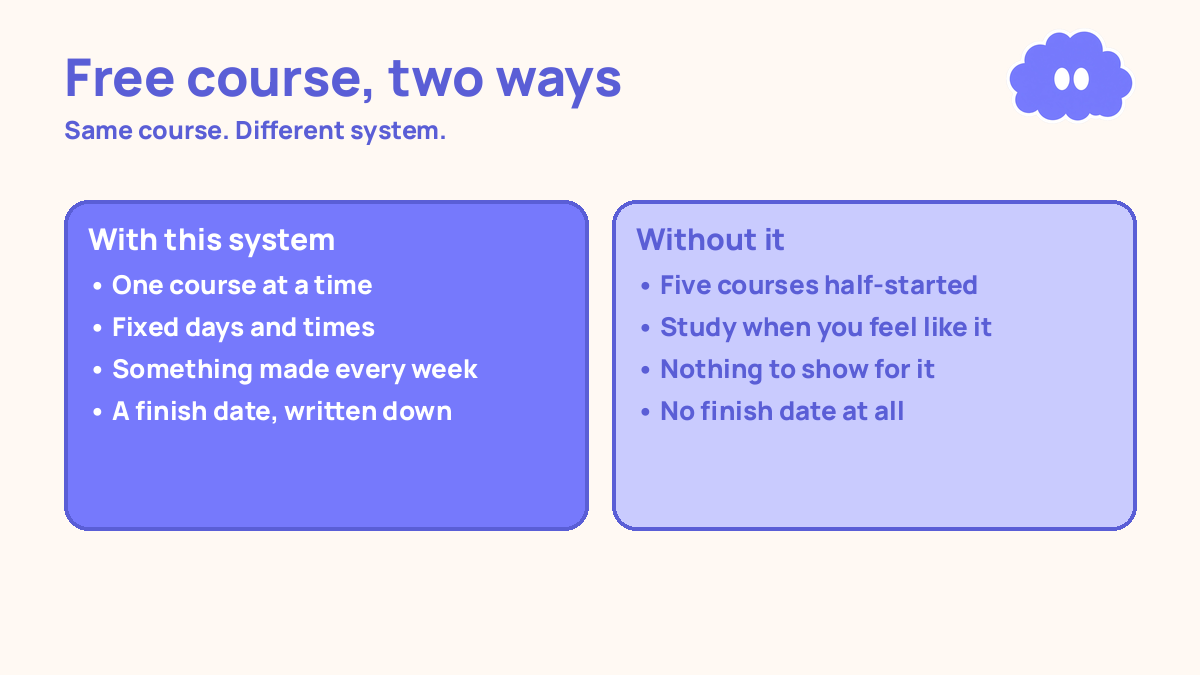
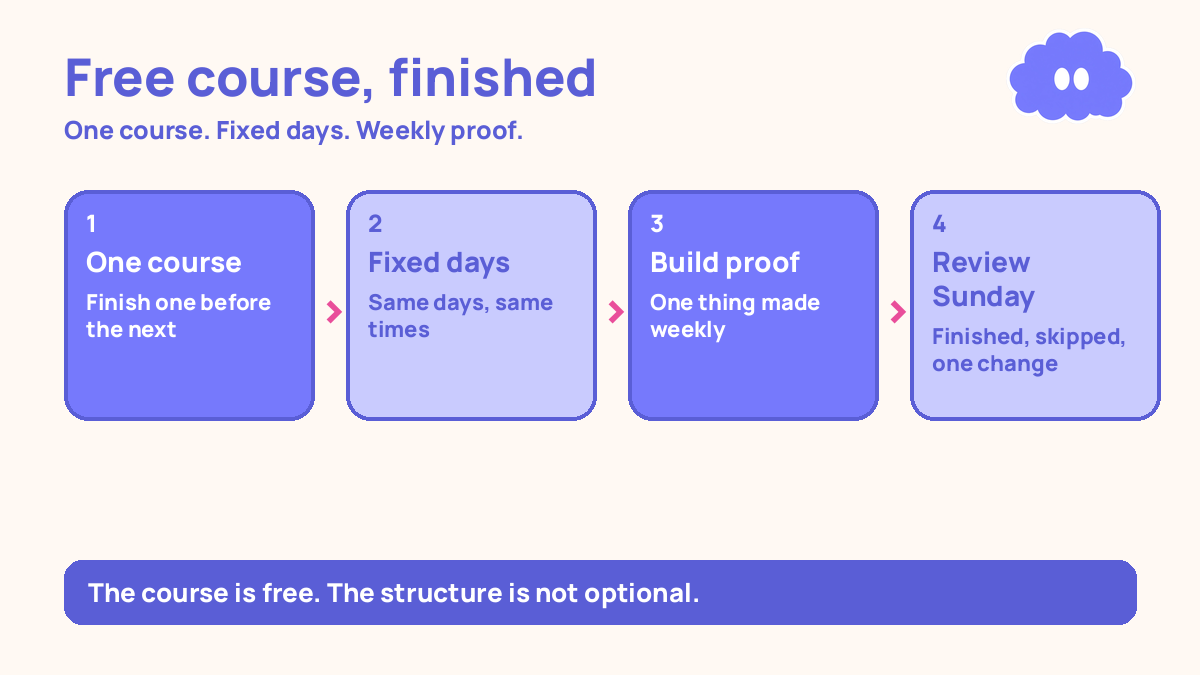
Free courses fail because nothing pushes you to finish: no deadline, no teacher, no money spent. So you have to supply the pressure yourself. Take one course at a time, fix the days and times you will study, set a finish date, make something visible every week, and review your progress every Sunday. That is the whole system. The course is free. The structure is not optional.
You know the pattern. You find a free course, you are excited, you watch three lessons in the first week. Then life gets busy, a week passes, then another. The course sits there, half-watched. It is not that the course was bad. It is that nobody was waiting for you.
Why free courses are the hardest to finish
A paid course has a cost that hurts if you quit. A university course has a teacher who notices, and an exam at the end. A free course has none of that. You paid nothing, nobody knows you started, and there is no date by which anything must be done. Skipping a week costs you nothing in the moment, so you skip it. Then you skip another. The course does not end. It just fades.
That is the whole problem, and it is not a problem with you. It is a problem with the setup. Willpower is not the answer — willpower is what you use when there is no system, and it runs out by Wednesday. The answer is to build the things a paid course gives you: a schedule, a deadline, someone who sees your work, and a regular check on whether you are actually moving.
The system in short
- Pick one course only, and write down what “finished” means and the date you will finish by.
- Fix the days and times you will study — the same days, the same times, every week.
- Study in blocks of 25 or 50 minutes, and test yourself from memory in every block.
- Make something visible every week: a small project, a set of notes, a piece of work you can show someone.
- Review every Sunday: what did you finish, what did you skip, and what changes next week?
Step 1: Pick one course, and write the finish date
Choose one course. Just one. If you are already halfway through two or three, pick the one closest to finished and park the rest. Write their names on a list titled “Later”, and do not open them until the first one is done.
Then write down what “finished” means, in one sentence. “Watch all 24 lessons and build the final project.” “Complete all 8 modules and pass the final quiz.” Not “do the course” — that is too vague to finish. A finish line you can see is a finish line you can reach.
Now pick a finish date. Count the lessons, divide by the weeks you have, and write the date in your notebook and on your calendar. A course with no finish date lasts forever. If the date turns out to be unrealistic, move it once, deliberately, and write down why. Before you start, check the course is worth your time with the five checks in how to check if an online course is worth it.
Step 2: Fix the days and times
Pick the days and the times, and write them down as an if-then plan: “If it is Tuesday and Thursday at 7pm, then I will study for one hour.” Decide the cue and the action in advance, instead of deciding again every day. Across 94 studies, Gollwitzer and Sheeran (2006) found that if-then plans raised goal attainment by a medium-to-large amount (d = 0.65) over holding the goal alone. The plan works because starting needs no fresh decision — the time arrives, and you start.
Choose times you can actually keep. Two hours a week you really do beats six hours a week you only plan. If your week is irregular, pick the two most reliable slots — the evenings after dinner, the mornings before work — and protect them. Tell the people you live with, if you can: “Tuesday and Thursday, 7 to 8, I am studying.” A slot other people know about is a slot that survives.
Step 3: Study in blocks, and test yourself in every block
A study block is 25 minutes or 50 minutes — both are practical timers, not prescriptions. Set a timer and work until it rings. In each block, learn something new, then close the lesson and test yourself from memory. Answer questions, solve a problem, or write down what you just learned without looking.
Testing yourself is the strongest method in the research base. In a 2013 review, Dunlosky and colleagues rated ten common study techniques, and only two received a high utility rating: practice testing and distributed practice. Re-reading and highlighting were rated low. Watching a free lesson twice is re-reading. Testing yourself after watching it once is learning.
Step 4: Make something visible every week
Every week, produce one thing you can show someone: a small project, a page of notes, a solved problem set, a short write-up of what you learned. It does not have to be good. It has to exist. A course you only watch leaves nothing behind. A course you build with leaves proof.
This is also how you know whether you are learning. If you cannot make anything with what you watched, you did not learn it — you only watched it. The weekly product is the honest check. If the week’s lessons were about spreadsheets, your product is a spreadsheet that does something.
Show it to someone: a friend, a family member, a study buddy online, or a post on a forum. What matters is that another person sees it. That is the pressure a free course does not give you, and you are building it yourself. If you have no one to show, keep the products in one folder and look at them yourself on Sunday.
Step 5: Review every Sunday
Every Sunday, spend 15 minutes on three questions. What did I finish this week? What did I skip, and why? What one change will I make next week? Write the answers down. A review you only think about is a review you forget by Monday.
If you are two weeks behind your finish date, decide deliberately: move the date, cut a section, or drop the course. A deliberate decision is fine. Silent drift is not. For the weeks after you start, the system for actually getting to the end is how to finish an online course.
A worked example: an 8-week free course, 40 hours
You pick a free web design course: 24 lessons, 8 modules, one final project. You have 5 hours a week. Your finish date is 8 weeks from now. Your study hours across the 8 weeks are: 5, 5, 5, 5, 4, 5, 5, and 6 — a total of 40 hours. Week 5 is 4 hours because work is busy that week, and the final week is 6 hours because that is when you build the project.| Week | Hours | What you do | Proof you make | |—|—|—|—| | 1 | 5 | Modules 1–2, write questions | A page of notes and 10 questions | | 2 | 5 | Modules 3–4, test week 1 | A simple page you built | | 3 | 5 | Modules 5–6, test weeks 1–2 | A page with a form | | 4 | 5 | Modules 7–8, test weeks 2–3 | A two-page site | | 5 | 4 | Review all questions, fix weak spots | A list of what you still get wrong | | 6 | 5 | Start the final project | Project outline and first page | | 7 | 5 | Build the project | A working draft of the site | | 8 | 6 | Finish the project, review everything | The finished site, shown to a friend |
Total: 40 hours, 8 weeks, one finished course, and one finished site you can show someone. The free course cost you nothing. The system cost you 5 hours a week, fixed in advance, and a Sunday review. That is the whole difference between a course you finish and a course you forget.
When it goes wrong
You start a second course before finishing the first. This is the most common failure, and it feels like progress. It is not. Fix it now: pick one course, park the other on your “Later” list, and go back to the first. If you truly cannot choose, pick the one closest to finished.
You miss a week and the guilt stops you from going back. One missed week is not a failed course. Lally and colleagues (2010) found that missing a single day did not measurably hurt habit formation. Open the course, do one 25-minute block, and you are back. The block is small on purpose. Do not try to “catch up” by doing three weeks in one weekend — that is how you burn out and quit for good.
You watch every lesson but make nothing. Watching feels like learning, and it is not. If you reach week four with no product to show, stop watching and build something from what you have already seen. A small, ugly project you made teaches you more than four more lessons you watched.
You finish the course and have nothing to show for it. A finished course with no proof is a course nobody can see, including you. The fix is in Step 4: make something every week, and keep it in one folder.
Weekly review checklist
Copy this list and use it every Sunday:
- How many hours did I study this week, and on which days?
- What did I make this week — and can I show it to someone?
- What did I skip, and why: the slot, the lesson, or life?
- Am I still on track for my finish date, or does it need to move?
- What one change will I make next week: a different slot, a smaller task, or a different lesson order?
Downloadable infographic spec: one vertical image, title “Free course, finished”, with the five steps — one course only, fixed days and times, study in blocks and test yourself, make something visible every week, review every Sunday — and the weekly review checklist, in Thynq cream, Cloud Purple, Dark Purple and pink, with the cloud mascot. Text taken word-for-word from this article.
What this system is not
It is not a promise that every free course is worth finishing, and it is not a claim that structure alone makes a bad course good. Some free courses are poor, and the right move is to drop them — deliberately, and on purpose. It does not promise a grade, and it does not promise that you will enjoy every week. What it promises is simpler: a system that gives a free course the things it lacks — a schedule, a deadline, visible proof, and a weekly check — so that finishing is a plan, not a hope.
Sources
- Dunlosky, J., et al. (2013). Psychological Science in the Public Interest, 14(1), 4-58. Only practice testing and distributed practice received a high utility rating; rereading and highlighting were rated low.
- Gollwitzer, P. M. & Sheeran, P. (2006). Advances in Experimental Social Psychology, 38, 69-119. Across 94 studies, if-then plans raised goal attainment by a medium-to-large amount (d = 0.65) over holding the goal alone.
- Lally, P., et al. (2010). European Journal of Social Psychology, 40(6), 998-1009. The median time for a new daily behaviour to feel automatic was 66 days, with a range of 18 to 254 days. Missing a single day did not measurably hurt the process.
For the general system this one sits inside, read self-study system for online learners.
Questions
Why do I never finish free courses?
Because nothing pushes you. There is no deadline, no teacher waiting, and no money spent, so skipping a week costs nothing in the moment. The fix is to build your own pressure: fixed days, a finish date, and proof of work each week.
How many free courses should I take at once?
One. Two free courses means two half-finished courses. Finish one, then start the next. If a second course tempts you, write it on a list for later and keep going with the first.
How do I stay motivated with no teacher checking on me?
Make your work visible. Show someone what you made each week — a friend, a study buddy, or a post online. And keep a short weekly review: what did I finish, what did I skip, and what changes next week.
Are free courses as good as paid ones?
Some are excellent and some are poor, and the price does not tell you which. Check a free course the same way you would check a paid one: syllabus, sample lesson, teacher, and reviews. The system for that is in the article on checking whether a course is worth it.