The direct answer
Before you pay for a course, or start a free one, check five things: does the syllabus teach what you want to be able to do, is the sample lesson clear, does the teacher show real work of their own, are the reviews specific, and does the price and the time fit your life. Spend about 50 minutes on the five checks. If three or more fail, skip the course. If only one is weak, decide whether you can live with it. That is the whole system.
You have probably done this before: paid for a course, or started a free one, and three weeks later you have watched four lessons, learned nothing you can use, and stopped opening it. The money is gone, the time is gone. The course was not too hard. It was the wrong course.
Why courses disappoint
Courses sell a feeling: the feeling of having started. You buy, you watch the first lesson, and it feels like progress. Then lesson five is boring, lesson eight assumes things you were never taught, and by lesson twelve you have stopped. The course did not fail you in week three. It failed you in the first ten minutes, when you never checked whether it taught what you needed.
There is a second problem. A course page is an advert. It shows the best lesson, the best review, the best student result — not the lessons where the teacher rambles, the topics the syllabus skips, or the students who quit. You cannot judge a course by its own page.
And there is a third problem: a course can be good and still be wrong for you. A brilliant course on advanced statistics is useless if you need basic spreadsheets. Worth is not a property of the course. It is a match between the course and your goal. That is why the first check is your goal, not the course.
The system in short
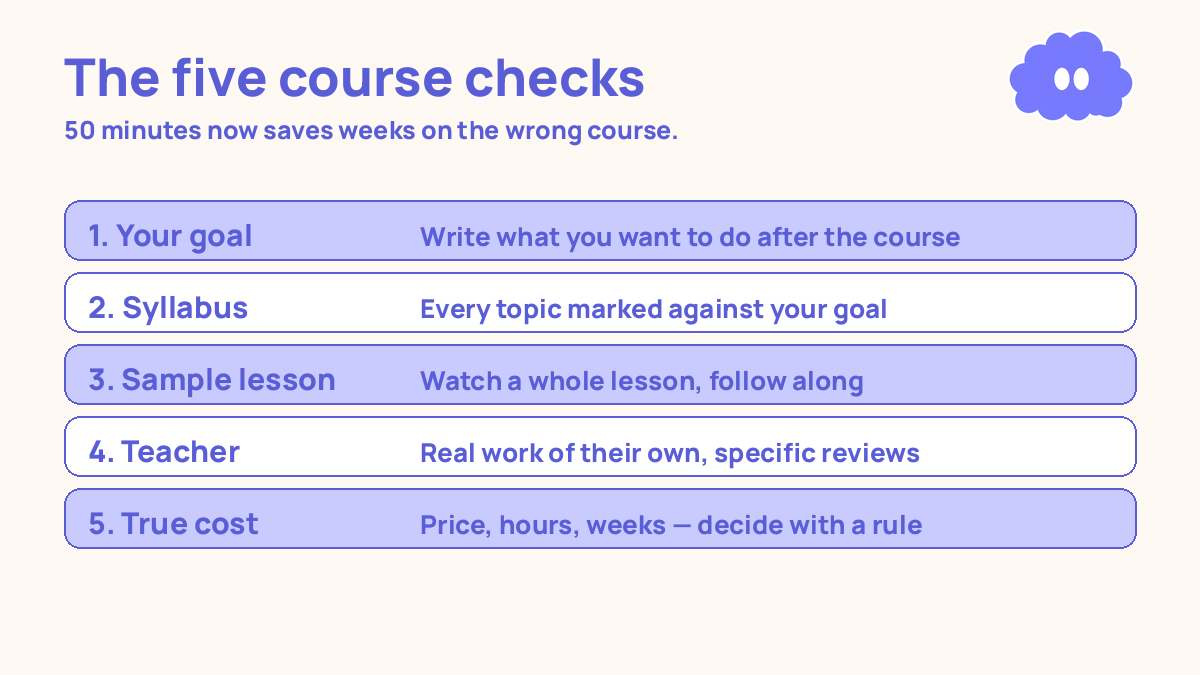
- Write your goal in one sentence: what you want to be able to do after the course.
- Read the full syllabus and mark every topic against your goal. Count what is missing.
- Watch the whole free sample lesson, not the trailer. Judge clarity, pace, and whether you can follow it.
- Check the teacher: real work of their own, and reviews that name specific things, good and bad.
- Count the true cost: the price, the hours, and the weeks. Decide with a rule written in advance, not with excitement.
If the course you are checking costs nothing, Study system for free online courses shows how to finish one without a deadline.
Step 1: Write your goal in one sentence
Before you look at any course, write down what you want to be able to do when it ends. Not “learn Python”. Something you can test: “Build a small website with a contact form”, “Analyse a spreadsheet of sales data and write a one-page summary”, “Hold a ten-minute conversation in Spanish”. One sentence, one thing you can do, with a result you can see.
This sentence is the test for everything that follows. A topic in the syllabus is worth your time if it helps you do that thing. A topic that does not help is a distraction, however interesting it looks. If you cannot write the sentence, you are not ready to choose a course.
Step 2: Read the full syllabus, line by line
Open the full syllabus, not the short list on the sales page. Go through every module and every lesson title. For each one, ask: does this help me do the thing in my sentence? Mark it yes, no, or partly. Count the yeses at the end.
A good syllabus for you has most of its lessons marked yes. A syllabus with half its lessons marked no is a course that will waste half your time. Look for the gaps too: does it skip the thing you most need? A web course that never teaches forms cannot help you build a website with a contact form, however good its other lessons are.
Check the order as well. Does it start where you are? A course that assumes you already know the basics will lose you in week one. A course that spends three weeks on things you already know will bore you into quitting. The syllabus should start close to where you are now and end at your goal.
Step 3: Watch the whole sample lesson
Most courses offer a free lesson. Watch the whole thing, not the two-minute trailer. A trailer is an advert. A full lesson shows you the teacher as they really teach: how fast they talk, whether they explain or just read slides, whether you can follow along without pausing every minute.
While you watch, try to do what the lesson asks. If it is a coding lesson, type the code. If it is a language lesson, say the words out loud. If you cannot follow it, or you have to rewind three times in ten minutes, that is information. The course will not get easier in lesson eight.
Step 4: Check the teacher and the reviews
Look for the teacher’s own work. A coding teacher should have code you can see. A design teacher should have designs. A language teacher should have recordings of themselves speaking. Real work is the best evidence there is, because it cannot be faked with a nice course page. If you cannot find anything the teacher has made or done outside the course, be careful.
Then read the reviews, and read them the right way. Ignore the ones that only say “great course” or “amazing teacher”. Look for reviews that name specific things: “the section on forms was clear, but the database part moved too fast”, “I built a working site by week four”. Specific reviews, good and bad, are the honest ones. If every review is five stars and none mentions a weakness, be careful — either the course is perfect, which is unlikely, or the bad reviews are missing.
Step 5: Count the true cost, and decide with a rule
A course costs more than its price. Count three things: the money, the hours, and the weeks. The money is on the page. The hours are the lesson time plus the practice time — a 10-hour course needs at least 10 more hours of practice, and probably more. The weeks are how long it will take at the hours you actually have, not the hours you wish you had. A course that needs 5 hours a week for 8 weeks is a course you cannot finish if you only have 2 hours a week.
Write your decision rule before you decide, in your notebook. For example: “I will buy it only if the syllabus covers my goal, the sample lesson was clear, and I have 4 hours a week for the next 8 weeks.” Deciding the rule in advance is an if-then plan: “If the course passes these checks, then I will buy it.” Across 94 studies, Gollwitzer and Sheeran (2006) found that if-then plans raised goal attainment by a medium-to-large amount (d = 0.65) over holding the goal alone. If the course fails your rule, skip it.
A worked example: checking a Python course in 50 minutes
You want to build a small website with a contact form, and you found a Python course for £40. You spend one evening checking it, 50 minutes in total: 10 minutes on the syllabus, 15 on the sample lesson, 10 on the teacher, 10 on reviews, and 5 on the price.
| Check | Minutes | What you find | Pass or fail |
|---|---|---|---|
| Syllabus | 10 | Covers web basics and databases, but no forms | Fail |
| Sample lesson | 15 | Clear, good pace, you follow along easily | Pass |
| Teacher | 10 | Has a public portfolio of real websites | Pass |
| Reviews | 10 | Specific, recent, mention the missing forms section | Pass |
| Price and time | 5 | £40, 8 weeks at 4 hours a week — you have 4 hours | Pass |
Four passes and one fail — but the fail is the thing you need most. The course never teaches forms, and forms are the whole point of your goal. Your rule says: skip it. You lose 50 minutes and £0. If you had bought it, you would have lost £40 and eight weeks, and still not have a contact form.
When it goes wrong
You buy the course before checking, because it is on sale. A sale is not a reason. The course will be on sale again, and a cheap wrong course is still a wrong course. Write your rule first, and do not buy until the checks are done. If the sale ends before you finish checking, let it end.
The syllabus looks perfect but the teaching is bad.
The reviews are all five stars and you trust them. Five-star reviews with no detail are not evidence. Look for the specific ones, and look for the low ones. If a course has no low reviews at all, treat that as a warning, not a recommendation. Every real course has a student it did not suit.
You check the course, it passes, and you still do not finish it. Checking is not finishing. A good course still needs steady work and a plan for finishing it. The system for that is how to finish an online course, which is about the weeks after you start, not the evening before you buy. The syllabus looks perfect but the teaching is bad.
Review checklist
Use this list before every course you pay for or start:
- Did I write my goal in one sentence, and does the syllabus teach it?
- Did I watch a whole sample lesson and follow along without rewinding constantly?
- Did I find the teacher’s own real work, and read specific reviews, good and bad?
- Did I count the money, the hours, and the weeks — and do I actually have them?
- Did I write my decision rule before deciding, and did the course pass it?
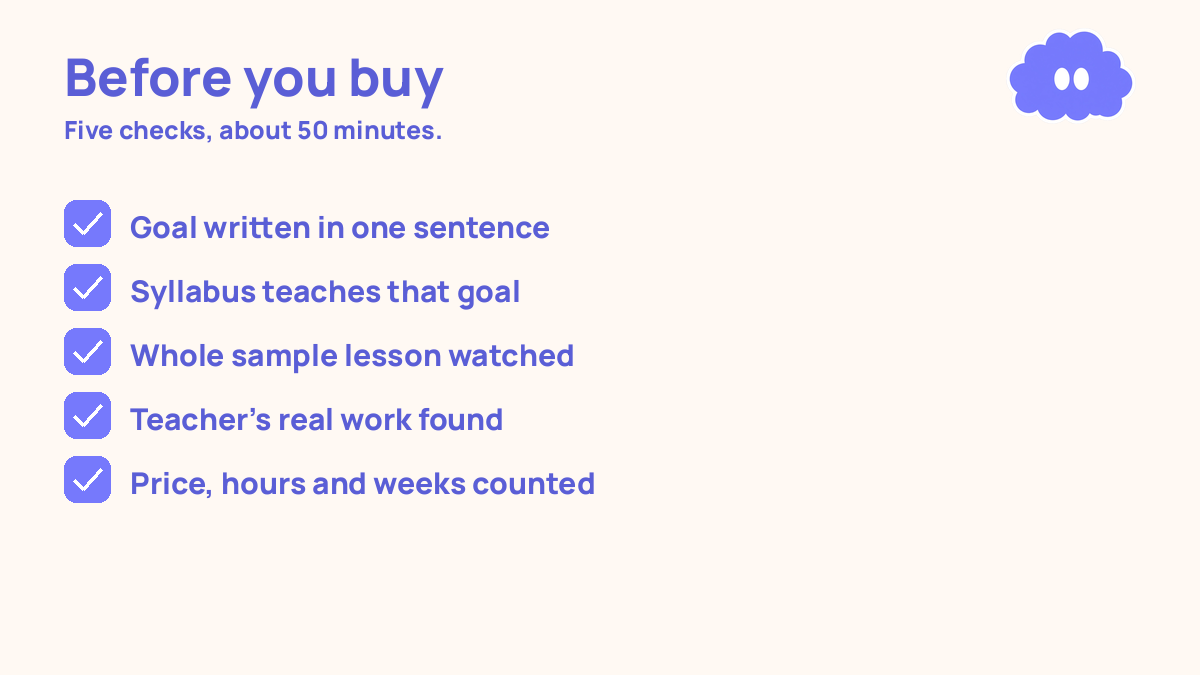
Downloadable infographic spec: one vertical image, title “Check before you buy”, with the five checks and the review checklist, in Thynq cream, Cloud Purple, Dark Purple and pink, with the cloud mascot. Text taken word-for-word from this article.
What this system is not
It is not a promise that a course that passes the checks will be perfect, and it is not a claim that free courses are worse than paid ones. Some free courses are excellent; some expensive courses are poor. It does not promise that you will finish a course that passes — finishing is a different system, and it starts the day after you buy. What it promises is simpler: 50 minutes of checking that stops you spending money and weeks on a course that was never right for you.
Sources
- Gollwitzer, P. M. & Sheeran, P. (2006). Advances in Experimental Social Psychology, 38, 69-119. Across 94 studies, if-then plans raised goal attainment by a medium-to-large amount (d = 0.65) over holding the goal alone.
- Dunlosky, J., et al. (2013). Psychological Science in the Public Interest, 14 (1), 4-58. Only practice testing and distributed practice received a high utility rating; rereading was rated low.
- Rowland, C. A. (2014). Psychological Bulletin, 140(6), 1432-1463. Testing beat restudying (g = 0.50); with feedback the effect was larger (g = 0.73) than without it (g = 0.39).
For the general system this one sits inside, read self-study system for online learners.
Questions
What is the first thing to check before buying a course?
Your own goal. Write down what you want to be able to do after the course, in one sentence. Then check the syllabus against that sentence. If the course does not teach the thing you want to do, no price makes it worth it.
How do I know if the teacher is any good?
Watch the free sample lesson, and look for real work the teacher has done — a portfolio, a project, a job in the field. A teacher who shows their own work is easier to trust than one who only shows a smiling photo and a list of certificates.
Can I trust course reviews?
Read the specific ones. A review that names what the student built, or what was missing, is useful. A review that only says “great course” tells you nothing. If every review is five stars and none mentions a weakness, be careful.
How long should checking a course take?
About 50 minutes for the five checks in this system: 10 on the syllabus, 15 on the sample lesson, 10 on the teacher, 10 on reviews, and 5 on the price. That is less than one evening, and it saves weeks on a wrong course.