The direct answer
How to stop falling asleep while studying starts with one question: why are you falling asleep. Usually it is one of three causes: sleep debt, a passive study method, or an environment that tells your brain it is time to sleep. Diagnose the cause first, fix the night before, give the brain a job, and set up the room.
The system in short
- Diagnose the cause with the three-cause check: sleep debt, passive method, or environment, and fix the cause you find.
- Fix the night before: a fixed wake time, a fixed lights-out time, and the phone charging outside the bedroom.
- Give the brain a job in every session: active methods only, and change the method every 25 minutes.
- Set up the room: upright, bright, cool, and never on the bed.
- Use the alertness ladder when sleepiness starts: move, water, cold air, and a change of method, in that order.
- Take a strategic nap when the ladder fails: 10 to 20 minutes, with a timer, and never after 4:00pm.
Step 1: Diagnose the cause with the three-cause check
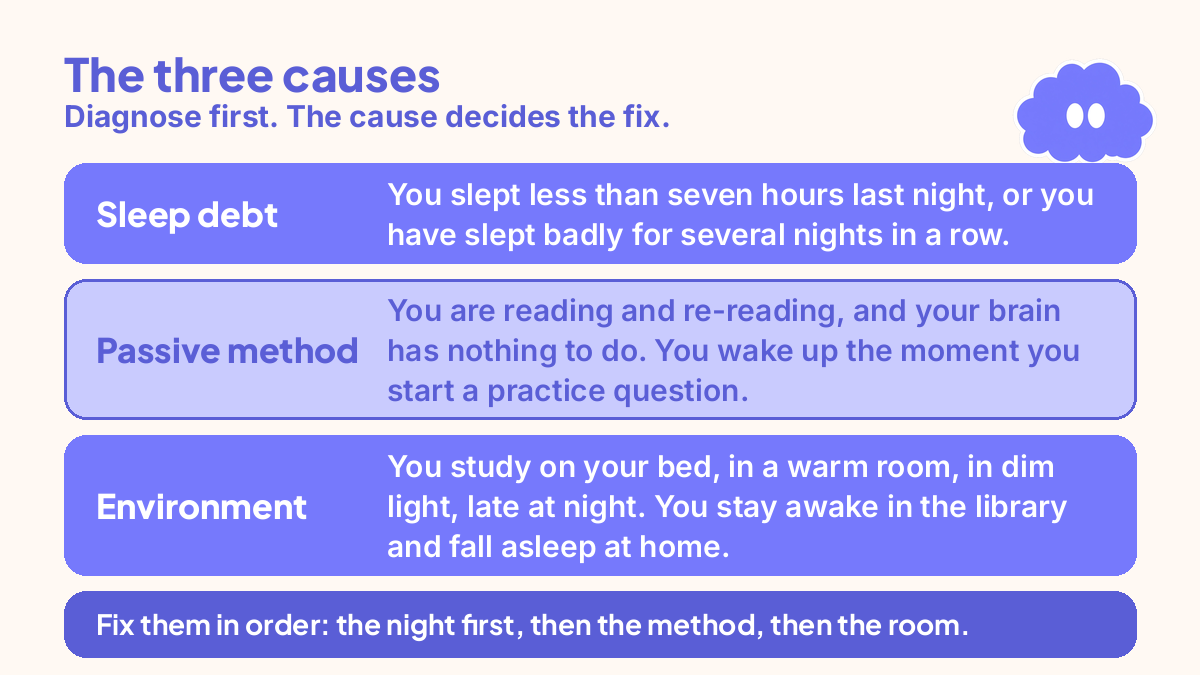
Before you change anything, diagnose. For three days, note when you fall asleep while studying, and check the three causes. The cause decides the fix, and the wrong fix wastes a week.
Cause one is sleep debt. You slept less than seven hours last night, or you have slept badly for several nights in a row.
Cause two is a passive method. You are reading and re-reading, or watching a video without taking notes, and your brain has nothing to do.
Cause three is the environment. You study on your bed, in a warm room, in dim light, late at night.
Step 2: Fix the night before
The real fix for falling asleep while studying happens the night before, not during the study session. A student who sleeps seven to nine hours, at the same times every day, falls asleep while studying far less than a student who does not, whatever method they use.
Set a fixed wake time, and keep it every day, including weekends. Set a fixed lights-out time that gives you at least eight hours before the alarm. Put the phone on charge outside the bedroom, and set a phone-off alarm 30 minutes before lights-out. Stop studying at least one hour before bed, keep the bedroom dark and cool, and avoid caffeine after 5:00pm or 6:00pm. These are simple habits, and they are the most effective way to stop falling asleep while studying, because they remove the cause instead of fighting the symptom.
If you have been sleeping badly for weeks, fix the night for a week before you judge the system. The guide to how sleep helps you remember what you studied explains why this matters for marks as well as for alertness: sleep is when the brain stores what you learned, and a tired brain cannot learn at full speed. The evening wind-down for better sleep before exams sets out the hour before bed in full.
Step 3: Give the brain a job in every session
A brain with nothing to do falls asleep. A brain with a job stays awake. Reading and re-reading is the easiest state to fall asleep in, because it asks nothing of you. Active methods ask for something every minute, and that is why they keep you awake as well as teaching you more.
Use active methods only when you are sleepy. Test yourself: close the notes and write or say everything you remember. Teach the material aloud, as if to a friend. Turn the notes into a diagram, a map, or a set of flashcards. Do practice questions, and mark them immediately. Read out loud instead of silently. Each of these gives your brain a job, and a brain with a job does not drift off.
Change the method every 25 minutes. Study in 25-minute blocks with 5-minute breaks, and use a different method in each block: test yourself in the first, draw a diagram in the second, do practice questions in the third. The change is the point: a new method is a new job, and a new job wakes the brain up.
Dunlosky and colleagues (2013) rated only practice testing and distributed practice as high utility, and Roediger and Karpicke (2006) showed students who recalled material remembered more a week later than students who restudied it.
Step 4: Set up the room so it does not put you to sleep
The room is the third cause, and it is the easiest to fix. Studying on a bed is asking to fall asleep: your brain associates the bed with rest, and it will do what it has learned to do there. Study at a desk and chair, not on the bed or the sofa, and keep the study area separate from the sleep area. If you live in one room, study at the desk and sleep in the bed, and never swap them.
Make the room bright. When it is dark outside, a single lamp or overhead light is not enough to keep you alert. Turn on every light, sit near a window in the daytime, and keep the study space well-lit.
Make the room cool. A warm room makes you drowsy. Open a window, turn the heating down, and keep the room around 20 to 22 degrees if you can.
Sit up, and stand up sometimes. Lying down is associated with rest, and sitting upright is associated with alertness. If you feel yourself fading, stand up and study standing for ten minutes, or walk to another room and back. The focus system for noisy environments and the guide to studying without your phone cover the rest of the setup: a quiet room, and a phone in another room, not on silent next to you.
Step 5: Use the alertness ladder when sleepiness starts
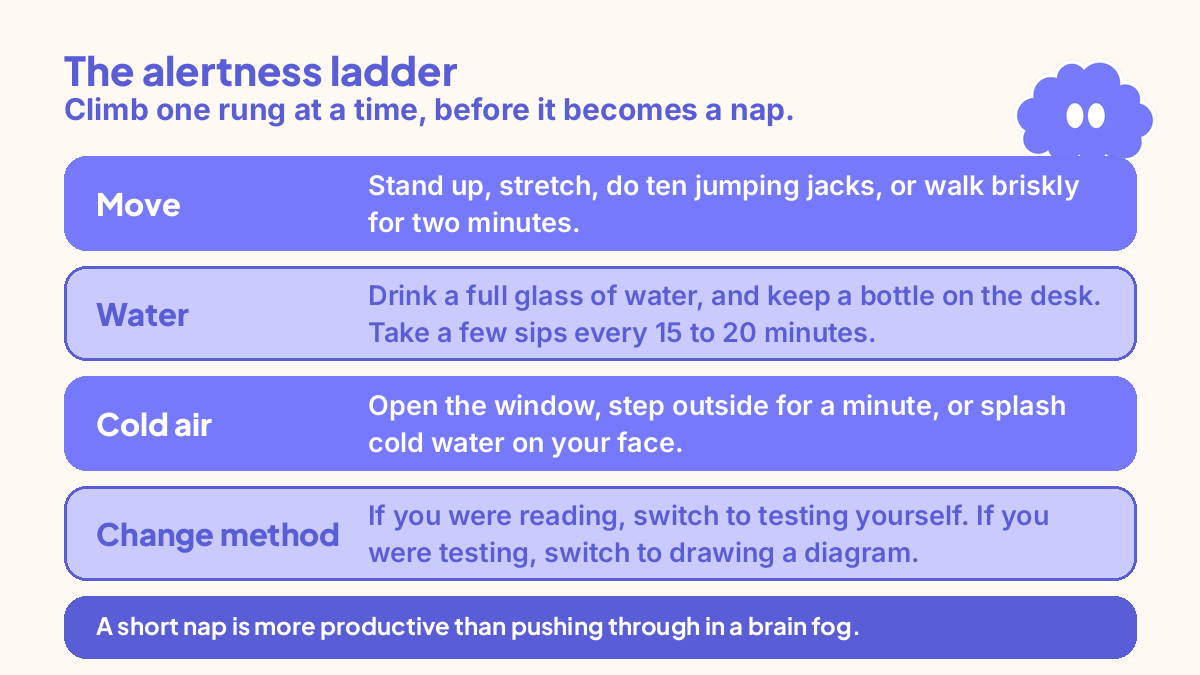
Sleepiness starts gradually, and the ladder catches it early, before it becomes a nap you did not plan. The ladder has four rungs, in order, and you climb one rung at a time.
Rung one: move. Stand up, stretch, do ten jumping jacks, or walk briskly for two minutes.
Rung two: water. Drink a full glass of water, and keep a bottle on the desk. Dehydration feels like tiredness, and a tired brain that is actually thirsty will wake up when it is watered.
Rung three: cold air. Open the window, step outside for a minute, or splash cold water on your face.
Rung four: change the method. If you were reading, switch to testing yourself. If you were testing, switch to drawing a diagram. If you were drawing, switch to practice questions.
If all four rungs fail, the ladder has done its job: it has told you that you are genuinely tired, not just bored. That is when you take the nap in step six, instead of fighting for another hour and learning nothing.
Step 6: Take a strategic nap when the ladder fails
A short nap is more productive than pushing through in a brain fog. Keep it to 10 to 20 minutes, set a timer, and take it before 4:00pm. Longer than 20 minutes, and you wake up groggy and waste the next hour. Later than 4:00pm, and it steals the night’s sleep.
Set the nap up properly. Lie down in a dark, cool room, set a timer for 20 minutes, and get up when it goes off, even if you feel you could sleep longer.
A nap is a tool for a bad day, not a replacement for a proper night of sleep. If you need a nap every day, the problem is the night before, not the afternoon. Go back to step two and fix the sleep window. If you need a nap and it is after 4:00pm, skip it: a late nap will cost you the night, and the night will cost you tomorrow.
If sleepiness is constant, every day, for weeks, and it does not improve with regular sleep, talk to a doctor. Constant sleepiness can have a medical cause, and a study system is not the tool for it.
A worked example: one week of fixing evening sleepiness
Your situation: Second-year student, exams in four weeks. You fall asleep every evening at 8:00pm, in the middle of your study session, and you wake up at 9:30pm having learned nothing. You sleep from midnight to 7:00am, seven hours, but you go to bed at different times and you check your phone until you fall asleep.
- Monday: diagnose. Three-cause check: sleep debt, yes, irregular bedtime and phone in bed. Passive method, yes, re-reading notes in the evening. Environment, yes, studying on the bed in a warm room.
- Tuesday: fix the night. Lights-out 10:30pm, wake 6:30am, phone charging outside the bedroom, phone-off alarm at 10:00pm. Study moves to the desk, lights on, window open. Evening session 7:00-8:00pm, two 25-minute blocks: test yourself first, then practice questions.
- Wednesday: first full day on the new night. Morning session 8:00-10:00am, hardest subject, active methods only. Evening session 7:00-8:00pm, same pattern.
- Thursday: the ladder gets used properly. Fading at 7:30pm: rung one, stand up and stretch.
- Friday: the pattern holds. Morning session is now the best hour of the day, and the evening session finishes on time. No nap needed.
- Saturday: timed practice in the morning, 90 minutes, active methods.
- Sunday: weekly review, 20 minutes. Sleep regular for five nights. Evening sleepiness gone on four of five evenings.
When it goes wrong
You fall asleep in the morning too, not just the evening. The cause is sleep debt, not the method or the room. Fix the night first, and give it a week. If a week of regular sleep does not fix it, talk to a doctor: constant sleepiness can have a medical cause.
The ladder works for ten minutes and then you fade again. You are genuinely tired, not just bored. Take the strategic nap: 10 to 20 minutes, timer, before 4:00pm. Then start the next block with an active method. If the nap does not help either, stop for the day: the day is lost, and tomorrow is not.
You fall asleep during the exam itself. That is a sign the night before was too short, not a sign you need a better method. Sleep before an exam helps you recall what you learned, and an all-nighter works against it. The evening study routine for tired students and the guide to what to do on the morning of an exam cover the exam week, and they both start with sleep.
Weekly review checklist
Use this checklist at the end of each week, in writing, in 20 minutes.
- How many hours did I sleep each night, and was the wake time the same?
- When did I fall asleep while studying, and which cause was it?
- Did I use active methods in every session, and did I change method every 25 minutes?
- Is the study area separate from the sleep area, bright, and cool?
- Did the alertness ladder work, and how often did I need the nap?
- What one change will I make to next week’s sessions, and what stays the same?
Downloadable infographic spec: one vertical image, title “How to stop falling asleep while studying”, with the six steps from “The system in short” and the six review questions above, in Thynq cream, Cloud Purple, Dark Purple and pink, with the Cloud mascot. Text taken word-for-word from this article.
What this system is not
This system is not a way to study on three hours of sleep, and it does not promise grades. It does not replace a proper night of sleep, and it does not replace medical care. It diagnoses the cause, fixes the night, gives the brain a job, sets up the room, and uses the ladder and the nap when they are needed.
Sources
- Dunlosky, J., et al. (2013). Improving students’ learning with effective learning techniques. Psychological Science in the Public Interest, 14(1), 4-58. Only practice testing and distributed practice rated high utility; re-reading and highlighting rated low.
- Roediger, H. L., & Karpicke, J. D. (2006). Test-enhanced learning. Psychological Science, 17(3), 249-255. Retrieval practice beat restudying after a delay; testing keeps the brain active as well as teaching more.
- Cepeda, N. J., et al. (2006). Distributed practice in verbal recall tasks: a review and quantitative synthesis. Psychological Bulletin, 132(3), 354-380. Spaced practice beat massed practice; changing method every 25 minutes is distributed practice inside one session.
For the full system behind this method, start with how to build a study system that fits your life.
Questions
Why do I keep falling asleep when I study?
Usually one of three causes: sleep debt from too little sleep at night, a passive study method that gives your brain nothing to do, or an environment that tells your brain it is time to sleep. Diagnose the cause first, because the fix is different for each one.
How long should a power nap be before studying?
Ten to 20 minutes, with a timer, and never after 4:00pm. Longer than 20 minutes, and you wake up groggy and waste the next hour. A short nap is a tool for a bad day, not a replacement for a proper night of sleep.
Does coffee stop you falling asleep while studying?
Caffeine helps for a few hours, but it is a loan, not a fix. It masks sleep debt and it makes the next night worse if you drink it late. Use it in the morning or early afternoon only, and never after 5:00pm or 6:00pm if you need to sleep that night.
What is the best time of day to study if I keep falling asleep?
Study in your peak hours, which for most students are the morning, between 8:00am and 12:00pm. Move the hardest subject to the morning, and use the tired hours for light tasks like flashcards. If you always fall asleep at 8:00pm, stop scheduling study for 8:00pm.