The direct answer
A focus system for noisy environments has three parts: block what you can, time what you cannot, and make the task small enough to survive the noise. Put in earplugs or headphones, pick one task and write it in one line, and study it in a 25-minute block. When the noise breaks in, write down where you stopped and start the block again. That is the whole system.
Your flatmate is on a call in the next room. Someone is cooking, the TV is on, a baby is crying downstairs, and a motorbike goes past every ten minutes. You have an exam in three weeks and no quiet room in the house. You sit down anyway, open your notes, and spend an hour reading the same page.
The problem is not that you cannot focus. The problem is that your attention is being pulled out of the room every few minutes, and each pull costs you the thread. In four experiments, Rubinstein, Meyer and Evans (2001) found people lost between 614 and 1,096 milliseconds on every switch between tasks, and lost more as the tasks got more complex. Noise forces switches: every shout, every door, every sudden sound is a switch you did not choose. You cannot stop the noise. But you can make the switches cheaper, and the blocks shorter, so the noise has less to break.
This system does not need a quiet house. It needs earplugs, a timer, and a task small enough to finish between interruptions.
The focus system for noisy environments in short
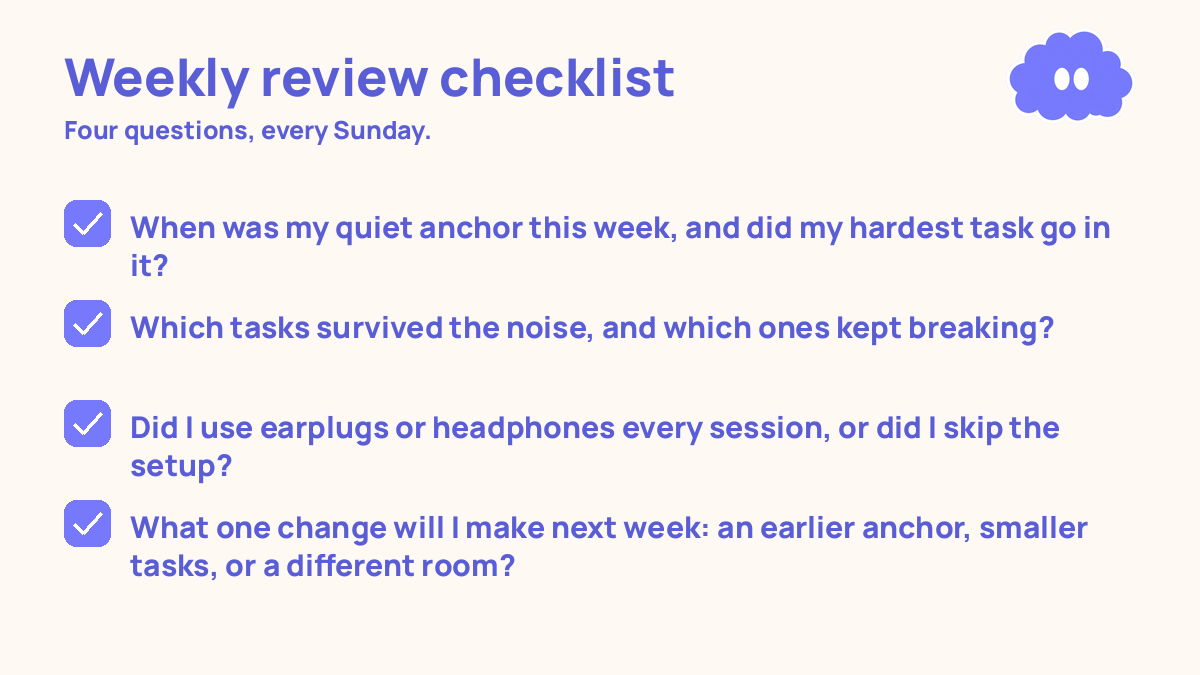
- Find your quietest anchor: the earliest hour, the emptiest room, or the library. Plan your hardest task for it.
- Block the noise you can: foam earplugs, or headphones with steady background sound.
- Write the task in one line, with a clear finish. Small tasks survive noise better than big ones.
- Set a timer for 25 minutes. Work on that task only until it rings.
- When noise breaks the block, write down where you stopped and start a fresh block.
- At the end of the day, count finished tasks, not quiet hours.
Step 1: Find your quietest anchor
Every noisy house has a quiet time and a quiet corner. Find them before you plan anything else. The quiet time is usually early morning — most houses are quiet before 8am — or late evening, after the TV goes off. The quiet corner might be a bedroom with the door shut, a kitchen table after dinner, or a stairwell landing no one uses.
Write them down. “Quiet: 6:30 to 7:30am, bedroom, door shut. Second quiet: 10 to 11pm, kitchen.” That is your anchor. Your hardest task goes in the anchor. The noisy hours get the easier tasks.
If there is a library within reach, that is the best anchor of all. A library is quiet by rule, not by luck. The dorm study system has more on this: how to claim a corner and agree quiet hours with flatmates. If the library is your anchor, the study system for library study shows how to plan a session there — seat, time, and task list included.
Step 2: Block the noise you can
Foam earplugs cost almost nothing and cut the worst of it: voices through a wall, traffic, a TV in the next room. Buy a pack, keep them in your study bag, and use them every session. They do not make the world silent. They make it muffled, and muffled is enough to hold a thread.
Headphones help too, with one rule: the sound must be steady. Rain, a fan, a single repeated tone, or music without words. Music with lyrics is the worst choice, because your brain follows words the same way it follows a conversation. A playlist of songs you know by heart is almost as bad — you sing along in your head instead of studying.
If you have no earplugs and no headphones, a closed door and a towel under it cut more noise than you would think. The system does not need equipment. It needs one layer between you and the noise.
Step 3: Make the task small enough to survive the noise
A big task breaks when the noise breaks in. “Revise chapter 6” shatters at the first interruption, because there is no clear place to restart. A small task survives: “Answer the 5 questions on page 112 from memory.” When the noise breaks in, you know exactly where you were — question 3 — and you can start again from there.
So write the task in one line, with a clear finish, and make it fit in 25 minutes. “Work 4 mole problems.” “Read pages 112 to 115 and write 3 questions.” “Draft one paragraph, about 150 words.” If the task takes longer than 25 minutes, split it before you start. Each piece is a unit you can finish between interruptions.
This is the same rule as in the phone focus system for distracted students: one task, written down, worked until it is finished or the timer rings. In a quiet room, a big task is fine. In a noisy one, a big task is a promise the noise will break.
Step 4: Run the block on a timer
Set a timer for 25 minutes. That is the Pomodoro length from Francesco Cirillo’s technique in the late 1980s, and one thing to know honestly: 25 minutes was Cirillo’s practical choice, not a number derived from cognitive science. In a noisy house, 25 minutes is also a practical length because it fits between the interruptions. A 50-minute block sounds better and breaks twice as often.
During the block, you do the one task. When the noise breaks in — a shout, a door, a motorbike — do not fight it. Wait for it to pass, look at your one-line task, and carry on. If the noise is continuous, a conversation next door that will not stop, do not sit through it. Stop the block, move, or wait.
If the noise breaks the block completely — someone comes in and starts talking to you — write down where you stopped, deal with it, and start a fresh 25 minutes. A broken block is not a failed day.
Step 5: Count finished tasks, not quiet hours
At the end of the day, count the tasks you finished, not the hours you sat in noise. Three small tasks finished in a noisy house is a good day. Six hours at a desk with nothing finished is not, however quiet it was.
This matters because noisy-house students judge themselves by the wrong measure. But the work is the work: 5 questions answered, 4 problems worked, one paragraph drafted. Count those.
Keep a simple tally on paper: date, tasks planned, tasks finished. After a week, you will see the pattern — which hours work and which tasks survive. Then move one thing: the hardest task into the quiet anchor.
A worked example: a noisy evening at home
You get home at 5pm. The house is loud until 10pm: TV, cooking, two flatmates talking, traffic outside. Your quiet anchor is 6:30 to 7:30am tomorrow. Tonight you have three small tasks.
5:00 — set up. Earplugs in. Write the three tasks: “Answer the 5 questions on page 112 from memory.” “Work 4 mole problems.” “Draft one paragraph, about 150 words.” Kitchen table, door shut, towel under it.
5:00–5:25 — block 1. The 5 questions from memory, then check. A flatmate shouts from the next room at minute 10. You wait, look at the task line, carry on from question 3. Done. Cross it off.
5:25–5:30 — break. Water, stretch. The TV is still on. It does not matter — the break is five minutes.
5:30–5:55 — block 2. The 4 mole problems. At minute 15 someone comes in to ask about dinner. You write “stopped at problem 3” on the pad, answer in one line, and start a fresh block.
5:55–6:20 — block 2, again. Problems 3 and 4, then check all 4. Done. Cross it off.
6:20–6:25 — break. Water, stretch.
6:25–6:50 — block 3. Draft the paragraph, about 150 words. The house is quieter now — one flatmate has gone out. Done. Cross it off.
6:50 — stop. Three tasks finished in a loud house, in under two hours. Tomorrow morning, 6:30 to 7:30am, the anchor: the hardest task of the week.
| Time | Task | Noise | Result |
|---|---|---|---|
| 5:00–5:25 | 5 questions from memory | Shout at minute 10 | Done |
| 5:30–5:55 | 4 mole problems | Interrupted at minute 15 | Block restarted |
| 5:55–6:20 | Mole problems 3–4, check | Quieter | Done |
| 6:25–6:50 | Draft one paragraph | Quieter | Done |
When it goes wrong
You try to study through the noise with no earplugs and no timer. The noise wins, because it has nothing to beat. The fix is the setup, not more effort: earplugs in, task written, timer set. If you skip the setup, the session was never really started.
You pick a task that is too big for the noise, and it breaks every time. Split it. A task that takes 50 minutes in a quiet room takes three 25-minute blocks in a noisy one, with a restart point written down after each piece. The restart point is what makes the split work.
You wait for the house to go quiet, and it never does. Stop waiting. The anchor is the only quiet you plan around; the rest of the day is noisy by default, and the system is built for that. Three small tasks in noise beat a perfect plan that needs silence.
You study late at night because it is the only quiet time, and you sleep badly. A quiet night session that costs you sleep is a bad trade. Sleep is when the day’s learning is consolidated. Try the early morning first. If nights are the only option, keep the session short and protect the sleep.
Weekly review checklist
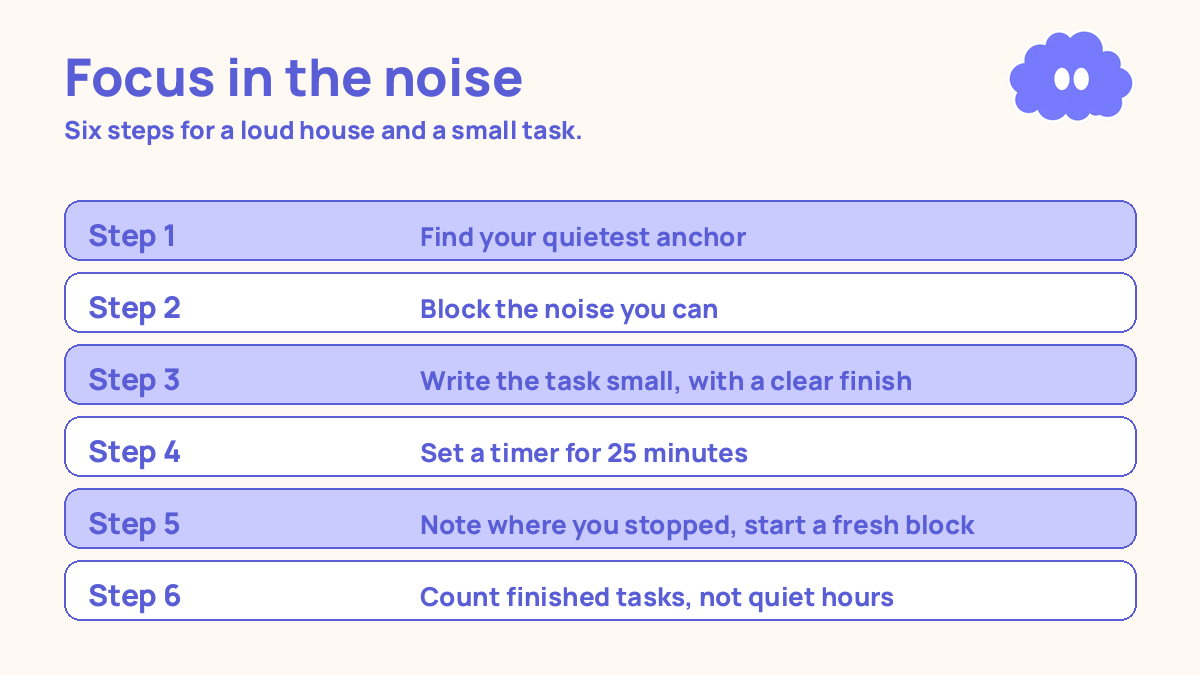
Copy this list and use it each week:
- When was my quiet anchor this week, and did my hardest task go in it?
- Which tasks survived the noise, and which ones kept breaking?
- Did I use earplugs or headphones every session, or did I skip the setup?
- What one change will I make next week: an earlier anchor, smaller tasks, or a different room?
Downloadable infographic spec: one vertical image, title “Focus in the noise”, with the six steps — find your quiet anchor, block the noise you can, make the task small, run the block on a timer, restart after interruptions, count finished tasks — and the rule “three small tasks in noise beat a perfect plan that needs silence”, in Thynq cream, Cloud Purple, Dark Purple and pink, with the cloud mascot. Text taken word-for-word from this article.
What this system is not
It is not a claim that noise does not matter, and it is not a promise of a grade. Noise genuinely costs focus, and a quiet room genuinely helps — this system is for the weeks when a quiet room is not available. The research it leans on is specific: in Rubinstein, Meyer and Evans (2001), people lost 614 to 1,096 milliseconds on every switch between tasks in lab experiments, and noise forces switches you did not choose. Use the system when the house is loud, and use the library or the early morning whenever you can.
Sources
- Rubinstein, J. S., Meyer, D. E. & Evans, J. E. (2001). “Executive control of cognitive processes in task switching”, Journal of Experimental Psychology: Human Perception and Performance 27(4), 763–797. Mean switch costs were 614 to 1,096 milliseconds per switch, larger for more complex or less familiar tasks.
- Diekelmann, S. & Born, J. (2010). “The memory function of sleep”, Nature Reviews Neuroscience 11(2), 114–126. Sleep improves the consolidation of what was learned; a short night after a long study day means the work was done but the consolidation was cut short.
- Cirillo, F. — Pomodoro Technique, late 1980s. Classic cycle: 25 minutes work, 5 minutes break, longer break after four. The 25-minute length was Cirillo’s practical choice, not a science-derived number.
Questions
Do I need noise-cancelling headphones?
No. Foam earplugs cost almost nothing and cut the worst of it. Ordinary headphones with steady background sound work too. The system is about the routine, not the equipment.
What if the noise is people talking, not traffic?
Voices are the hardest noise to ignore, because your brain follows words. Earplugs plus steady background sound help most. If you can, move to a room where no one is talking, even for one 25-minute block.
Should I study at night when it is quiet?
Only if you can still sleep properly. A quiet night session that costs you sleep is a bad trade: sleep is when the day’s learning is consolidated. Try the early morning first — most houses are quiet before 8am.
What if I cannot find any quiet time at all?
Then make the block shorter and the task smaller. A 15-minute block with one written task still counts, and three short blocks beat one long block that never happens. The system is built for that.