The direct answer
A study system for library study works like this: arrive with a written plan, work in 25-minute blocks on one task at a time, test yourself from memory instead of re-reading, and leave with tomorrow’s plan already written. The library does half the work for you — it is quiet, it has no TV, and everyone around you is studying. Your job is to arrive knowing exactly what you will do.
You walk into the library with a bag full of books and a vague plan to “study”. Three hours later you have read some notes, answered two messages, and you cannot say what you actually did. The library was quiet. You were not focused.
The library helps, but it does not do the studying. The library’s advantage is that it removes the hardest part — starting. You went there to study, everyone around you is studying, and there is nothing else to do.
One thing the research is clear about: in a 2013 review, Dunlosky and colleagues rated ten common study techniques, and only two received a high utility rating — practice testing and distributed practice. Re-reading was rated low. A library session spent re-reading is a quiet version of the weakest method.
The study system for library study in short
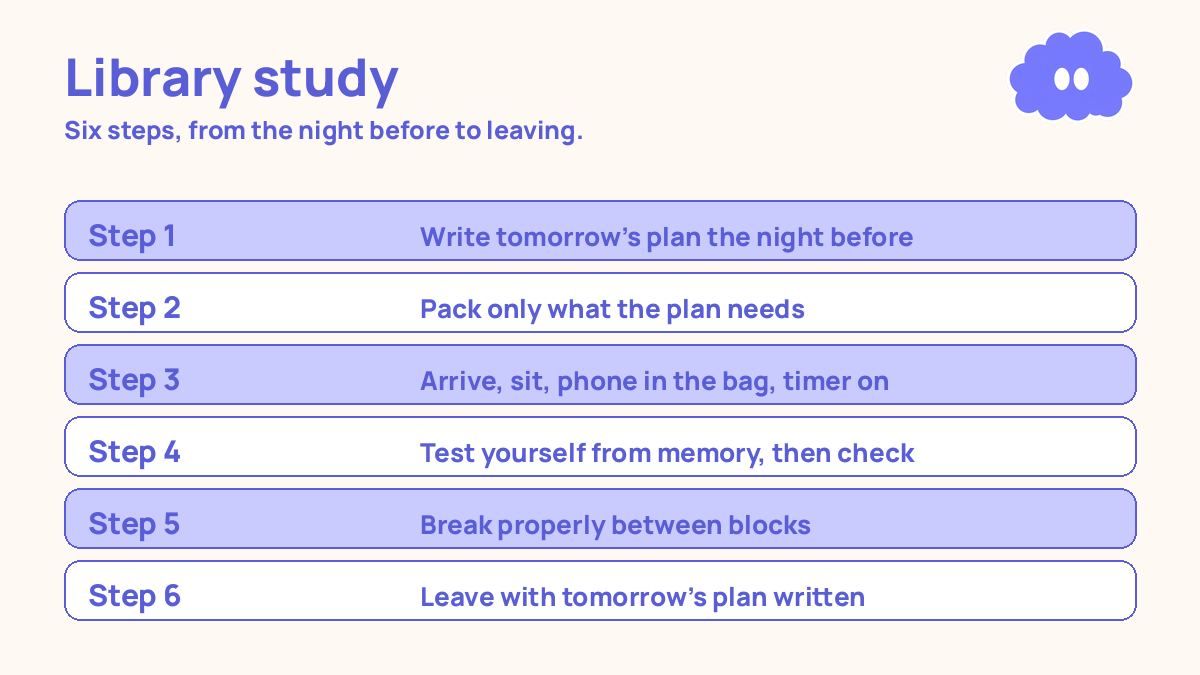
- The night before, write tomorrow’s plan: 3 to 5 tasks, one line each, in order.
- Pack only what the plan needs. Leave the rest at home.
- Arrive, sit down, phone on silent in your bag. Set a timer for 25 minutes.
- Work one task at a time. Test yourself from memory, then check.
- Take a 5-minute break between blocks. Walk, water, look out of a window.
- Before you leave, write tomorrow’s plan. Leave while you still have energy.
Step 1: Write the plan the night before
Never plan a library session in the library. Decide the night before, on paper, what tomorrow’s session is for. Three to five tasks, one line each, in the order you will do them. “Answer the 10 cell-division questions from memory.” “Work 5 mole problems on page 42.” “Draft essay paragraph 2, about 150 words.”
Each line needs a finish. “Biology” is not a task. “10 questions answered and checked” is a task. If you cannot write the finish in one line, the task is too big. Split it before the morning.
The plan does two jobs. It tells you what to pack, and it tells you what to do when you sit down, so there is no moment of opening your bag and wondering. The students who waste library sessions are not lazy. They arrive without a plan.
Step 2: Pack only what the plan needs
Pack the night before, from the plan. The books or notes for today’s tasks, a pen, paper, and earplugs. Leave the rest at home.
Every extra book is a reason to switch tasks. You open the extra book “just to check something” and twenty minutes later you are studying a different subject. Every extra device is a distraction. If the laptop is not on the plan, leave it. A bag full of maybe-books is a bag full of decisions.
Step 3: Arrive, sit, start the timer
Arrive at the same time each library day, and sit in the same area if you can. Routine makes the start automatic. The quiet floor is best if there is one. A desk facing a wall beats a desk facing the room — fewer people to watch.
Phone on silent, in your bag, not on the desk — the phone focus system for distracted students is the full version of this rule. Set a timer for 25 minutes — a watch, or the laptop if it is on the plan. The 25-minute length comes from Francesco Cirillo’s Pomodoro Technique in the late 1980s, and one thing to know honestly: it was Cirillo’s practical choice, not a number derived from cognitive science. If a task needs a longer run, use 50-minute blocks.
Then start the first task on the plan. Not the easiest one. The first one on the list, which you put there last night.
Step 4: Test yourself, do not re-read
Inside each block, test yourself from memory. Answer questions without looking. Work problems without the worked example open. Write what you remember, then check against your notes. That is the method the research supports: practice testing was one of only two techniques Dunlosky and colleagues rated high utility in 2013, and in a 2014 meta-analysis Rowland found testing beat restudying by a medium amount (g = 0.50) across 61 studies, with 81% of comparisons showing a benefit.
Re-reading feels easier and more fluent. That fluency is the trap: in the Roediger and Karpicke (2006) study, students who restudied felt more confident immediately after studying, but remembered less a week later than students who had tested themselves. If it felt easy, test yourself.
Spacing matters too. Cepeda and colleagues (2006) found spaced practice beat massed practice across materials and ages, and the best gap grows with how long you need to remember the material. So use the library session to test today’s topics and re-test last week’s: one block for new material, one block for review. A practical starting schedule is to review a topic the next day, in 3 days, and in 7 days — a schedule to try, not a rule from the research.
Step 5: Break properly, then leave on time
Between blocks, take a 5-minute break. Walk to the water fountain. Stand up, stretch, look out of a window. Do not open your phone — five minutes of scrolling is not a break, and in a library it is the easiest way to lose the session. After four blocks, take a longer break of 15 to 30 minutes.
Leave while you still have energy. Two to three hours is enough for most students: four to six honest blocks. A four-hour session that ends in staring is not better than a two-hour session that ends with finished tasks. If there is no library near you, the same session works at home — the dorm study system shows how to run it where you live.
Before you pack up, write tomorrow’s plan on paper: 3 to 5 tasks, one line each, in order. That takes two minutes, and it is what makes tomorrow’s session start the moment you sit down.
A worked example: a Tuesday library session
You plan on Monday night. Three tasks for Tuesday, 9am to 12pm.
Monday night — the plan. Three lines: “Answer 10 cell-division questions from memory, then check.” “Work 5 mole problems on page 42.” “Draft essay paragraph 2, about 150 words.” Pack: biology notes, chemistry textbook, essay notes, pen, paper, earplugs. Laptop stays home.
9:00 — arrive. Quiet floor, desk facing the wall. Phone on silent in the bag. Timer set.
9:00–9:25 — block 1. Answer the 10 questions from memory. 8 right, 2 wrong. Write the 2 wrong ones on the list for Thursday’s review.
9:25–9:30 — break. Water fountain, stretch, look out of the window.
9:30–9:55 — block 2. Check the 10 answers against your notes. Write the two correct answers in full, from memory. Done. Cross it off.
9:55–10:00 — break. Walk, water.
10:00–10:50 — block 3. 50-minute block. Work the 5 mole problems. Problem 4 needs a formula — look it up, write it on the pad, and finish. Check all 5. Done. Cross it off.
10:50–11:05 — longer break. Walk outside, eat something. No phone.
11:05–11:55 — block 4. 50-minute block. Draft essay paragraph 2, about 150 words. Read it back once, fix the worst sentence. Done. Cross it off.
11:55 — leave. Three tasks finished in three hours. Before you pack up, write Wednesday’s plan: “Re-test the 2 cell-division questions.” “Start chapter 5 problems.” “Draft essay paragraph 3.”
| Time | Task | Method | Result |
|---|---|---|---|
| 9:00–9:25 | 10 cell-division questions | From memory | 8 right, 2 for review |
| 9:30–9:55 | Check answers, rewrite 2 | From memory, then check | Done |
| 10:00–10:50 | 5 mole problems | Worked, checked | Done |
| 11:05–11:55 | Draft essay paragraph 2 | Draft, read back once | Done, about 150 words |
The focus system for noisy environments is the companion piece for the days you cannot get to the library: the same one-task rule, with earplugs and small tasks that survive noise.
When it goes wrong
You arrive without a plan and spend the first hour deciding. The fix is the night before, not the morning. A plan takes two minutes to write and saves the first hour. If you forgot the plan, write it in the library before you open a book: three tasks, one line each. Then start.
You re-read your notes for three hours and call it studying. Re-reading was rated low utility by Dunlosky and colleagues in 2013, and it feels fluent while it teaches little. The fix is the method: every block must include testing yourself from memory, then checking. If a block has no test in it, it was not a study block.
You stay four or five hours and the last two are staring. Leave earlier. Two to three hours of honest blocks beat five hours of sitting. Set a leaving time when you arrive, and keep it.
You bring everything “just in case” and switch subjects all morning. Pack from the plan, not from anxiety. If a book is not on today’s plan, it stays home. Three tasks, three sets of materials, nothing else. The bag is the plan.
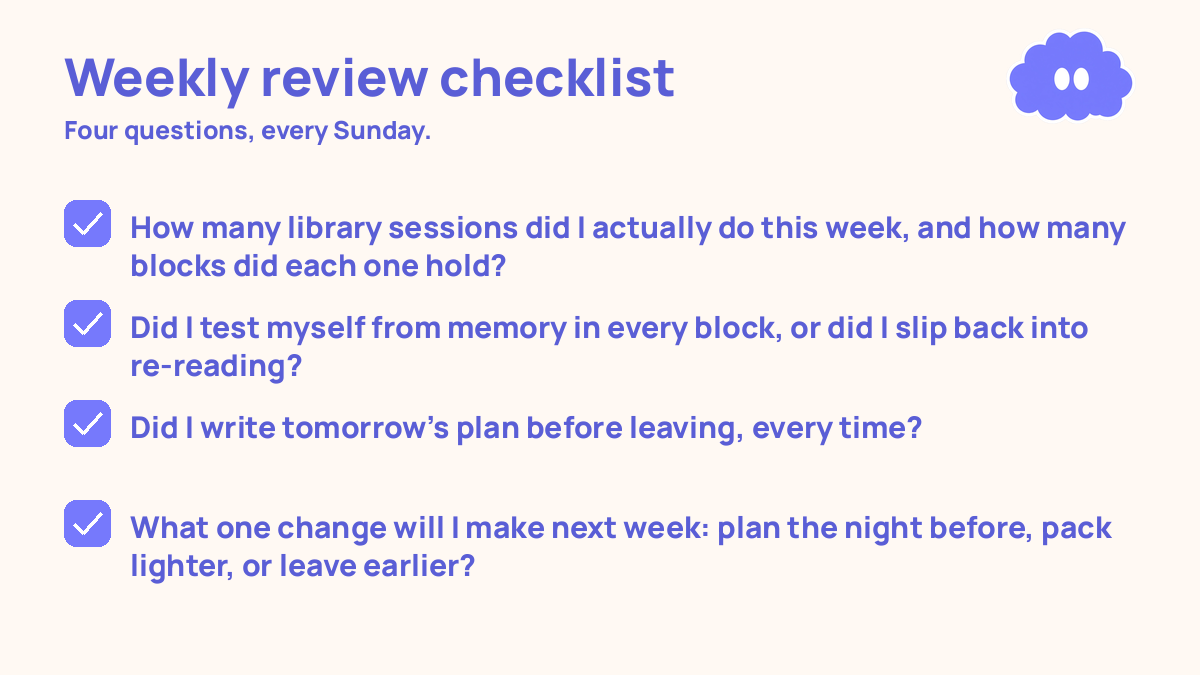
Weekly review checklist
Copy this list and use it each week:
- How many library sessions did I actually do this week, and how many blocks did each one hold?
- Did I test myself from memory in every block, or did I slip back into re-reading?
- Did I write tomorrow’s plan before leaving, every time?
- What one change will I make next week: plan the night before, pack lighter, or leave earlier?
Downloadable infographic spec: one vertical image, title “Library study”, with the six steps — plan the night before, pack only what the plan needs, arrive sit start the timer, test yourself do not re-read, break properly, leave with tomorrow’s plan — and the rule “the library does half the work, the plan does the rest”, in Thynq cream, Cloud Purple, Dark Purple and pink, with the cloud mascot. Text taken word-for-word from this article.
What this system is not
It is not a claim that the library is the only place to study, and it is not a promise of a grade. It is a practical system for students who have a library within reach and keep wasting the sessions they get there. The research it leans on is specific: Dunlosky and colleagues (2013) rated practice testing and distributed practice as the only high-utility techniques of the ten they reviewed; Rowland (2014) found testing beat restudying by g = 0.50 across 61 studies. None of that promises a result. It says which methods are worth the library hours.
Sources
- Dunlosky, J., et al. (2013). “Improving students’ learning with effective learning techniques”, Psychological Science in the Public Interest 14(1), 4–58. Only practice testing and distributed practice received a high utility rating; rereading was rated low.
- Rowland, C. A. (2014). “The effect of testing versus restudy on retention”, Psychological Bulletin 140(6), 1432–1463. Testing beat restudying by g = 0.50 across 61 studies; 81% of comparisons showed a benefit; feedback raised the effect to g = 0.73.
- Cepeda, N. J., et al. (2006). Psychological Bulletin 132(3), 354–380. Spaced practice beat massed practice across materials, ages and retention intervals; the best gap grows with how long you need to remember the material.
- Roediger, H. L. & Karpicke, J. D. (2006). Science. Students who recalled a passage remembered more a week later than students who restudied it, even though restudiers felt more confident immediately after studying.
- Cirillo, F. — Pomodoro Technique, late 1980s. Classic cycle: 25 minutes work, 5 minutes break, longer break after four. The 25-minute length was Cirillo’s practical choice, not a science-derived number.
Questions
How long should a library session be?
Two to three hours is enough for most students: four to six 25-minute blocks with real breaks. Longer sessions usually turn into sitting, not studying. Leave while you still have energy, and come back tomorrow.
What should I bring to the library?
Only what the plan needs: the books or notes for today’s tasks, a pen, paper, and earplugs. Leave the rest at home. Every extra book is a reason to switch tasks, and every extra device is a distraction.
Can I study in the library every day?
Yes, if it is close enough that getting there does not eat the session. Two or three library days a week is enough to change a week. The system works at home too, but the library makes the start automatic.
What if the library is full or noisy?
Arrive early, or use the quiet floor if there is one. Earplugs handle the rest. If the library is genuinely full, use the same system at home: written plan, timed blocks, phone in another room.