
The direct answer
Learning how to split your essay word count across sections starts with one decision: about 10 percent for the introduction, about 70 percent for the body split evenly across your arguments, about 10 percent for the counterargument, and about 10 percent for the conclusion. Write the target next to its heading and check the count as you write.
Most students write first and count later. The result is almost always the same: an introduction that runs long, a first argument that eats the budget, and a conclusion squeezed into two rushed sentences. The split is a decision you make before the first sentence, not an observation you make after the last one.
The system in short
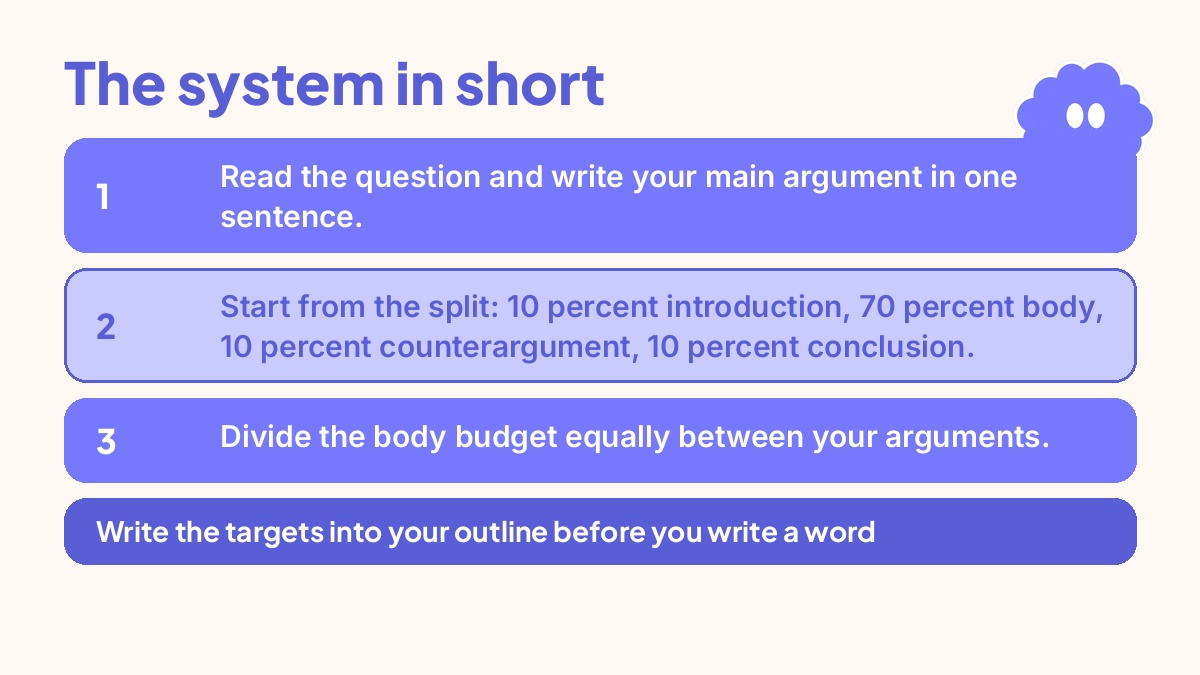
- Read the question and write your main argument in one sentence.
- Start from the split: 10 percent introduction, 70 percent body, 10 percent counterargument, 10 percent conclusion.
- Divide the body budget equally between your arguments.
- Give every section a topic sentence, evidence, and a “so what”.
- Write the targets into your outline before you write a word.
- Check the count as you write, and cut from the body, never the conclusion.
Step 1: Read the question and write your main argument in one sentence
Copy the question out and underline three things: the command word, the topic, and any limits, such as a date range, a text, or a word count. The command word tells you what kind of answer to give: “Discuss” means look at different sides, then say where you stand; “Evaluate” means weigh strengths and weaknesses and reach a judgement; “To what extent” means say how far you agree.
Before you plan any sections, write one sentence that answers the question. For example: “Social media platforms should carry some responsibility for misinformation, because their design amplifies false claims faster than true ones.” If you cannot write that sentence yet, think more before you plan. Every section you plan next should back it up.
Then count your arguments. Most essays need two or three. One is rarely enough, and five in 2,000 words means each gets about 280 words, too little for evidence and analysis. Pick your two or three strongest points, and note the evidence for each one. Strongest first works for most essays. If you are writing coursework, the wider routine is in how to write a coursework essay.
Step 2: Start from the split, then adjust it for your question
The starting split for a standard essay is about 10 percent for the introduction, about 70 percent for the body, about 10 percent for the counterargument, and about 10 percent for the conclusion. It is a starting point, not a rule. Your brief and your marking criteria come first, and if they give a different balance, follow them.
Applied to common lengths: a 1,000-word essay gives 100, 700, 100, and 100; a 1,500-word essay gives 150, 1,050, 150, and 150; a 2,000-word essay gives 200, 1,400, 200, and 200; a 3,000-word essay gives 300, 2,100, 300, and 300. Work out your own numbers before you write, and write them down.
Other guides use a simpler 10/80/10 rule: 10 percent introduction, 80 percent body, 10 percent conclusion. That rule folds the counterargument into the body. The split in this article separates it out, because the counterargument is a distinct job: the strongest objection, fairly stated, and your reply. If your essay type has its own shape, such as a literature review, use that shape instead. For a longer project, the chapter version is in how to plan your dissertation word count.
Step 3: Divide the body budget equally between your arguments
Once the body total is fixed, divide it equally between your main arguments, unless the question clearly weights one more than the others. Equal division prevents the most common pattern: the first argument gets the most attention, and the last gets the least because the words have run out.
For a 2,000-word essay, the body budget is about 1,400 words. Three arguments get about 467 words each. Two get 700 each. Four get 350 each. Write the per-argument number into your outline next to each argument, and treat it as a limit. If an argument needs more than its share, it is probably two arguments tangled together: split it, and give each half its own topic sentence.
The counterargument gets its own 10 percent, about 200 words in a 2,000-word essay: enough for the strongest objection, fairly stated, and your reply. Do not spend it on a weak objection you can knock down easily. The objection should be the one a good reader would actually raise. For a compare-and-contrast essay, split the body equally between the two sides instead, point by point.
Step 4: Give every section a topic sentence, evidence, and a “so what”
A word budget only works if each section knows what its words are for. Build every body section the same way: a topic sentence that states the point in one line, the evidence that backs it, and a “so what” that says why the evidence supports your thesis. The “so what” does the analysis, which is where most of the marks sit.
For a 467-word section, a workable shape is about 40 words for the topic sentence, about 150 for the evidence, and about 250 for the analysis, with the rest for the link back to the question. If your section is mostly summary, the shape is wrong: you are describing the evidence instead of using it. Ask why the evidence matters until the analysis is the longest part. The habit is in elaborative interrogation for students.
The counterargument follows the same shape in miniature: state the objection, give the evidence, then reply. The reply is the point of the section, so give it at least half the words. A reply that says “this is wrong” without evidence is not a reply. If you test each argument from memory before you write it, the gaps show up early: try Blurting method for students: write down everything you remember on one argument at a time.
Step 5: Write the targets into your outline before you write a word
An outline with no numbers is a wish. Write the target next to each section heading before you write. For the 2,000-word essay here, the outline reads: introduction 200, arguments about 467 each, counterargument 200, conclusion 200. If yours do not add up to your total, fix them now.
Use the site’s essay outline planner to hold the outline. It splits a total word count across sections starting from about 10 percent introduction, about 70 percent body split evenly across your arguments, about 10 percent counterargument, and about 10 percent conclusion. It has four essay types, argumentative, discursive, analytical, and compare and contrast, and switching the type changes the section names and prompts while keeping what you have written. Each body section has a topic sentence slot, evidence, and a “so what” slot. Fill them in your own words.
Keep the outline to one page: each section is a line or two, not a paragraph. The only sentence worth writing out in full is your main argument. If the outline is turning into the essay, stop and start writing. If your essay is timed, the exam version is in essay exam system for students.
Step 6: Check the running count as you write, and cut from the body
Check your word count against the targets as you write, section by section. Select each section in turn and compare it with its target. If a section is running over budget, cut now, while it is still in front of you. Cutting a 400-word introduction down to 200 after the essay is finished means rewriting, not editing.
If a section is over, cut description, not analysis. Shorten the background, cut a repeated example, and keep the sentences that argue. If a section is under, add evidence or a better reply, not padding. If a section is over because the argument needs the words, move the budget: take words from a section that is under, and write the new targets into your outline.
Never borrow from the conclusion. The conclusion is the last thing written and the first budget to get raided when the body overruns. A two-sentence conclusion signals to your marker that the body was poorly planned. Protect the conclusion budget: if the body is over, cut from the body. When the draft is done, check the brief once more for what counts: the reference list almost never counts, and footnotes, tables, and appendices vary by university.
A worked example: a 2,000-word essay in six sections
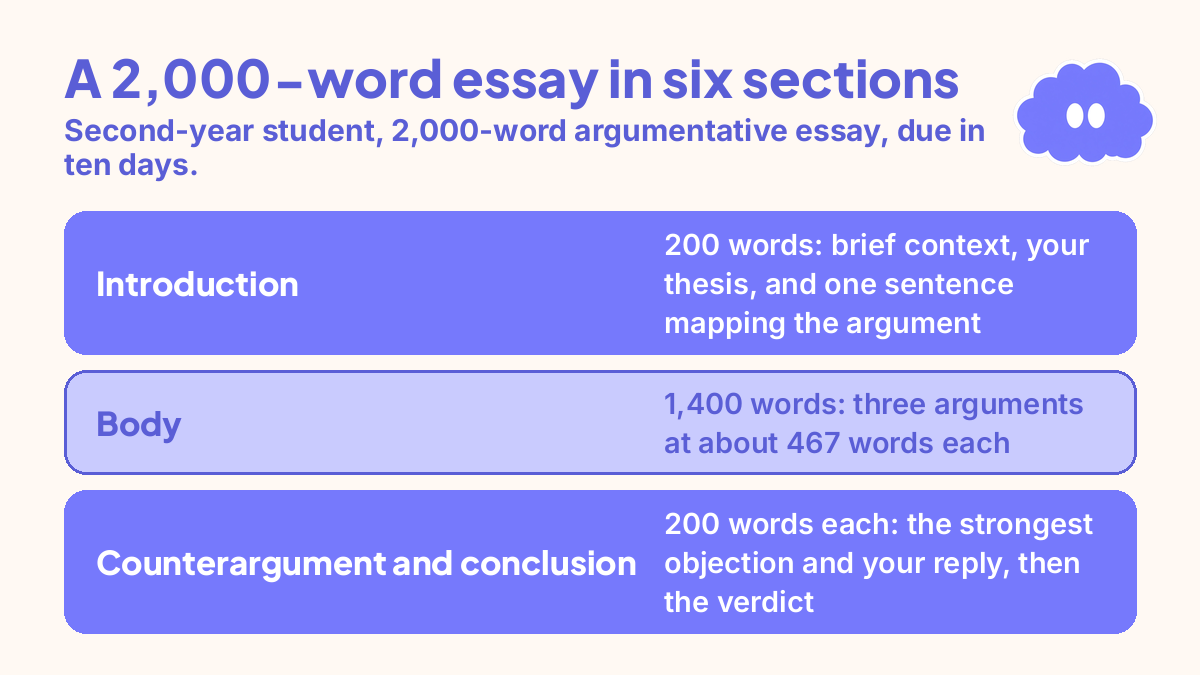
Your situation: Second-year student, 2,000-word argumentative essay, due in ten days. The question: “To what extent should social media platforms be held responsible for misinformation?” Your main argument: “Platforms should carry some responsibility, because their design amplifies false claims faster than true ones.”
- Introduction, 200 words: brief context, your thesis, and one sentence mapping the argument: design, moderation, user behaviour, then the objection. Write the thesis first.
- Argument 1, about 467 words: design amplifies false claims. Evidence: recommendation systems surface engaging posts, and false claims are often more engaging than corrections. Analysis: the platform is not a neutral noticeboard, so responsibility follows from design.
- Argument 2, about 467 words: moderation is inconsistent. Evidence: the same claim is removed on one platform and left up on another. Analysis: the rules exist, so the failure is in applying them.
- Argument 3, about 466 words: users share without checking. Evidence: most shares happen within seconds of seeing a post. Analysis: design rewards speed over accuracy, so users alone cannot carry the blame.
- Counterargument, 200 words: the strongest objection is free speech: platforms should not decide what is true. Reply: responsibility does not mean deciding truth. It means slowing amplification and enforcing the rules that already exist.
- Conclusion, 200 words: the verdict: platforms should carry some responsibility, limited to design and enforcement, not to judging every claim. No new evidence. The total adds up: 200 plus 467 plus 467 plus 466 plus 200 plus 200 is 2,000.
When it goes wrong
The introduction ate 30 percent of the essay. Stop and cut it to its target before you write another word. Keep the thesis and the map sentence, and cut the background: one or two sentences of context is enough. Write the introduction last if the problem keeps happening: the thesis is easier to state once you know what the body argues.
The first argument ate the budget. Cut it to its target now, while it is fresh. Shorten the evidence, keep the analysis, and move the cut material to a note. Then write the remaining arguments to their targets, and do not let the first one borrow from the last.
The conclusion has two sentences. Do not leave it like that. A conclusion needs about 10 percent: the answer, the findings in brief, and what follows. If the words are gone, cut 100 words from the body and give them back to the conclusion.
The body is uneven: one argument is 700 words and another is 200. The long one is probably two arguments tangled together. Split it where the topic changes, give each half its own topic sentence, and move words to the short one. If the short one cannot grow, drop the argument and give its words to the others.
The brief counts differently from your plan. Check the handbook before you write: does the reference list count, do footnotes count, do tables count. If the total you planned on was wrong, rework the split from the correct total before you write another word.
Weekly review checklist
- Did I write the split before I started, and do the targets add up to the total?
- Is the introduction about 10 percent, and does it state the thesis?
- Is the body divided equally between my arguments, with no argument over its share?
- Does the counterargument state the strongest objection fairly, with a real reply?
- Is the conclusion protected at about 10 percent, with no new evidence in it?
- What is the one change I will make next week?
Downloadable infographic spec: one vertical image, title “How to split your essay word count across sections”, with the six steps from “The system in short” and the six review questions above, in Thynq cream, Cloud Purple, Dark Purple and pink, with the Cloud mascot. Text taken word-for-word from this article.
What this system is not
This system is not a set of rules your marker will enforce. The 10/70/10/10 split is a starting point, and your brief, your marking criteria, and your essay type all outrank it. A split is a planning tool, not a law.
It is not a substitute for reading the question. A perfect split on the wrong question still fails. If the split and the question disagree, the question wins.
It is not a promise that the essay will write itself. The split tells each section how many words it gets. It does not tell you what to say in them. The argument, the evidence, and the analysis are still yours to do.
Sources
- Projectitude. How to divide word count between essay sections. The 10/80/10 rule, the section budget method, dividing the body equally, adjusting for the question verb, and protecting the conclusion.
- HLPER. How to write an essay plan. The five stages of planning, the 10 percent rule, splitting the word count before writing, and a worked 1,000-word plan.
For the full system behind this method, start with how to build a study system that fits your life.
Questions
How many words should the introduction of an essay be?
About 10 percent of the total. For a 2,000-word essay, that is about 200 words: enough for brief context, your thesis, and one sentence mapping the argument. If your brief gives a different share, follow it instead.
How do I split the body word count between arguments?
Divide the body budget equally between your arguments, unless the question clearly weights one more than the others. For a 2,000-word essay with three arguments, the body gets about 1,400 words, so each argument gets about 467 words. Equal shares stop the first argument eating the words the last one needs.
What is the 10/70/10/10 split for essays?
It is the starting split in the site’s essay outline planner: about 10 percent for the introduction, about 70 percent for the body split evenly across your arguments, about 10 percent for the counterargument, and about 10 percent for the conclusion. It is a starting point, not a rule. Your brief and your marking criteria come first.
What do I do if one section runs over its word budget?
Cut from the body, never from the conclusion. Shorten description and repeated evidence, and keep the analysis. If a section is over because the argument needs the words, move the budget. If the whole essay is over, cut the weakest paragraph, not the conclusion.