
The direct answer
To plan your dissertation word count, split the total into a word budget for each chapter, then divide the words you still have to write by the writing days left before your deadline. A 12,000-word dissertation with 10,000 words left and 40 writing days needs 250 words a day.
Most students plan a dissertation backwards: they write until they run out of time, then discover the literature review took half the words and the discussion has 800 left. The fix is arithmetic done early: the word limit and the deadline turn into a budget per chapter and a target per day.
The system in short
- Read your handbook for the word limit, what counts, and the deadline.
- Split the total into chapter budgets, starting from the standard shares.
- Count your writing days, not your calendar days, and work out the daily target.
- Write to the daily target, and log the words every day.
- Rebalance the budget when a chapter runs over, and move words between chapters.
- Review every week: words written, words left, and days left.
Step 1: Read your handbook for the word limit, what counts, and the deadline
Before you plan anything, find three facts in your handbook. First, the word limit: the total number of words, and whether it is a maximum, a target, or a range. Second, what counts towards it: the main text almost always counts, and the reference list almost never does, but footnotes, tables, figure captions, and appendices vary, and the abstract usually has its own limit. Third, the deadline, and whether there is a tolerance, such as 10% over or under.
Write these three facts down: a budget built on the wrong total is wrong in every chapter. If your department sets exact word limits per chapter, use those instead of the shares in this article: the handbook wins, always. If anything is unclear, ask your supervisor and get the answer in writing before you start.
Step 2: Split the total into chapter budgets, starting from the standard shares
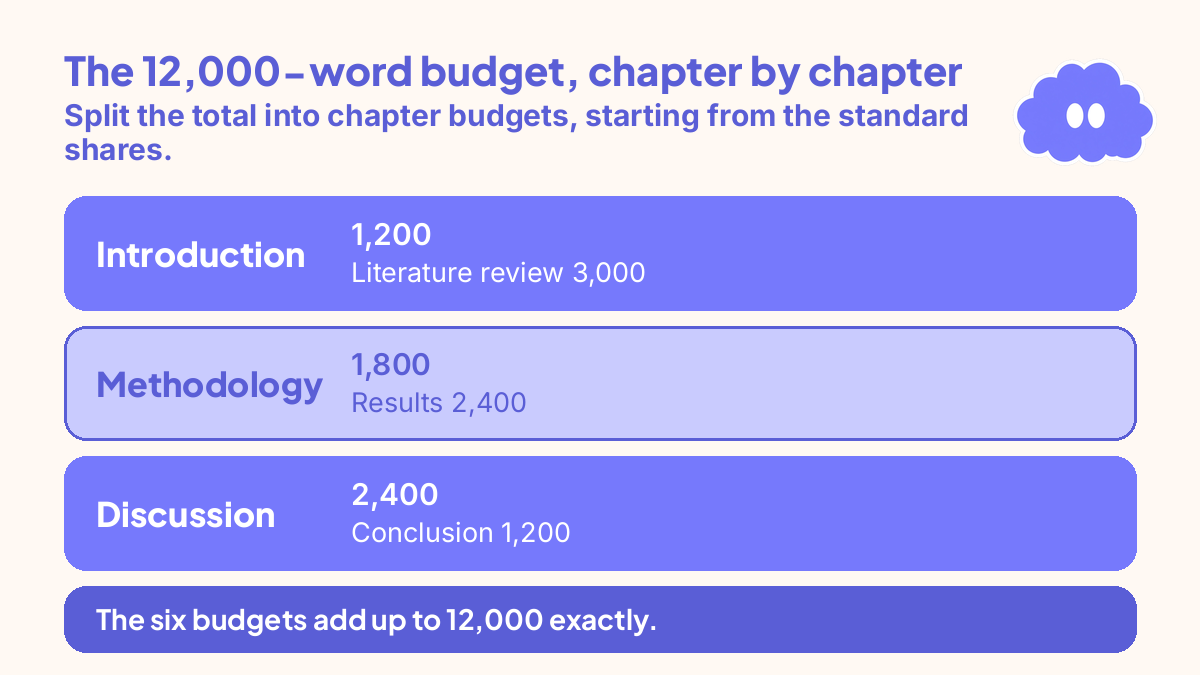
Give each chapter a word budget, and check that the budgets add up to your total exactly. For an empirical dissertation, a common starting split is: introduction 10%, literature review 25%, methodology 15%, results 20%, discussion 20%, and conclusion 10%. For 10,000 words, that is 1,000, 2,500, 1,500, 2,000, 2,000, and 1,000. For 12,000 words, it is 1,200, 3,000, 1,800, 2,400, 2,400, and 1,200.
For a literature-based dissertation, the split is different: introduction and conclusion of 1,000 words each, and three themed chapters of about 2,000 words each, in a 10,000-word total. For a PhD thesis, the same shares stretch over more chapters. The shares are a starting point, not a rule: if your methodology is short because the method is standard, give those words to the discussion, where the marks are.
The dissertation word count planner does this arithmetic for you: put in your total word count, your chapters, and your deadline, and it gives you the budget per chapter. Change the percentages and every budget updates, and if your chapters add up to more or less than 100%, it says so. Use the presets as a starting point, then change them to match your handbook.
Step 3: Count your writing days, not your calendar days, and work out the daily target
A daily target built on calendar days is a fiction: nobody writes on every day between now and the deadline. Count your writing days instead: take the days from today to the deadline, then subtract the days you will not write, weekends, work days, other exams, and the last two weeks, which you will keep for editing. What is left is your writing days, and the target is the words left divided by that number.
The planner does the arithmetic: it multiplies your total by each chapter’s percentage, then divides the words you have left by the writing days left. A 12,000-word dissertation with 10,000 words left and 40 writing days needs 250 words a day. A 10,000-word dissertation with 8,000 words left and 20 writing days needs 400 a day, which is a warning, not a target: the honest response is to start earlier or cut the scope.
Write the target down where you will see it every morning. A target you cannot see is a target you will forget, and a forgotten target becomes a last-week rush.
Step 4: Write to the daily target, and log the words every day
Write the target number of words each writing day, and log the words the same day, before you stop. The log is a single line: the date, the chapter, and the words written. It takes one minute, and it is what makes the target real. The planner’s progress tracker does this in your browser: type the words written for each chapter, and the progress bar and the daily target update. Nothing is sent anywhere, and Clear my data deletes it all.
Write the words in the chapter that is due next, not the chapter you feel like writing: if the literature review is at 2,400 of its 2,500 words and the methodology is at 200 of 1,800, the methodology is next, even if the literature review feels safer. Stopping at the target is as important as reaching it: a day of 250 words, stopped on time, leaves you fresh for tomorrow.
If a day produces nothing, write zero in the log and move on. A zero is information, not a failure. Three zeros in a row is a signal to change the plan, not to write 750 words tomorrow to catch up.
Step 5: Rebalance the budget when a chapter runs over, and move words between chapters
Chapters run over. When one passes its budget, decide where the extra words come from, and write the new split down. The rule is to cut description, not analysis: shorten the literature review’s summaries, tighten the methodology’s description of standard procedures, and keep the results and the discussion intact, because those are the chapters that earn marks.
If a chapter is over because the argument genuinely needs the words, move the budget: take 500 words from the literature review and give them to the discussion, and write the new split in the planner. The total is what matters, not any single chapter. If the whole dissertation is over the limit, cut repeated summaries, background the reader already knows, and long quotations that could be paraphrased. Do not cut the analysis, the limitations, or the answer to the research question.
Check the total every time you rebalance: a budget that adds up to 105% is not a budget, it is a wish. The planner flags this. Fix it the same day, by moving words between chapters, not by hoping the extra 5% will disappear in editing.
Step 6: Review every week
Spend 15 minutes every week on four numbers and one decision: words written, words left, writing days left, and the daily target now. The decision is whether the plan is still possible. If the target has risen above 400 words a day, start writing more days a week, cut the scope, or ask your supervisor about the deadline. If it has fallen below 150, the extra time goes to editing, not to new writing.
The review catches the two failure modes early. The first is the chapter that eats the budget: if the literature review is at 3,000 words against a 2,500 budget and the results chapter is still empty, stop the literature review today and start the results. The second is the target that never gets met: if three weeks running you wrote half the target, count your real writing days again, not a heroic week.
End the review by writing next week’s writing days in the diary, with the chapter each day is for. That is the system: handbook, budget, target, log, rebalance, review.
A worked example: a 12,000-word dissertation in ten weeks
Your situation: Masters student, empirical dissertation, 12,000-word limit, references and appendices excluded. Deadline in ten weeks. You have written 2,000 words of the literature review. You write on weekdays only, and you will keep the last two weeks for editing.
- Step 1, handbook: The limit is 12,000 words, references and appendices excluded, with a 10% tolerance. Footnotes count; tables do not.
- Step 2, budget: The empirical split gives introduction 1,200, literature review 3,000, methodology 1,800, results 2,400, discussion 2,400, and conclusion 1,200. The six budgets add up to 12,000 exactly.
- Step 3, days and target: Ten weeks is 50 weekdays. The last two weeks are for editing, so 40 writing days remain. You have 10,000 words left, so the daily target is 250 words a day.
- Weeks 1 to 3: 15 writing days, 3,750 words. The literature review reaches its 3,000-word budget (1,000 more words), the introduction is written (1,200 words), and the methodology is started (1,550 of 1,800). The log shows 5,750 words written in total.
- Weeks 4 to 5: 10 writing days, 2,500 words. The methodology is finished (250 words), and the results chapter reaches 2,250 of its 2,400. The log shows 8,250 words in total.
- Week 6, the problem: The results chapter runs over: 2,700 words against a 2,400 budget, because one finding needs a longer explanation. The chapter is finished (150 words), the overrun is written (300 words), and the discussion is started (800 words). You move 300 words from the discussion budget to the results: results 2,700, discussion 2,100. The total is still 12,000.
- Weeks 7 to 8: 10 writing days, 2,500 words. The discussion is finished (1,300 words) and the conclusion is written (1,200). The full draft is 12,000 words.
- Weeks 9 to 10, editing: You spend the two weeks editing, checking references, and proofreading, with no new writing. The dissertation is submitted on the Friday, on time.
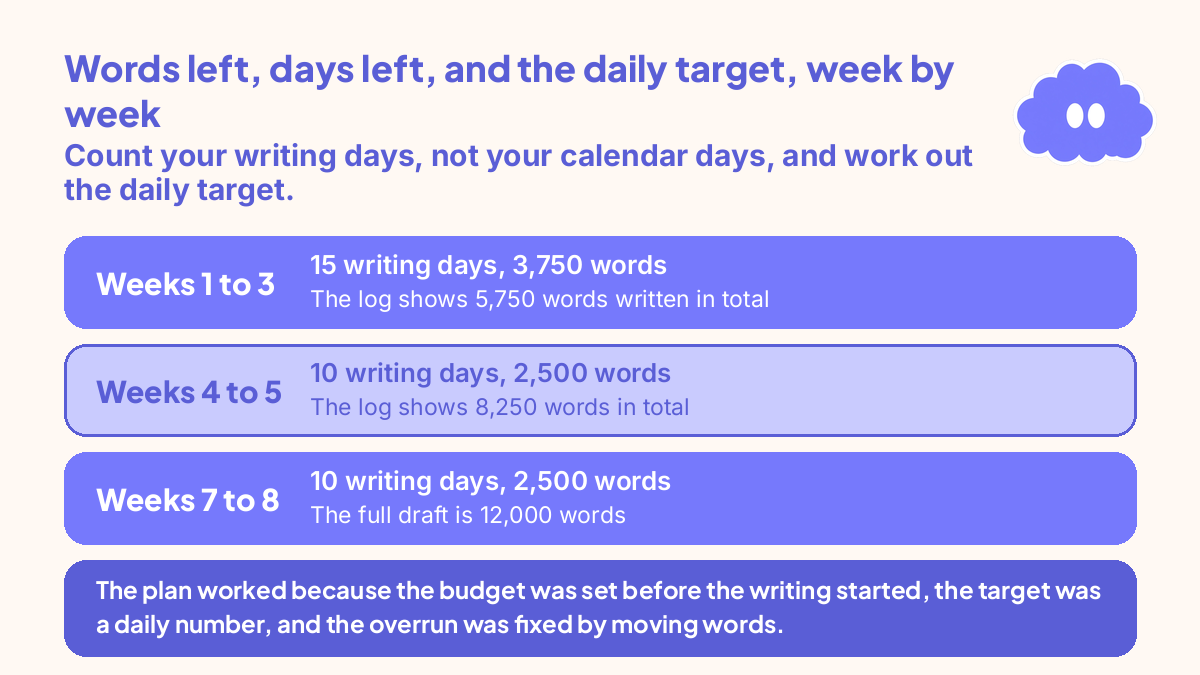
The plan worked because the budget was set before the writing started, the target was a daily number, and the overrun was fixed by moving words. The two editing weeks were protected from the start.
When it goes wrong
The daily target is over 400 words a day. Start writing more days a week, cut the scope with your supervisor, or ask about the deadline. Do not attempt 400 words a day for four weeks: the writing it produces is usually the writing you cut in editing.
One chapter eats the whole budget. Stop that chapter today and start the next one. A literature review at 4,000 words against a 2,500 budget has taken the discussion’s words. Cut the summaries, keep the argument, and move on.
You have not logged the words for two weeks. Log today’s words, count the words written so far, and work out the new daily target. The numbers will tell you whether you are on track.
The handbook says something different from this article. The handbook wins. If it sets exact word limits per chapter, use those. If it counts footnotes, rebuild the budget with the right total.
You keep the editing weeks for writing. The last two weeks are for editing, references, and proofreading, not for new chapters. A dissertation finished the night before submission has not been proofread. Protect the editing weeks the way you protect the deadline.
Weekly review checklist
- How many words have I written in total, and how many are left?
- How many writing days are left, and what is the daily target now?
- Is any chapter over its budget, and where will those words come from?
- Did I log the words every writing day this week?
- Are the editing weeks still protected, or has writing crept into them?
- What chapter am I writing tomorrow, and how many words does it need?
Downloadable infographic spec: one vertical image, title “How to plan your dissertation word count”, with the six steps from “The system in short” and the six review questions above, in Thynq cream, Cloud Purple, Dark Purple and pink, with the Cloud mascot. Text taken word-for-word from this article.
What this system is not
It is not a way to write a dissertation in a week; the daily target works because it is small and repeated. It is not a substitute for your handbook, which sets the limit, the counting rules, and the deadline. It does not write the dissertation for you, and it does not judge the quality of the words. And it does not guarantee a pass; it guarantees a finished draft, on time, with the words in the right chapters.
Sources
- Thynq dissertation word count planner. The tool page on thynq.org, read 20 November 2026. Supports the tool description in this article: the chapter budgets, the daily target method, the progress tracker, and the empirical split of introduction 10%, literature review 25%, methodology 15%, results 20%, discussion 20%, and conclusion 10%.
- Dunlosky, J., et al. (2013). Improving students’ learning with effective learning techniques. Psychological Science in the Public Interest, 14(1), 4-58. Practice testing and distributed practice rated high, which supports writing a little every day rather than in one long session.
- Cepeda, N. J., et al. (2006). Distributed practice in verbal recall tasks. Psychological Bulletin, 132(3), 354-380. Spaced practice beat massed practice, which supports spreading the writing across the writing days.
For the wider thesis system behind this one, start with How to write a thesis conclusion.
Questions
How many words should each chapter of a dissertation be?
There is no universal rule: your handbook, discipline, and supervisor decide. A common starting split for a 10,000-word empirical dissertation is introduction 1,000, literature review 2,500, methodology 1,500, results 2,000, discussion 2,000, and conclusion 1,000. Check that they add up to your total.
How many words a day do I need to write for my dissertation?
Divide the words you still have to write by the writing days left before your deadline. If you have 10,000 words left and 40 writing days, that is 250 words a day. The number updates as you write, so a day you write 500 words brings tomorrow’s target down, and a day you write nothing pushes it up.
What counts towards the dissertation word count?
The main text of the chapters almost always counts, and the reference list almost never does. Footnotes, tables, figure captions, and appendices vary by university, and the abstract usually has its own limit. Check your handbook before you plan, because a budget built on the wrong total is wrong in every chapter.
What do I do if one chapter runs over its word budget?
First, check whether another chapter is under budget, because the total is what matters. If the whole dissertation is over, cut description, not analysis: shorten the literature review’s summaries, tighten the methodology, and keep the results and discussion intact. If a chapter is over because the argument needs the words, move the budget.