The direct answer
How to revise when you have one week left is a triage system, not a cramming plan. Spend day one sorting every topic by marks per hour, make a drop list of what you will not cover, test first and read second for five days, run one practice on day six, and use day seven for light review and sleep.
The mistake is to try to cover everything evenly. Seven days is roughly 25 to 35 hours of real revision if you work hard and still sleep. That is enough to get solid on your most important topics and to practise exam questions.
The system in short
- Triage on day one in three hours: mark every topic by how likely it is to be examined and how well you know it, and rank by marks per hour.
- Make a drop list: the topics you will not cover, decided once, written down, and not revisited.
- Test first, read second: for each priority topic, try questions before re-reading, then read only what you got wrong.
- Revisit every day: start each morning with a 20-minute re-test of yesterday’s topics, so nothing learned on Monday is gone by Friday.
- Run timed practice on day six: one full paper or one timed section in the real format, marked the same day.
- Use day seven for light review and sleep: the error log, the one-page notes, and an early night, with no new material.
Step 1: Triage on day one, in three hours, by marks per hour
Day one is not a study day. It is a sorting day, and it takes three hours. Spend half a day on it, even if it feels like wasted time, because every hour after that depends on it.
List every topic in the course. For each one, mark two things: how likely it is to be examined, and how well you know it. Likelihood comes from past papers: count how often each topic appears in the last three to five years of papers, and how many marks it carries. Knowledge comes from honesty: could you explain it without notes, do you remember parts, or does the heading look new.
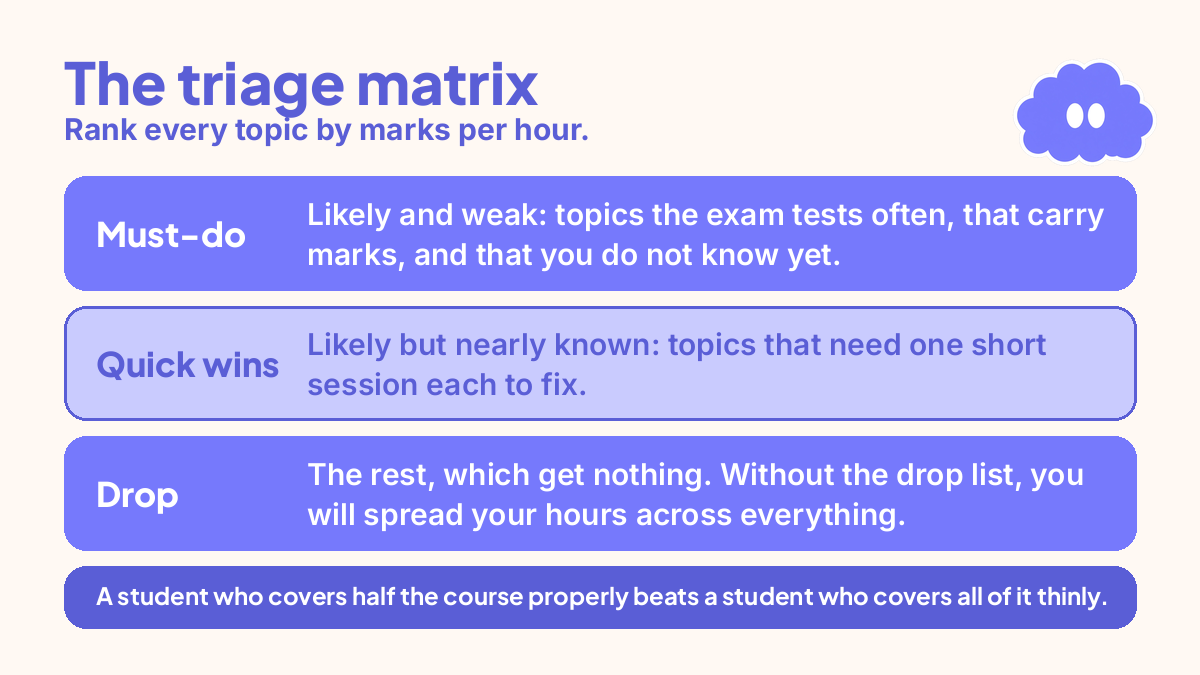
Now rank the topics by marks per hour. The top of the list is likely and weak: topics the exam tests often, that carry marks, and that you do not know yet. Those are the topics where an hour of work earns the most marks. The bottom is unlikely and strong: topics the exam rarely tests, that you already know. Those get nothing this week.
Split the list into three piles. Must-do: the top third, the likely and weak topics, which get days two to five. Quick wins: topics that are likely but nearly known, which need one short session each to fix. Drop: the rest, which get nothing. The drop list is the hardest part of the system and the most important: without it, you will spread your hours across everything and learn nothing properly. The system for revising when you have one month left uses the same triage, and the revision timetable that works shows how to turn the list into a daily plan.
Step 2: Make a drop list and do not revisit it
Write the drop list on paper, with the reason for each topic in one line: “unlikely, 2 marks in five years”, or “too big, cannot be learned in a week”. Then put the list away and do not reopen it.
The drop list works because it ends the argument. Without it, you will spend the week feeling guilty about the topics you are not covering, and guilt will pull you into re-reading them at midnight, which helps nobody. With it, the decision is made, the reasons are written down, and your attention is free for the must-do list.
Tell someone your drop list: a friend, a teacher, a parent. Saying it out loud makes it real, and it stops the midnight second-guessing.
The drop list is not a prediction that a dropped topic will not appear. It is a bet that the hours are worth more on the must-do list. If a dropped topic does appear, you will lose those marks, and you will still gain more from the topics you did cover. That is the trade, and it is the right one: a student who covers half the course properly beats a student who covers all of it thinly.
Step 3: Test first, read second
For each must-do topic, the method is the same, and it is the opposite of what most students do. Do not read first. Test first.
Open the topic, try the questions before you re-read anything: past paper questions, end-of-chapter questions, or questions you write yourself. Attempt them properly, with a timer, and pay attention to the exact moments where you get stuck. Each stuck moment is a precise, named gap: a definition you cannot state, a diagram you cannot draw, a method you cannot start.
Now, and only now, go to the notes, and learn just the thing the question demanded. Read the section, close the notes, and write what you remember. Check in a different colour. Then try the question again. This is faster than reading everything first, because every minute goes to content the exam has just proven you need.
Use this 50-minute block for each topic: 15 minutes testing, 15 minutes reading the gaps, 20 minutes re-testing. Do two or three blocks a day, with a break between them.
Keep an error log as you go: one line per mistake, with the topic, the question type, and the fix. The error log becomes the most important book in the last two days. The past-paper system for exams sets out the same error-log habit in full.
Step 4: Revisit every day, for 20 minutes
A week is long enough to forget what you learned on Monday. The fix is a daily revisit: start each morning with a 20-minute re-test of yesterday’s topics, before you touch anything new.
The revisit is short and strict. Take yesterday’s must-do topics, close the notes, and test yourself: five questions, five flashcards, or five minutes of writing from memory per topic. Mark what you missed, and put the misses on today’s list. Then move on. The revisit is not a second study session. It is a check that yesterday’s work stuck.
If the revisit shows a topic is gone, do not panic and do not re-read the whole chapter. Re-test the gaps only, for 15 minutes, and move on. A topic that needs three revisits is a topic that needs to stay on the must-do list, not a topic that needs more hours today.
Step 5: Run timed practice on day six
Day six is not for learning. It is for testing everything covered so far under conditions that match the real exam. Sit a full past paper, or one timed section if the paper is long, with a timer running, no notes nearby, exactly as the real exam will demand.
Mark the paper against the mark scheme the same day. For every mark lost, write one line on the error log: the topic, the question type, and the fix. Sort lost marks into three piles: content you did not know, technique such as running out of time or misreading the command word, and careless errors. Put the biggest pile on day seven’s light review, not on a new study session: day seven is for fixing, not for learning.
Step 6: Use day seven for light review and sleep
The day before the exam is not the day for new material. Go through your error log and your one-page notes, re-test the flashcards you kept getting wrong, and then stop. Two hours of light review in the morning is enough. The afternoon is for rest: a walk, a proper meal, and packing your exam bag.
Do not pull an all-nighter. Sleep is when your brain sorts and stores what you learned, and a tired brain on exam day makes silly mistakes. Go to bed at your normal time, or earlier, and set two alarms. The guide to what to do on the morning of an exam covers the exam-day routine: eat, check the bag, arrive early, and read the paper properly before you write.
A worked example: seven days, three subjects, five hours a day
Your situation: GCSE student, one week to the first exam. Three subjects: maths, English, and science. Five focused hours a day, Monday to Sunday, with the exam on Monday morning.
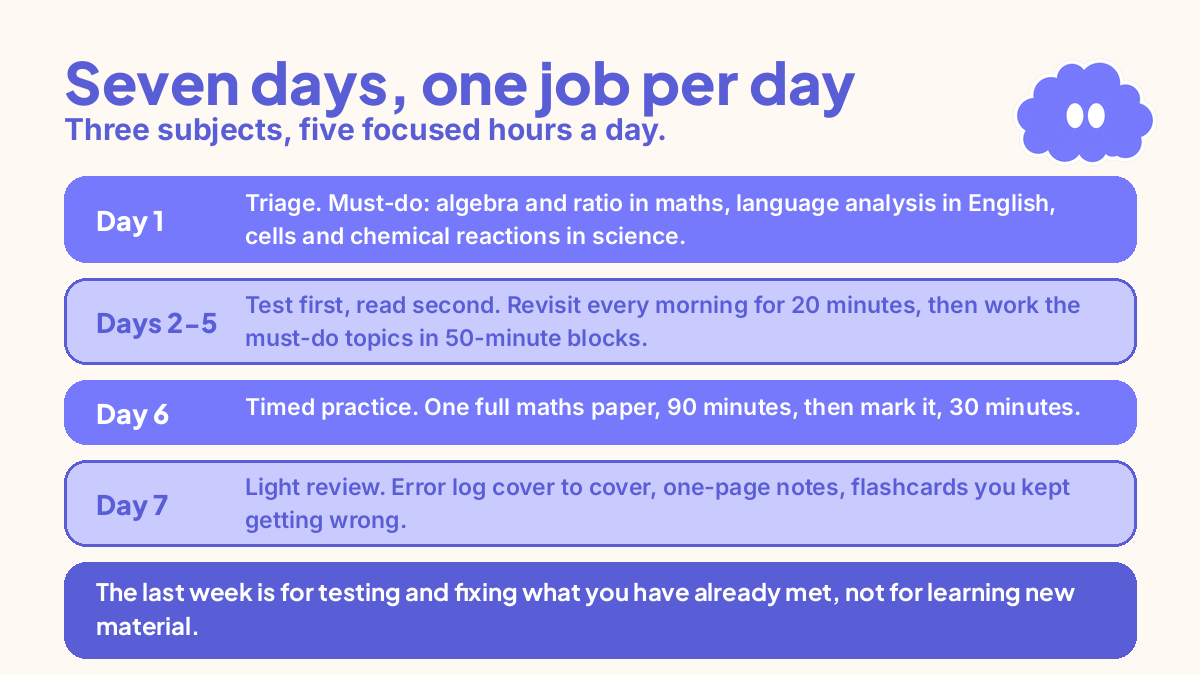
- Day 1, Monday, 9:00am-12:00pm: triage. List every topic in all three subjects. Count past paper appearances over five years. Must-do: algebra and ratio in maths, language analysis in English, cells and chemical reactions in science. Quick wins: graphs in maths, poetry comparison in English, forces in science. Drop: three low-mark topics in science, two in English. Write the drop list and put it away.
- Day 2, Tuesday, 9:00am-2:00pm: test first, read second. Morning: algebra, 15 minutes testing, 15 minutes reading gaps, 20 minutes re-testing, then ratio the same way. Afternoon: language analysis, same block. Error log: 6 lines. Evening: nothing.
- Day 3, Wednesday, 9:00-9:20am: revisit yesterday’s topics, 20 minutes. Then: cells and chemical reactions, two blocks. Afternoon: quick wins, graphs and poetry comparison, one block each. Error log: 5 new lines.
- Day 4, Thursday, 9:00-9:20am: revisit. Then: algebra re-test and ratio re-test, one block each, then language analysis re-test. Afternoon: forces quick win and science cells re-test. Error log: 4 new lines.
- Day 5, Friday, 9:00-9:20am: revisit. Then: mixed testing, two topics together, so you have to choose the right method for each question. Afternoon: one-page notes for each subject, written from memory, then checked. Error log: 3 new lines.
- Day 6, Saturday, 9:00-11:00am: timed practice. One full maths paper, 90 minutes, then mark it, 30 minutes.
- Day 7, Sunday, 9:00-11:00am: light review. Error log cover to cover, one-page notes, flashcards you kept getting wrong. Afternoon: walk, pack the exam bag, eat well, bed by 10:00pm. No new material, no mock, no late night.
When it goes wrong
You cannot finish the triage in three hours. Stop at three hours and use what you have. A rough triage is better than a perfect one that eats day two. Mark the uncertain topics as quick wins and move on.
You keep adding topics back from the drop list. Read the reason you wrote for each one. The reason has not changed. If a teacher tells you a dropped topic is likely, swap it for a must-do topic of the same size, and do not add it on top.
You fall behind on day three and panic. Cut one must-do topic to a quick win and move on. The system survives a cut. It does not survive a panic that turns day three into an all-nighter and ruins days four to seven.
The timed practice on day six goes badly. That is what it is for. Mark it, sort the lost marks, and fix the biggest pile on day seven. A bad mock six days before the exam is useful information. A bad mock the day before the exam is a disaster, which is why the mock is on day six.
Weekly review checklist
Use this checklist at the end of the week, in writing, in 20 minutes, after the exam.
- Which topics moved from weak to shaky, or from shaky to strong, during the week?
- Did the drop list hold, or did I keep adding topics back?
- What did the daily revisits show: which topics stuck, and which needed three tries?
- Which lost marks from the day six paper are now fixed, and which are still on the error log?
- Did I protect my sleep every night, especially the last two?
- What one change will I make to my next one-week plan, and what stays the same?
Downloadable infographic spec: one vertical image, title “How to revise when you have one week left”, with the six steps from “The system in short” and the six review questions above, in Thynq cream, Cloud Purple, Dark Purple and pink, with the Cloud mascot. Text taken word-for-word from this article.
What this system is not
This system is not a way to learn a whole course in seven days. It does not promise grades, and it does not replace months of study. It turns a week of panic into a week of triage, testing, and timed practice, and it protects your sleep.
Sources
- Dunlosky, J., et al. (2013). Improving students’ learning with effective learning techniques. Psychological Science in the Public Interest, 14(1), 4-58. Only practice testing and distributed practice rated high utility; re-reading and highlighting rated low.
- Roediger, H. L., & Karpicke, J. D. (2006). Test-enhanced learning. Psychological Science, 17(3), 249-255. Retrieval practice beat restudying after a delay.
- Cepeda, N. J., et al. (2006). Distributed practice in verbal recall tasks: a review and quantitative synthesis. Psychological Bulletin, 132(3), 354-380. Spaced practice beat massed practice; the daily revisits are the spacing in this system.
For the full system behind this method, start with how to build a study system that fits your life.
Questions
Can I revise a whole course in one week?
Not all of it. A week holds roughly 25 to 35 hours of real revision, which is enough to get solid on your most important topics and practise exam questions. It is not enough to relearn a whole course from scratch, so the system triages ruthlessly and drops what cannot be covered.
How many hours should I revise a day with one week left?
Five to six focused hours a day is realistic for most students, split into blocks of 45 to 50 minutes with short breaks. More than that, and the extra hours are foggy re-reading that teaches nothing. Protect your sleep every night, especially the last two.
Should I learn new topics in the last week?
No. The last week is for testing and fixing what you have already met, not for learning new material. A topic you have never seen will not be mastered in seven days, and the hours it takes are stolen from topics that could earn marks.
What should I do the day before the exam?
Light review only: your error log, your one-page notes, and the flashcards you kept getting wrong. No new topics, no full mock, no late night. Pack your bag, eat well, and go to bed early. Sleep before an exam helps you recall what you learned.