
The direct answer
How to revise biology for exams comes down to testing yourself from memory on every topic, learning each process as a chain of causes, and redrawing every diagram without looking. Biology is the subject that punishes rereading most: the content is wide, the terms are precise, and the questions ask you to explain why things happen, not just name them.
Reading your notes on the heart makes the heart feel familiar. The exam will ask you to explain what happens if a valve fails, and familiarity will not answer that.
The system in short
- Turn your specification into a topic list, and work from that list.
- Drill terms and definitions from memory, in short sessions.
- Learn each process as a chain, and practise breaking it.
- Redraw every diagram from memory, and test the function of each part.
- Practise past-paper questions by topic, and log every mark you drop.
- Keep the practicals and the maths in the weekly rotation.
Step 1: Turn your specification into a topic list, and work from that list
Start with your exam board’s specification, not your textbook: it is the list of everything you can be tested on, written by the people who write the questions. Turn it into a topic list with a confidence rating next to each topic: strong, shaky, or weak. That list is your revision plan.
This step matters more in biology than in most subjects because the content is so wide: cell biology, genetics, evolution, homeostasis, ecology, coordination, reproduction, and the practicals, each with its own terms, diagrams, and processes. Without a list, you revise the topics you like and skip the ones you avoid. The list makes the avoidance visible. How to revise science for exams covers the same habit for science as a whole. Rate the topics honestly: strong means you can explain it from memory, shaky means you can describe it but not explain it, and weak means you cannot start without looking. Tick a topic off only when you can answer past-paper questions on it without notes.
Step 2: Drill terms and definitions from memory, in short sessions
Biology uses precise language, and mark schemes often require a specific term stated in a specific way. Osmosis, active transport, mitosis, meiosis, aerobic respiration, homeostasis: a loose paraphrase can miss the key component and lose the mark. So terms get drilled, not read.
Make a flashcard for each topic: term on one side, definition on the other. Test yourself with the answer hidden, and say the definition before you check. If you get it wrong, mark it and return to it in the next session, before new material. Test first, read second: reading the card and nodding is not revision. Keep the sessions short: 20 minutes of term drilling, then stop. Three short sessions across the week beat one long session on Sunday: the gap is what makes the memory stick. Dunlosky and colleagues (2013) rated practice testing as one of only two techniques with high utility for long-term learning, and Cepeda and colleagues (2006) confirmed that spreading practice across sessions beats covering the same material in one block.
Step 3: Learn each process as a chain, and practise breaking it
Knowing the steps of a process is not enough in biology: the exam asks why each step happens, what would happen if it failed, and how a change in one variable affects the whole process. A list of steps earns the describe marks; the chain of causes earns the explain marks, where most biology grades are won or lost.
Take each major process, photosynthesis, respiration, the cardiac cycle, and the nitrogen cycle, and learn it as a chain. For each step, write what happens, why it happens, and what would happen if it failed. Photosynthesis is a chain in which light energy splits water, the products of that step drive the next, and a failure at any point changes what comes out. The heart is a sequence in which each contraction causes the next, and a faulty valve changes the pressure everywhere downstream.
Practise the chain on a blank page: close your notes, write the process from memory, and add the causal link after each step. Then check the order and the why against your notes. The broken-step test is the proof: if this step stopped, what would happen next? If you cannot answer, you do not understand the chain yet.
Step 4: Redraw every diagram from memory, and test the function of each part
Biology exams regularly ask you to draw or label diagrams: cell structures, the heart, the eye, the digestive system, a nephron, a leaf cross-section. A diagram question tests two things: whether you know the names of the structures, and whether you understand what each part does. Students who only look at labelled diagrams fail the second test.
The routine is the same every time. Look at the labelled diagram once and read what each part does. Cover it. Draw it on a blank page from memory, with the labels. Open your notes and compare: which labels are missing or in the wrong place, and which structures can you not explain? Write the function of each part next to its label, then repeat it next session, until you can draw it without thinking.
Draw simply: the exam rewards clear shapes, correct labels, and the right connections, not art. Keep the same simple drawing for each diagram every time, so the drawing becomes automatic and your attention goes to the labels and the functions. Test the structure-function link directly: a question about the alveoli might ask how each structural feature maximises the rate of gas exchange, and the answer is the features plus their reasons.
Step 5: Practise past-paper questions by topic, and log every mark you drop
Start past-paper questions by topic early, before you feel ready. Attempting a question before you are confident strengthens retention, and it shows you exactly what the mark scheme wants. Past-paper system for exams covers the routine in detail; the biology version of it is to work by topic, mark carefully, and log the misses.
For each topic, answer a set of past-paper questions with the book closed, under a time limit. Then mark your answers against the official mark scheme, and look for three things: missing specific wording, describing when the question asked you to explain, and missing causal links. These are the three ways biology marks are most often lost.
Log every topic where you drop marks, with one line per miss: the question, the mark you lost, and the reason. That log tells you what to do next: a topic with three misses gets a slot next session; a topic with no misses gets a weekly check. How to track your past paper scores to find weak topics shows how to keep the log so it stays useful across weeks. Then learn the command words: “State” wants one term, “Describe” wants what happens, “Explain” wants what happens and why, “Compare” wants similarities and differences, “Evaluate” wants a supported conclusion, “Calculate” wants a number with the working shown. As the exam gets closer, sit full papers under timed conditions, and Use AI to mark your past paper answers can check an answer you are unsure about.
Step 6: Keep the practicals and the maths in the weekly rotation
Practicals catch students every year. They look like side content, but they appear all over the papers as experiment designs, evaluation questions, and data analysis. A student who revised only the theory will have nothing to say when a question asks why a control was used.
For each required practical, be able to write the method, explain why each step is done, name the variables, and handle the maths. Why repeat readings? To spot anomalies and calculate a mean. Why use a control? To show the change was caused by the variable you changed. Why measure at regular intervals? To see the pattern over time. Write these reasons down for each practical, one line each, and test yourself on them like terms.
The maths in biology is a small, predictable set: magnification (image size divided by actual size), percentage change, rates from graphs, and genetic cross probabilities. The operations are not hard, but students who have not practised them under time pressure make errors at exactly the point where they cannot afford to. Work through the method once with your notes open, then attempt several examples without notes, and include a calculation question in every past-paper session. Put the practicals and the maths on the weekly rotation: one practical and one calculation type per week is enough.
A worked example: a week of biology revision, six weeks before the exam
Your situation: Year 11 student, GCSE biology, six weeks to the first paper. Your list has 12 topics: photosynthesis and the heart are weak, genetics is shaky, cell structure is strong. You have an hour a day after school, and two hours on Saturday morning.
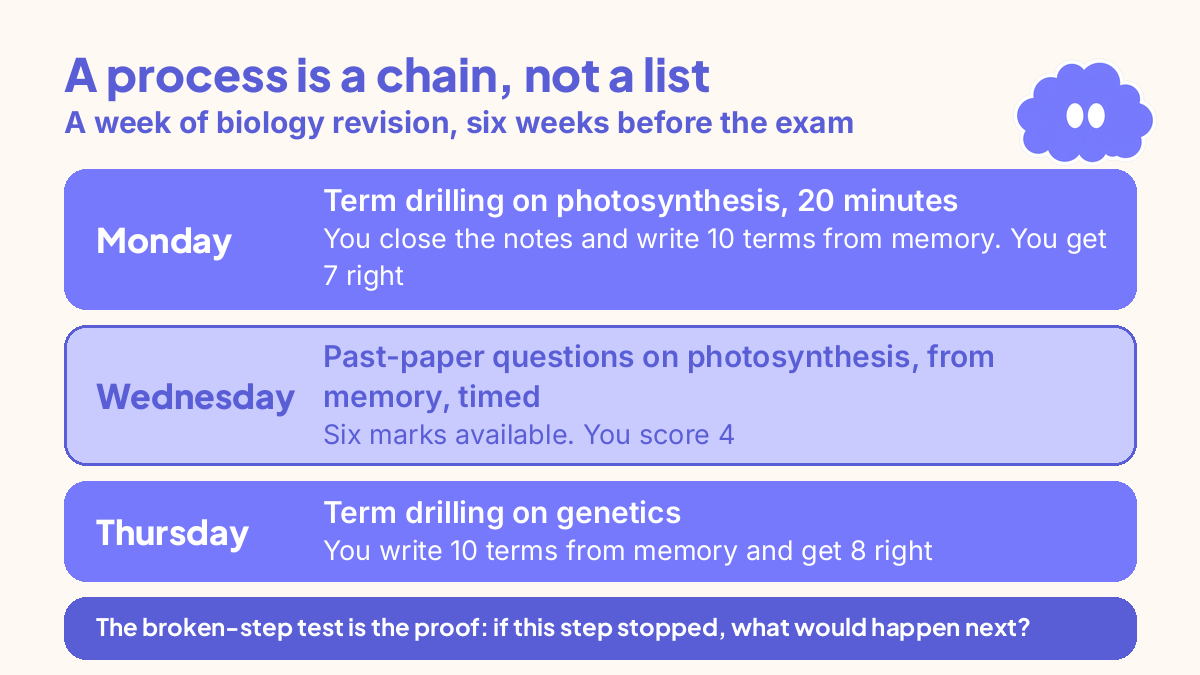
- Monday: Term drilling on photosynthesis, 20 minutes: you close the notes and write 10 terms from memory. You get 7 right. Then photosynthesis as a chain: you write the process from memory, with the why after each step, and find you missed one link.
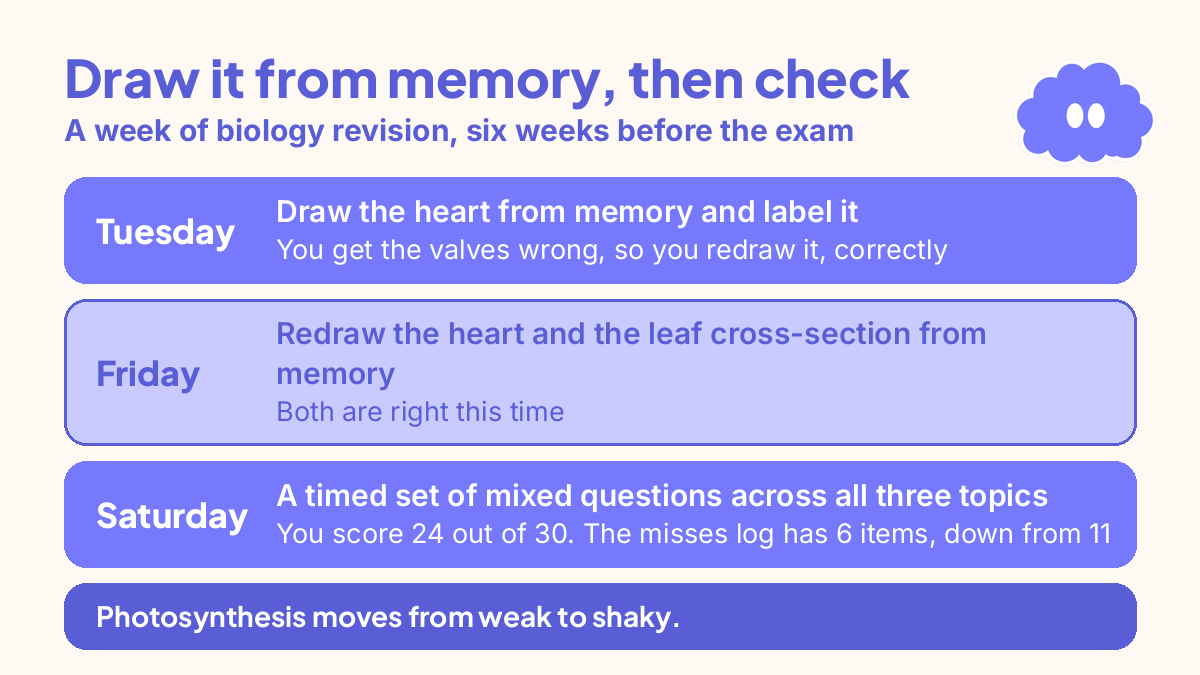
- Tuesday: The 3 missed terms from Monday, tested first, then 10 new terms on the heart. Then draw the heart from memory and label it. You get the valves wrong, so you redraw it, correctly.
- Wednesday: Past-paper questions on photosynthesis, from memory, timed. Six marks available. You score 4. The two lost marks are both explain questions where you described the steps but gave no causal link. You write both questions in the misses log. Then the required practical on light intensity and photosynthesis: you write the method and the reasons from memory.
- Thursday: Term drilling on genetics: you write 10 terms from memory and get 8 right. Then genetics as a chain: you write out a monohybrid cross from memory, with the probabilities, and check it. Then three magnification calculations.
- Friday: Redraw the heart and the leaf cross-section from memory. Both are right this time. You also retest the two photosynthesis explain questions from Wednesday: both are right.
- Saturday: A timed set of mixed questions across all three topics. You score 24 out of 30. The misses log has 6 items, down from 11. Photosynthesis moves from weak to shaky.
The week held five hours of revision, all from memory. The misses log shrank, two diagrams became automatic, and the two explain questions from Wednesday were right by Friday.
When it goes wrong
You keep rereading notes and feeling prepared, then blanking in the exam. Rereading builds recognition, not recall. Stop reading and start testing: close the book, write what you remember, and check the gaps.
You know the steps of a process but lose the explain marks. You are describing, not explaining. After every step, add the why. Take three past-paper explain questions and check the mark scheme for the causal links you skipped.
Your diagrams are right in your notes and wrong from memory. You are practising by looking, not by drawing. Cover the diagram and draw it, every other day for a week, and it will hold.
You keep losing marks on the same topic and cannot see why. Read the mark scheme, not your answer. The gap is usually one word: a missing term, a missing “because”, or a number without its unit. Write the exact wording on a card and drill it.
Weekly review checklist
- Which topics moved on the specification list this week, and which are still weak?
- Did I test myself from memory in every session, or did I slide back into rereading?
- Can I write each process as a chain, with the why after each step, without notes?
- Can I draw each diagram from memory, with labels and functions, without looking?
- What does the misses log say, and is it getting shorter?
- Did the practicals and the maths get their slot this week, or did they slip?
Downloadable infographic spec: one vertical image, title “How to revise biology for exams”, with the six steps from “The system in short” and the six review questions above, in Thynq cream, Cloud Purple, Dark Purple and pink, with the Cloud mascot. Text taken word-for-word from this article.
What this system is not
It is not a shortcut for learning the content. Biology has a lot of content, and no system removes that; the system only makes the hours you spend on it count. It is not a promise of a grade, and it does not replace your specification, your textbook, or your teacher. It is not a substitute for the general science system; this one covers what is different about biology, and the two work together. And it is not a last-minute plan: if the exam is tomorrow, test the misses log, redraw the diagrams, and sleep.
Sources
- Roediger, H. L., & Karpicke, J. D. (2006). Test-enhanced learning. Psychological Science, 17(3), 249-255. Testing from memory beat restudying a week later, which supports testing in every session.
- Dunlosky, J., et al. (2013). Improving students’ learning with effective learning techniques. Psychological Science in the Public Interest, 14(1), 4-58. Practice testing and distributed practice rated high; rereading rated low, which is why this system tests from memory and spaces sessions across the week.
- Cepeda, N. J., et al. (2006). Distributed practice in verbal recall tasks. Psychological Bulletin, 132(3), 354-380. Spaced practice beat massed practice, which supports short sessions across the week.
- Root Tutor. How to Revise Biology for GCSE and A-Level. The describe and explain distinction, the structure-function link, and practicals as method and evaluation questions.
For the wider exam system behind this one, start with How to build a study system that fits your life.
Questions
How do I revise biology when there is so much content?
Work topic by topic from your specification, and test yourself on each topic before moving on. Biology rewards recall, not reading: close the notes, write out the terms and the process from memory, check the gaps, and return to the weak topics across the week. One topic finished properly beats three topics skimmed.
How do I learn biology diagrams for exams?
Draw them from memory, then check. Look at the labelled diagram once, cover it, draw it on a blank page with the labels, and compare. Test yourself on what each part does, not just its name, and repeat the same diagram across several days until you can draw it without thinking.
What is the best way to answer explain questions in biology?
State what happens, then say why, with a causal link after each step: because, therefore, which leads to. Describe means what happens. Explain means what happens and why. Practise by taking past-paper explain questions and checking your answer against the mark scheme for the causal links you skipped.
Should I revise biology practicals, or just the theory?
Revise the practicals. They appear all over the papers as method questions, evaluation questions, and data analysis, and they catch students who only revised the theory. For each required practical, be able to write the method, say why each step is done, and handle the maths that goes with it.