The direct answer
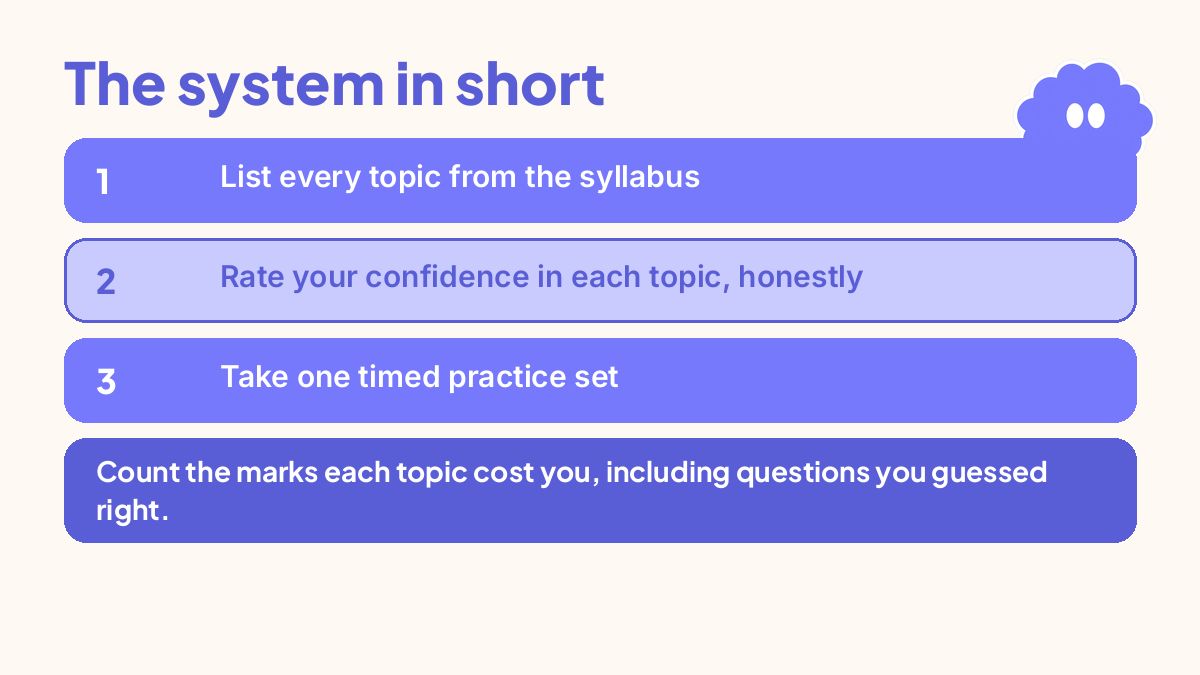
To learn how to find your weakest maths topics before the exam, list every topic from the syllabus, rate your confidence, then take one timed practice set and mark it honestly. Count the marks each topic cost you, including questions you guessed right, and rank the topics. The top topics get your next three practice sessions.
Most students revise maths by feel. They spend the most time on the topics they enjoy, which are usually the ones they already know, and they avoid the topics that feel uncomfortable, which are usually the ones that cost marks. This system replaces that feeling with a count: one practice set, marked properly, tells you more about your weak topics than a week of rereading notes.
The system in short
- List every topic from the syllabus, with nothing left out.
- Rate your confidence in each topic, honestly, from 1 to 5.
- Take one timed practice set covering all the topics.
- Mark wrong answers and lucky guesses, and count marks lost per topic.
- Rank the topics by marks lost and pick the top three.
- Give the top three topics your next three sessions, then retest.
Step 1: List every topic from the syllabus
Open your syllabus or exam specification and copy every topic into a list, using the syllabus wording, not your own shorthand, because your shorthand hides topics you have forgotten. If the syllabus lists 14 topics, your list has 14 rows.
Do not skip a topic because you think it will not come up. Examiners choose from the whole syllabus, and the topic you skip is the one that appears as a ten-mark question. Do not merge topics either: “algebra” is not one topic when the syllabus lists equations, inequalities, and simultaneous equations separately.
Leave two blank columns beside each topic: one for your confidence rating and one for marks lost. This list becomes your revision map for the rest of the exam period, so keep it somewhere visible, where you will actually look at it.
Step 2: Rate your confidence in each topic, honestly
Rate each topic from 1 to 5. A 1 means you could not start a question on it. A 2 means you could start but would get stuck. A 3 means you can answer standard questions but not unusual ones. A 4 means you are comfortable with most question styles. A 5 means you could teach it.
Be honest, because this rating is a guess you are about to test. If you catch yourself writing 4 for everything, you are rating your comfort, not your knowledge. Ask yourself for each topic: “Could I answer a question on this right now, without notes, in exam time?” If the answer is no, the rating is 3 at most.
Write the ratings down and do not change them after the practice set. The gap between what you expected and what the test shows is one of the most useful results in this system. It tells you which topics you overrate, and overrated topics are dangerous, because you will not revise them.
Step 3: Take one timed practice set covering all the topics
Find or build one practice set that covers every topic on your list, with about 40 questions. Past papers are the best source, and the past-paper system for exams explains how to use them properly. If no single paper covers everything, combine questions from two papers, but keep the total near 40.
Take it under exam conditions. Set a timer, close your notes, and work through the questions in order. Do not skip a question because the topic feels weak; a skipped question is a lost mark, and you need that information. When you guess, put a small mark beside the question, because a guessed answer that happens to be right will otherwise look like knowledge.
Stop when the timer ends. Exam timing is part of what you are measuring, and questions you answer after the time is up are not questions you can answer in an exam.
Step 4: Mark wrong answers and lucky guesses, and count marks lost per topic
Mark the set strictly against the answer key. A wrong answer is a lost mark, and a guessed answer that is right is also a lost mark for this purpose, even though it scored. Add every guessed question to the not-solid count for its topic. A guess is not knowledge, and the exam will ask a similar question with different numbers.
Now count, topic by topic. For each topic, add up the questions that are not solid: the wrong answers plus the lucky guesses. Write that number in the marks-lost column. A topic with 5 not-solid questions cost you more than a topic with 1, whatever your confidence rating said. This count usually disagrees with your ratings in at least one place.
Work out your solid score too: subtract the not-solid questions from the total and divide by the total. That number is your honest baseline, and it is lower than your raw score whenever you guessed. For a fuller method of turning past-paper scores into a revision plan, read How to track your past paper scores to find weak topics.
Step 5: Rank the topics by marks lost and pick the top three
Sort your list by marks lost, highest first. The topics at the top are your weakest topics, by evidence, not by feeling. Pick the top three. If two topics tie, pick the one with the lower confidence rating first.
Three is the right number. One topic is too few, and five spreads your time so thin that no topic gets a full session. Three topics, one session each, is a plan you can finish in a week, and finishing matters more than planning.
Write the three topics on a card and put it where you study. Each one gets a full practice session, in order, weakest first. Set a checkable target for each session: not “revise functions” but “answer 10 fresh functions questions without guessing”. If you need a full method for revising a single topic, How to revise maths for exams covers the session structure in detail.
Step 6: Give the top three topics your next three sessions, then retest
Run the three sessions over the next three study days, one topic per session. Each session follows the same shape: 10 minutes reviewing the method from your notes, 30 minutes answering fresh questions on that topic only, and 10 minutes marking and writing down every error and every guess. Do not reuse the questions from the practice set, because reused questions test memory of the answers.
After each session, re-rate your confidence in that topic. A topic leaves the weak list only when you answer fresh questions on it without guessing and without notes. Until then, it stays on the list.
When the three sessions are done, take a second timed practice set. Mark it the same way, count marks lost per topic again, and build a new top three. One of the old three will usually have dropped off, and a new topic will have taken its place. Repeat the cycle until the exam.
If a topic refuses to move after two full cycles, the problem is usually understanding, not practice. Go back to the textbook or a worked example, study the method once, then try again. More questions on a method you do not understand only rehearses the same mistake. If the exam is a second attempt, the retake system in How to retake an exam: a study system for students who have to sit it again pairs well with this one, because it starts from exactly this kind of honest diagnosis.
A worked example
Your situation: You are a GCSE student with a maths exam in three weeks and a syllabus of 12 topics. You take a 40-question practice set on a Saturday morning, timed at one hour, to find which topics to revise first.
You list the 12 topics and rate your confidence. Functions gets a 3, Probability a 3, Geometry a 4, Algebra a 4, and the rest mostly 3s and 4s. Geometry at 4 feels safe, and Probability at 3 feels like the weak spot. Those ratings are guesses, and the test is about to check them.
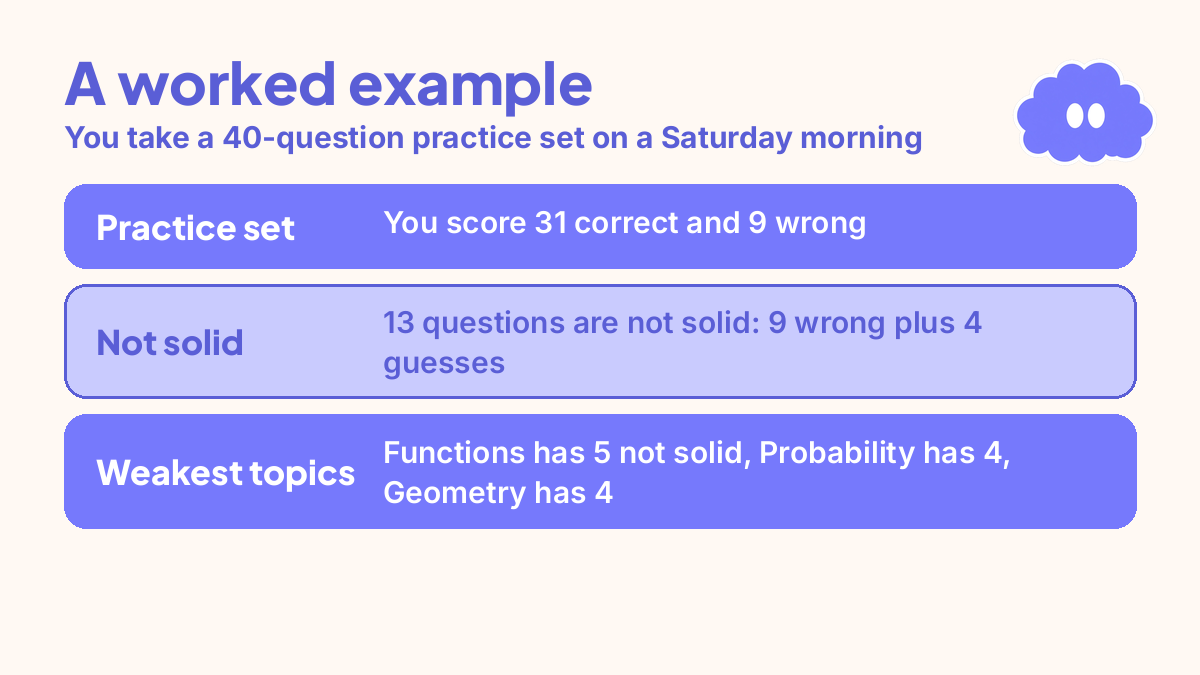
You take the 40-question set in 60 minutes, marking each guess with a G. You score 31 correct and 9 wrong, but 4 of the 31 correct answers were guesses, so 13 questions are not solid: 9 wrong plus 4 guesses. Your honest score is 27 solid answers out of 40, which is 67.5 percent, not the 77.5 percent the raw score suggests.
- Saturday, 10.00 to 11.00 am: take the 40-question practice set, timed, marking guesses with a G.
- Saturday, 11.00 to 11.30 am: mark the set strictly. Count 9 wrong and 4 guessed right. Total not solid is 13.
- Saturday, 11.30 am to 12.00 pm: count marks lost per topic. Functions has 5 not solid, Probability has 4, Geometry has 4, and the other 9 topics share the remaining 0.
- Saturday, 12.00 to 12.15 pm: rank the topics. Functions is first with 5, Probability and Geometry tie at 4 each. Probability has the lower confidence rating, so it comes second and Geometry third.
- Monday, 5.00 to 5.50 pm: session 1, Functions. Ten minutes reviewing the method, 30 minutes on fresh Functions questions, 10 minutes marking. Re-rate Functions from 3 to 4.
- Wednesday, 5.00 to 5.50 pm: session 2, Probability, same shape. Re-rate Probability from 3 to 4.
- Friday, 5.00 to 5.50 pm: session 3, Geometry, same shape. Re-rate Geometry from 4 to 4, but the guesses are gone, so the 4 now means something.
The next Saturday, you take a second 40-question set and repeat the count. If Functions drops to 1 not solid, it leaves the top three and a new topic takes its place. That is the cycle, and three weeks of it is enough to move the whole list. The maths revision tracker makes the bookkeeping easier: you list your exam topics, rate your confidence in each, enter your exam date, and it ranks your topics weakest first and gives the weakest topics a bigger share of your practice time.
When it goes wrong
You skip the confidence ratings. Then you have no guess to test and no way to spot the topics you overrate. Rate first, test second, compare after.
You count guessed answers as correct. Your weak list comes out too short, and the exam finds the gaps you hid. Mark every guess.
You revise the topics you enjoy instead of the top three. If a session is not on one of the top three topics, it is a reward session, not a revision session, and it comes after the real work.
A topic does not improve after two cycles. Stop practising it and go back to understanding it. Reread the method, work through one example slowly, and ask for help if it still does not make sense. Practising a misunderstood method only makes the mistake faster.
You run out of time before the exam. Cut the list to the single weakest topic and give it every remaining session.
Weekly review checklist
- Is my topic list complete, with every syllabus topic on it?
- Did I rate my confidence before testing, or did I skip the ratings?
- Did I take a timed practice set this week, marking guesses honestly?
- How many questions were not solid, and which topics cost the most marks?
- Are my top three topics the ones with the most marks lost, not the ones I enjoy least?
- Did each weak topic get a full session with fresh questions?
- Did I re-rate confidence after each session, and did any topic leave the weak list?
Downloadable infographic spec: A vertical infographic in Thynq colours (cream background, dark purple title, cloud-purple steps, pink accents) with the cloud mascot at the top, titled “How to find your weakest maths topics before the exam”. It lists 6 steps: list every topic from the syllabus; rate your confidence in each topic, honestly; take one timed practice set; mark wrong answers and lucky guesses; rank the topics by marks lost and pick the top three; give the top three topics your next three sessions, then retest. It ends with 6 review questions: Is my topic list complete? Did I rate my confidence before testing? Did I take a timed practice set this week? How many questions were not solid? Are my top three topics the ones with the most marks lost? Did each weak topic get a full session with fresh questions?
What this system is not
This system is not a prediction of your exam grade. A practice set is a sample, not the exam. The system tells you where to spend your time, not what mark you will get.
It is not a substitute for learning the methods. Finding a weak topic is step one. Fixing it means understanding the method, then practising it. The diagnosis is quick; the repair takes the sessions.
It is also not a reason to ignore your strong topics entirely. A topic you knew a month ago can fade, so give strong topics one short mixed set in the final week, and give weak topics the sessions before that.
Sources
- Dunlosky, J., Rawson, K. A., Marsh, E. J., Nathan, M. J., & Willingham, D. T. (2013). Improving students’ learning with effective learning techniques: Promising directions from cognitive and educational psychology. Psychological Science in the Public Interest, 14(1), 4-58. Supports the use of practice testing to find gaps and the warning against rereading notes as a revision method.
For the full system behind this method, start with How to build a study system that fits your life. If you want an outside check on your written maths answers, Use AI to mark your past paper answers explains how to get honest feedback.
Questions
How do I find my weakest maths topics before the exam?
List every topic from the syllabus, rate your confidence in each, then take one timed practice set and mark it. Count marks lost per topic, including questions you guessed right, and rank the topics by marks lost. Your weakest topics are the ones that cost you the most marks.
Should I count a question I guessed right as correct?
No. A lucky guess is not knowledge, and the exam will ask a similar question with different numbers. Mark every guessed answer as not solid, even if it scored a mark, and count it against that topic.
How many topics should I focus on at once?
Three. Give your three weakest topics the next three practice sessions, one topic per session. More than three spreads your time too thin, and the weakest topic never gets the attention it needs.
How often should I retest my weak topics?
Retest each weak topic with fresh questions after one focused session on it, then again a few days later. Re-rate your confidence each time. A topic leaves the weak list only when you answer fresh questions on it without guessing.