
The direct answer
To cut an essay that is over the word limit, measure the exact overage, then remove repetition first, tighten wordy phrases second, and touch whole paragraphs last. Protect evidence and analysis throughout, and recount after each pass so the argument survives intact.
Being over the limit feels worse than it is. You have written too much, which means you have material to work with.
The better approach treats cutting as editing in a fixed order. Most overages are not one bad paragraph. They are small amounts of repetition and wordiness spread across every paragraph. Remove them in the right order and the essay gets shorter and clearer at the same time. This system shows you where the words hide, how to count honestly, and how to stop when the essay is both under the limit and still itself.
The system in short
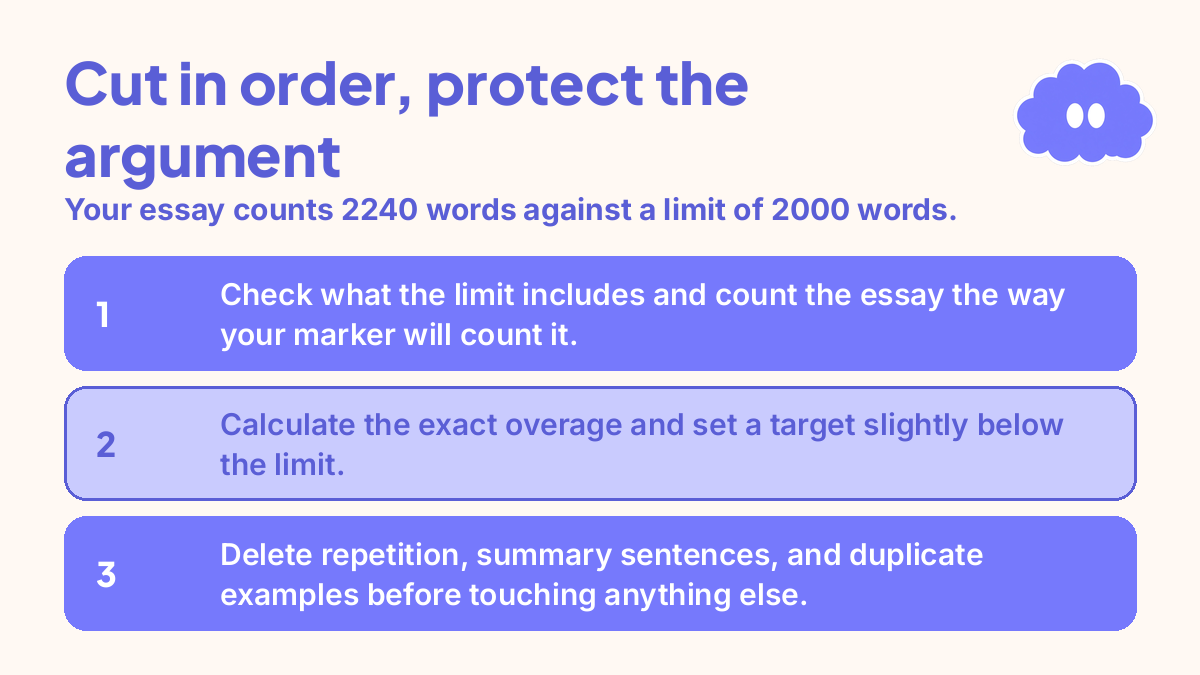
- Check what the limit includes and count the essay the way your marker will count it.
- Calculate the exact overage and set a target slightly below the limit.
- Delete repetition, summary sentences, and duplicate examples before touching anything else.
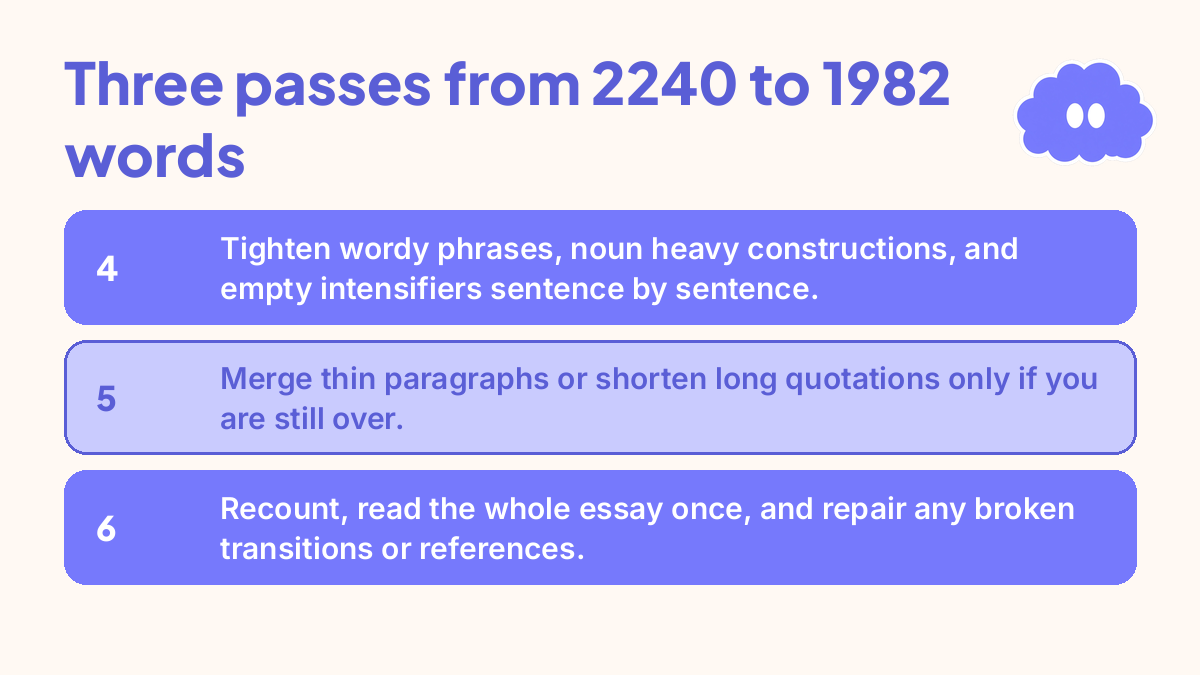
- Tighten wordy phrases, noun heavy constructions, and empty intensifiers sentence by sentence.
- Merge thin paragraphs or shorten long quotations only if you are still over.
- Recount, read the whole essay once, and repair any broken transitions or references.
Step 1: Count the way your marker will count
Start with the rules, not the text. Read your assignment brief or handbook and note what the word limit includes and excludes. Reference lists are commonly excluded. Tables, figure captions, appendices, title pages, and abstracts are often excluded too, but practice varies, so your brief is the authority. In text citations are commonly included and often forgotten, so budget for them if your brief counts them.
Then count the essay in the tool your marker is most likely to use, which is usually your word processor. Word counts differ between tools because they treat hyphenated compounds, numbers, and headings differently. If you are close to the limit, a difference of twenty words can matter. Count once, carefully, with the included sections selected correctly.
You can also track the cut as you work with the essay word counter, which shows live counts for words, characters, sentences, and paragraphs while you edit. Set your target in the counter and watch the distance close with each pass. The counter also shows reading time at 200 words per minute and speaking time at 130 words per minute, which helps if the same text must also be presented. It keeps up to 5 saved drafts on your device, so you can keep the original beside the cut version and compare them safely.
Record three numbers before you cut anything. Your current count. Your limit. The difference between them. That difference is your job. If you are 240 words over a 2000 word limit, you need to remove at least 240 words, and aiming for 260 gives you a small safety margin for counting differences.
Step 2: Delete repetition before anything else
Repetition is the cheapest cut because it removes words without removing meaning. Read only the first sentence of each paragraph. Many paragraphs spend their first sentence warming up, announcing the point instead of making it. If the paragraph opens just as well without that sentence, delete it.
Next, hunt summary sentences. These restate what a paragraph or a source has just said, often at the end of a paragraph or in the conclusion where points get replayed one by one. A conclusion should synthesise, showing what the points mean together, not repeat them in shorter form. Delete sentences that say the essay again and keep sentences that say what follows from the evidence.
Work paragraph by paragraph and keep a running tally of words removed. After this pass, recount the whole essay. Many writers find that repetition alone removes most of a modest overage. If you are now under the limit, stop cutting content and move to the final read. Cutting further only weakens a finished essay.
Step 3: Tighten phrases and sentences
If repetition was not enough, move to wordiness. This pass works sentence by sentence and removes constructions that carry no argument. Start with throat clearing openers, the phrases that announce what you are about to do rather than doing it. It is important to note that the sample was small becomes the sample was small. The shorter version is not just shorter. It reads as a finding instead of an announcement.
Next, replace wordy connectives with single words. Due to the fact that becomes because. In order to becomes to. At this point in time becomes now. A number of becomes several. The majority of becomes most. Each swap saves two or three words, and an essay usually contains enough of them to matter.
Then turn noun heavy constructions back into verbs. Conducted an investigation into becomes investigated. Made a decision to becomes decided. Performed an analysis of becomes analysed. Has the ability to becomes can. These forms feel academic but they are only longer. The verb buried in the noun does the real work, and restoring it saves about three words each time while making the sentence clearer.
Remove intensifiers that add emphasis without information. Very, really, extremely, highly, particularly, quite, clearly, and obviously rarely change meaning. A very large increase is no more informative than a large increase. If precision matters, give the number instead. The number is shorter than the intensifier plus explanation, and it is better evidence.
Use one focused timed block for this pass, as in How to study in one hour a day. Handle hedging with care. Words such as perhaps, somewhat, arguably, and it seems that sometimes express genuine caution when evidence is partial. Keep those. Cut hedging that only avoids commitment. It could be argued that the policy was ineffective becomes the policy did not reduce rates when the evidence supports the stronger claim. If the evidence does not support it, the problem is your evidence, not your phrasing, and shortening the hedge will not fix it.
Step 4: Merge and shorten only if you are still over
Structural cuts cost content, so they come last. If you are still over after repetition and tightening, look for two thin paragraphs that make one point. Often a paragraph break was added for visual relief rather than because the argument turned. Merge them, keep the stronger topic sentence, and delete the duplicated transition. Check the seam carefully so the merged paragraph still flows.
Shorten long quotations next. A sixty word quotation where twenty words carry the meaning holds forty cuttable words. Quote the essential phrase and paraphrase the rest in your own words, keeping the citation. A tighter quotation is usually a better one because it shows exactly which words matter.
Only now consider cutting a whole paragraph, and only if it duplicates another point or drifts from the question. Protect the introduction and conclusion. For prevention next time, see how to split your essay word count across sections and how to write a coursework essay. Cut it cleanly, including its setup and transition, rather than leaving a half argument behind. Then reread the surrounding paragraphs to repair the join. A clean removal reads better than a wounded paragraph that still takes up space.
Step 5: Recount and repair the joins
Recount the full essay after structural cuts. Confirm you are under the limit with a small margin. Then read the whole essay once from start to finish at normal reading speed. Cutting introduces its own errors. A sentence may now begin with however pointing at something you deleted. A pronoun may refer to a noun that no longer exists. A transition may lead into a paragraph that moved or vanished.
Repair each break with the smallest fix. Delete the orphan transition, restore the missing noun, or add a short linking phrase. Recount after repairs, because fixes add words back. Two or three words per repair is normal. Budget for them in your safety margin rather than cutting to the exact limit and then breaking it with repairs.
Check citations as you read. Every claim that had evidence before cutting should still have it. Every quotation you shortened should still carry its citation. Every paraphrase should still point to its source. Cutting words must never cut attribution. If a citation disappeared with a deleted sentence, restore the citation with the claim it supports or delete the claim as well.
Step 6: Submit the counted version
Save the final version with a clear filename and submit that file, not an earlier draft. Recheck the count in the submitted file itself, including the sections your brief counts. Students regularly submit the wrong version after a long editing session.
A worked example: 240 words over a 2000 word limit
Your situation: Your essay counts 2240 words against a limit of 2000 words. You need to remove at least 240 words. You set a target of 1970 words, which means removing 270 words and leaving a margin of 30 words for counting differences and repairs. Your deadline is tomorrow evening.
In the first pass, you read the first sentence of each of your eight body paragraphs. Four paragraphs open with warm up sentences. Deleting those four sentences removes 58 words. You then delete three summary sentences that restate points already made, removing 47 words. Total removed so far is 105 words. Your count is now 2135 words, because 2240 minus 105 equals 2135.
In the second pass, you tighten phrases. You delete six throat clearing openers, saving 36 words. You replace eight wordy connectives, saving 19 words. You turn seven noun heavy constructions back into verbs, saving 21 words. You remove eleven intensifiers, saving 11 words. This pass removes 87 words in total, because 36 plus 19 plus 21 plus 11 equals 87. Your count is now 2048 words, because 2135 minus 87 equals 2048. You are still 48 words over the limit and 78 words above your target.
In the third pass, you merge two thin paragraphs that make one point, saving 34 words at the seam. You shorten one long quotation from 62 words to 24 words, saving 38 words while keeping the citation. This pass removes 72 words, because 34 plus 38 equals 72. Your count is now 1976 words, because 2048 minus 72 equals 1976.
You read the essay once and repair two broken transitions, adding back 6 words. Your final count is 1982 words, because 1976 plus 6 equals 1982. You are 18 words under the limit. Total words removed across all passes is 258, because 2240 minus 1982 equals 258. Every point, every piece of evidence, and every citation is still present. The essay is shorter and clearer, and you submit the counted file.
When it goes wrong
You cut a paragraph and the argument breaks. Restore it from your saved original and find the words in repetition and wordiness instead. A paragraph that carries a point is never the cheapest cut, however tempting its word count looks.
You are still over after every pass. Recheck what the limit includes. Then make one structural decision: merge two paragraphs, shorten a quotation, or remove a genuinely duplicated point cleanly. Avoid shaving single words at random, which damages sentences without solving the count.
Your count differs between tools. Count in the tool your marker will use, usually your word processor, and aim a little below the limit. If the difference is large, check hyphenated words, numbers, headings, and whether you selected the right sections.
Cutting removed a citation. Restore the citation with its claim, or remove the claim as well. Never leave a borrowed idea without attribution to save three words. The citation is part of the evidence, not decoration.
Weekly review checklist
- Did you check what your word limit includes before counting anything?
- Do you know your exact overage and your target count with a safety margin?
- Did you remove repetition and summary sentences before touching whole paragraphs?
- Have you tightened throat clearing openers, wordy connectives, and noun heavy phrases?
- Are all evidence, analysis, and citations still present after cutting?
- Did you read the full essay once and repair broken transitions or references?
- Is the file you will submit the final counted version under the limit?
Downloadable infographic spec: A vertical 1000x1500 image in Thynq colours, cream background with cloud purple and dark purple cards and the cloud mascot at the top, titled How to cut an essay that is over the word limit, showing the six steps word for word from the system in short and the seven weekly review questions word for word from the checklist above.
What this system is not
This system is not permission to pad, shrink fonts, widen margins, or hide words in footnotes and tables to evade a limit. Markers recognise those moves, and they damage trust in work that may otherwise be strong. Cut honestly or do not cut at all.
It is also not a substitute for planning. Cutting rescues a finished draft, but section targets prevent the rescue. If every essay needs heavy cutting, set word targets per section before drafting and check counts while you write. The habits in how to plan your dissertation word count scale down well to essays.
Sources
- Study Toolkit. How to Cut an Essay to the Word Limit. Supports cutting throat clearing openers, hedging, nominalisations, wordy connectives, and intensifiers before structural cuts, and protecting the introduction and conclusion.
- Editage. How to Reduce Your Word Count and Write Concisely. Supports removing redundant phrases, turning nominalisations back into verbs, and applying concise writing strategies during revision rather than drafting.
For timed drafting practice that keeps essays closer to the limit, see essay exam system for students.
Questions
What should I cut first when my essay is over the word limit?
Cut repetition first. Remove summary sentences that restate a point, warm up sentences that delay the claim, and second examples that prove the same thing as the first. Then tighten wordy phrases. Protect evidence, analysis, and the conclusion synthesis until the easy cuts are done.
How do I know exactly how many words to cut?
Check what your limit includes, count the essay the way your marker will count it, and subtract the limit from your current total. Then aim a little below the limit to allow for counting differences between tools. Recount after each pass instead of guessing.
Should I cut a whole paragraph to meet the word limit?
Only as a late step, and only if the paragraph duplicates another point or drifts from the question. Deleting a paragraph that carries an argument costs more than it saves. Most overages spread across the whole essay as repetition and wordiness, so cut there first.
What must I never cut to save words?
Never cut the evidence for a claim, the analysis that explains what the evidence means, or the citations that support your points. Do not truncate the introduction or conclusion either. Shorten the sentences around the argument, not the argument itself.