
The direct answer
To learn how to ask your teacher for help when you are behind, name the exact work you missed, say what you have tried, ask what to prioritise first, and agree one next step with a date you will report back.
Being behind rarely feels like one clear problem. It feels like missed classes, half finished work and a low mark you did not expect, all at once. A vague message asking for help gives your teacher nothing concrete to act on. A specific message does the opposite: it shows the size of the problem, the effort you have already made and the decision you need.
Timing matters as much as wording. Contact before a deadline or soon after a low mark keeps more options open. Contact after final grades leaves very few. The system below turns a difficult conversation into five plain moves: list the facts, choose the channel, write the message, meet prepared and report back.
The system in short
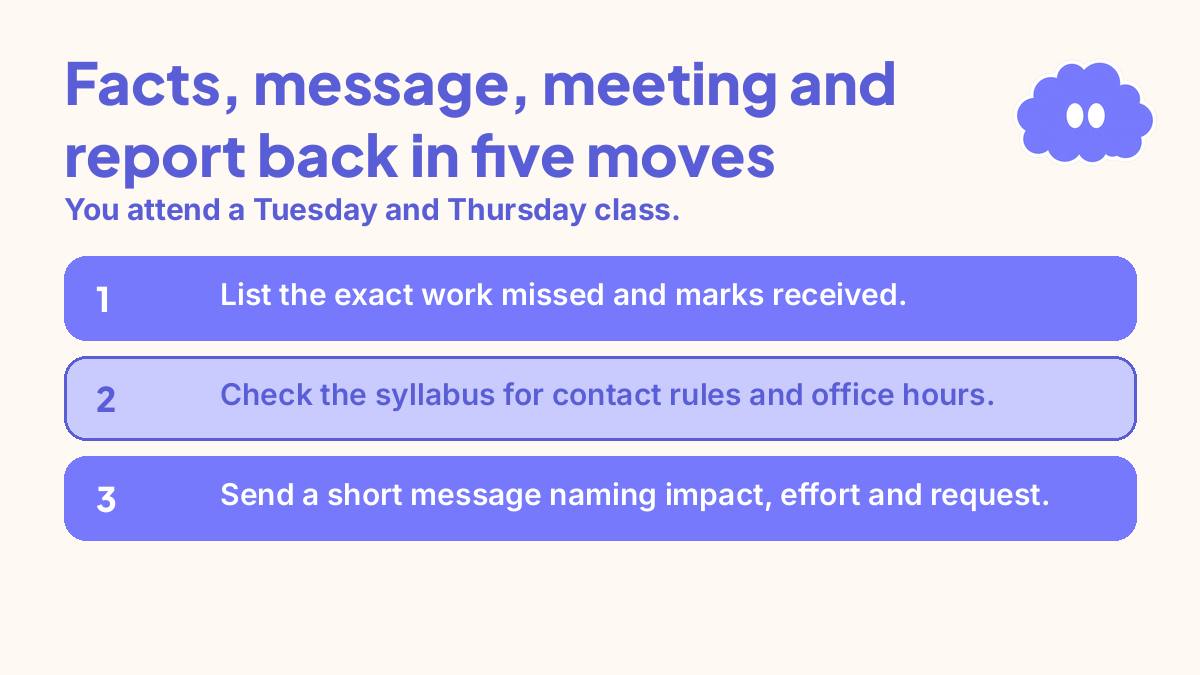
- List the exact work missed and marks received.
- Check the syllabus for contact rules and office hours.
- Send a short message naming impact, effort and request.
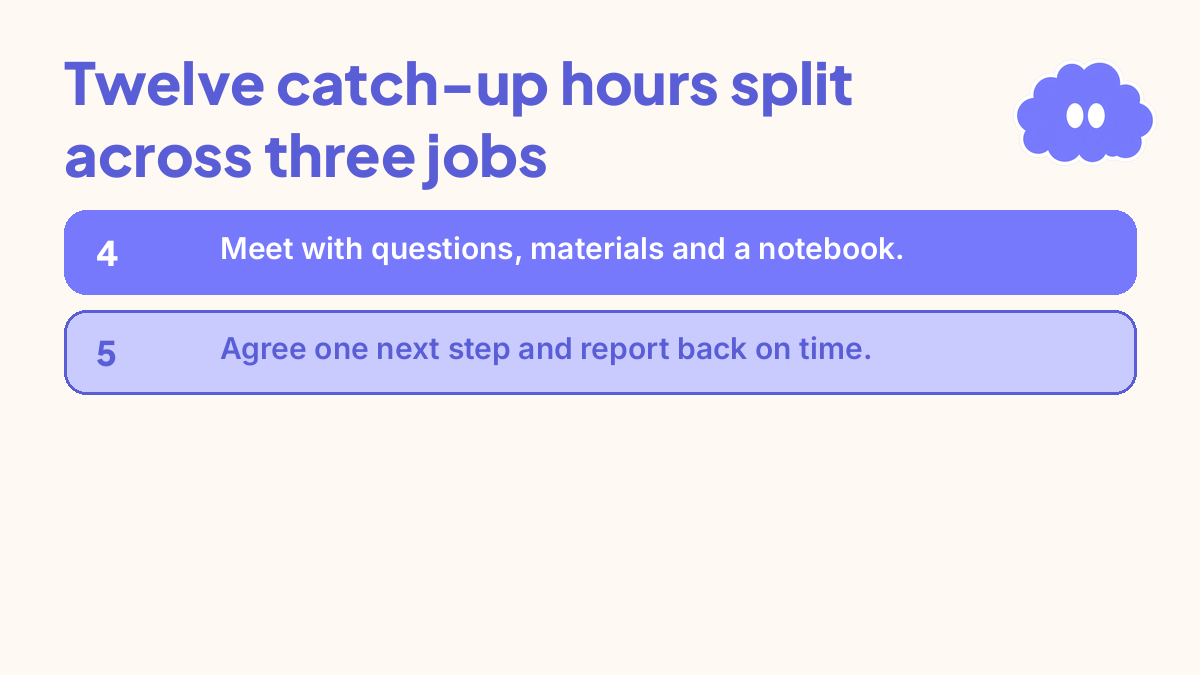
- Meet with questions, materials and a notebook.
- Agree one next step and report back on time.
Step 1: List the exact work missed and marks received
Start with facts on paper, not with a general feeling of failure. Write the class name, the assignments missed or submitted late, the dates involved and any marks that show where understanding broke down. Add the next deadline or exam date. This short list becomes the backbone of your message and your meeting.
Separate three kinds of problem. Some work is missing. Some work was submitted but marked low because a topic was not understood. Some work is coming soon and needs a plan before it joins the missing list. Each kind needs a different request, and your teacher can help faster when the kinds are not mixed together.
Note what you have already tried. That might include rereading notes, attending a help session, asking a classmate or starting an assignment and getting stuck at a named point. Effort you can describe carries more weight than effort you only claim. It also stops the conversation from repeating advice you have already followed.
If the list feels too large to face, rank it by date and by marks at stake. The sorting habit in how to manage multiple assignment deadlines helps you see the nearest pressure first. You do not need a full recovery plan before you ask for help. You need an honest list and one clear question about priorities.
Step 2: Check the syllabus for contact rules and office hours
Read the course syllabus or handbook before you write. Many teachers state a preferred contact method, office hours, late work rules and response times. Using the stated channel shows respect for those rules and puts your message where the teacher expects to find it.
Choose timing with care. Write before a deadline when you know work will be late. Write soon after a low mark when the pattern is still new. For a longer conversation, ask for office hours or a meeting time rather than trying to explain everything in a corridor between classes.
Keep expectations realistic about replies. Teachers teach, mark and meet many students. A reply may take a few working days, and evenings, weekends and holidays are not working time for most staff. Send one clear message and wait. Repeated messages in one day rarely speed help and can bury the original request.
If your school or university offers advising, tutoring or disability support, note those services now as well. Your teacher may refer you there, and formal adjustments usually run through a designated office rather than a classroom conversation. Knowing the route in advance makes the referral quick when it comes.
Step 3: Send a short message naming impact, effort and request
Write a message that answers three questions. What is happening? How is it affecting this class? What kind of help would make a difference? Keep the message short enough to read in one minute. Long messages hide the request, and dramatic messages make the academic problem harder to see.
Use plain sentences you can adapt. I am in your Tuesday class and I have missed the last two problem sets. My quiz mark showed I do not understand the current unit. I have reread the notes and attempted the first set, and I am stuck on the second topic. Could I come to office hours this week to agree what to prioritise before the next exam?
Share impact and time frame without sharing private detail you would rather keep. You can say a health issue, family matter or work disruption affected your study time without describing the full history. Your teacher needs the academic consequences: missed classes, late work and reduced preparation. Documentation belongs in official channels when policy asks for it.
Make one specific request. Ask for a meeting, a priority order, feedback on an approach or guidance on support services. Avoid asking for a guaranteed outcome. Phrases such as what options are available under the course policy respect the rules while still opening a real conversation. If you need an extension, ask before the deadline where possible and name the new date you propose. End with thanks and your full name and class group, so the teacher can place you without searching.
Step 4: Meet with questions, materials and a notebook
Prepare for the meeting as you would for a short lesson. Bring your list from Step 1, the relevant assignment brief or marked work, your notes and a notebook. Bookmark pages you may need to show. Preparation lets you use limited time on decisions rather than searching through a bag.
Write your questions in advance, in priority order. Start with the decision you need most: what should I work on first? Then ask about understanding: where did this answer lose marks? Then ask about process: what should I do before the next assessment? Three ordered questions beat ten scattered ones.
During the meeting, listen for one specific change you can act on. Feedback can sting, especially when you already feel behind. Write it down rather than debating it in the moment. If a comment is unclear, ask for an example. A clear example turns general advice into a task you can finish this week.
Close the meeting by repeating the agreed actions aloud. Confirm what you will do, what your teacher will do and when you will next make contact. Thank your teacher for the time. A short written follow-up after the meeting protects both of you from different memories of the same conversation. Send that follow-up the same day, while the details are fresh for both of you.
Step 5: Agree one next step and report back on time
Leave with one next step, not a complete rescue plan. The step might be completing the highest priority assignment, attending tutoring twice or redoing one topic with practice questions. One finished step rebuilds momentum faster than five promised steps that collapse together.
Put the step into your week at a fixed time. If time is scarce, How to study in one hour a day shows how a single protected hour can hold catch-up work without pretending the whole backlog fits in a day. Plan the session the night before using how to plan a study day the night before, so the first action is already decided when you sit down.
Report back on the date you agreed, even if the news is mixed. A short update shows the help was used well: what you finished, what mark or feedback followed and what remains stuck. Teachers can adjust advice only when they hear what happened next. Silence after help often reads as the problem continuing.
If you slip again, restart small rather than waiting for a perfect week. The reset method in how to get back on track after a bad study day fits here: one block, one topic, one honest update. For exam catch-up specifically, how to revise when you are behind cuts the topic list to what the exam will most likely ask.
A worked example: two missed problem sets, exam in 21 days
Your situation: You attend a Tuesday and Thursday class. You missed two problem sets in weeks 5 and 6, scored low on the week 6 quiz and have an exam in 21 days. You can study for 60 minutes on 4 evenings each week.
On Monday evening you spend 20 minutes listing facts. The list shows 2 missed problem sets, 1 low quiz and 1 exam in 21 days. You note that you reread the unit notes twice and attempted half of the first problem set. Your priority question is which topics to repair first.
On Tuesday you check the syllabus. Office hours run on Wednesday from 14:00 to 15:00, and email is the stated contact method. You send a short message naming the missed sets, the quiz result, the work you attempted and a request to attend office hours. The message takes 10 minutes to write because the facts are already listed.
On Wednesday you meet for 15 minutes with your list, the marked quiz and a notebook. You agree three actions: complete problem set 5 by Friday, attend tutoring once before the exam and practise the two weakest topics first. You confirm the actions aloud and send a short follow-up message the same evening.
Your study time is 60 minutes on 4 evenings each week, which gives 240 minutes per week. Over 3 weeks that is 720 minutes, or 12 hours. You assign 4 hours to the two problem sets, 5 hours to the two weakest topics and 3 hours to timed practice. The parts add to 12 hours. On day 14 you report back with problem set 5 finished and one topic still weak, so the final week focuses there.
When it goes wrong
You wait until final grades are set. Options narrow sharply once marking closes. Ask earlier next time, and ask now anyway about exam focus, support services and priorities for any remaining work.
Your message is vague. A message saying only that you are struggling gives your teacher no decision to make. Rewrite it with the missed work, the mark that concerns you and one specific request.
You share more private detail than you wanted. Return to impact and time frame. You can correct course in a follow-up message by focusing on the academic effects and the help you need.
The meeting produces advice but no action. Ask one closing question: what should I do first this week? Write the answer down, set the report back date and put the first session in your calendar before you leave.
You miss the report back date. Send the update late rather than not at all. State what you finished, what slipped and what you will do next. A late honest update still keeps the conversation open.
Weekly review checklist
Copy this list and use it each week:
- What exact work is still missing or weak this week?
- Did I contact my teacher through the stated channel?
- What one next step did we agree, and is it finished?
- Did I report back on the date I promised?
- Which topic still needs help, tutoring or practice?
- What one change will I make next week: earlier contact, clearer questions or a fixed study hour?
Downloadable infographic spec: one vertical 1000x1500 image in Thynq colours with the cloud mascot, title “How to ask your teacher for help when you are behind”, with the five steps “List the exact work missed and marks received”, “Check the syllabus for contact rules and office hours”, “Send a short message naming impact, effort and request”, “Meet with questions, materials and a notebook” and “Agree one next step and report back on time”, plus the six weekly review questions above. Text word-for-word from this article.
What this system is not
It is not a guarantee of an extension, a changed grade or special treatment. Teachers work within course policies, marking deadlines and fairness to other students. A clear request can open options that exist. It cannot create options that policy forbids.
It is also not a substitute for wider support when difficulties span several classes or affect health, housing, money or safety. Advising, counselling, disability services and financial support exist for those situations, and your teacher can point you toward them. The study system behind the catch-up work sits in how to build a study system that fits your life, which helps you protect the weekly hour after the conversation ends.
Sources
- Research.com. How to Talk to a Professor When You Are Struggling. Research.com Student Guides, verified 2026. Supports early contact, naming academic impact without private detail, specific requests and using campus support services.
- Kuther, T. (2019). How to Get Help from Your Professor. ThoughtCo, updated 3 July 2019. Supports checking syllabus contact rules and office hours, preparing questions and materials, taking notes and thanking the teacher.
Questions
What should I say if I do not know where to start?
Say that plainly and ask for help with priorities. Name the class, state that you are behind and ask which work matters most first. A teacher can triage with you once the problem is visible.
How much personal detail should I share?
Share the academic impact and the time frame, not private details you would rather keep to yourself. Your teacher needs to know which work was affected and what help would make a difference.
Is it too late to ask near the end of term?
Ask anyway, and expect fewer options. Late contact can limit extensions and make-up work, but a teacher may still clarify priorities, exam focus and support services. Early contact keeps more options open.
What if my teacher cannot change a deadline?
Accept the policy answer and ask what remains possible. Priorities for the next assessment, tutoring, advising or disability support may still help. Agree one next step and report back on the date you set.