The direct answer
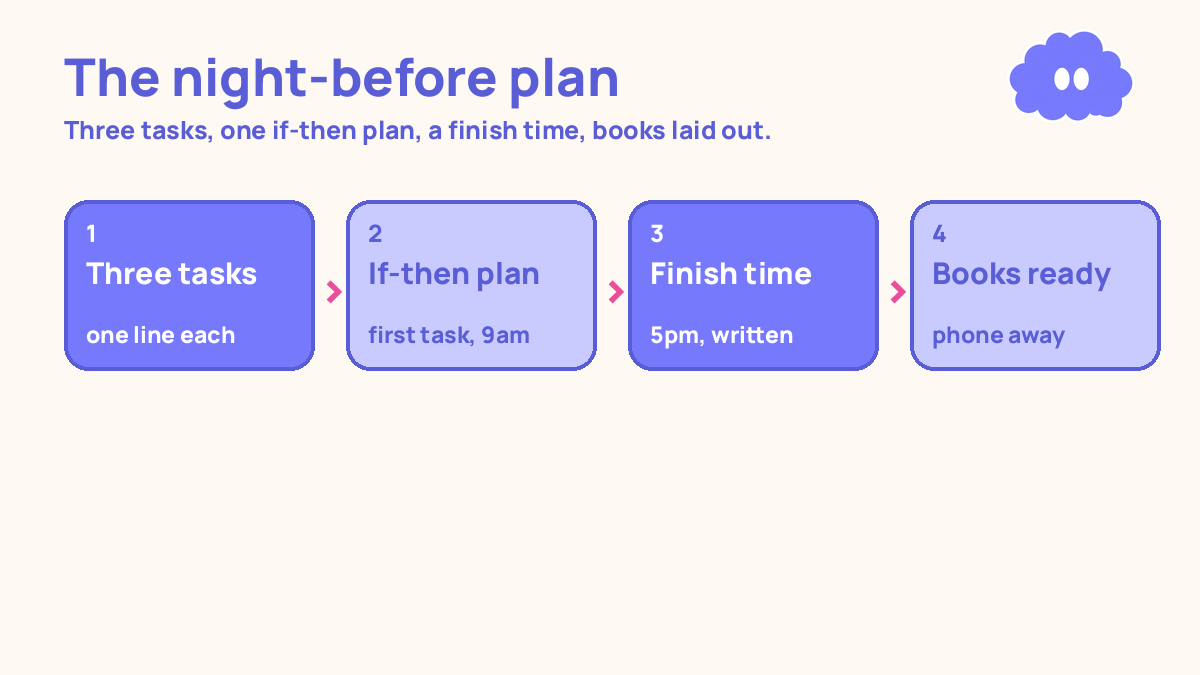
Here is how to plan a study day the night before: take 10 minutes after dinner, pick three finished tasks, write the first one as an if-then plan, set a finish time, and lay out the books you need. That is the whole system. The plan is not about controlling tomorrow. It is about removing tomorrow’s first decision, so you start instead of negotiating with yourself.
You need a piece of paper, ten minutes, and three tasks written down before you go to bed.
The morning that never starts
You wake up, check your phone, and tell yourself you will start studying after breakfast. After breakfast you check your phone again. By 11am you have not started, and now you feel guilty, so you avoid the desk even more. By 2pm the day feels wasted.
The problem is not laziness. The problem is that the morning has no first step. “Study today” is not a first step. It is a wish, and a wish is easy to put off. A plan written the night before gives the morning a first step that is already decided: “If I sit down at 9am, then I will answer the first cell-division question.” You do not decide in the morning. You start.
An if-then plan is more than a to-do list. In a meta-analysis of 94 studies, Gollwitzer and Sheeran (2006) found that deciding the cue and the action in advance raised goal attainment by a medium-to-large amount (d = 0.65) over holding the goal alone. Writing it the night before is the rehearsal.
The system in short
- After dinner, sit at your desk for 10 minutes. Same time, same place, every night.
- Pick three finished tasks for tomorrow. One line each. Something you can check off.
- Write the first task as an if-then plan: “If I sit down at 9am, then I will…”
- Pick a finish time for tomorrow. Write it next to the tasks.
- Lay out what you need: the book, the notes, the pen, the phone in another room.
- In the morning, do the first task first. No phone, no deciding, no negotiating.
How to plan a study day the night before: the 10-minute routine
The routine is 10 minutes, after dinner, at your desk, where tomorrow’s work will happen. The same time and the same place matter.
Ten minutes is a limit, not a target. If the plan takes longer, the tasks are too big or too vague. Split them until each one fits on a single line. A plan that takes 30 minutes to write is a plan you will stop writing.
Keep the plan on paper, not in an app. Paper is on the desk when you wake up. An app is inside the phone, and the phone is where the morning disappears.
Step 1: Pick three finished tasks
A finished task is something you can check off. “Answer the 10 questions on cell division from memory.” “Work through the five mole-calculation problems on page 42.” “Write one essay paragraph and read it aloud.” Each one has a clear end, and you know when you reach it.
“Study biology” is not a finished task. “Revise chemistry” is not a finished task. “Read chapter 7” is not one either, unless you add the check: read it, close it, and write down the three main points from memory. The check is what turns reading into work.
Pick three, not six. Three is a number you can finish in a day. Six guarantees you end the day behind, and ending the day behind is what makes you stop planning. If you finish all three by 3pm, add a fourth, or stop early.
Order the three tasks by difficulty: hardest first. The hardest task gets your freshest hour, and finishing it first makes the rest of the day feel easy.
Step 2: Write the first task as an if-then plan
Take the first task and write it as an if-then plan: “If I sit down at 9am, then I will answer the first cell-division question.” Name the cue — sitting down at 9am — and the action — the first question. Not the whole task. The first small piece.
This is the step that makes the morning start. A to-do list says what to do. An if-then plan says when to do it and what the first move is. When 9am arrives, you do not have to decide anything. The decision was made last night.
Write the plan where you will see it in the morning: on the paper, on top of the book, on the desk.
If your mornings are unpredictable, write the cue around the fixed point: “If I get home at 4pm, then I will answer the first question before I open my phone.”
Step 3: Pick a finish time and lay out the books
Pick the time you will stop tomorrow, and write it next to the three tasks. For most students, 5pm or 6pm works. The finish time makes the day finite, so the hours before it matter. Without it, the day spreads to fill every hour and still feels unfinished at midnight.
Then lay out what you need: the book open to the right page, the notes on top, a pen, a glass of water. Put the phone on charge in another room. The morning version of you is tired and will take the easiest path. Make the easiest path the right one.
This step takes two minutes and saves twenty in the morning. A morning spent looking for the book and deciding what to do first is a morning that never starts.
Step 4: In the morning, do the first task first
When you sit down, do the first task first. No phone, no email, no “just checking one thing”. Open the book, read the if-then plan, and do the first small piece. Two minutes is enough to start.
If the first task feels too big in the morning, shrink it. “Answer the 10 questions” becomes “answer the first question”. One question is a start, and a start is all the morning needs.
Do not check the phone until the first block is done. One check becomes twenty minutes, and twenty minutes becomes a morning that never started. The phone focus system for distracted students covers the phone part: phone in another room, timer on, one task at a time.
A worked example: a Tuesday planned on Monday night
You have classes in the morning and the afternoon free. Your three tasks for Tuesday: answer the 10 cell-division questions from memory, work through the five mole problems, and write one essay paragraph.
Monday, 8:30pm — Plan (10 minutes): At your desk, write the three tasks on paper. Write the first one as an if-then plan: “If I sit down at 1pm, then I will answer the first cell-division question.” Finish time: 5pm. Lay out the biology book open to the questions page, the chemistry notes, and a pen. Phone on charge in the kitchen. Tuesday, 1:00pm — Start: Sit down. Read the plan. Answer the first question. Keep going. 1:00–1:50pm — Block 1: Answer all 10 questions from memory, then check. Two wrong. Write the two correct answers out by hand. 1:50–2:00pm — Break: Stand up, water, window. 2:00–2:50pm — Block 2: Work through the five mole problems. Three right, two wrong. Redo the two wrong ones slowly. 2:50–3:00pm — Break: Walk to the kitchen and back. 3:00–3:50pm — Block 3: Write one essay paragraph. Read it aloud. Fix the sentence that does not make sense when you hear it. 3:50–4:00pm — Break: Ten minutes, away from the desk. 4:00–4:50pm — Block 4: Review yesterday’s topics from memory — ten minutes per topic, two topics. 4:50–5:00pm — Close: Check off all three tasks. Write tomorrow’s plan. Stop at 5pm.
| Unplanned Tuesday | Planned Tuesday | |
|---|---|---|
| Morning | No plan, phone first | Plan written Monday night |
| 1:00pm | Deciding what to do | First question answered |
| 3:00pm | Half a chapter, guilty | Two blocks finished |
| 5:00pm | Still going, tired | Done, three tasks checked |
| Evening | More tired studying | Free, plan for tomorrow written |
What changes after a week of planning
The first three nights, the plan feels like extra work. Ten minutes at your desk when you would rather be on the sofa. By the fifth night, it feels like closing the day. The morning changes first: you sit down and you know the first task, because yesterday-you wrote it down.
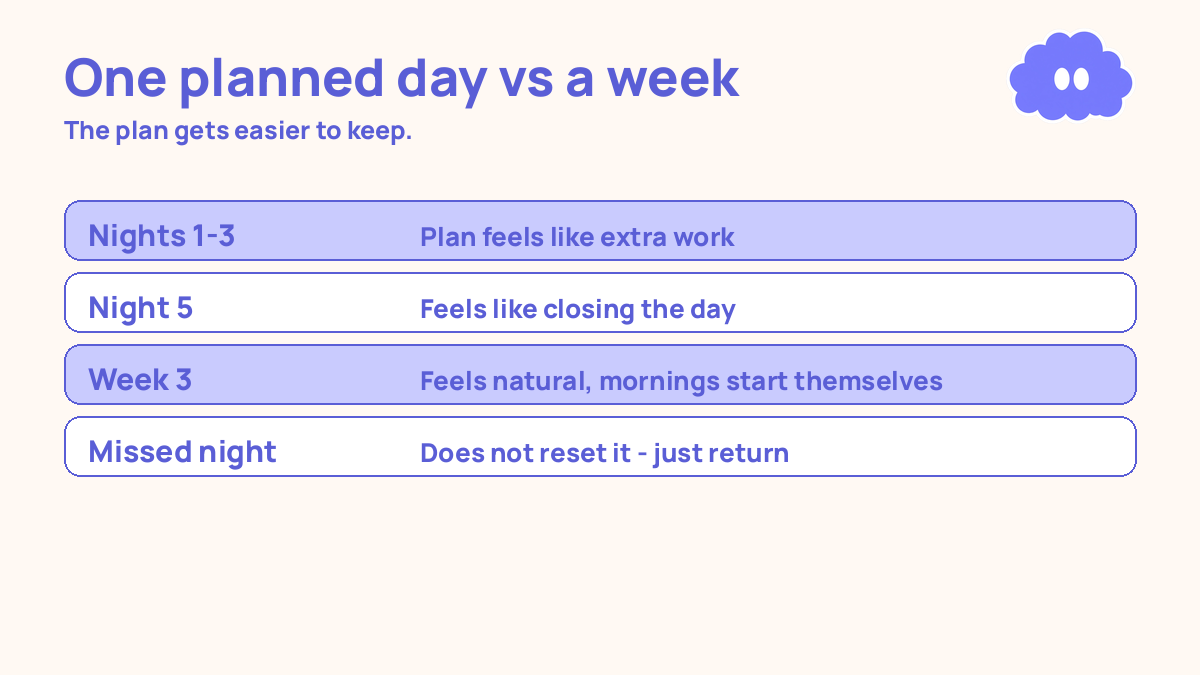
Routines take longer than people think to feel automatic. In a study of 96 people building one new daily behaviour, Lally and colleagues (2010) found the median time was 66 days, with a range of 18 to 254 days, and missing a single day did not measurably hurt. Do not expect the plan to feel natural after three nights.
If you want the plan to cover the whole week, not just one day, the weekly study planner for students shows how to spread the work across seven days. And if your mornings are the hard part, the morning study routine for students builds the first hour of the day around the plan.
When it goes wrong
You write the plan and then ignore it in the morning. The plan was probably too vague, or the first task was too big. Tomorrow night, make the first task smaller: one question, one problem, one sentence. A plan you can start is a plan you will follow.
The plan falls apart by 10am. That is normal. A plan is a starting point, not a promise. Cross out what changed, write the new first task, and keep going. The plan did its job: it got you started.
You forget to plan three nights in a row. Tie the plan to something you already do every night. After brushing your teeth, sit at your desk for ten minutes and write the plan. A new habit needs an old cue to hang on to.
You plan six tasks every night and finish two. The list is too big. Cut it to three, and put the hardest first. Three finished tasks beats six half-finished ones.
Weekly review checklist
Copy this list and use it each week:
- How many nights this week did I write tomorrow’s plan?
- How many mornings did I start with the first task on the plan?
- Which plans worked — and which ones fell apart by 10am, and why?
- What one change will I make next week: smaller first tasks, an earlier plan time, or fewer tasks?
Downloadable infographic spec: one vertical image, title “The 10-minute night-before plan”, with the six steps — sit at your desk after dinner, pick three finished tasks, write the first as an if-then plan, pick a finish time, lay out the books, do the first task first — in Thynq cream, Cloud Purple, Dark Purple and pink, with the cloud mascot. Text taken word-for-word from this article.
What this system is not
It is not a promise that planning will make every day go as written, and it is not a claim that an if-then plan guarantees you will reach your goal — Gollwitzer and Sheeran (2006) found a medium-to-large average effect, not a guarantee. It is a practical 10-minute routine: three tasks, one if-then plan, a finish time, and the books laid out. If a day goes wrong, the plan does not fail. You cross out what changed and keep going.
Sources
- Gollwitzer, P. M. & Sheeran, P. (2006). Implementation intentions and goal achievement: a meta-analysis of effects and processes. Advances in Experimental Social Psychology, 38, 69-119. If-then plans raised goal attainment by a medium-to-large amount (d = 0.65) across 94 studies.
- Lally, P., et al. (2010). How are habits formed: modelling habit formation in the real world. European Journal of Social Psychology, 40(6), 998-1009. Median time for a new daily behaviour to feel automatic was 66 days, range 18-254; one missed day did not measurably hurt.
For the week around the day, read the weekly study planner for students, and for the morning itself, the morning study routine for students.
Questions
How long does the night-before plan take?
Ten minutes. Three tasks, a finish time, the first task written as an if-then plan, and your books laid out. If it takes longer than ten minutes, the tasks are too big.
What if my plan falls apart by 10am?
That is normal. A plan is a starting point, not a promise. Cross out what changed, write the new first task, and keep going. The plan did its job: it got you started.
Should I plan the whole week the night before?
No. Plan one day, the night before. The week gets a lighter plan on Sunday: which topics on which days. The daily plan is where the detail lives.
I keep forgetting to plan. How do I remember?
Tie it to something you already do every night: after brushing your teeth, sit at your desk for ten minutes and write the plan. Same time, same place, same pen. After a few weeks it becomes the thing you do before bed.