
The direct answer
How to write up a thesis when your results are inconclusive? Report the effect size with its confidence interval, ask what the interval excludes, and say whether the question remains open or the effect is probably too small to matter. A non-significant result means your data provide little evidence against the null. It does not mean the null is true.
The first instinct is usually the wrong one. Students hide the null result in vague language, run a new analysis until something turns significant, or rewrite the hypothesis to match what the data show. Examiners catch all three. The system below gives you a defensible write-up in six steps.
The system in short
- Report the result as it is: the effect size, the confidence interval, and the p-value, with no spin.
- Ask what the interval excludes, and decide whether your null is informative or the question remains open.
- Check the analysis itself before you blame the phenomenon: test choice, assumptions, and coding.
- Work through the plausible explanations with evidence, and drop the ones your design cannot support.
- Write the discussion in order: restate, interpret, compare, limit, and point to the next study.
- Write the conclusion and the limitations honestly, and prepare the three defence questions the null will attract.
Step 1: Report the result as it is, with the effect and the interval
Write the result in one plain paragraph before you interpret anything: the hypothesis you tested, the test you used, the effect size, the confidence interval, and the p-value. For example: “The intervention group scored 2.1 points higher than the control group on the recall test (d = 0.12, 95% CI -0.08 to 0.32, p = 0.18). The difference was not statistically significant.” Do not add “the intervention showed a promising trend” or “the result approached significance”. A p-value of 0.18 does not approach anything.
Report every pre-specified outcome, regardless of direction. If you measured three outcomes and one is significant and two are not, report all three, in the same format, in the same place. Reporting only the significant one is selective reporting. How to write a thesis results chapter covers the reporting format in full: numbers first, interpretation later. Use the phrase “not statistically significant” and nothing stronger. Your data can only support “we did not detect an effect”, and that is what you write.
Step 2: Ask what the interval excludes, and name your null
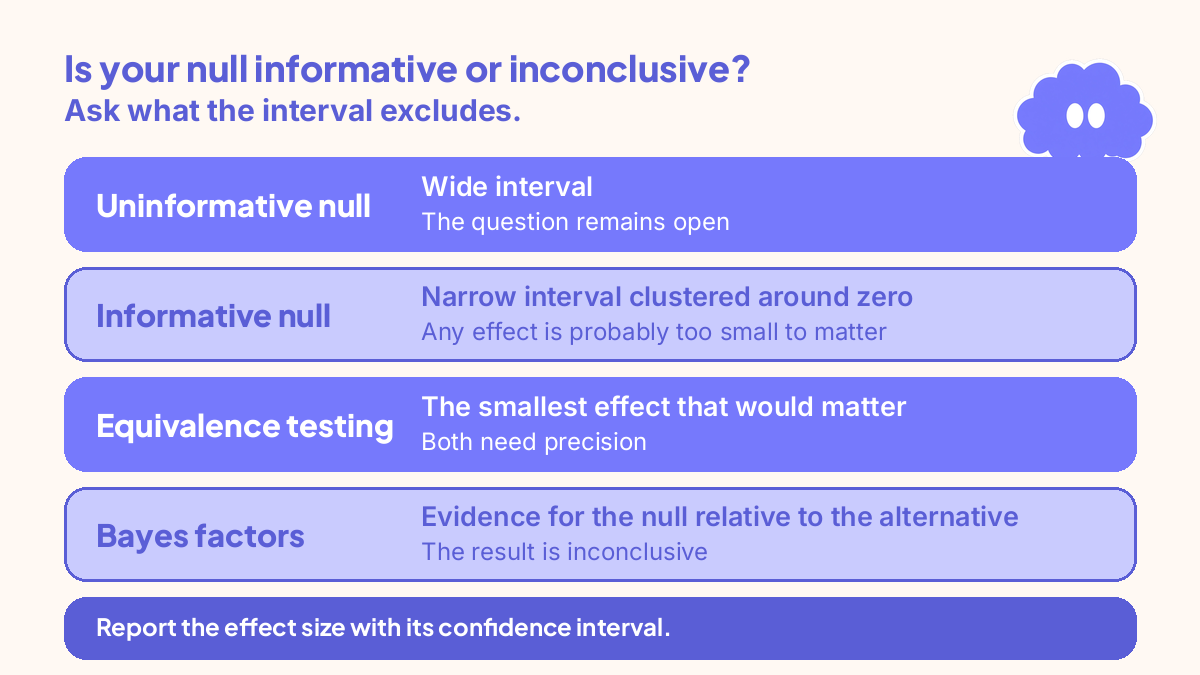
Before you write a word of discussion, establish which kind of null you have. Report your effect size with its confidence interval, then ask one question: does the interval exclude the effects you would consider meaningful? A wide interval means your study was not precise enough to distinguish trivial effects from substantial ones. That is an uninformative null: the question remains open. A narrow interval clustered around zero, which excludes effects of practical importance, is an informative null, and you can say, with evidence, that any effect is probably too small to matter.
If you want to claim positively that an effect is negligible, you need a different tool. Equivalence testing lets you specify in advance the smallest effect that would matter, then test whether your observed effect is significantly smaller than that bound. Bayes factors quantify evidence for the null relative to the alternative. Both need precision. With a small sample, you may be unable to reject either the null or the equivalence bound, in which case the correct conclusion is that the result is inconclusive.
Step 3: Check the analysis before you blame the phenomenon
Before you attribute the null to the phenomenon, check that the analysis itself was sound. Confirm you chose an appropriate test and that its assumptions hold. Check the coding: a reversed scale, a mislabelled group, or a filter that dropped half the sample will produce a null result that has nothing to do with your research question. Re-run the analysis from the raw data.
Do not compute observed power to explain the result. Observed power is a direct mathematical function of the p-value, so a non-significant result always produces low observed power. Reporting it restates the p-value in different units and adds nothing. If your concern is whether the study could have detected a meaningful effect, use a sensitivity analysis, which reports the minimum effect your design could detect. Check the measures too: unreliable measures shrink observed effects toward zero, so modest reliability is a substantive explanation, not an excuse. How to write a thesis methodology is the place to document what you checked.
Step 4: Work through the explanations with evidence
Work through the plausible reasons your study did not detect an effect, with evidence rather than speculation. Consider each of the following against your own design, and discuss the ones that apply. First, a true null. The effect may not exist, or may be too small to matter. Second, insufficient precision. Your sample may have been too small to detect the effect that exists. Support this with your sensitivity analysis and interval width, never with observed power. Third, measurement unreliability. A noisy instrument shrinks what you can detect, so report the reliability coefficients and say what they imply.
Fourth, restriction of range. If your sample varied little, there was less covariation to detect. Fifth, ceiling and floor effects. If most participants scored near the top or bottom of your measure, real differences had nowhere to appear. Sixth, implementation fidelity. If the intervention was not delivered as intended, a null result tells you about implementation rather than efficacy. Seventh, insufficient follow-up. Eighth, heterogeneous effects. An average null can conceal offsetting effects in subgroups, though any subgroup analysis must be labelled exploratory unless pre-specified. For each explanation you raise, name the evidence that supports it. An explanation with no evidence is speculation.
Step 5: Write the discussion in order
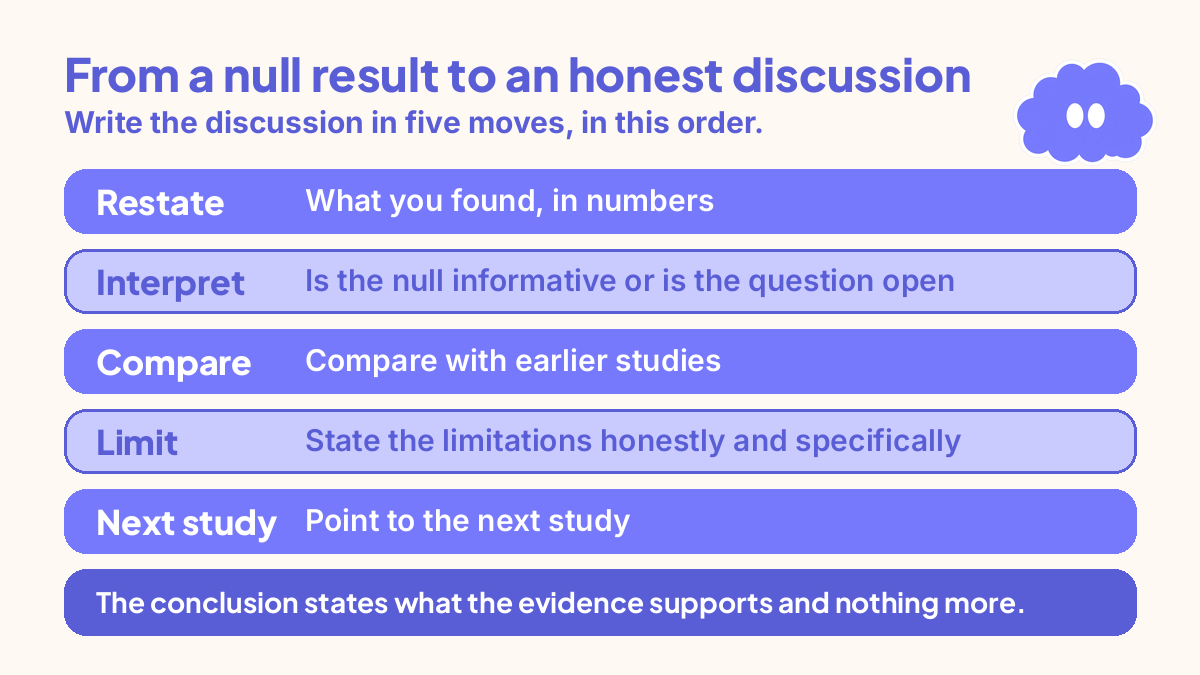
Write the discussion in five moves, in this order. First, restate the result in one paragraph: what you found, in numbers, with no interpretation. Second, interpret it: is the null informative or is the question open, and what does the interval allow you to say? Third, compare with earlier studies. Where your result agrees with previous work, say so and say why. Where it disagrees, work through whether the difference is the sample, the measure, the dose, or the design.
Fourth, state the limitations honestly and specifically. Name the three that matter most, with numbers where you can: the achieved sample size, the reliability of the key measure, and the follow-up period. Fifth, point to the next study: the sample size it would need, the measure it would use, and the follow-up it would run. How to write a thesis discussion chapter gives the full structure for this chapter.
Step 6: Write the conclusion, and prepare for the defence
Write the conclusion to match the discussion. If the question remains open, say so: “This study did not detect an effect of the intervention on recall, and the wide confidence interval means the question remains open.” If the null is informative, say that: “The narrow interval around zero suggests any effect is too small to matter in practice.” How to write a thesis conclusion covers the wording: the conclusion states what the evidence supports and nothing more.
Prepare for the three questions the null will attract in the defence. First, “Why do you think you found nothing?” Answer in two sentences, with your best explanation and its evidence. Second, “Was your study simply underpowered?” Answer with the sensitivity analysis and the interval width, never with observed power. Third, “Would you run the study again, and what would you change?” Answer with the specific next study from Step 5. If you get stuck while drafting, How to get unstuck on a thesis has the routine for breaking a writing block without lowering the standard.
A worked example: a Tuesday in May, a p-value of 0.18
Your situation: You are a master’s student in education, testing whether a four-week spaced-practice programme improves recall of science facts in 14-year-olds. You have 62 students, 31 in each group, and the result is p = 0.18.
Monday, you write the result paragraph. “The programme group scored 2.1 points higher than the control group on the 40-point recall test (d = 0.12, 95% CI -0.08 to 0.32, p = 0.18). The difference was not statistically significant.”
Tuesday, you ask what the interval excludes. It runs from -0.08 to 0.32, so it includes effects you would care about, a gain of 5 points or more, and effects you would not. Your null is uninformative, and the question remains open. An equivalence test is not possible: with 62 students, the interval is too wide.
Wednesday, you check the analysis. You re-run it from the raw data: the coding is correct, the test is appropriate, and the assumptions hold. The recall test has an alpha of 0.68, modest, and 11 of the 62 students scored above 36 out of 40, near the ceiling.
Thursday, you work through the explanations. Precision is the main one: with 62 students, the study could only reliably detect a large effect. Measurement is second: an alpha of 0.68 and a ceiling effect both shrink what you could detect. Fidelity is third: the teacher delivered three of four sessions, and the fourth was cut short by a school trip.
Friday, you write the discussion in order and name the next study: 200 students, a more reliable test with a higher ceiling, four full sessions, and a six-week follow-up. The conclusion says the question remains open. In the defence, you answer in two sentences.
When it goes wrong
Your supervisor wants you to drop the null chapter. Say plainly that a thesis without the main result is a thesis with a hole in it. Offer the honest version first.
You are tempted to run one more analysis until something is significant. Stop. Looking through the data for something that reached significance, then presenting it as though it had been the hypothesis all along, has a name: HARKing, hypothesising after the results are known. It turns chance findings into theory.
Your sample is too small for an equivalence test or a Bayes factor. Then do not run one. A test your data cannot support is worse than no test, because it looks like rigour and delivers nothing. Say the result is inconclusive, and name the sample size the next study would need.
A reviewer or examiner says the study was underpowered. Agree, if it was, and show the sensitivity analysis. “Yes, with 62 students we could reliably detect only a large effect. The interval shows that, and the next study would need about 200 students.” An examiner who hears that knows you understand the design.
You find a significant subgroup by fishing through the data. Label it exploratory, report it in one paragraph, and do not build the discussion around it. An unplanned subgroup finding is a lead for the next study, not a result of this one.
Weekly review checklist
Review your write-up once a week while you draft the results and discussion chapters. Ask yourself these six questions, and write the answers in one page.
- Have I reported every pre-specified outcome, with the effect size, the interval, and the p-value?
- Have I said whether the null is informative or the question remains open, and shown the interval that supports it?
- Have I checked the analysis from the raw data, and reported the sensitivity analysis instead of observed power?
- Have I worked through the plausible explanations with evidence, and dropped the ones my design cannot support?
- Does the discussion follow the order, restate, interpret, compare, limit, and point to the next study?
- Does the conclusion claim only what the evidence supports, and have I rehearsed the three defence questions?
Downloadable infographic spec: one vertical image, title “Write up a thesis when your results are inconclusive”, with the six steps and the six weekly review questions, in Thynq cream, Cloud Purple, Dark Purple and pink, with the cloud mascot. Text taken word-for-word from this article.
What this system is not
This system is not a way to make a disappointing study look successful. Everything here is about interpreting and reporting a null result accurately. None of it is about making the data say something they do not say. The honest version is also the more defensible one, and examiners can tell the difference.
It is not a statistics textbook. Equivalence testing, Bayes factors, and sensitivity analysis are described here so you know what to ask for and what to write. If you need to run one, work with your supervisor or a statistics adviser. A test you do not understand is a test you cannot defend.
It is not a reason to stop collecting good data. A null result from a well-designed study is a finding. A null result from a sloppy study is a waste of a year. If the design was not sound, say so in the limitations, and say what you would change.
Sources
- ScribeLab. My Results Were Not Significant. Is My Dissertation Ruined? 2026. Supports the informative and uninformative null distinction, the warning against post hoc power and HARKing, and the explanations for a null result.
- Altman, D. G., and Bland, J. M. (1995). Absence of evidence is not evidence of absence. British Medical Journal, 311, 485. Cited in the ScribeLab guide above; supports the framing that a non-significant result does not show the null is true.
- Wasserstein, R. L., and Lazar, N. A. (2016). The ASA statement on p-values: context, process, and purpose. The American Statistician, 70(2), 129-133. Cited in the ScribeLab guide above; supports the warning that conclusions should not rest only on whether a p-value passes a threshold.
Questions
What does it mean if my thesis results are not significant?
It means your data provide little evidence against the null hypothesis. It does not mean the null is true, and it does not mean your intervention had no effect. Report the effect size with its confidence interval, then ask what the interval excludes: if it still includes effects you would care about, the result is inconclusive.
Can I still pass with inconclusive results?
Yes. A thesis is assessed on the quality of the question, the soundness of the design, and the rigour of the reasoning, not on whether the result crossed a threshold. Null findings are published, defended, and awarded every year. What sinks a candidate is mishandling the null: claiming no effect, reaching for post hoc power, or rewriting the hypothesis.
Should I run more participants to get a significant result?
Not to chase a p-value. Collecting more data after seeing a non-significant result, then testing again, inflates the chance of a false positive unless the plan was set in advance. A pre-planned second wave is legitimate. Adding participants until the result turns significant is not.
What should I write in the discussion when my hypothesis was not supported?
State the result plainly, report the effect size and interval, say whether the null is informative or the question remains open, work through the plausible explanations with evidence, compare with earlier studies, and end with honest limitations and a specific next study. Never write that the intervention had no effect.