The direct answer
How to write a personal statement for university is a drafting system, not a writing talent. Build an evidence bank first, answer the three UCAS questions separately, reflect on every claim instead of listing it, draft in order, then cut to the character limit. The statement that wins offers is the one with specific evidence and honest reflection.
The system in short
- Build an evidence bank before you write a word: five subject moments, five study skills, and five outside experiences, each with one sentence of reflection.
- Map the evidence to the three questions: each piece of evidence goes to one question only, so nothing repeats.
- Write the reflection, not the list: every claim ends with a so what sentence that says what you learned or how it changed you.
- Draft in order: question one, then question two, then question three, in plain sentences, without worrying about the character limit yet.
- Cut to the limit with the cutting routine: remove adjectives, remove repeated ideas, remove any sentence that could belong to any applicant.
- Get one careful reader and run a final check: spelling, character count, and a voice check that asks whether it sounds like you.
Step 1: Build an evidence bank before you write a word
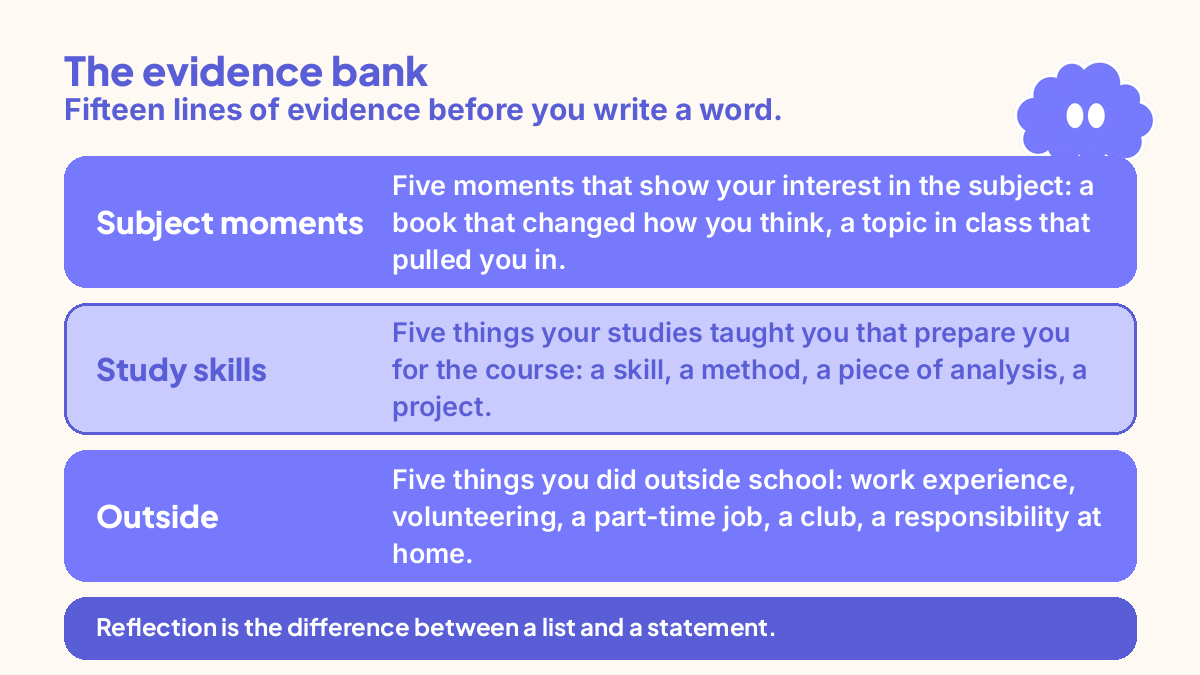
Most personal statements fail before the first sentence, because the writer starts with a blank page and tries to sound impressive. Start with evidence instead. The evidence bank is a list, not prose, and it takes 45 minutes.
Make three columns. In the first, list five moments that show your interest in the subject: a book that changed how you think, a topic in class that pulled you in, a question you could not stop thinking about, a documentary, a talk, a project. Write each one in a single line, with the specific detail that makes it yours: the title, the chapter, the experiment, the argument.
In the second column, list five things your studies taught you that prepare you for the course: a skill, a method, a piece of analysis, a project, a result you are proud of. Again, one line each, with the specific detail: the method you used, the problem you solved, the mark you earned and why it mattered.
In the third column, list five things you did outside school: work experience, volunteering, a part-time job, a club, a responsibility at home, a hobby that connects to the subject. One line each, with the specific detail: what you did, for how long, and what it involved.
Step 2: Map the evidence to the three questions
Admissions staff read the three answers together, so repeating yourself wastes characters you cannot afford. Map every piece of evidence to one question only.
Question one, why this course, takes your subject moments: the book, the topic, the question that pulled you in. Question two, how your studies prepared you, takes your study skills and your school work. Question three, what else you have done, takes your outside experiences. If a piece of evidence fits two questions, choose the one where it is strongest and use it there only.
Check the balance before you draft. Question one should carry the most weight, because it answers why you want the course at all. Question two should show preparation, not repeat your grades: the tutor already has your grades. Question three should be the smallest part, and every item in it must connect back to the course. A part-time job that taught you to manage time is relevant. A hobby with no link to the course is not, unless you can say what it taught you that the course needs.
Step 3: Write the reflection, not the list
The most common fault in personal statements is the list: “I did work experience at a hospital. I volunteered at a food bank. I was captain of the netball team.” Each sentence is true, and none of them tells the tutor anything about you. The tutor learns nothing from what you did. They learn from what you noticed and what changed.
Every claim in your statement needs a so what sentence. The pattern is simple: what happened, what you noticed, what it taught you. “I spent two weeks in a hospital pharmacy” is a list. “I spent two weeks in a hospital pharmacy, and I noticed that the pharmacists spent more time checking each other than checking the drugs, which taught me that safety in medicine is a system, not a single person’s care” is a statement. The second version is longer, but it is the only one worth the characters. The system for writing a coursework essay uses the same test: specific evidence beats general claims, every time.
Step 4: Draft in order, in plain sentences
Now draft, one question at a time, in order. Do not try to write a beautiful opening. Write plain sentences that say what you mean. The opening line should name the subject and the reason you want it, in your own words, in one sentence. If the first draft of the opening is dull, leave it dull and fix it later. A dull opening you can fix beats a clever opening you never write.
Draft each answer separately, without worrying about the character limit. Write more than you need: about 20 percent more than the budget for that question. It is easier to cut good material than to stretch thin material, and the cutting step is where the statement gets sharp.
Write in your own voice. Short sentences are fine. Simple words are fine. The tutor is reading for evidence and reflection, not for vocabulary. If you would not say a sentence out loud, do not write it. Read each draft aloud as you go: if you stumble, the sentence is too long or too complicated. Rewrite it shorter.
Step 5: Cut to the limit with the cutting routine
The cutting routine runs in three passes, and it takes about an hour for the whole statement.
First pass: cut repeated ideas. Read all three answers together. Any idea that appears twice gets cut from the weaker answer. Any sentence that repeats the question gets cut. If question two says “my studies prepared me by teaching me to analyse data” and question one already says you love analysing data, one of them goes.
Second pass: cut adjectives and filler. Remove “very”, “really”, “extremely”, and “passionate” wherever they appear. Remove phrases like “I believe that” and “in my opinion”. Remove any sentence that starts with “Ever since I was young”. Each cut saves characters and makes the statement stronger, because the evidence is doing the work instead of the adjectives.
Third pass: count characters and cut to the budget. Use a character counter, not a word counter: the limit is 4,000 characters including spaces. If you are over, cut whole sentences, not words. A sentence that is half cut is worse than a sentence that is gone. If you are under, add reflection, not claims: one more so what sentence is worth more than one more achievement.
The essay word counter tool can check the length, and the essay outline planner tool can hold the structure while you draft. Keep cutting until the total is under 4,000 and every answer is over 350 characters. Then stop. A statement that is 3,800 characters and sharp beats one that is exactly 4,000 and padded.
Step 6: Get one careful reader and run a final check
Ask one person to read the statement: a teacher, a tutor, or someone who knows the subject. One reader is enough. Five readers will pull the statement in five directions and it will sound like nobody.
Ask the reader three questions only: does it sound like me, is there any sentence you do not believe, and is there any part where you lose interest. Those three answers tell you everything. Do not ask them to rewrite it. Do not accept edits that change your voice. If a sentence sounds like your teacher wrote it, it will read like your teacher wrote it.
Submit it, and move on. The statement is one part of the application, not the whole of it. A good statement, sent on time, beats a perfect statement that is still being rewritten the night before the deadline. The system for planning your final year at university puts the application in its place among the other deadlines of the year, so the statement gets its week and then gets sent.
A worked example: ten days to a finished statement for psychology
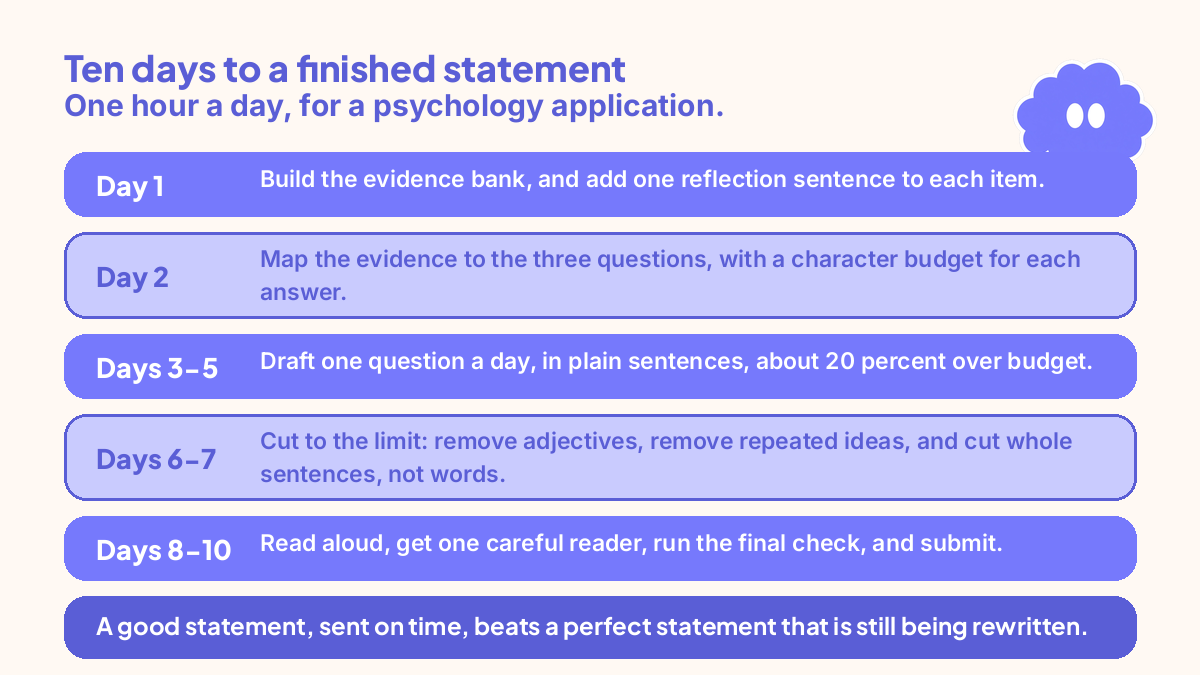
Your situation: Year 13 student applying for psychology through UCAS. No work experience in psychology, but a part-time job in a care home, an EPQ on memory, and a school psychology society. Ten days before the deadline, one hour a day.
- Day 1, 4:00-4:45pm: build the evidence bank. Subject moments: the memory chapter in class, a book on eyewitness testimony, a podcast on false memories. Study skills: the EPQ on memory, a statistics project, an essay on attachment. Outside: care home job, psychology society, volunteering at a youth club. Add one reflection sentence to each.
- Day 2, 4:00-4:45pm: map the evidence to the three questions. Question one: memory chapter, eyewitness book, false memory podcast. Question two: EPQ, statistics project, attachment essay. Question three: care home job, society, youth club. Budget: 1,600, 1,400, 1,000 characters.
- Day 3 to 5, 4:00-5:00pm: draft one question a day, in plain sentences, about 20 percent over budget. Question one opens with the memory chapter and the question it left: why do two people remember the same event differently.
- Day 7, 4:00-5:00pm: second and third cutting passes. Remove adjectives, remove “I have always been passionate”, count characters: 4,350. Cut two whole sentences from question two and one from question three. Total: 3,920.
- Day 8, 4:00-4:30pm: read aloud, fix three sentences that stumble, check the spelling of every psychology term.
- Day 9, 4:00-4:30pm: one careful reader, a teacher, answers the three questions. She says the care home paragraph is the strongest part and the opening is dull. Rewrite the opening in one sentence, using the memory question from day 3.
- Day 10, 4:00-4:15pm: final check. Character count 3,940. Each answer over 350. Submit.
When it goes wrong
You have a blank page and no idea where to start. Do not start with the first sentence. Start with the evidence bank. Fifteen lines of evidence, each with a reflection, is a statement waiting to be written. The first sentence comes last, not first.
Your statement reads like a list of achievements. Add a so what sentence to every claim. What happened, what you noticed, what it taught you. If a claim has no reflection, cut it. Three reflected experiences beat ten listed ones.
You are over the character limit and cannot cut more. Cut whole sentences, not words. Look for the sentence that could belong to any applicant and delete it. Look for the second mention of the same evidence and delete it. If you are still over, cut the weakest item in question three entirely. The statement is stronger for it.
Your statement sounds like someone else wrote it. Read it aloud. Any sentence you would not say out loud is not yours. Rewrite it in the words you would use to explain it to a friend. If a teacher’s edit changed your voice, undo the edit.
Weekly review checklist
Use this checklist at the end of each drafting week, in writing, in 20 minutes.
- Is the evidence bank complete, with five items in each column and a reflection on every one?
- Is every piece of evidence mapped to one question only, with nothing repeated?
- Does every claim have a so what sentence, and have I cut the sentences that could belong to any applicant?
- Is each answer drafted, and is the total within 20 percent of the character budget?
- Has the cutting routine run all three passes, and is the total under 4,000 characters?
- Has one careful reader answered the three questions, and have I run the final check?
Downloadable infographic spec: one vertical image, title “How to write a personal statement for university”, with the six steps from “The system in short” and the six review questions above, in Thynq cream, Cloud Purple, Dark Purple and pink, with the Cloud mascot. Text taken word-for-word from this article.
What this system is not
This system is not a template that writes the statement for you. It does not promise offers, and it does not replace your own evidence. It turns a blank page into a draft, and a draft into a statement that sounds like you.
It is also not a way to invent experience. If you have not done something, do not claim it. Admissions tutors check, and a statement built on invented experience falls apart at interview. Write about what you have actually done, and reflect on it honestly.
Sources
- UCAS (2026). Personal statement guidance for 2026 entry: three structured questions, 4,000 characters in total including spaces, minimum 350 characters in each answer. Guidance published on the UCAS website and confirmed in the UCAS announcement of 18 July 2024. The three questions, the character limit, and the minimum per answer are the facts this article is built on.
For the full system behind this method, start with how to build a study system that fits your life.
Questions
What is the format of the UCAS personal statement now?
For 2026 entry onwards, UCAS asks three structured questions instead of one free essay. The total limit is 4,000 characters including spaces, with a minimum of 350 characters in each answer. The three questions ask why you want the course, how your studies prepared you, and what else you have done to prepare.
How do I start a personal statement when I have nothing to write about?
Start with an evidence bank, not with a first sentence. List five moments that show your interest in the subject, five things your studies taught you, and five things you did outside school. Most students find they have more evidence than they thought once it is written down.
How long should a personal statement be?
For UCAS, the total is 4,000 characters including spaces across the three questions, which is roughly 600 words. Each answer needs at least 350 characters. Draft each answer separately, then cut the total down to the limit instead of writing short and padding it out.
What should I not put in a personal statement?
Do not list achievements without saying what they taught you, do not open with a childhood cliche, and do not copy phrases from example statements. Admissions tutors read thousands of statements, and copied lines are easy to spot. Write about your own evidence, in your own words.