The direct answer
How to prepare for a university entrance exam is a system built around one fact: admissions tests assess how you think as much as what you know. Name the test and its rules first, take a baseline under real conditions, train the skills it rewards, log every error, and taper with mocks.
The mistake is to study for the test as if it were a school exam, re-reading subject notes for weeks and taking one mock the night before.
The system in short
- Name the test and its rules: which test, when it is taken, how to register, what it covers, and how it is marked.
- Take a baseline: one full practice test under real conditions, scored honestly, before you study anything.
- Split the preparation: the thinking skills the test rewards, and the content it assumes, trained separately.
- Train the moves that bank points: the question types that appear most, drilled in short timed sessions.
- Keep an error log and review it weekly: every mistake sorted by skill, content, or technique, with a fix.
- Run mocks on a schedule and taper: three or four full mocks, the last 3 to 4 days before the test, then light review and rest.
Step 1: Name the test and its rules
Do not start studying until you can answer five questions about the test. Which test is it. When is it taken. How do you register, and by when. What does it cover. How is it marked.
Which test depends on the course and the university. Some courses need no test at all. Some need a general test of thinking skills. Some need a subject test: medicine, law, and maths courses commonly do. Check the university’s own website for your course, not a forum, and check it before you apply, because the test you need decides the preparation you need.
Registration is the trap. Completing your university application does not automatically register you for an admissions test. You have to follow a separate process, and the registration deadline is often weeks before the application deadline. Some tests have registration deadlines in September or October for a test the same month. Find the deadline on the test’s own website, put it in your calendar the day you find it, and register as soon as you know which test you need. Missing the registration deadline disqualifies you, and no amount of preparation fixes that.
Read the test’s official guide and one specimen paper before you study anything, and write the sections, timing, and rules on one page. That page is the plan.
Step 2: Take a baseline before you study anything
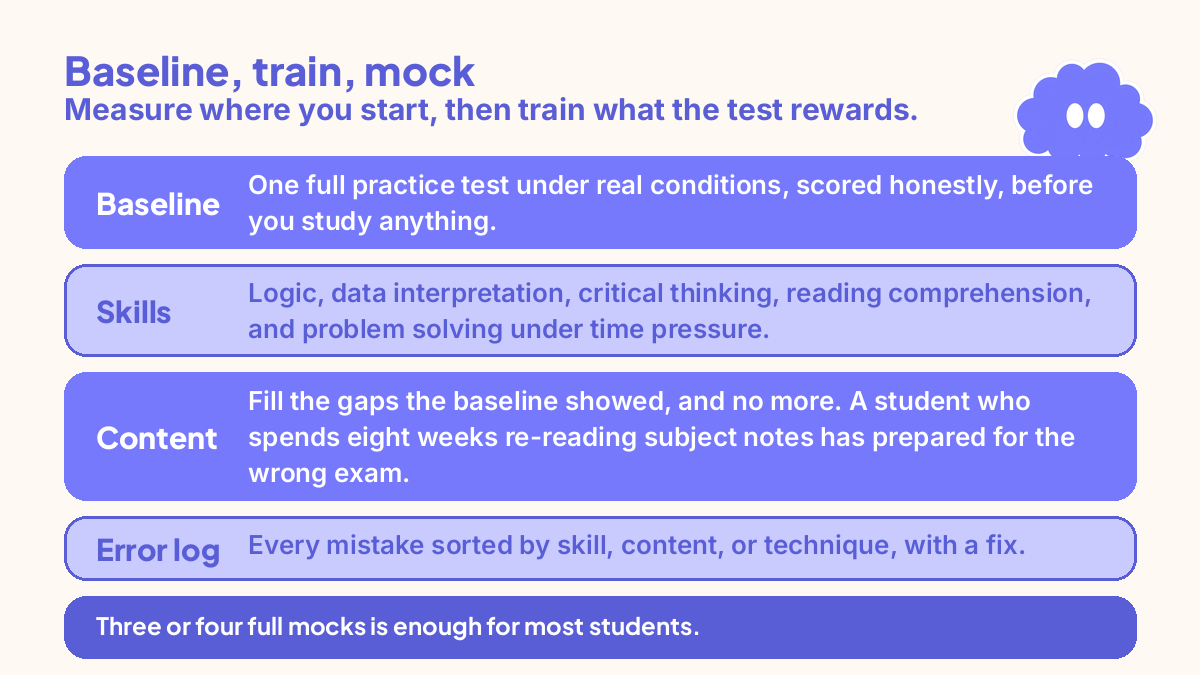
Take one full practice test under real conditions, before you study anything. Use an official specimen paper or past paper, sit it in one sitting, under the real time limit, with no notes, no phone, and no pausing the clock. Then mark it honestly, against the official mark scheme.
The baseline is not a test of your worth. It is a measurement, and it does three things. First, it shows your starting score, so you can see whether the preparation is working. Second, it shows which sections are weakest, so the preparation goes to the right place. Third, it shows what the test feels like: the pace, the question style, and the pressure. Students who skip the baseline study everything evenly and improve nothing measurably.
Score the baseline by section, not just as a total. Note the time per section, and whether you finished. Write the baseline down: the date, the paper, the score by section, and the time. The system for using mock exams to prepare treats the baseline the same way, as a rehearsal that produces information, not a verdict.
Step 3: Split the preparation into skills and content
Admissions tests reward thinking skills more than subject knowledge. The skills are the same across most tests: logic, data interpretation, critical thinking, reading comprehension, and problem solving under time pressure. The content is what the test assumes you already know: school maths, school science, or the subject of the course.
Split the preparation in two. Skills get the most time, because they are what the test measures and what school does not teach directly. Content gets the time the baseline shows it needs, and no more. A student who spends eight weeks re-reading subject notes for a test of logic has prepared for the wrong exam.
Train skills in short, focused sessions. For logic, work through ten questions a day, timed, and write one line for each answer explaining why the right answer is right and why the wrong ones are wrong.
Fill content gaps from the baseline only. If the baseline showed your maths is weak, revise the maths the test uses, not the whole school course. If it showed your science is fine, leave it alone. The system for revising maths for exams covers the calculation discipline the test needs, and the multiple-choice exam system for students covers the question format most admissions tests use.
Step 4: Train the moves that bank points
Every test has question types that appear again and again, and each type has a move: a way of approaching it that banks points reliably. Learn the moves, then drill them.
For most admissions tests, the moves are: read the question stem before the passage, so you know what to look for. Underline the command word, so you answer what is asked. Eliminate the two answers that are clearly wrong before you choose between the two that remain. If a question takes more than two minutes, mark it, move on, and come back if time allows. A question you skip and return to is worth more than a question you stare at while three easier ones go unanswered.
Drill the moves in short timed sessions, not in full papers. Twenty minutes a day, one question type at a time, timed, marked immediately. Write the move at the top of the page before you start, so you practise the move, not just the questions. After a week, the moves become automatic, and the timed sessions get faster.
Step 5: Keep an error log and review it weekly
Every mistake goes on the error log, with one line: the question type, the skill or content it needed, and the fix. Sort the log into three piles each week: skills, content, and technique. Skills errors are questions you did not know how to approach. Content errors are facts or methods you did not know. Technique errors are time, misreading, or careless slips.
The log decides next week’s preparation. If the skills pile is biggest, drill the moves. If the content pile is biggest, revise the content the log names. If the technique pile is biggest, practise the timing: 1 mark takes about 1 minute, and a question that takes more than two minutes gets marked and skipped. The past-paper system for exams sets out the same error-log habit in full, and Dunlosky and colleagues (2013) rated only practice testing and distributed practice as high utility, which is what the log and the drills are.
Step 6: Run mocks on a schedule and taper
Three or four full mocks is enough for most students. Take the first as a baseline, one in the middle to check progress, one near the end to confirm the plan, and the last 3 to 4 days before the real test. Never take a mock the day before the test: it will leave you tired, and a bad result the night before will cost you sleep.
Run each mock under real conditions: the same time of day as the real test if you can, the same time limit, no notes, no phone, no pausing the clock. Mark it the same day, and update the error log. Compare the score by section with the baseline. If a section has improved, the preparation is working. If it has not, change the preparation for that section: different drills, different content, or a different move.
Taper in the last week. Reduce the hours by half, and use the time for light review: the error log, the one-page notes, and the moves.
A worked example: twelve weeks to test day, four hours a week
Your situation: Year 13 student applying for law. The admissions test is in October, 12 weeks away. Four hours a week to prepare, around school. The test has two sections: multiple choice on logic and reading, and an essay.
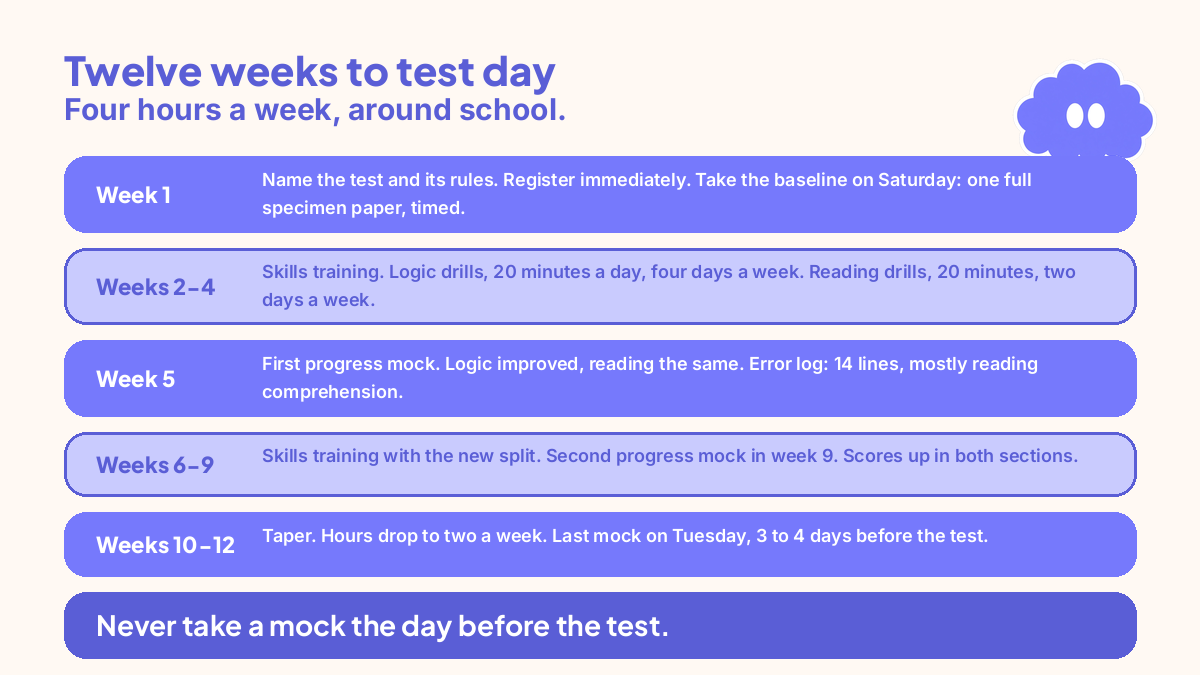
- Week 1: name the test and its rules. Check the university website and the test provider’s guide: the test, the October date, the September registration deadline, the two sections, the timing, no calculator. Register immediately. Take the baseline on Saturday: one full specimen paper, timed, marked honestly. Scores: logic weak, reading middling, essay untested.
- Week 2 to 4: skills training. Logic drills, 20 minutes a day, four days a week: ten questions, timed, one line per answer explaining why. Reading drills, 20 minutes, two days a week: read once, close, write the argument in two sentences.
- Week 5: first progress mock. Saturday, full paper, timed, marked the same day. Logic improved, reading the same. Error log: 14 lines, mostly reading comprehension. Change the plan: reading drills move to four days a week, logic to three.
- Week 6 to 8: skills training with the new split. Reading drills now include the move: read the question stem before the passage.
- Week 9: second progress mock. Scores up in both sections. Error log: 9 lines. Content gaps: two logic question types still weak, so drill those two types only for a week.
- Week 10 to 11: taper starts. Hours drop to two a week. Light review: error log, one-page notes, moves.
- Week 12, test week: last mock on Tuesday, 3 to 4 days before the test, marked the same day. Wednesday and Thursday: light review only, error log and moves. Friday: rest, pack the bag, early night. Saturday: test day, same routine as the mocks.
When it goes wrong
You missed the registration deadline. Check whether late registration is possible, and whether another test date exists. If not, talk to the university: some courses accept an alternative test or waive the requirement. Do not assume the application is dead until the university says so.
Your baseline is far below your goal. Increase the hours, not the panic. Six hours a week for 12 weeks beats 12 hours a week for 6 weeks, because the skills need time to become automatic. If the gap is still too big after four weeks, talk to a teacher about whether the course is the right target, or whether a different course needs a different test.
Your score is not improving. Check the error log: are you drilling the same question types you keep getting wrong, or are you re-doing the ones you already get right. Improvement comes from the weakest section, not the strongest. Change the drills to match the log.
You run out of time in every mock. Practise the timing, not the content. Mark and skip any question that takes more than two minutes, and come back to it. The moves in step four are the fix: read the stem first, eliminate two answers, and move on.
Weekly review checklist
Use this checklist at the end of each preparation week, in writing, in 20 minutes.
- Which sections improved this week, and which did not?
- What does the error log show: skills, content, or technique?
- Did the drills match the log, or did I practise what I already knew?
- Is the registration done, and is the test date in the calendar?
- How many mocks are left, and when is the next one?
- What one change will I make to next week’s preparation, and what stays the same?
Downloadable infographic spec: one vertical image, title “How to prepare for a university entrance exam”, with the six steps from “The system in short” and the six review questions above, in Thynq cream, Cloud Purple, Dark Purple and pink, with the Cloud mascot. Text taken word-for-word from this article.
What this system is not
This system is not a guarantee of a place, and it does not replace the rest of the application. It does not promise grades or scores, and it does not cover every test: the rules, the registration, and the content of your test must be checked on the test provider’s own website. It turns preparation into a measured plan, with a baseline, drills, an error log, and mocks.
Sources
- Dunlosky, J., et al. (2013). Improving students’ learning with effective learning techniques. Psychological Science in the Public Interest, 14(1), 4-58. Only practice testing and distributed practice rated high utility; re-reading and highlighting rated low.
- Roediger, H. L., & Karpicke, J. D. (2006). Test-enhanced learning. Psychological Science, 17(3), 249-255. Retrieval practice beat restudying after a delay; timed practice under test conditions is the preparation.
For the full system behind this method, start with how to build a study system that fits your life.
Questions
How early should I start preparing for a university entrance exam?
Start 8 to 12 weeks before the test if you can, at 3 to 5 hours a week. That is enough for a baseline, skill training, and three or four mocks without taking over your life. Starting earlier helps, but starting late with a focused plan beats starting early with no plan.
Do I need to register separately for an admissions test?
Often, yes. Completing your university application does not automatically register you for an admissions test. Check the test’s own website for the registration deadline, which is often weeks before the application deadline, and register as soon as you know which test you need.
Should I prepare for the content or the skills in an entrance exam?
Both, but in the right order. First, learn what the test rewards: most admissions tests assess thinking skills such as logic, data interpretation, and critical thinking more than subject knowledge. Then fill the content gaps the baseline showed, and train the skills with timed practice.
How many mock tests should I take before an entrance exam?
Three or four full mocks is enough for most students. Take the first as a baseline, one in the middle to check progress, and the last 3 to 4 days before the real test, never the day before. Mark every mock the same day and put every error on the log.