
The direct answer
Use the formula: the mark you need equals your target, minus your current grade times the share of the course already marked, divided by the final exam’s weight. With 72% now and a final worth 30%, you need 32% to finish at 60%.
Most students guess at this number, and guessing is what makes finals week frightening. The number is arithmetic, and once you know it, you know exactly how much revision matters and where your time should go. You can check your own numbers in the final grade calculator, which does the same maths and shows the best grade still in reach when the target is impossible.
The system in short
- Find your three numbers: your current grade, your target grade, and the final exam’s weight.
- Work the formula: mark needed equals target minus current grade times the share already marked, divided by the final’s weight.
- Read the answer honestly: over 100% means the target is out of reach, 0% or below means it is already secured.
- Turn the gap into a revision plan: the bigger the gap, the more the plan focuses on the topics worth the most marks.
- Check the rules that change the answer: a minimum mark on the final itself, rounding, and marks that are not yet in.
- Review weekly for 15 minutes: re-run the numbers as new marks come in, and change the plan when the number changes.
Step 1: Find your three numbers
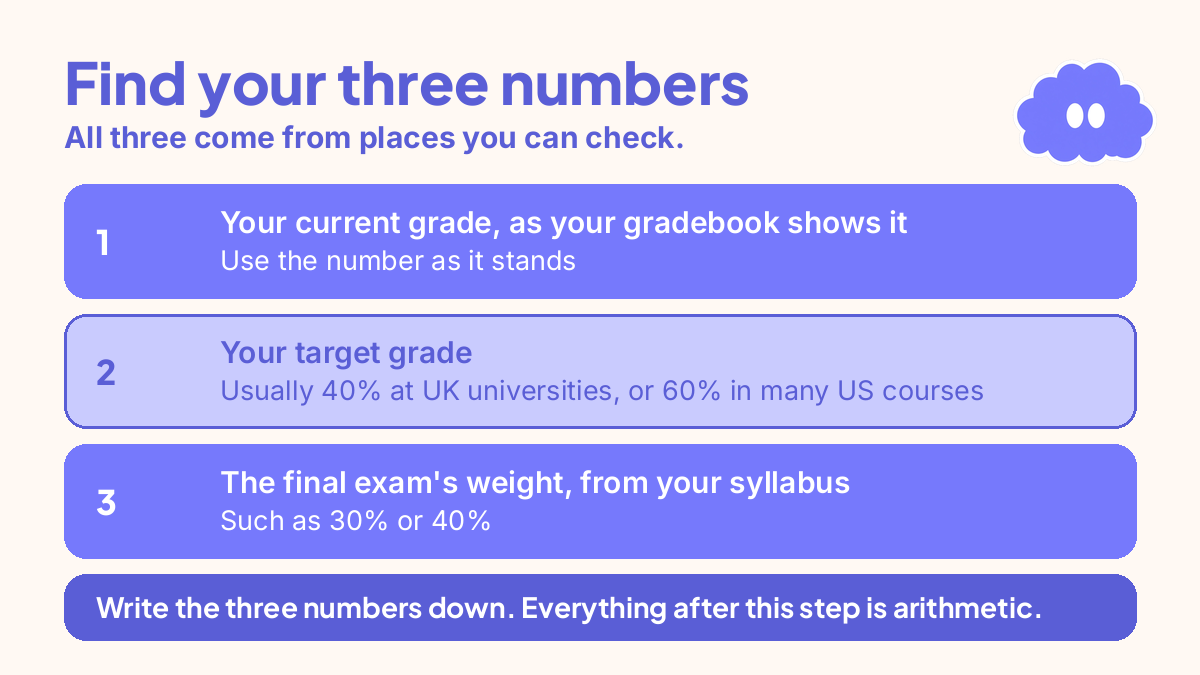
You need three numbers, and all three come from places you can check, not from guessing. First, your current grade: the percentage you have now, from the work already marked, as your gradebook or course page shows it. Use the number as it stands, not the number you hope it will be after a remark. If some marks are not yet in, use the marks you have, and note that the number will move.
Second, your target grade: the overall course grade you want. For passing, that is your course’s pass mark, usually 40% at UK universities, or 60% in many US courses. For a grade boundary, use that boundary: 70% for a First, 60% for a 2:1, 50% for a 2:2, at UK universities. Check your course handbook for the exact number, because the pass mark varies, and some courses also require a minimum mark on the final exam itself, separate from the overall grade. That rule matters, and it is covered in Step 5.
Third, the final exam’s weight: the share of the course grade the final is worth, from your syllabus, such as 30% or 40%. If there is more than one assessment left, the calculator can work with all remaining work at once, and the number it gives is the average you need across all of it.
Write the three numbers down: current grade, target, weight. Everything after this step is arithmetic.
Step 2: Work the formula
The formula is: mark needed equals your target, minus your current grade times the share of the course already marked, divided by the final exam’s weight. In symbols, needed equals (target minus current grade times one minus weight) divided by weight, with the weight written as a decimal. The logic is simple: your current grade has already banked some points, the target minus those banked points is what is left to earn, and the final exam’s weight is the share of the grade that can still earn them.
Work it with a real example. Your current grade is 72%, the final is worth 30%, and your target is 60%. Your banked points are 72 times 0.70, which is 50.4. The points still needed are 60 minus 50.4, which is 9.6. Divide by 0.30, and the answer is 32%.
Try a second one. Your current grade is 62%, the final is worth 40%, and your target is 60%. Your banked points are 62 times 0.60, which is 37.2. The points still needed are 60 minus 37.2, which is 22.8. Divide by 0.40, and the answer is 57%.
Try a third, for a higher target. Your current grade is 84%, the final is worth 25%, and your target is 80%. Your banked points are 84 times 0.75, which is 63. The points still needed are 80 minus 63, which is 17. Divide by 0.25, and the answer is 68%.
If you would rather not do the arithmetic by hand, the final grade calculator does it for you: enter your current grade, your target, and the final’s weight, and it shows the exact mark you need. Check the answer by hand once, with the formula above, so you trust the number before you plan around it.
Step 3: Read the answer honestly
The answer falls into three kinds, and each one means something different. If the answer is between 0% and 100%, it is a real target, and Step 4 turns it into a plan. If the answer is over 100%, the target cannot be reached on this exam, even with a perfect score. If the answer is 0% or below, the target is already secured by the work you have done.
For an answer over 100%, work out the best overall grade you can still get by scoring 100% on the final: your current grade times the share already marked, plus 100 times the final’s weight. With a current grade of 60% and a final worth 25%, the best you can finish is 45 plus 25, or 70%. So a target of 80% is out of reach, but 70% is the highest boundary still in reach, and that becomes the new target.
For an answer of 0% or below, the pass is secured, but check the rule in Step 5 before you relax. With a current grade of 80% and a final worth 20%, a target of 60% needs minus 20%. You will pass even with a low mark on the final. That does not mean you should skip the exam. It means the revision plan changes: protect the grade you have, rather than chase a grade you have already secured.
Step 4: Turn the gap into a revision plan
The gap between the mark you need and the mark you usually get is what the revision plan is for. If you need 32% and you usually score 60%, the plan is light: keep the material warm, practise the exam format, and do not panic. If you need 68% and you usually score 60%, the plan is serious: eight points of improvement, which means targeted work on the topics worth the most marks, not more hours of rereading.
Start with the topics that carry the most marks. Look at past papers and mark schemes, and list the topics by how many marks they usually carry. Spend your time on the top half of that list. Then test yourself from memory on those topics, and mark the practice with the same strictness the exam will use. If you need help turning practice into marks, Use AI to mark your past paper answers shows how to get honest feedback on a past paper without waiting for a teacher.
Plan backwards from the number. If you need 68% and the exam is in three weeks, that is three weeks to close an eight-point gap, or about two topics a week brought from shaky to solid. If you need 57% and the exam is in one week, the plan is different: one week to hold the grade, with the topics you already know tested and secure. For the one-week version, how to revise when you have one week left has the day-by-day shape. And if the number says you cannot pass, read How to retake an exam: a study system for students who have to sit it again now, not after the results.
Step 5: Check the rules that change the answer
Three rules can change the answer, and all three are in your course handbook. First, a minimum mark on the final itself. Some courses require you to score at least a set mark on the final, such as 40%, whatever your overall grade is. If that rule applies to you, the formula’s answer is not the whole story: you need the higher of the two numbers, the formula’s answer and the minimum. A student who needs 32% overall but must score 40% on the final needs 40%.
Step 6: Review weekly for 15 minutes
Once a week, spend 15 minutes re-running the numbers and checking the plan. Three questions: has your current grade changed, because a new mark came in? Has the mark you need changed, and does the revision plan still match it? Are you on track for the topics that carry the most marks, or has the plan drifted into easy rereading?
Write the new numbers down next to the old ones, so you can see the trend. If the mark you need is falling, the plan is working. If it is rising, the plan needs to change with it. For the revision behind the plan, how to revise when you are behind covers the recovery shape when the numbers say you are short of time.
A worked example: three students, three numbers
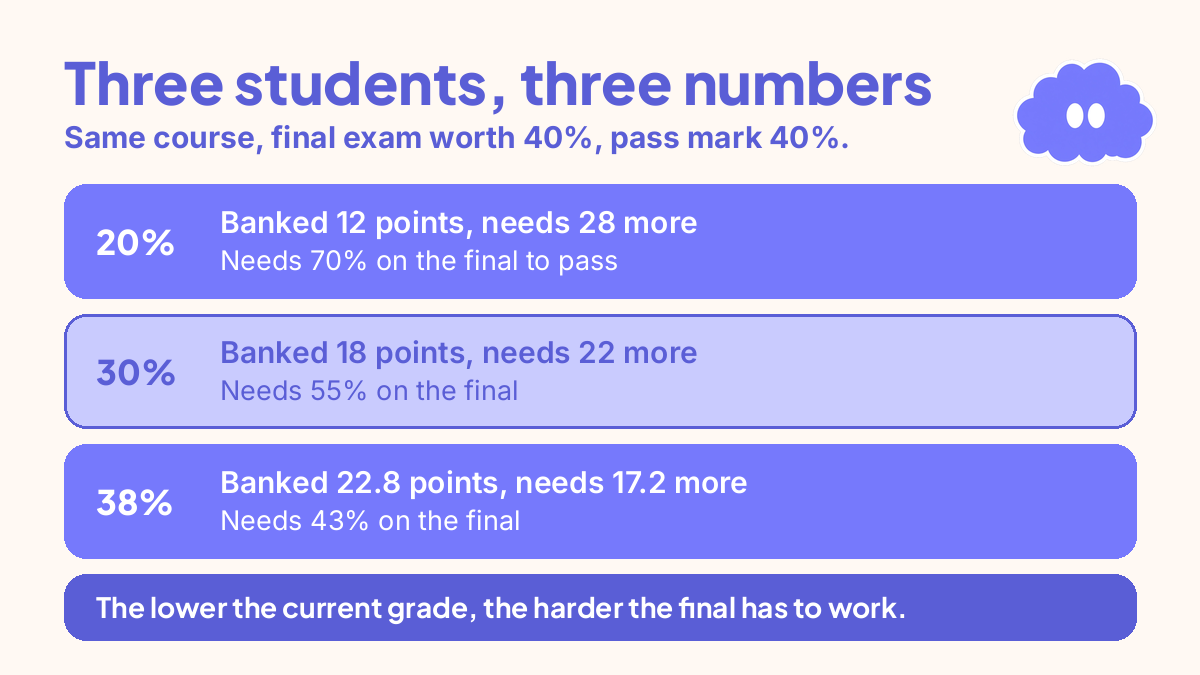
Your situation: Three students, same course, final exam worth 40%, pass mark 40%. Each one works the formula with their own current grade.
Three students, same course, final exam worth 40%, pass mark 40%: a student at 20% needs 70% on the final, a student at 30% needs 55%, and a student at 38% needs 43%. The lower the current grade, the harder the final has to work, and the table below shows the same pattern for other grades and weights.
| Current grade | Mark needed on a final worth 25% | Mark needed on a final worth 40% | Mark needed on a final worth 50% |
|---|---|---|---|
| 20% | 100% | 70% | 60% |
| 30% | 70% | 55% | 50% |
| 35% | 55% | 48% | 45% |
| 38% | 46% | 43% | 42% |
The table shows the mark needed to finish at 40%, the usual UK pass mark, for four current grades and three final weights. Read your row and your final’s weight, and the number is the mark you need. If your current grade or weight is not in the table, use the formula, or the calculator, with your own numbers.
When it goes wrong
You used the wrong weight. Check the syllabus again. A final worth 40% and a final worth 25% give very different answers, and the most common error in this calculation is reading the wrong number. If your weights do not add up to 100, something is wrong, and the syllabus is the place to check.
The answer is over 100% and you feel like giving up. Do not. Work out the best grade still in reach, set that as the target, and plan around it. A student who cannot reach 80% can still reach 70%, and 70% is a grade worth working for. And if even the pass is out of reach, read the resit rules now, because a planned resit beats a surprised one.
Weekly review checklist
- What are your three numbers today: current grade, target, and the final’s weight?
- What mark do you need, and has it changed since last week?
- Is the answer between 0% and 100%, or do you need a new target?
- Have you checked the minimum mark rule and the rounding rule in your handbook?
- Are you spending time on the topics worth the most marks, or on easy rereading?
- What will you do this week to close the gap by one point?
Downloadable infographic spec: one vertical image, title “How to work out what mark you need on your final exam to pass”, with the six steps from “The system in short” and the six review questions above, in Thynq cream, Cloud Purple, Dark Purple and pink, with the Cloud mascot. Text taken word-for-word from this article.
What this system is not
It is not a promise that the number is exact. The formula is exact, but the current grade behind it depends on marks that may still move, and the final grade depends on rounding, minimum marks, and rules that vary by course. It is not a replacement for your course handbook, which is the only source for your pass mark, your weights, and your minimum mark rules. What it does is smaller and more useful than a prediction: it replaces fear with a number, and a number with a plan.
Sources
- Thynq. Final grade calculator. Read November 2026. The mark needed on the final, or on all remaining work; UK presets of 70% for a First, 60% for a 2:1, 50% for a 2:2, and 40% for a pass; the worked example of 62% on work worth 60% with a 40% final needing 57% to finish on 60%.
- Easy Grade Tool. Final exam grade calculator. Read November 2026. The formula for the mark needed on a final, with worked examples at 32% for a 72% current grade and a 30% final, and 68% for an 84% current grade and a 25% final.
- EZ Grader Calc. Final grade calculator: what do I need on my final? Read November 2026. The same formula, with the worked example of 67.5% for a 55% current grade and a 40% final, and the warning to check for a minimum mark on the final itself.
For the revision behind the number, read how to revise when you are behind. For what happens if the number says you cannot pass, read How to retake an exam: a study system for students who have to sit it again.
Questions
How do I work out what mark I need on my final exam to pass?
Use the formula: mark needed equals your target minus your current grade times the share of the course already marked, divided by the final exam’s weight. With 72% now and a final worth 30%, you need 32% to finish at 60%. Put your own numbers into the final grade calculator instead of guessing.
What is the pass mark for a university exam?
It depends on your course. The pass mark is usually 40% at UK universities, or 60% in many US courses. Some courses also require a minimum mark on the final exam itself, separate from the overall grade. Check your course handbook and use that number as your target.
What if the mark I need on my final is over 100%?
Then the target cannot be reached on this exam, even with a perfect score. Work out the best overall grade you can still get by scoring 100%, and set that as your new target. Then plan your revision around reaching the highest grade boundary that is still in reach.
What if the mark I need is 0% or below?
Then your target is already secured by the work you have done, and you will pass even with a low mark on the final. Check first whether your course also requires a minimum mark on the final itself. If it does not, use the remaining revision time to protect your grade, not to chase it.