The direct answer
How to use past papers when you have already done them all: mine the old papers for patterns, rebuild them into new questions, and write your own papers from your notes. A past paper you have already seen cannot test you again, but it can teach you what the exam asks, and which topics it never leaves out.
Most courses only have a handful of past papers, and many university modules have none at all. Students who run out usually do one of two things, and both waste time: they redo the same papers and congratulate themselves on high scores, or they stop practising and go back to re-reading notes. The system below does neither. It turns the finished papers into raw material, and it builds new practice out of that material.
The system in short
- Save one or two papers for the final week, unseen, so you have a real check left at the end.
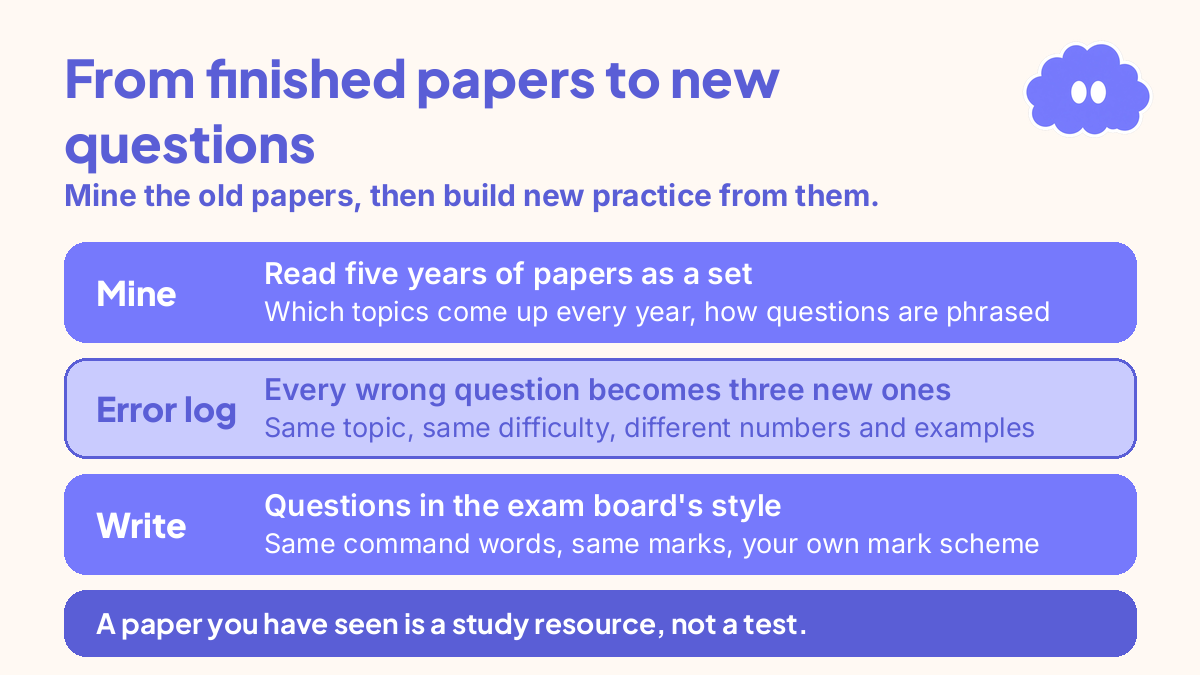
- Mine the finished papers for patterns: which topics come up every year, and how the questions are phrased.
- Turn your error log into a question bank: every question you got wrong becomes three new questions.
- Write your own questions in the exam board’s style, from your own notes, with your own mark scheme.
- Build a full practice paper from your own questions, and sit it timed, under real conditions.
- Review for 15 minutes each week: which new questions exposed a gap, and which topics are still untested?
Step 1: Save one or two papers for the final week
Before you do anything else, check how many papers you have left that you have not seen. If there are any, save one or two of them for the final week, unseen, and do not touch them until then. An unseen paper in the final week is the only honest check you have left of where you stand, and it is worth more than any amount of redoing old papers. Put the saved papers in an envelope or a folder, label it with the date you will open it, and leave it alone.
If you have already done every paper, including the ones you meant to save, the system still works, but the final check changes: your own practice paper from Step 5 becomes the final check, and it needs to be built from questions you have not seen before, which is why the question bank in Step 3 matters so much.
The rule is simple: a paper you have seen is a study resource, not a test. A paper you have not seen is a test. Do not confuse the two.
Step 2: Mine the finished papers for patterns
Take the last five years of papers and mark schemes, and read them as a set, not one at a time. Write down three things. First, which topics come up every year, and which ones come up rarely or never. Second, how the questions are phrased: the command words, the marks, and the shape of the question. Third, what the mark scheme rewards: a keyword, a method, a diagram, a certain number of points.
The pattern is usually clear within an hour. One topic appears in every paper, sometimes as a six-mark question and sometimes as a twelve-mark one. Another topic appears once in five years. The command words repeat: describe, explain, evaluate, calculate, compare. The mark scheme rewards the same things every time: a definition in the first line, a worked example, a conclusion.
Write the pattern down in one page. That page is now your revision plan: the topics that always come up get the most hours, the topics that never come up get the least, and the command words tell you what kind of answer to practise. For the wider skill of turning past paper results into a plan, the method in How to track your past paper scores to find weak topics shows how to read the scores across subjects.
Step 3: Turn your error log into a question bank
Every question you got wrong on a past paper is the start of three new questions. Take the error log from your marked papers, the list of questions you dropped marks on, and for each one, write three new questions on the same topic, at the same difficulty, in the same style. If you got a question on osmosis wrong, write three new questions on osmosis: one that asks you to describe it, one that asks you to explain it, and one that asks you to apply it to a new example.
The three questions should be different from the original, not copies of it. Change the numbers, change the example, change the command word, but keep the topic and the difficulty. The point is to test the same understanding in a new form, so you cannot answer from memory of the old paper. A student who writes three new questions for each error has a question bank of 30 questions from 10 errors.
Write the answers too, from your notes, so each question has a mark scheme. The answer is what makes the question usable: without it, you cannot mark yourself honestly, and an unmarked question teaches you almost nothing. Keep the bank in one place, grouped by topic, and add to it every time a new error appears.
Step 4: Write your own questions in the exam board’s style
The question bank from Step 3 covers your weak topics. Step 4 covers the rest. Take one topic from your notes, look at how the exam board phrases questions on that topic, and write a question in the same style, with the same marks and the same command words. If the board asks six-mark “explain” questions on a topic, write a six-mark “explain” question. If it asks two-mark “state” questions, write a two-mark “state” question.
Copy the style, not the content: the command word, the marks, the number of lines for the answer, and the way the question is broken into parts. A question that looks like an exam question feels like one, and that matters, because part of what you are practising is reading the question properly and giving the answer it asks for.
Swap questions with a friend, so neither of you knows the answers in advance. A question written by someone else is a much better test than one you wrote yourself, because you cannot remember the answer while you are writing the question. For the skill of marking answers strictly, the method in Use AI to mark your past paper answers shows how to get honest feedback on your answers.
Step 5: Build a full practice paper and sit it timed
Once you have 20 or 30 questions in the bank, build a full practice paper from them. Pick the questions to match the real exam: the same number of questions, the same marks, the same time limit, and the same mix of topics. If the real exam is two hours with 80 marks, your practice paper should be two hours with 80 marks. Write the paper on a clean sheet, with no notes on it, and put the mark schemes in a separate document.
Then sit it, under real conditions. Clear the desk, put your notes and phone in another room, set a timer for the real exam length, and answer everything from memory. Do not look anything up. Do not stop the timer. If the paper is too long to do in one go, do one full section under its share of the time.
Mark it strictly against your own mark scheme, the same way you marked the real past papers. List every question where you dropped marks, and add those errors to the log. Then write three new questions for each error, as in Step 3, and the cycle starts again. One paper properly digested per week beats three skimmed.
Step 6: Review for 15 minutes each week
At the end of each week, spend 15 minutes on three questions. First, which new questions exposed a gap, and which ones did you answer easily? Second, which topics are still untested, because no question in the bank covers them? Third, is the question bank growing, or are you reusing the same questions?
Write the answers in two or three lines. If the bank is not growing, the problem is usually Step 3: the error log is not being turned into new questions. If a topic is still untested, write three questions on it this week, even if you have not got it wrong yet. If your exam is online rather than on paper, the system in How to prepare for an online proctored exam covers the different conditions you need to practise under.
A worked example: A-level biology, all papers done, six weeks to go
Your situation: A-level biology student, six weeks to the exam. All past papers from the last five years are done, and the scores are in a tracker. The error log shows three recurring problems: osmosis questions, genetics calculations, and six-mark “evaluate” questions.
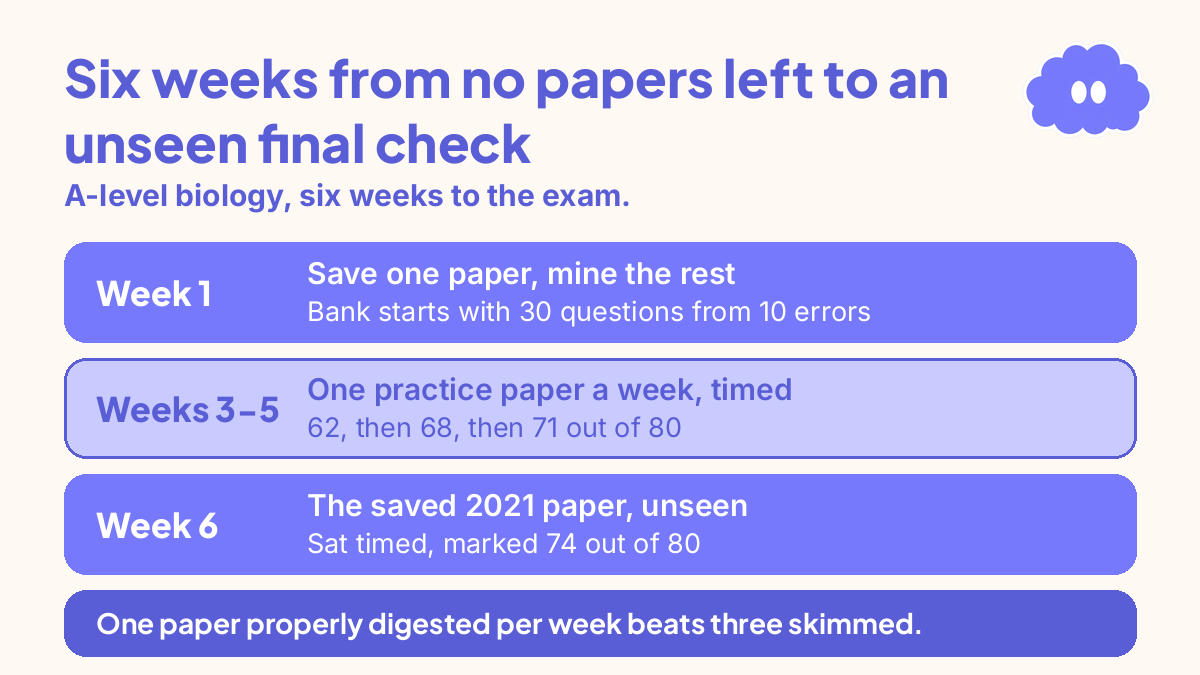
- Week one, save and mine: One paper from 2021 was never done, so it is saved for the final week, in an envelope, labelled with the date. The other papers are mined: osmosis comes up every year, genetics calculations come up in four of five years, and “evaluate” questions always ask for two sides and a conclusion.
- Week one, error log to question bank: Ten errors in the log. Each one becomes three new questions, so the bank starts with 30 questions: ten on osmosis, ten on genetics calculations, ten “evaluate” questions on different topics. Answers are written from the notes, with a mark scheme for each.
- Week two, own questions: Three new questions written for each of the five topics that have no errors but also no practice: cell division, the heart, hormones, ecosystems, and immunity. The bank is now 45 questions.
- Week three, practice paper one: Built from 15 questions, 80 marks, two hours, matching the real exam’s mix. Sat timed, on a Saturday morning, phone in another room. Marked strictly: 62 out of 80. The errors are five new ones, all on the heart, which was a topic with no errors before. Fifteen new questions are written for the heart.
- Week six, final week: The saved 2021 paper is opened and sat timed, unseen. Marked: 74 out of 80. The exam is in three days, and the student knows, honestly, where they stand.
When it goes wrong
You keep redoing the same paper and the score keeps going up. That score is meaningless, because it measures your memory of the paper, not your knowledge. Stop redoing it. Mine it for patterns instead, and build new questions from the errors. If you must redo a paper, wait at least four weeks, sit it timed, and judge yourself only on the questions you still get wrong.
The question bank is all on one topic, and the other topics are untested. That happens when the error log is all on one topic, which is normal: the errors cluster where you are weakest. But the bank needs to cover the whole syllabus, so write three questions for each untested topic too, even if you have never got one wrong on it. An untested topic is a risk, and the bank is how you remove it.
Weekly review checklist
- How many new questions did I write this week, and which topics do they cover?
- Which new questions exposed a gap, and what did I do about it?
- Which topics are still untested, because no question in the bank covers them?
- Did I sit a practice paper this week, timed, and did I mark it strictly?
- Is the saved paper for the final week still unseen, and is it still saved?
- What must next week protect: a practice paper, a question-writing session, or a swap with a friend?
Downloadable infographic spec: one vertical image, title “How to use past papers when you have already done them all”, with the six steps from “The system in short” and the six review questions above, in Thynq cream, Cloud Purple, Dark Purple and pink, with the Cloud mascot. Text taken word-for-word from this article.
What this system is not
It is not a promise that your own questions are as good as the exam board’s. They are not, and they never will be, because the exam board has years of data and you have your notes. It is not a way to avoid the real past papers, and it will not work if you write easy questions and mark them generously. What it does is smaller: it keeps the testing going after the papers run out.
Sources
- Dunlosky, J., et al. (2013). Improving students’ learning with effective learning techniques. Psychological Science in the Public Interest, 14(1), 4-58. Practice testing and distributed practice rated high; rereading rated low, which is why finished papers are mined for new questions instead of re-read.
- Roediger, H. L., & Karpicke, J. D. (2006). Test-enhanced learning. Psychological Science, 17(3), 249-255. Recallers remembered more a week later than restudiers, which supports testing yourself with new questions rather than re-reading the old papers.
- Cepeda, N. J., et al. (2006). Distributed practice in verbal recall tasks. Psychological Bulletin, 132(3), 354-380. Spaced practice beat massed practice, which supports one practice paper a week, properly digested, instead of several in one day.
For the wider past paper system behind this one, start with Past-paper system for exams.
Questions
What should I do when I have done all the past papers?
Stop sitting the same papers and start mining them. Read the last five years of papers and mark schemes, and write down which topics come up every year and how the questions are phrased. Then write your own questions in the same style, from your own notes, and sit those under timed conditions.
Is it worth redoing a past paper I have already done?
Only after a long gap, and only as a check, not as practice. A paper you have already done tests whether you remember that paper, not whether you could answer a new one. If you redo it, wait at least four weeks, sit it timed, and judge yourself on the questions you still get wrong.
How do I write my own practice questions?
Take one topic from your notes, look at how the exam board phrases questions on that topic, and write a question in the same style, with the same marks and the same command words. Write the answer too, from your notes, so you have a mark scheme. Swap questions with a friend so neither of you knows the answers in advance.
Where can I find more practice questions when the past papers run out?
Use topic question banks from your exam board, questions from other boards on the same topics, and questions you write yourself from your notes. Check that the questions match your syllabus and your exam format before you use them, because a question from a different course can teach you the wrong thing.