
The direct answer
How to use a study streak to study every day: pick up to three study habits, tick off at least one each day, and let the count of days do the reminding. A day counts when one habit is ticked. Keep the bar low, tick at the same point each day, and restart the next day after a miss.
You already know the pattern. You study well for four or five days, miss one day, and the routine falls apart. The problem is rarely the missed day. It is that nothing tells you what to do the morning after it. A streak gives you that instruction: tick one habit today, and the run starts again.
A streak is not a measure of how much you learned. Ten minutes is ten minutes, whether it is day 1 or day 40. What a streak changes is how the work feels: keeping a run alive becomes a small goal of its own, and that goal can pull you back to your desk on a day when “study more” would not. Researchers Silverman and Barasch found that an unbroken streak in a log makes people more likely to keep going, even when their past behaviour was the same.
The system in short
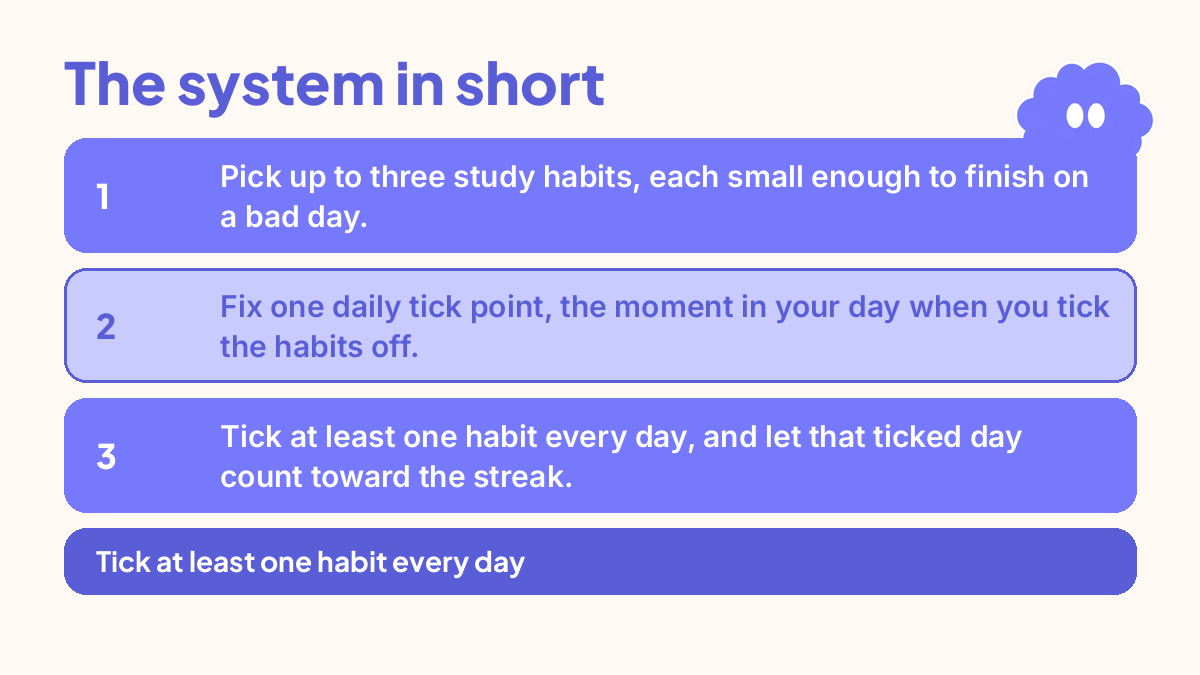
- Pick up to three study habits, each small enough to finish on a bad day.
- Fix one daily tick point, the moment in your day when you tick the habits off.
- Tick at least one habit every day, and let that ticked day count toward the streak.
- Read the heatmap every Sunday, and look for the gaps, not just the run.
- After a missed day, restart the next day with the same habits and the same small bar.
- Compare your current streak with your longest streak once a week, then keep going.
Step 1: Pick up to three study habits
A streak needs a clear rule for what counts, and the rule has to be small. Pick one, two, or three habits, and no more. Each habit should be a single action with a clear finish.
Good habits name the action and the amount. “Revise biology for 25 minutes” counts. “Test myself on ten flashcards” counts. “Write one paragraph of my essay plan” counts. “Study hard” does not count, because it has no finish line, and “read the whole chapter” is too big for a bad day.
Write the habits down where you will see them. A card on your desk, a note on your phone, or the study streak tracker all work, as long as the list is the same every day. The tracker lets you write up to three study habits and tick them off each day, and a day counts when at least one habit is ticked. Match the habits to the work you have: revision before an exam, writing while you draft. How to build a daily study habit shows how one small session at the same time each day becomes the habit the streak counts.
Step 2: Fix one daily tick point
A streak fails when the tick has no fixed moment. “Sometime today” becomes “I forgot” by bedtime. Fix one point in your day for the tick.
The best tick point is the moment your study session ends. Finish the session, tick the habit, and the day is counted. If you study at different times each day, anchor the tick to an event: after dinner, after your last lecture, or when you close your laptop.
Let your streak mean “I showed up today”, not “at exactly 7pm”.
Set a backup for late days: a phone reminder at 9pm that says “tick the streak”. If it finds you with nothing ticked, you still have time for the smallest habit before midnight. A ticked habit should mean the habit was actually done. If you catch yourself ticking habits you did not do, the fix is a smaller habit.
Step 3: Tick at least one habit every day
This is the daily work. Each day, do at least one of your habits, then tick it off. That is a counted day. Do more when you have time and energy, but never make “more” the rule.
The bar is one habit, not three, because the streak protects consistency, not volume. On a good day you might tick all three and study for two hours. On a bad day you tick one and study for 25 minutes. Both days count the same. A system that only counts good days gives you no reason to show up on a bad one.
If nothing is ticked yet today, the streak still shows yesterday’s run until midnight, waiting for one tick to carry it forward.
Do not tick tomorrow’s habits today, or yesterday’s to fill a gap. You can tick and un-tick today only. A missed day is a missed day, and Step 5 handles it. When the day is busy, shrink the session: 25 minutes of testing yourself from memory beats an hour of re-reading notes while half asleep. If you only have an hour in the whole day, How to study in one hour a day shows how to split it.
Step 4: Read the heatmap every Sunday
A streak number tells you how long the run is, and a heatmap tells you where it breaks. Once a week, look at the pattern: the tracker shows 16 weeks of study days as a heatmap.
Look for the pattern first, then the number. Are the gaps always on Saturdays, or the day after a late shift? A streak that breaks in the same place every week is not a willpower problem. It is a timetable problem: move the session or shrink the habit on that day.
Use the Sunday read to change one thing, not five. If Saturdays keep breaking the run, move the session to Saturday morning, or make Saturday’s habit the smallest one you have. Write down what the heatmap showed, in one line, next to next week’s plan. It is the same habit of looking back that a weekly study review system asks for: fifteen minutes, four questions in writing, and one change only.
Step 5: Restart the next day after a miss
A missed day will happen. When a day passes with nothing ticked, the streak resets to zero, and your only job is to tick one habit the next day.
Start the new run the morning after the miss, not on Monday or the first of the month. Researchers Dai, Milkman, and Riis found that people are more likely to tackle goals right after landmarks like a new week. A new week is a fine place to restart, but waiting for one wastes days. Tomorrow is close enough.
Do not punish the miss by doubling the next day’s work. Two hours of catch-up study teaches you that missing a day is expensive, and expensive mistakes are the ones people avoid by quitting. One ordinary session, one tick, and the run is alive again. In the study by Lally and colleagues, missing a single day did not measurably hurt habit formation. What matters is the return, not the gap.
If the same miss keeps happening, change the habit, not the person. A habit that breaks every Friday is a habit that does not fit Fridays. Make the Friday habit smaller, move it earlier, or swap it for a different one. A broken streak is about the log, not about you, and the fastest repair is always the same: one habit, ticked today.
Step 6: Use the streak to plan, not just to count
After three or four weeks, the streak becomes a planning tool. The number tells you how steady you have been, and the heatmap tells you where the weak days sit. Use both to plan next week.
If your longest streak is 14 days and it always breaks on the same kind of day, that day needs a smaller habit or an earlier session. If your heatmap shows a blank week every month, look at what that week contains, and plan around it in advance.
Download your streak and heatmap as an image or print it. A printed heatmap shows the run where the work happens.
Do not let the streak decide whether you rest. If you are ill or exhausted, rest wins, and the streak can wait. A streak is a tool, not a rule.
A worked example: three weeks of a streak, starting on a Monday
Your situation: you are a second-year biology student with an exam in six weeks. You study after dinner, usually from 7pm to 8pm, and you have never studied every day for more than a week.
You pick three habits: “test myself on ten flashcards”, “revise biology for 25 minutes”, and “write one paragraph of my essay plan”. Any one ticked counts the day. The tick point is the end of the evening session, with a 9pm phone reminder as a backup.
Week one goes well. Monday to Friday you tick habits one and two most days, and by Friday the streak shows 5. On Saturday you are out with friends, and you tick habit one at 10pm with five minutes of flashcards before bed. The streak shows 6. On Sunday you tick habit two in the morning: seven days, no gaps, streak 7.
Week two is harder. On Wednesday you finish a late shift at 9pm, too tired to study, and you miss the day. The streak resets to zero. On Thursday you do not double the work. You do habit one at 7pm, tick it, and the new run starts at 1. By Sunday the streak shows 4, and the longest streak still shows 7.
Week three you change one thing. Wednesday is always the late shift, so you move the Wednesday habit to the morning: ten flashcards before the shift, ticked by 8am. By Sunday the streak shows 7 again. You print the streak and heatmap and pin them above your desk.
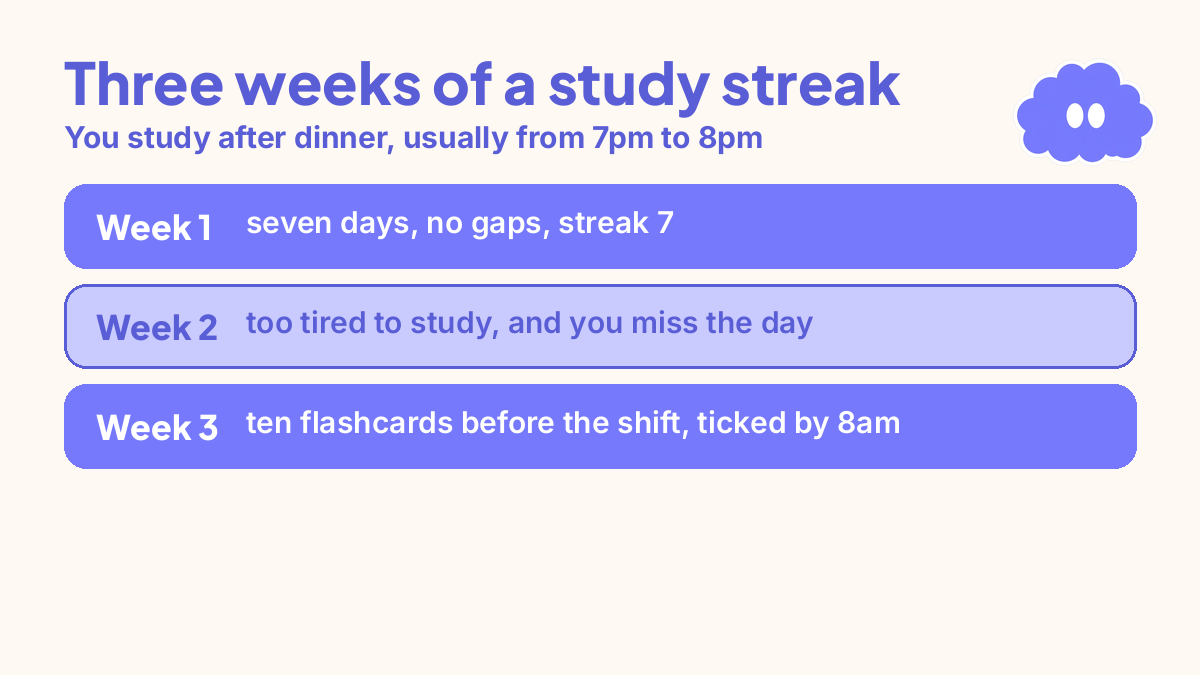
The example shows the two rules that matter most. First, the day counts on one habit, so a tired day still counts. Second, the restart is one ordinary session the next day, not a punishment session. It made the bad days survivable, and survivable bad days are what a long run is made of.
When it goes wrong
You pick habits that are too big. A habit like “revise for two hours” breaks on the first tired day. Shrink every habit until you can do it on your worst day: 25 minutes, ten cards, one paragraph.
You miss a day and quit. This is the most common failure: treating the number as a verdict. The number is a log. In the study by Lally and colleagues, a single missed day did not measurably hurt habit formation. Tick one habit the next day and the run starts again.
You tick habits you did not do. The count stops meaning anything, and the streak stops helping. The fix is smaller habits, not stricter rules.
The streak makes you anxious. If the number makes you study when you are ill, or makes a missed day feel like a failure, loosen the rules. Drop to one habit. Take a week off counting and just study. Silverman and Barasch found that a broken streak lowered motivation most when people blamed themselves for the break. Self-blame is the part to remove, not the study.
You study only to keep the streak alive. A streak can become the goal instead of the learning, and then you tick a habit and learn nothing. Check yourself once a week: can you say what you learned, in one sentence, without looking at your notes? If not, change a habit so it forces recall. The retrieval practice system for students describes that habit.
Weekly review checklist
- How many days did I tick at least one habit this week, and how many did I miss?
- Which habit did I tick most often?
- Where are the gaps in the heatmap, and do they fall on the same day each week?
- Is my current streak longer than last week?
- Did I study to learn, or only to keep the streak alive?
- What is the one change I will make next week?
Downloadable infographic spec: one vertical image, title “How to use a study streak to study every day”, with the six steps and the six weekly review questions, in Thynq cream, Cloud Purple, Dark Purple and pink, with the cloud mascot. Text taken word-for-word from this article.
What this system is not
A streak is not a study plan. It tells you to show up, not what to study. You still need a plan for each session. For the full system behind this method, start with how to build a study system that fits your life.
A streak is not a measure of learning. Ten minutes is ten minutes on day 1 and day 40. Test yourself from memory, and judge by what you can recall, not by the number.
A streak is not a promise. Nothing here guarantees a grade, and a long run does not make a hard exam easy. What a streak offers is steadier days, which give the rest of your system a chance to work.
Sources
- Silverman, J., and Barasch, A. (2023). On or off track: How (broken) streaks affect consumer decisions. Journal of Consumer Research, 49(6), 1095-1117. Supports the finding that an unbroken streak makes people more likely to keep going.
- Lally, P., van Jaarsveld, C. H. M., Potts, H. W. W., and Wardle, J. (2010). How are habits formed: Modelling habit formation in the real world. European Journal of Social Psychology, 40(6), 998-1009. Supports the 66 day median, the 18 to 254 day range, and the finding that a missed day did not measurably hurt habit formation.
- Dai, H., Milkman, K. L., and Riis, J. (2014). The fresh start effect: Temporal landmarks motivate aspirational behavior. Management Science, 60(10), 2563-2582. Supports restarting after a slip at a fresh start.
Questions
What counts as a day in a study streak?
A day counts when you tick off at least one of your study habits. You do not need all three, or a long session. One habit ticked is enough to keep the run going.
What should I do when my study streak breaks?
Start a new run the next day, with the same habits and the same small bar. A broken streak is a fact about the log, not a verdict on you. The fastest repair is one ordinary session.
How many habits should I track in a streak?
Three at most, and one is enough to start. Each habit should be a small action you can finish on a bad day, such as 25 minutes of revision or ten flashcards. More habits make the day harder to count.
How long does it take for daily study to feel automatic?
Longer than three weeks, and the range is wide. Lally and colleagues (2010) found the median time for a new daily behaviour to feel automatic was 66 days, with a range of 18 to 254 days. Expect weeks of repetition.